
In this guide
Burn rate and runway are the two numbers a founder is asked about first, and they are not the same thing. Burn rate is how much cash your company loses in a month. Runway is how many months that cash will last at the current burn. Put simply, runway is your cash balance divided by your monthly net burn, so a stronger burn figure lengthens the runway and a weaker one shortens it. This explainer sets out how to calculate both honestly, what a good burn rate looks like for an Indian startup, and how a funding round should change the maths.
What is a burn rate, and what is runway?
A burn rate is the pace at which a company spends its cash reserves before it reaches break-even. It is quoted per month and measured in actual rupees leaving the bank, not accounting profit. Runway is the consequence of that burn: the length of time, in months, before the cash runs out if nothing changes. The two travel together because runway is calculated from burn, but they answer different questions. Burn asks how fast; runway asks how long. A board will forgive a high burn if the runway behind it is comfortable and the money is buying growth. It will not forgive a short runway, whatever the burn.
The difference between runway and burn rate matters most when you present to investors. Quote burn as a monthly figure and runway as a month count, and never blur the two into a single number. If you run a subscription model, keep your monthly recurring revenue line separate so the board can see cash collected against cash spent rather than one net figure that hides both.
Gross burn versus net burn: report the honest one
Gross burn is total cash going out in a month across salaries, rent, cloud bills, marketing and everything else. Net burn is gross burn minus the cash your customers actually pay you in the same month. Net burn is the honest figure because it reflects the real drain on your reserves. A company with a Rs 42 lakh gross burn that collects Rs 25 lakh from customers has a net burn of Rs 17 lakh, and it is the Rs 17 lakh that eats the bank balance.
Founders sometimes quote gross burn because it looks like a bigger operation, or net burn when they want the runway to look longer. Pick net burn and stay with it. Consistency lets your board track the trend, and the trend is what tells them whether the business is getting more efficient as it scales. For a fuller picture of how cash statements are built, our teams handle this within Startup Accounting Services India and, for subscription businesses, SaaS Accounting Services (IT & SaaS).
The burn rate formula and how to calculate runway in months
The burn rate formula is straightforward once you fix the period and the source. Follow these steps each month.
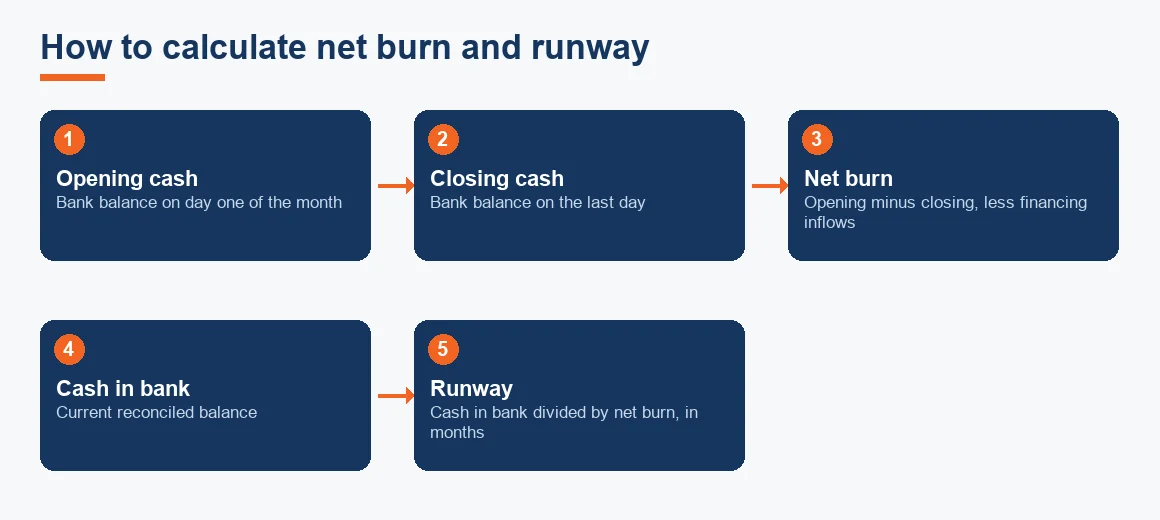
- Take the opening cash balance from the bank statement on the first day of the month.
- Take the closing cash balance on the last day of the month.
- Net burn for the month equals opening balance minus closing balance, adjusted for any one-off financing inflow such as a fresh tranche, which you remove so it does not flatter the number.
- To calculate runway, divide the current cash in bank by that monthly net burn.
- Express the answer in months. A Rs 3 crore balance and a Rs 17 lakh net burn give roughly 17.6 months of runway.
The alternative to the bank-difference method is to build net burn from the line items, adding up cash outflows and subtracting cash collected. Both should agree once you have completed the bank reconciliation. If they do not, the reconciliation is where the missing cash is hiding.
Burn rate compared with runway at a glance
The table below summarises how the two figures differ so you can label them correctly in your MIS.
| Aspect | Burn rate | Runway |
|---|---|---|
| Question it answers | How fast is cash leaving? | How long until cash runs out? |
| Formula | Cash out minus cash in, per month | Cash in bank divided by net burn |
| Unit | Rupees per month | Months |
| Improved by | Cutting cash costs or lifting collections | Lower burn or more cash raised |
| Board reads it as | Efficiency of spend | Time available to act |
What is a good burn rate for a startup?
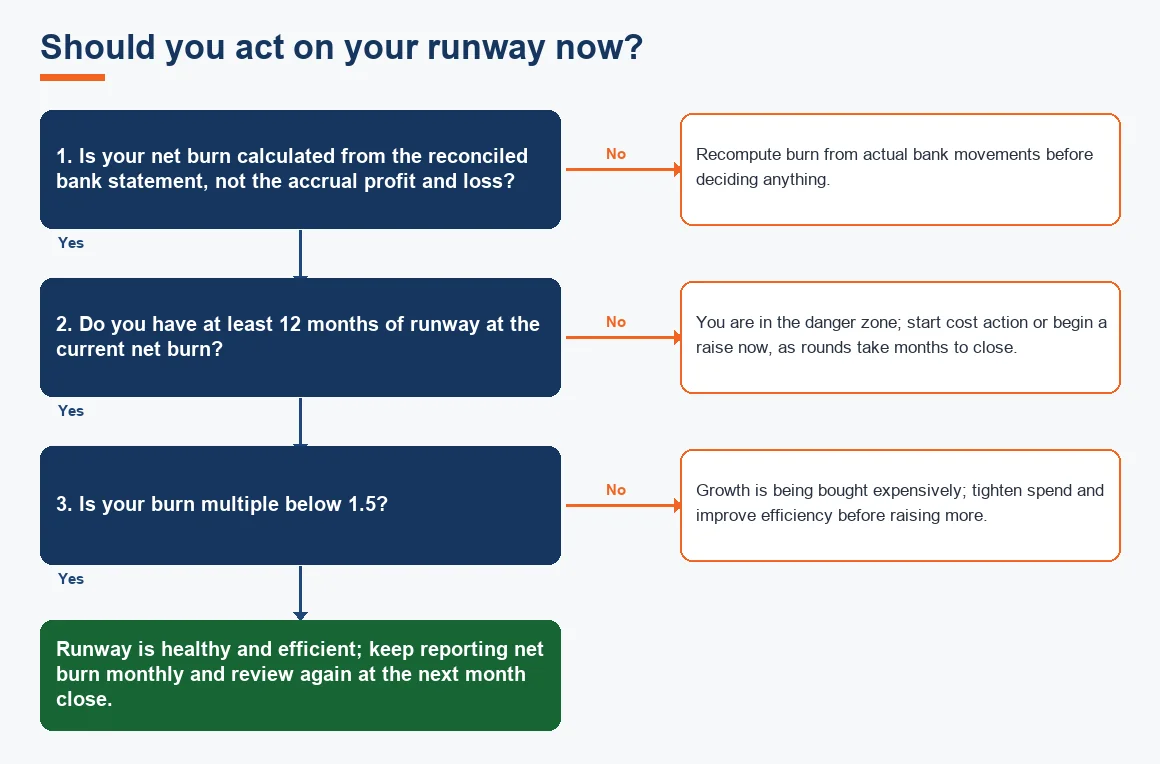
There is no single good number, because burn only makes sense against runway and against the growth it buys. A workable benchmark is a net burn that leaves at least 18 months of runway just after a raise and at least 12 months at any other time. Twelve months is the point at which most founders should already be either cutting cost or preparing to raise, because a round takes time to close.
A better efficiency test is the burn multiple: net burn divided by the net new annual recurring revenue added in the same period. Burning Rs 2 crore to add Rs 2 crore of new ARR is a multiple of 1. Below 1.5 reads as efficient at Series A, while anything above 2 signals that growth is being bought expensively. The burn multiple stops you rewarding a company that simply spends less while also growing less. Watch it alongside your EBITDA trend so you can see operating losses narrowing as revenue climbs.
How a funding round changes the runway calculation
A raise does not extend runway by as much as the headline suggests, because two things change at once. First, add only the net proceeds actually credited, after placement fees, legal cost and any tranche still conditional on milestones. Second, divide by the burn you expect after the raise, not the burn before it. Hiring plans usually lift monthly spend within a quarter of the money landing.
So a Rs 20 crore round at a planned Rs 1 crore post-raise burn gives 20 months, not the 40 that the old Rs 50 lakh burn would suggest. This is also what runway means in VC conversations: investors read runway as the time you have to hit the next milestone that justifies the next round, calculated on the burn you are about to run, not the one you are leaving behind. A raise also moves your cap table, so model the ownership impact at the same time as the cash impact.
How can I reduce my burn rate?
Reducing burn is about cash, so start with the largest cash lines and the ones you can move quickly.
- Collections first. Every rupee collected earlier lowers net burn without cutting a single cost. Tighten invoicing and follow-up before you touch headcount.
- People and contractors. Salaries are usually the biggest cash line. Slow hiring against milestones rather than the calendar.
- Cloud and software. Right-size infrastructure and remove seats nobody uses; these renew silently.
- Marketing. Hold spend where the burn multiple stays healthy and pull it where payback is slow.
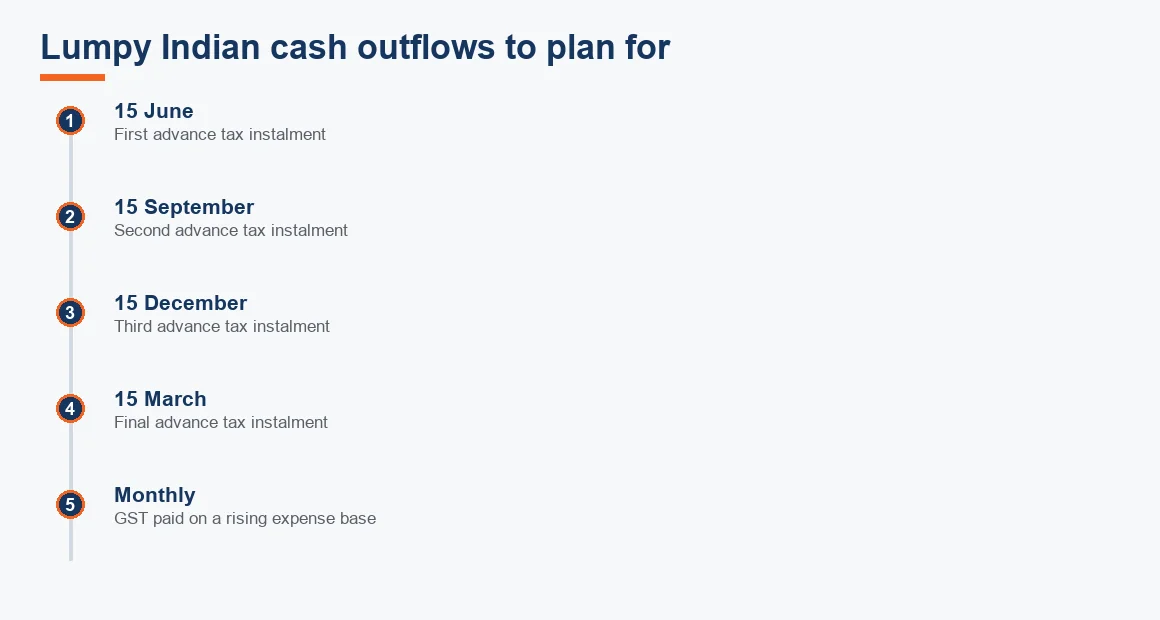
- Timing of statutory outflows. Plan for advance tax in June, September, December and March and for GST on a rising expense base, so a heavy month does not surprise the runway.
Remember that non-cash items such as depreciation never move your burn; you can model their profit effect separately with a depreciation calculator. If you are still deciding what finance support you need at this stage, our note on when a startup should hire a CA versus use accounting software is a useful companion, as is the year-one accounting checklist.
Worked example: net burn and runway for a seed company
Assume a seed-stage company holding Rs 3,00,00,000 in the bank. The table builds net burn from its monthly cash lines, then divides the balance by that net burn to find the runway. All figures are illustrative and exclude non-cash charges.
| Line item | Monthly cash (Rs) |
|---|---|
| Salaries and contractor payments | 28,00,000 |
| Office rent and utilities | 4,00,000 |
| Cloud and software | 3,50,000 |
| Marketing spend | 5,00,000 |
| Other admin | 1,50,000 |
| Gross burn | 42,00,000 |
| Less: cash collected from customers | (25,00,000) |
| Net burn | 17,00,000 |
| Cash in bank | 3,00,00,000 |
| Runway (3,00,00,000 / 17,00,000) | 17.6 months |
Note that depreciation and the ESOP share-based payment charge are absent from the table because they never leave the bank. If this company raised Rs 20 crore and lifted planned spend to a Rs 1 crore net burn, its runway would be 20 months, not the 40 the Rs 17 lakh rate implied before the raise.
Key terms
- Monthly Burn Rate: cash lost in a month, ideally measured net of collections.
- Cash Runway Calculation: cash in bank divided by monthly net burn, expressed in months.
- Operating Cash Runway: runway measured on operating cash flows before financing inflows.
- Cap Table Dilution: the fall in founder ownership when new shares are issued in a round.
- Ind AS 102 Share-based Payment: the standard under which the ESOP charge is a non-cash expense.
Reporting burn to your board and investors
Present net burn and runway on the same slide every month, within ten working days of month close, using the reconciled bank position. Monthly review matters because Indian cash outflows are lumpy: advance tax lands in four instalments across the year, annual insurance falls in one month, and GST rises with your expense base. Quarterly review hides these and gives you no time to react. Investors preparing to fund you will look for the same discipline, which is why our guide to due-diligence-ready books stresses a clean bank-to-burn trail. If you qualify for the tax holiday, read our explainer on the Section 80-IAC tax holiday for DPIIT startups, since a lower tax outflow directly lengthens runway. Businesses selling through platforms should also factor marketplace settlement timing, covered in our E-Commerce Accounting Services, and product companies can see our IT & Software Company Accounting Services for revenue timing under subscription and licence models.
Where deferred revenue is large, do not confuse cash collected upfront with revenue earned; track deferred revenue separately so a big annual prepayment does not make a bad burn month look healthy.
Key takeaways
- Burn rate is cash lost per month; runway is how many months that cash lasts. Runway equals cash in bank divided by net burn.
- Report net burn, read from a reconciled bank statement, and keep it consistent so the trend is visible.
- Hold at least 18 months of runway after a raise and 12 months otherwise; watch the burn multiple, aiming below 1.5 at Series A.
- Exclude non-cash charges such as depreciation and the ESOP expense; include the cash TDS on ESOP exercise when it is actually paid.
- After a raise, add only net proceeds and divide by the higher post-raise burn.
Sources: advance tax due dates from the Income Tax Department; share-based payment treatment under Ind AS 102 as issued by the Institute of Chartered Accountants of India; GST payment obligations from the GST portal.
Decision guide