In this guide
A startup accounting checklist for year one is mostly about two things: setting up clean, double-entry books from the first transaction, and meeting a handful of statutory deadlines that begin ticking the day the company is incorporated. Year one is compliance-heavy and low in volume, so the work is less about complicated reporting and more about not missing a filing. This guide walks through the accounting basics, the exact deadlines a new private limited company faces, and a worked example of how a first invoice should be booked. If you want the work done for you rather than done yourself, that sits with our Startup Accounting Services India team, not this article.
What are the accounting basics for startups?
The basics do not change because you are a startup. Every rupee that moves is recorded twice, once as a debit and once as a credit, under double-entry bookkeeping. Those entries roll up into a general ledger, the ledger is proved with a trial balance, and the trial balance becomes your balance sheet and profit and loss account at year end. What is specific to a startup is that you are building this from nothing, so the decisions you make in the first month (which software, what chart of accounts, cash versus accrual accounting) shape everything that follows.
For a company registered under the Companies Act 2013, accrual accounting is mandatory, not optional. That means you recognise income when it is earned and expenses when they are incurred, regardless of when cash actually moves. Founders who run their books on a simple cash basis in year one almost always have to unwind that work before their first audit or funding round.
What are the 5 basics of accounting to set up first?
Before you record a single transaction, put these five foundations in place. They are the practical core of any startup bookkeeping checklist.
- A dedicated current account. Never mix personal and company money. Every founder-funded rupee should enter the company as share capital or a clearly documented loan.
- Accounting software. Zoho Books, Xero or Tally, chosen and set up before the invoices start, not three months in.
- A chart of accounts. A tidy list of ledgers matched to how you actually spend, so reports mean something.
- Registrations that apply to you. GST where you cross the threshold or need it commercially, TDS (TAN), and PF or ESI once you have enough employees.
- A document trail. Invoices, bills, contracts and bank statements filed so that a journal entry can always be traced back to a source document.
The year-one startup accounting checklist, step by step
Here is the sequence a newly incorporated private limited company should follow, roughly in the order the deadlines arrive.
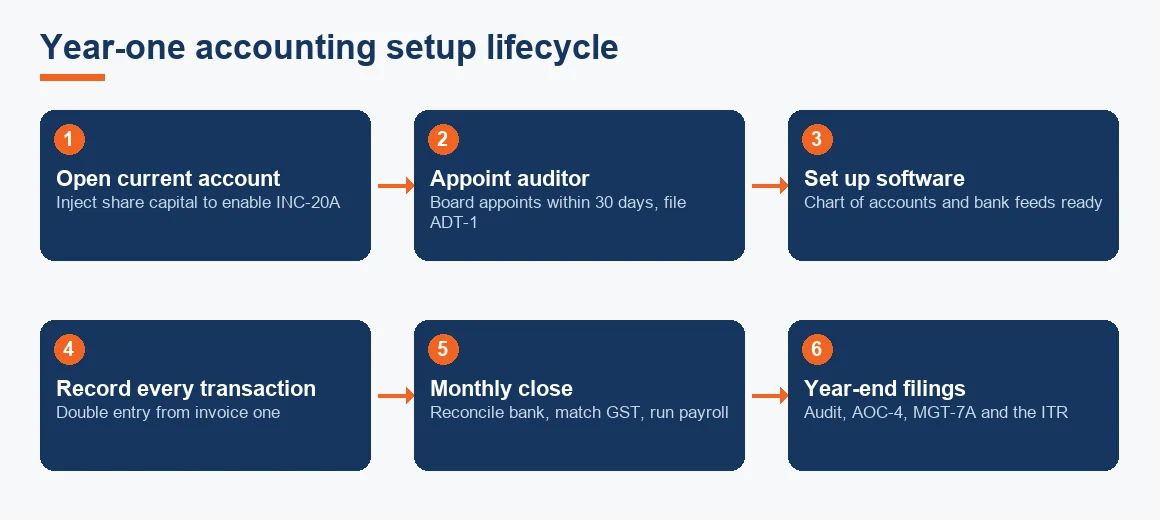
- Open the current account and inject capital. Deposit the subscribed share capital so you can file INC-20A.
- Appoint the first auditor within 30 days. The board appoints under Section 139(6); file Form ADT-1 to inform the Registrar.
- File INC-20A within 180 days. This declares commencement of business. A company cannot borrow or start operations properly until it is filed.
- Set up software and record from transaction one. Bank feeds, sales invoices, purchase bills, expense claims, all booked as they happen.
- Run monthly compliance. GST returns, TDS deposits and returns, and payroll if you have staff.
- Close every month. Reconcile the bank, match GST input credit, and review the trial balance.
- Complete year-end filings. Statutory audit, AOC-4, MGT-7A, the income tax return and DIR-3 KYC for directors.
What are the first statutory deadlines?
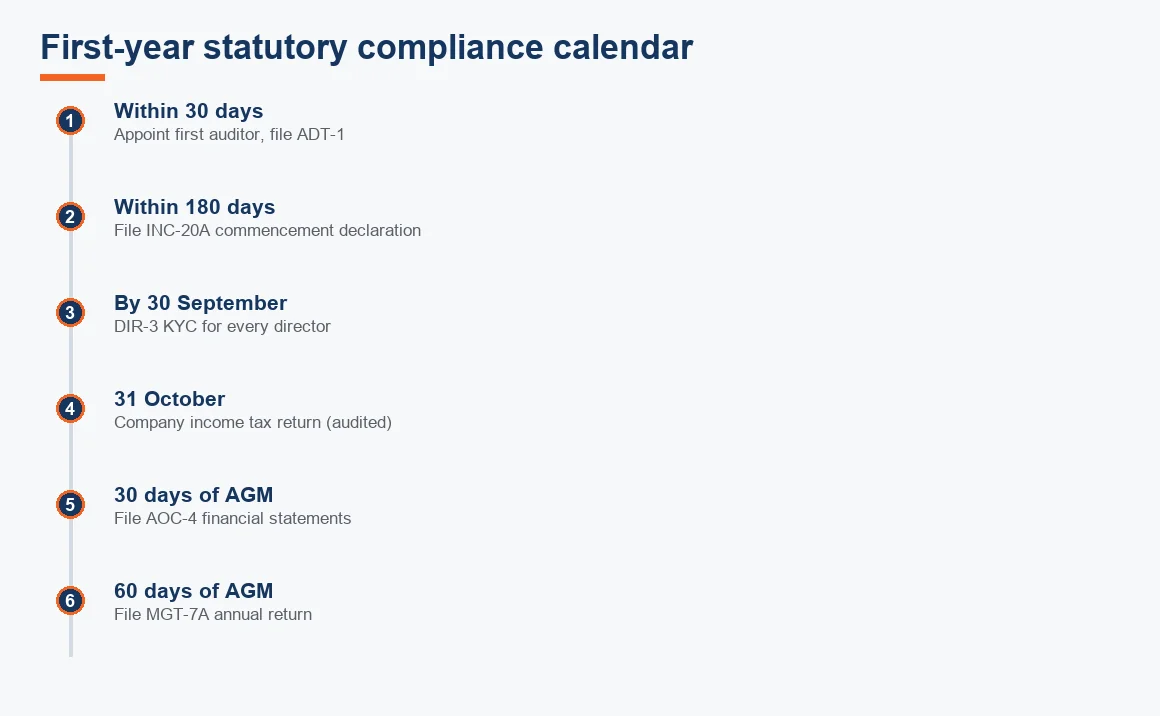
This is the part founders most often miss, because the penalties are automatic and the dates start from incorporation, not from when you feel ready. The table below summarises the core year-one filings for a private limited company. The Ministry of Corporate Affairs publishes the forms and thresholds at mca.gov.in.
| Filing | Form | Statutory due date |
|---|---|---|
| Appoint first auditor | ADT-1 | Board appoints within 30 days of incorporation |
| Declaration of commencement of business | INC-20A | Within 180 days of incorporation |
| Director KYC | DIR-3 KYC | By 30 September |
| Financial statements | AOC-4 | Within 30 days of the AGM |
| Annual return | MGT-7A | Within 60 days of the AGM |
| Company income tax return | ITR-6 | 31 October (audited accounts) |
MSME-1 and DPT-3 also apply where you have outstanding dues to micro or small suppliers, or loans and deposits to report. If you are a DPIIT-recognised startup, do not overlook the three-year tax holiday available under Section 80-IAC, which we cover in Section 80-IAC Tax Holiday for DPIIT Startups.
Does a company with no revenue still need to do all this?
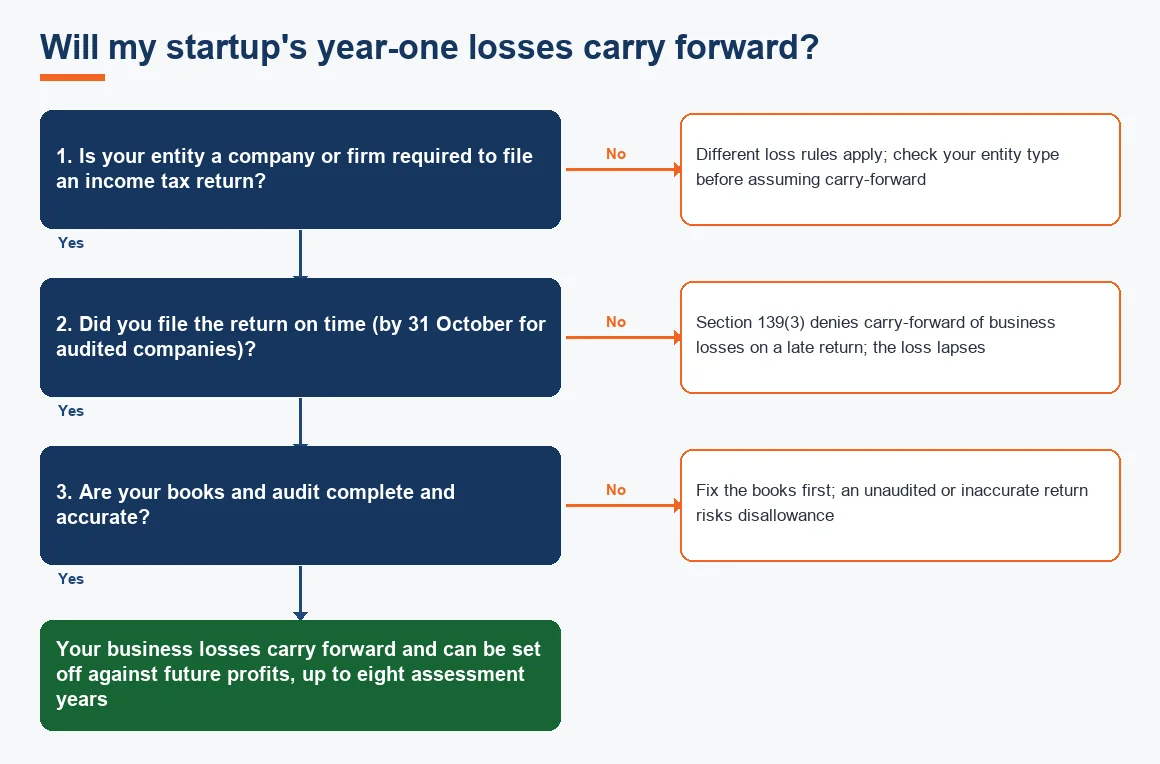
Yes. A company files an income tax return for every financial year whether or not it earned a single rupee, and the ROC filings above are not waived for a dormant or pre-revenue company. There is a real upside to doing it properly: filing the return on time protects the carry-forward of business losses. Section 139(3) of the Income-tax Act denies loss carry-forward when the return is late, and for a startup burning cash to build a product, those accumulated losses are often the most valuable tax asset on the books. The Income Tax Department portal at incometax.gov.in is where the return is filed.
What are the 3 golden rules of accounting?
Founders often ask about the traditional golden rules, which sit underneath the modern debit-and-credit approach. They are worth knowing because they explain why entries go where they do.
- Real accounts
- Debit what comes in, credit what goes out. Applies to assets such as cash, equipment and bank balances.
- Personal accounts
- Debit the receiver, credit the giver. Applies to people and organisations such as a supplier or a customer.
- Nominal accounts
- Debit all expenses and losses, credit all incomes and gains. Applies to items such as salaries, rent and sales.
In practice modern software applies the equivalent asset-liability-equity logic for you, but the rules are the reason a professional fee is a debit and the money owed to the consultant is a credit.
What are 5 common startup costs to record?
A startup costs accounting habit worth forming early is tagging spend correctly from day one, because these five categories dominate year-one outflows and each is treated differently for tax and reporting.
- Incorporation and legal: company registration, stamp duty, professional fees. Often booked as preliminary expenses.
- Software and subscriptions: accounting tools, cloud hosting, SaaS licences, usually monthly operating expenses.
- Salaries and contractor fees: typically the largest line, and the one that triggers TDS and payroll compliance.
- Rent, utilities and office setup: a mix of operating expenses and capitalised fixed assets such as laptops and furniture.
- Marketing and customer acquisition: ad spend and launch costs, watched closely because they drive your monthly burn rate.
Capitalised assets are depreciated over their life rather than expensed at once; our Depreciation Calculator handles the Schedule II rates. Watching burn against cash in the bank is the founder's core financial discipline, explained in Burn Rate and Runway: How Founders Should Read Their MIS.
Worked example: booking a first consultant invoice
Assume your startup engages a consultant for professional services of Rs 50,000 (indicative, Exl GST). GST applies at 18% and TDS under Section 194J applies at 10% on the fee. Here is the correct journal entry, showing how one transaction touches expense, input GST, a statutory deduction and a supplier liability at the same time.
| Ledger | Debit (Rs) | Credit (Rs) |
|---|---|---|
| Professional fees (expense) | 50,000 | - |
| Input CGST | 4,500 | - |
| Input SGST | 4,500 | - |
| TDS payable (Section 194J) | - | 5,000 |
| Consultant (sundry creditor) | - | 54,000 |
| Total | 59,000 | 59,000 |
The debits and credits both total Rs 59,000, so the entry balances. You pay the consultant Rs 54,000, deposit Rs 5,000 as TDS with the government, and claim Rs 9,000 of input GST against your output liability once it appears in GSTR-2B. The CBIC guidance on input credit and returns is at cbic-gst.gov.in. Get this pattern right on transaction one and every month closes cleanly.
Should you do it in-house or outsource in year one?
Because year-one volume is low but the compliance surface is wide, most startups find an outsourced firm cheaper and safer than an early in-house hire. The judgement call is really about volume and stage.
The full decision, including when software alone is enough, sits in When Should a Startup Hire a CA vs Use Accounting Software?. If your startup is a SaaS or IT business with export revenue and ESOPs, the reporting is heavier from day one, which is why we treat SaaS Accounting Services and IT and Software Company Accounting Services as their own tracks, just as marketplace sellers need E-Commerce Accounting Services. Whichever route you take, keeping the books tidy is what makes them due-diligence ready when a term sheet arrives. If you are unsure which accounting standards apply as you scale, the AS vs Ind AS Comparison Matrix is a quick reference.
Key terms
- Double-Entry Bookkeeping: the system where every transaction is recorded as an equal debit and credit.
- General Ledger: the master record where all account balances are held.
- Trial Balance: a listing that proves total debits equal total credits before you draft statements.
- Accrual Accounting: recognising income and expense when earned or incurred, mandatory for companies.
- Monthly Burn Rate: the net cash a startup spends each month, the number founders watch most.
Key takeaways
- Year-one accounting is compliance-heavy and low in volume: set up clean books and meet the statutory deadlines.
- Appoint the first auditor within 30 days and file INC-20A within 180 days of incorporation.
- A company files its income tax return by 31 October even with zero revenue, protecting loss carry-forward under Section 139(3).
- Use accrual accounting and a well-planned chart of accounts from the first transaction, not after your first audit.
- Outsourcing usually beats an early in-house hire until transaction volume or a priced funding round justifies the switch.
Decision guide