In this guide
An MIS report (management information system report) is a periodic pack of financial and operating numbers, usually monthly, that turns your ledger into decisions the owner can act on. It sits outside statutory filing: it is management-facing, unaudited, and built for speed rather than for the auditor. This guide explains the MIS report format, the key elements, the common types, and gives you a worked example you can copy for your own business.
What is an MIS report in simple words?
In simple words, an MIS report is the monthly story of how the business is doing, told in numbers. It takes the raw entries sitting in your general ledger, checks that they tie back to the trial balance, and presents the result as decision information rather than as a compliance document. Where a statutory profit and loss tells the tax officer what happened last year, an MIS report tells the owner what happened last month and what to do about it this month.
The distinction matters because the two documents serve different masters. Audited accounts follow Schedule III and cannot be published until they are final. An MIS pack is allowed to use estimates and cut-offs, provided the basis stays consistent month to month, which is exactly why it can reach the owner ten days after month end instead of six months later. If you need the commercial side of this handled for you, that is the job of a MIS Reporting Services engagement, but the concept itself is simple: timely, comparable, management-facing numbers.
Why is MIS reporting important?
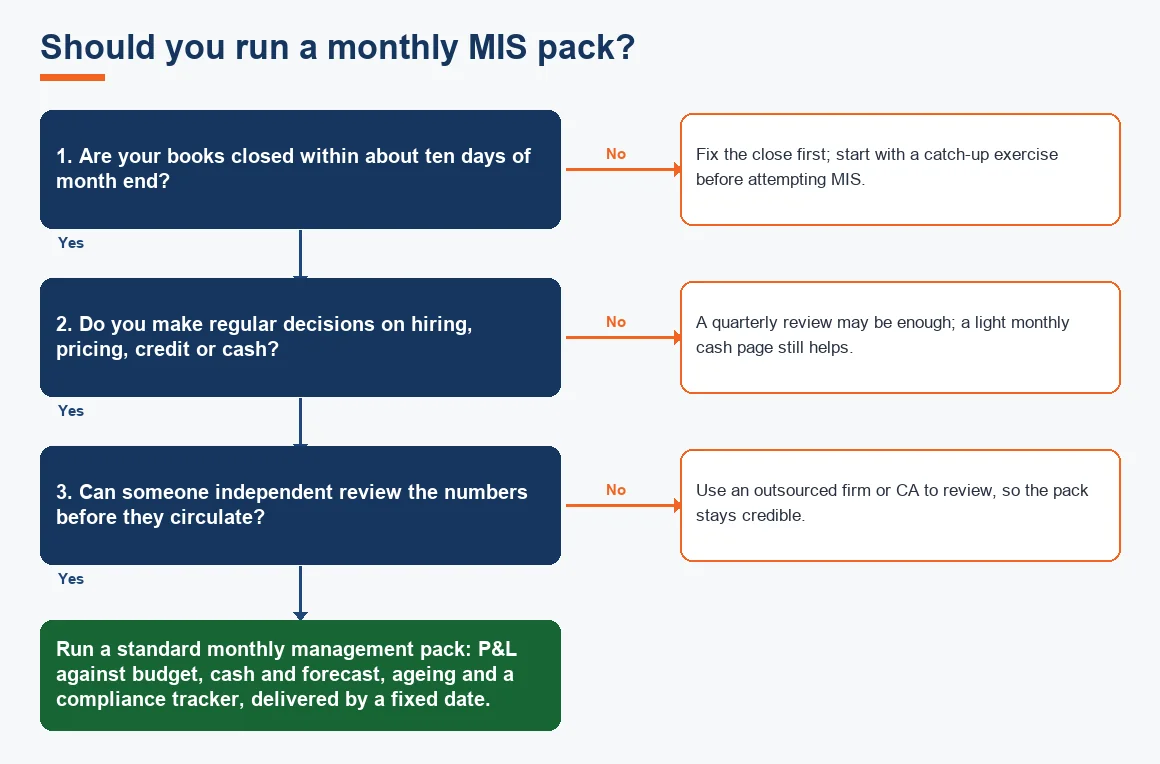
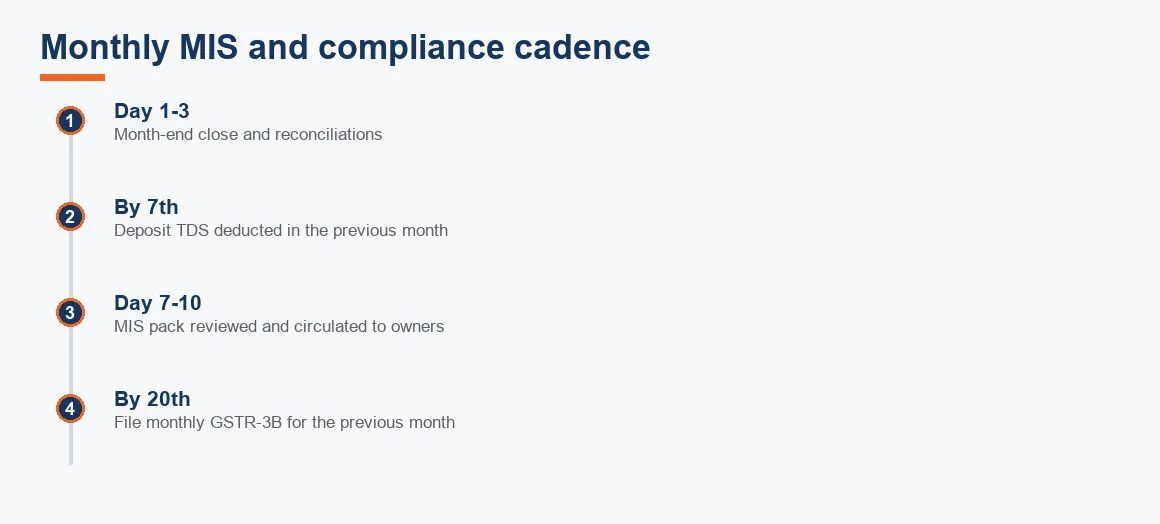
MIS reporting is important because decisions do not wait for audited accounts. A lender reviewing a working capital limit, an owner deciding whether to hire, a founder watching the cash runway: all of them need numbers while those numbers still matter. A pack delivered within seven to ten working days of month end lets you correct a slipping margin or a stretched receivable before it becomes a crisis. Waiting until the GST and TDS returns are filed pushes delivery past the 20th and strips most of the value out of the exercise.
Good MIS also builds credibility. When a bank or an investor asks for last month's figures and receives a clean, consistent pack the same week, it signals that the business is run on data. That trust is hard to win from a set of accounts that arrives late and changes every time it is reissued.
What are the key elements of a good MIS report?
The key elements of a good MIS report are less about how many pages it runs to and more about whether each number can be trusted and compared. A strong pack carries the following.
- A clear period and scope: the month, the year to date, and which entities are covered.
- Comparatives: every figure shown against budget, against the prior month, and against the year to date, so a reader can see direction, not just level.
- Variance analysis: the gap between actual and budget, with a one-line reason for anything material, so the report explains itself.
- Cash and ageing: the bank position with a rolling forecast, plus receivable and payable ageing, because profit on paper does not pay salaries.
- A compliance tracker: GST, TDS, PF and ESI due dates and status, so nothing statutory slips while everyone watches the margin.
- A tie-back: opening figures that agree to the previous month's closing trial balance, without which the whole trend is meaningless.
What are the types of MIS reports?
Businesses run several types of MIS report at different cadences, each aimed at a different reader. The summary below sets out the ones an Indian SME most commonly uses.
| Report type | What it shows | Frequency | Primary reader |
|---|---|---|---|
| Monthly management pack | P&L against budget, EBITDA, cash, ageing, compliance | Monthly | Owner, CFO, board |
| Cash and receivables report | Bank balance, rolling forecast, debtor ageing and collection status | Weekly | Owner, finance controller |
| Sales and margin dashboard | Revenue by product, region or channel with gross margin | Weekly or monthly | Sales head, owner |
| Cost and expense report | Spend by head against budget, with variance reasons | Monthly | Department heads |
| Compliance status report | GST, TDS, PF, ESI and ROC due dates and filing status | Monthly | Owner, company secretary |
Larger or funded businesses layer more on top, such as project-wise profitability, contribution-margin views and a burn-and-runway page, but the five above are the working core.
What is the MIS report format for a monthly pack?
The monthly MIS report format is best thought of as a short, ordered set of one-page views rather than one long document. A typical pack opens with a one-page summary, then the profit and loss against budget, then cash and forecast, then ageing, then the compliance tracker, and closes with two or three operating metrics for the sector. Each page shows the current month, the prior month and the year to date side by side.
The revenue and margin page usually carries EBITDA as its headline profit measure, since it strips out financing and depreciation and lets owners compare operating performance month to month. The cash page pairs the closing bank balance with a short forecast, and the receivables page leans on an accounts receivable ageing schedule and the resulting days sales outstanding so collection pressure is visible. For a ready layout, our monthly MIS report format for management walks through each page, and the financial KPIs every MIS dashboard should track guide covers which metrics to put on the summary sheet.
What are examples of MIS reports in real life?
An example of MIS in real life is easiest to picture by sector. A trading business runs a weekly stock and margin report that flags slow-moving lines before they tie up cash. A manufacturer runs a cost sheet comparing standard cost to actual, so a rise in a raw material shows up as a variance the same month. A services firm tracks unbilled hours and project margin, because its cost is people rather than stock. An e-commerce seller reconciles marketplace settlements against gross sales, since the amount that hits the bank is never the amount invoiced. Each of these is an MIS report: a periodic, management-facing view built to catch a problem while it is still cheap to fix.
Even a two-person business benefits from the discipline. A simple monthly page showing revenue, gross margin, cash and the top five overdue debtors is a genuine MIS report, and it is often the difference between an owner who knows the business is tightening and one who finds out when a cheque bounces.
Worked example: a monthly profit and loss against budget
Here is a worked monthly management view for a small business, with actuals set against budget and the variance calculated. A positive revenue variance is favourable; a positive cost variance is adverse because it means more was spent than planned. Figures are illustrative.
| Line | Actual (₹) | Budget (₹) | Variance (₹) | Read |
|---|---|---|---|---|
| Revenue | 42,00,000 | 40,00,000 | +2,00,000 | Favourable |
| Cost of goods sold | 25,20,000 | 24,00,000 | +1,20,000 | Adverse |
| Gross profit | 16,80,000 | 16,00,000 | +80,000 | Favourable |
| Gross margin | 40.0% | 40.0% | 0.0 pts | Held |
| Operating expenses | 9,50,000 | 9,00,000 | +50,000 | Adverse |
| EBITDA | 7,30,000 | 7,00,000 | +30,000 | Favourable |
The pack reads at a glance: revenue beat budget by two lakh, but because cost of goods sold rose in step, gross margin held at 40 per cent rather than improving. Operating expenses ran fifty thousand over plan, so the EBITDA gain was a modest thirty thousand. The one-line variance note against operating expenses (say, a one-off recruitment cost) is what turns this from a table into a decision. Notice too that gross profit of 16,80,000 less operating expenses of 9,50,000 ties exactly to EBITDA of 7,30,000, the kind of internal check that should never be skipped.
How to build an MIS report, step by step
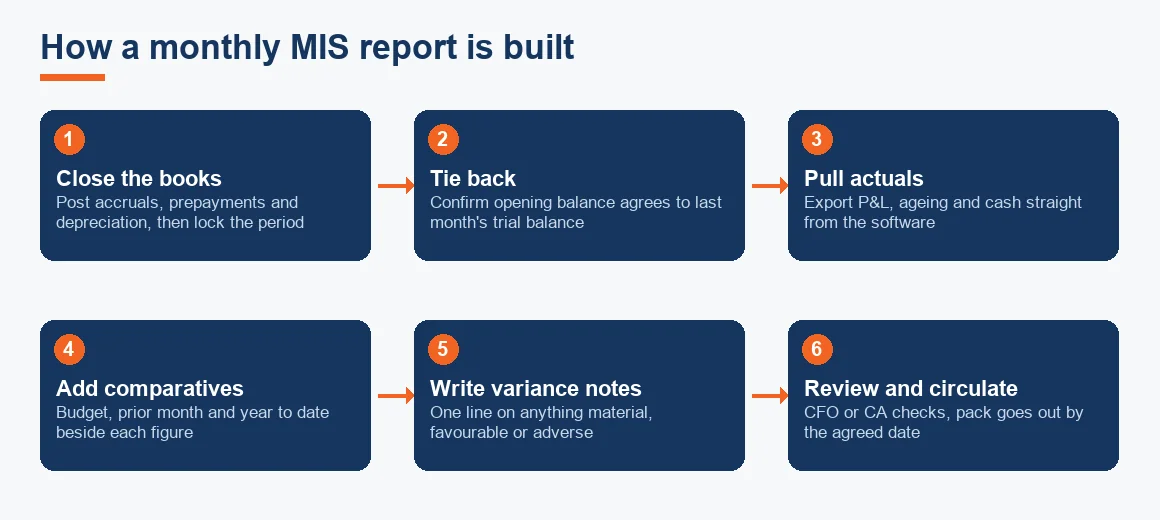
The build follows the month-end close and should be turned into a repeatable routine so it never depends on one person's memory.
- Close the books: post accruals, prepayments and depreciation, then lock the period so the numbers stop moving.
- Tie back: confirm the opening trial balance agrees to last month's closing balance before anything else.
- Pull the actuals: export the P&L, ageing and cash position, ideally straight from the accounting software rather than rekeyed.
- Set the comparatives: drop in budget, prior month and year to date beside each figure.
- Add variance notes: write one line against anything material, favourable or adverse.
- Review and circulate: a CFO or chartered accountant checks the numbers, then the pack goes out by the agreed date.
If you would rather assemble it in a spreadsheet than in software, our step-by-step guide on how to create an MIS report in Excel takes you through the formulas. Reliable MIS depends on the underlying books being current, so if you are behind, a Backlog Bookkeeping / Catch-Up exercise usually comes first. Clean, ongoing accounting and bookkeeping is what makes a same-week MIS pack possible at all.
Who prepares the MIS report in a company?
The accounts team prepares the MIS report and the CFO or a chartered accountant reviews it before circulation. In a smaller business without a full finance function, the pack usually comes from an outsourced accounting firm as part of the monthly retainer, which also keeps the review independent of the person posting the entries. Whoever owns it, the ageing pages depend on tidy sub-ledgers, so businesses often pair MIS with Accounts Receivable Outsourcing and Accounts Payable Outsourcing to keep debtor and creditor data clean enough to report on.
What the MIS report is not is a replacement for statutory accounts. It uses management estimates and cannot be filed. For the formal set, prepared under Schedule III for the auditor and the registrar, that is a separate financial statement preparation exercise. If you want the full contrast between the two documents, we cover it in MIS report vs financial statements.
Key terms
- EBITDA: earnings before interest, tax, depreciation and amortisation, the usual headline profit line on an MIS pack.
- Variance Analysis: the study of the gap between actual and budgeted figures, with reasons for anything material.
- Days Sales Outstanding (DSO): the average number of days it takes to collect a rupee of sales, a core receivables metric.
- Working Capital: current assets less current liabilities, the cash cushion an MIS cash page is really tracking.
- Trial Balance: the list of ledger balances an MIS pack must tie back to before it can be trusted.
Turning it into a habit
An MIS report is only as useful as its consistency. The layout, the comparatives and the delivery date should stay the same month after month so the eye learns where to look and a slipping trend jumps out. Start with a single well-built monthly pack, add a weekly cash and receivables view once that is steady, and layer sector metrics on only when they earn their place. If assembling it in-house is a stretch, a depreciation line and other close entries can be worked out quickly with a tool such as our depreciation calculator, and the rest can be structured around the template below.
Key takeaways
- An MIS report is a monthly, management-facing, unaudited pack that turns the ledger into decisions, distinct from statutory accounts.
- Every figure should carry comparatives, budget, prior month and year to date, plus a one-line variance note on anything material.
- Deliver within seven to ten working days of month end, and always tie the opening balance back to last month's trial balance.
- The core types are the monthly management pack, cash and receivables, sales and margin, cost, and a compliance tracker.
- Build the books clean first; if you are behind, catch up before you report, and let a CFO or chartered accountant review before circulation.
Decision guide