In this guide
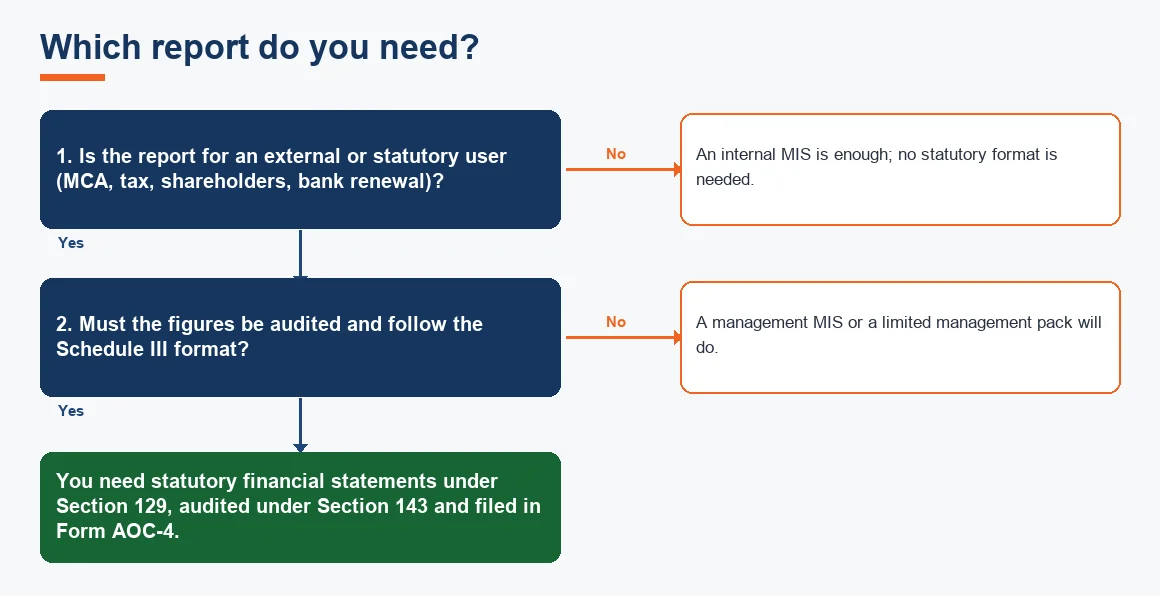
Put simply, an MIS report and a set of financial statements answer two different questions. An MIS (Management Information System) report is an internal document that helps founders and managers decide what to do next month, so it can carry estimates, branch or segment cuts and figures that are still unbilled. Financial statements are the statutory record for a full year: they follow prescribed accounting standards and the Schedule III format, they are audited, and they are filed with regulators. Both are built from the same ledger, which is exactly why they must reconcile at the year end, with the audited numbers treated as the single source of truth.
What is an MIS report in accounting and finance?
In accounting, a Management Information System report is a summarised pack of numbers, prepared for internal readers, that turns raw ledger data into something a manager can act on. It typically pulls revenue, gross margin, department-wise costs, cash position, receivable ageing and a few key ratios onto one or two pages. Because it exists to support decisions, an MIS can present a figure the statutory accounts would never show: pipeline revenue, unbilled work in progress, a management estimate of a bonus provision, or a branch profit split that has no place on a Companies Act balance sheet.
An MIS statement therefore has no legally prescribed shape. Two businesses in the same sector can run completely different MIS packs, and the same company will redesign its MIS as it grows. The one discipline that keeps it honest is a check row that ties the MIS back to the trial balance extracted from the accounting software. If you want the mechanics of building one, our guide on how to create an MIS report in Excel and the ready monthly MIS report format for management cover the layout in detail, and what an MIS report is, with examples shows sample packs by business type.
What are financial statements, and what are the four types?
Financial statements are the formal, standardised accounts a company prepares under Section 129 of the Companies Act 2013. They are drawn from the closed and adjusted general ledger, presented in the Schedule III format, and audited before anyone outside the business relies on them. The four statements people usually mean are:
- The balance sheet, which shows assets, liabilities and equity on the closing date.
- The statement of profit and loss, which shows income and expenses for the year.
- The cash flow statement, which reconciles profit to actual cash movement.
- The statement of changes in equity, which tracks movements in share capital and reserves.
These sit alongside the notes to accounts, which explain the policies and give the detail behind each line. The whole set must follow either Accounting Standards (AS) or Indian Accounting Standards (Ind AS), depending on the company's size and listing status. If you are unsure which framework applies, our Ind AS applicability checker and the AS vs Ind AS comparison matrix settle it quickly, and preparing the full audited set is what our financial statement preparation service handles.
MIS vs financial statements: the core differences
The cleanest way to hold the two apart is to compare them on purpose, audience, format and frequency at the same time. An MIS is fast, flexible and internal; financial statements are slow, standardised and public.
| Feature | MIS report | Financial statements |
|---|---|---|
| Purpose | Decisions and control | Compliance and stewardship |
| Primary audience | Founders, department heads, board, lenders | Shareholders, MCA, Income Tax Department, banks |
| Format | No prescribed format | Schedule III under the Companies Act 2013 |
| Standards | None mandatory | AS or Ind AS |
| Frequency | Monthly, often weekly for cash | Annual (quarterly if listed) |
| Audited? | No | Yes, under Section 143 |
| Filed? | No | Form AOC-4 with the MCA |
| Can carry estimates? | Yes | Only where a standard permits |
What is the difference between MIS and AIS in accounting?
These two are often confused because the letters overlap. In accounting, an AIS is an Accounting Information System: the software and process that captures transactions, posts them through double-entry bookkeeping and stores them, such as Tally, Zoho Books or an ERP. An MIS sits on top of that data and summarises it for managers. In short, the AIS records; the MIS reports. One is the plumbing, the other is the dashboard.
A quick word of caution for Indian readers: AIS also stands for the Annual Information Statement issued by the Income Tax Department, a taxpayer's record of reported income and high-value transactions. That is a tax document and has nothing to do with the accounting-system sense of AIS used here. Context tells you which one is meant.
Who prepares an MIS report, and how is it used in finance?
An MIS is usually prepared by the in-house accounts team, a finance manager or an outsourced accounting partner, and reviewed by the CFO or founder. It is not signed off by an auditor, because it is not a statutory document. In practice the person who owns month-end close also owns the MIS, since the pack is only as current as the books behind it. Where a business is months behind, an MIS cannot run at all until the ledger is brought up to date, which is where backlog and catch-up bookkeeping comes in.
In finance, an MIS is used to steer: to spot a margin slipping, to chase a receivable before it ages past terms, to check burn against runway, and to hold each department to its budget through variance analysis. Much of that signal comes from the payables and receivables cycle, so teams that run accounts receivable and accounts payable tightly tend to produce the sharpest MIS. The specific ratios worth putting on the front page are covered in our note on the key financial KPIs an MIS dashboard should track.
The three types of MIS
MIS reports are commonly grouped into three levels by who reads them: operational MIS for day-to-day control (daily sales, cash, stock), tactical or management MIS for monthly review (department margins, ageing, budget variance), and strategic MIS for the board and investors (growth, runway, unit economics). A well-designed pack usually carries a little of all three.
Why the two must reconcile
Because the MIS and the financial statements are both built from the same ledger, they should never drift apart without an explanation. At the year end, the accountant reconciles the management view to the statutory one: unbilled revenue that the MIS recognised early is aligned to the revenue-recognition standard, management provisions are firmed up, depreciation is recomputed to Schedule II, and any estimate is replaced by an audited figure. What remains is a clean bridge from the MIS profit the founder saw each month to the audited profit that goes into Form AOC-4.
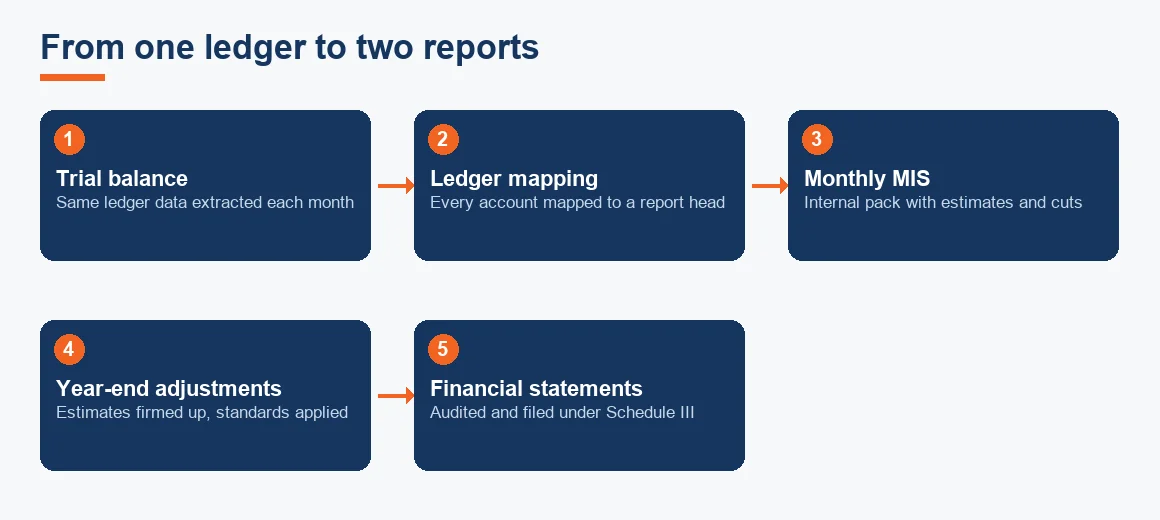
Keeping that bridge documented is good discipline all year, not just at close. It means the board is never surprised by the audited result, and it gives the auditor a clear trail from management numbers to the final Schedule III balance sheet.
Worked example: reconciling MIS profit to statutory profit
Suppose a services company's March MIS shows a profit before tax of INR 40,00,000. At audit, three adjustments are needed to reach the statutory figure. The reconciliation below shows how the management number becomes the audited number. Figures are illustrative.
| Line | Adjustment | Amount (INR) | Reason |
|---|---|---|---|
| MIS profit before tax | Opening figure | 40,00,000 | As shown in the March management pack |
| Less: unbilled revenue reversed | Deduct | (6,00,000) | Not yet earned under the revenue standard |
| Less: gratuity provision firmed up | Deduct | (1,50,000) | Actuarial estimate booked in full at audit |
| Add: depreciation aligned to Schedule II | Add | 90,000 | MIS had used a higher management rate |
| Statutory profit before tax | Audited figure | 33,40,000 | Carried into the statement of profit and loss |
The INR 6,60,000 gap is not an error; it is the honest difference between a fast management view and an audited one. The value of the reconciliation is that every rupee of that gap is explained and can be defended.
The reporting calendar: MIS versus statutory dates
The two reports also run on very different clocks. An MIS closes within a few days of month-end and is issued straight to management. Statutory financial statements follow a fixed annual path after 31 March, through audit and the AGM to the MCA filing.
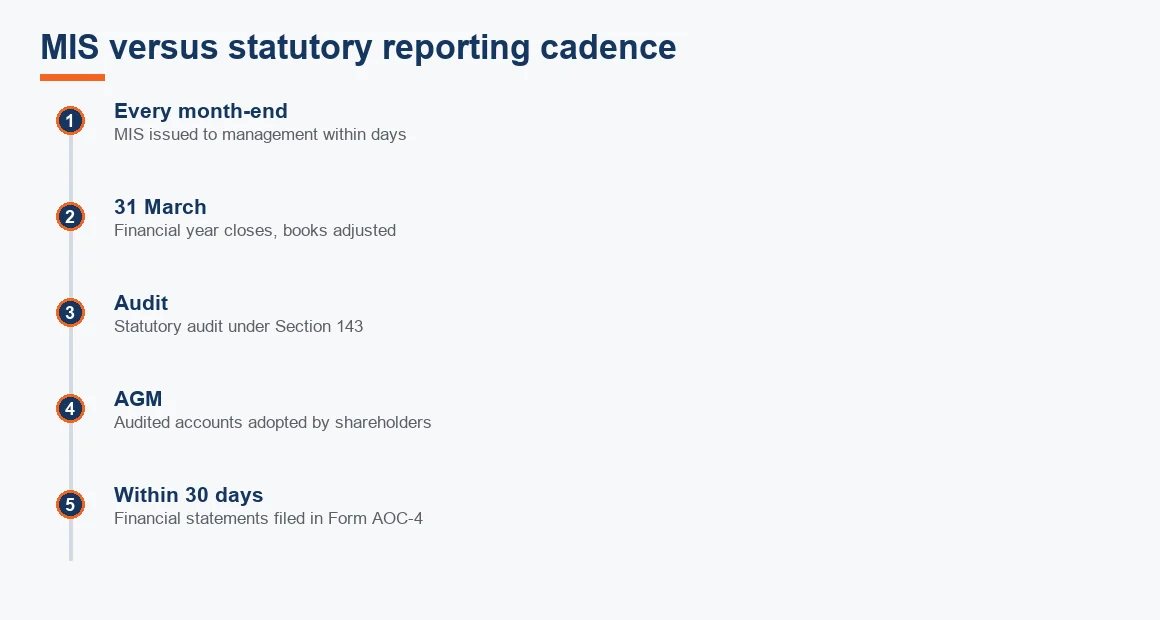
For listed companies there is a further layer: quarterly results under the SEBI Listing Regulations. But for the vast majority of private companies, the rhythm is simple: an internal MIS every month, and one audited, filed set of financial statements a year.
Key terms
- Trial Balance: the list of every ledger balance on a date, and the common starting point for both an MIS and the financial statements.
- Schedule III Balance Sheet: the prescribed presentation format for company financial statements under the Companies Act 2013.
- Variance Analysis: comparing actual results against budget or a prior period, a core job of the MIS.
- Notes to Accounts: the disclosures that explain the policies and detail behind each line of the statutory accounts.
- EBITDA: earnings before interest, tax, depreciation and amortisation, a headline metric most MIS packs track monthly.
Key takeaways
- An MIS is for internal decisions; financial statements are the audited, filed record for external users.
- An MIS has no fixed format and can carry estimates; financial statements must follow AS or Ind AS and Schedule III.
- Only financial statements are audited under Section 143 and filed in Form AOC-4 within 30 days of the AGM.
- Both come from the same ledger, so reconcile them at year end and treat the audited figures as the single record.
- If you need only the operating story, an MIS is enough; if a regulator, the MCA or the tax return is involved, you need statutory statements. For help producing either, see our MIS reporting service.
For statutory references, the format and content of financial statements are governed by the Ministry of Corporate Affairs under the Companies Act 2013, the underlying accounting standards are issued by the Institute of Chartered Accountants of India, and quarterly reporting for listed entities is set out by the Securities and Exchange Board of India.
Decision guide