In this guide
A monthly MIS report format is a fixed internal template that presents a business's profit and loss, balance sheet, cash position, receivables and payables, and budget versus actual figures in one management pack, refreshed every month. MIS stands for management information system, and in plain words the report is the set of numbers your management reads to decide what to do next, not a statutory filing. This guide sets out the sections a monthly pack should carry, how to prepare it, a Excel structure you can reuse, and a worked variance example. If you would rather hand the monthly close and pack to a team, that sits with our MIS Reporting Services; this article stays on the format itself.
What is a monthly MIS report in simple words?
A monthly MIS report is an internal summary of how the business performed last month and where it stands today, written for owners and managers rather than for the tax department or the auditor. It answers three questions every month: did we make money, do we have cash, and what is different from what we planned. Because it is internal, it can show branch, product or segment results, provisional figures and budget comparisons that a statutory financial statement is not allowed to mix in. For the difference in detail, see our note on MIS report versus financial statements, and for a broader tour of formats and examples, what is an MIS report.
What should a monthly MIS report format contain?
A good format is short at the top and detailed underneath. The first page is a one-screen summary that a director can read in five minutes; the schedules behind it hold the supporting detail. A typical monthly pack for an Indian SME carries the following, in this order.
- Executive summary: revenue, gross profit, EBITDA, net profit and closing cash, each shown for the month and year to date against budget.
- Profit and loss: the month and year-to-date statement, with major expense heads and variance columns.
- Balance sheet: a Schedule III style summary so working capital and borrowings are visible at a glance.
- Cash and bank: closing balances, limits used and a short cash forecast for the next month.
- Receivables and payables ageing: debtor and creditor buckets, with days sales outstanding tracked month on month.
- Statutory position: GST output, input credit as per books and as visible in GSTR-2B, and TDS deducted and payable, all labelled provisional until filed.
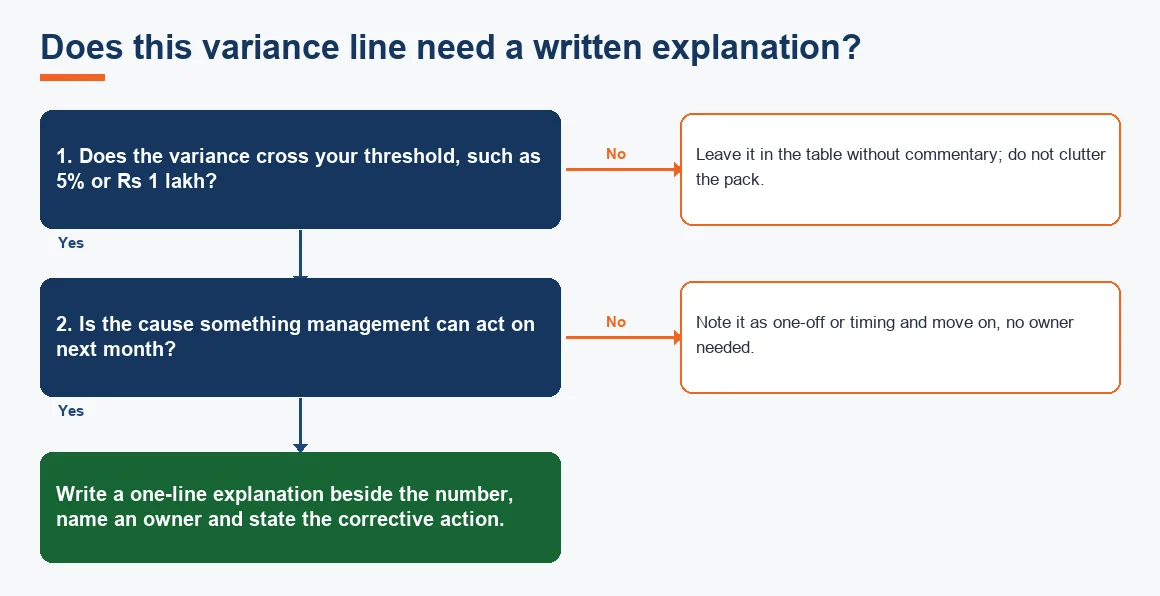
- Budget versus actual: the variance section, explained line by line above a set threshold.
The heavy lifting behind ageing and payables usually comes from clean sub-ledgers, which is why accounts receivable and accounts payable discipline shows up directly in the quality of the monthly pack.
How to prepare a monthly MIS report step by step
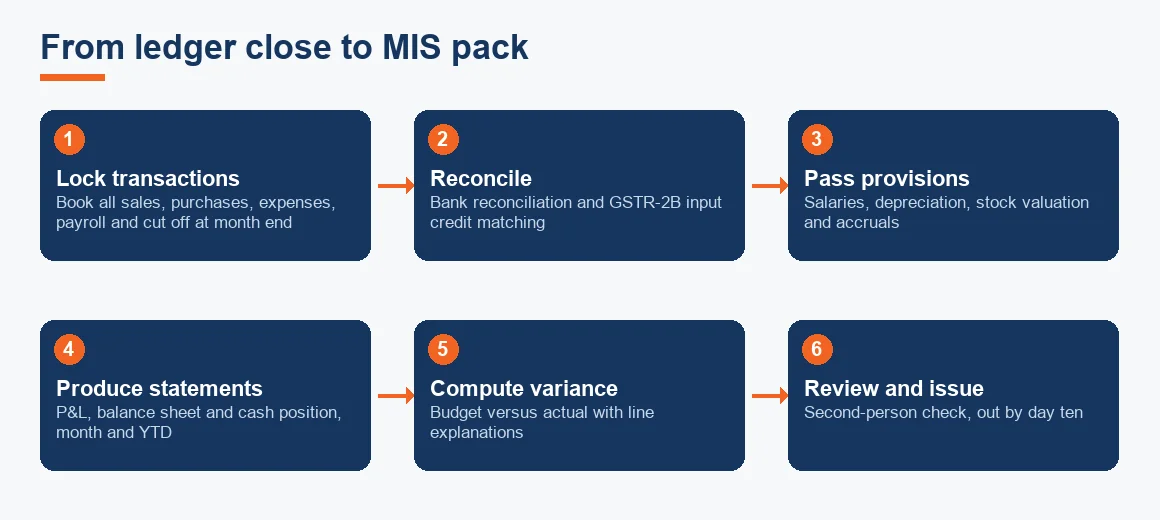
Preparing the pack is really about closing the books cleanly first. Once the close is disciplined, the report is a refresh, not a rebuild. The sequence below is what most finance teams follow.
- Lock the transactions: ensure all sales, purchases, expenses and payroll for the month are booked, and cut off the ledger at month end.
- Reconcile the bank: complete bank reconciliation for every account so cash in the books equals cash in the statement.
- Match input credit: reconcile purchases against GSTR-2B so input tax credit in the pack is the amount you can actually claim.
- Pass month-end provisions: salaries, utilities, rent, interest, depreciation and stock valuation, so the profit is real and not a cash snapshot. Follow a fixed month-end close checklist here.
- Produce the statements: generate the profit and loss, balance sheet and cash position for the month and year to date.
- Compute variances: place budget, actual and variance side by side and write the explanation next to any line crossing your threshold.
- Review and issue: a second person sanity-checks the pack before it goes to management, ideally by the tenth working day.
If several months are unclosed and the ledger is behind, the pack cannot be trusted until the backlog is cleared; that clean-up is a backlog bookkeeping and catch-up job before monthly reporting can start.
Monthly MIS report format in Excel
Most Indian SMEs run the MIS in Excel, which is fine as long as the structure is stable. Build one workbook with a summary tab and a tab per schedule. The core of every schedule is the same five-column shape: the line item, budget for the month, actual for the month, variance in rupees and variance in percentage, then repeat those for the year to date. Keep the account names identical to your ledger so the figures can be pulled by formula rather than retyped. For the mechanics of formulas, pivot tables and linked cells, our step-by-step on creating an MIS report in Excel goes deeper than we will here.
The one habit that keeps an Excel pack honest is never overtyping a formula cell with a hard number. If a figure looks wrong, fix the source, not the summary. For KPI selection on the summary page, the shortlist in our guide to financial KPIs for an MIS dashboard is a sensible starting set.
MIS report versus statutory financial statements
The two are related but not the same, and confusing them is where formatting goes wrong. The MIS is internal and monthly; the statutory statement is annual, audited and bound by disclosure rules. The numbers should reconcile at year end, but the MIS is free to show more.
| Feature | Monthly MIS report | Statutory financial statement |
|---|---|---|
| Audience | Owners, management, lenders | Shareholders, regulators, auditor |
| Frequency | Monthly | Annual |
| Format | Flexible, decision-led | Schedule III, Companies Act |
| Standards | Internal, provisional allowed | AS or Ind AS, audited |
| Extra detail | Segment, branch, budget, KPIs | Restricted to disclosures |
Who prepares the MIS report and by when?
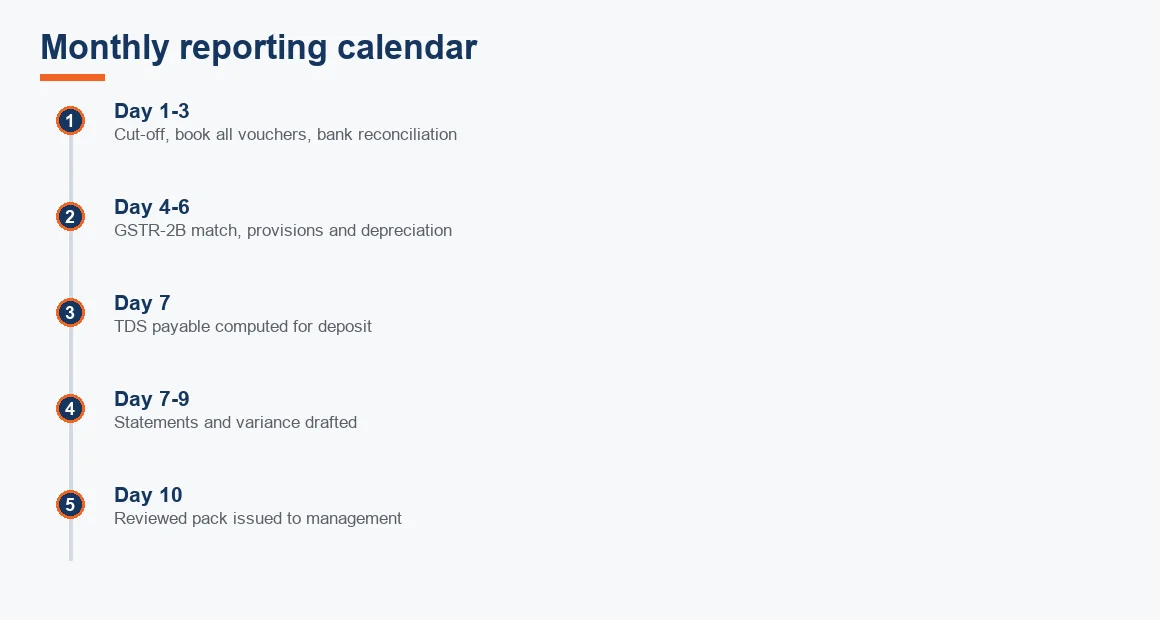
In a small business the accountant or finance manager prepares the pack and the founder or director reviews it. In a larger firm a dedicated MIS or financial planning role owns it, with sub-ledger owners feeding receivables, payables and inventory. The realistic timeline is a close within seven to ten working days of month end, once provisions are done monthly rather than saved up for the year. Working capital lenders usually want their version of the pack by the tenth or fifteenth of the following month, so the internal deadline has to sit ahead of that.
Worked example: reading a budget versus actual variance
The variance section is the part management actually acts on, so it is worth seeing how the numbers behave. The table below shows a single month for a services business. Variance is actual minus budget for revenue and the reverse sense for costs, and the percentage is variance over budget. Amounts are illustrative.
| Line item | Budget (Rs) | Actual (Rs) | Variance (Rs) | Variance % |
|---|---|---|---|---|
| Revenue | 40,00,000 | 37,00,000 | -3,00,000 | -7.5% |
| Direct cost | 24,00,000 | 23,20,000 | +80,000 | +3.3% |
| Gross profit | 16,00,000 | 13,80,000 | -2,20,000 | -13.8% |
| Overheads | 9,00,000 | 9,45,000 | -45,000 | -5.0% |
| Net profit | 7,00,000 | 4,35,000 | -2,65,000 | -37.9% |
Read it from the bottom line up. Net profit is Rs 2,65,000 below budget, a 37.9% miss, which looks alarming until you trace it. Revenue fell Rs 3,00,000 (7.5%), and because direct cost only fell Rs 80,000, gross profit dropped Rs 2,20,000. Overheads, which are largely fixed, ran Rs 45,000 over. The story the pack should tell in one sentence beside the number: the month missed on revenue, not on cost control, and the fixed overhead base then magnified the shortfall at the net line. That is a demand problem, not a spending problem, and it points management at sales rather than cost cutting. This is exactly what disciplined variance analysis is meant to surface.
Key terms
- Variance Analysis: comparing actual results against budget to explain the gap and act on it.
- Working Capital: current assets less current liabilities, the cash a business needs to run day to day.
- Days Sales Outstanding (DSO): the average number of days it takes to collect from customers.
- Month-End Close Checklist: the fixed list of tasks that must be done before the books can be reported.
- GSTR-2B Input Tax Credit Matching: reconciling purchase records against the auto-drafted GSTR-2B to confirm claimable credit.
Statutory figures inside the monthly pack
Even though the MIS is internal, the statutory numbers it carries must be right, because management makes cash decisions on them. Show output and input GST as provisional against the auto-drafted GSTR-2B on the GST portal, and read the CBIC position on returns and credit at the CBIC GST site rather than relying on memory. For TDS, the amount deducted and payable by the seventh of the following month should appear as a provision; the current rates and due dates are on the Income Tax Department site. These are liabilities that have already accrued, so leaving them out of the pack understates what the business owes and flatters the cash forecast.
Key takeaways
- Keep the top of the pack to one screen: revenue, gross profit, EBITDA, net profit and closing cash, month and year to date against budget.
- Close cleanly first, with bank reconciliation, GSTR-2B matching and month-end provisions, then the report is a refresh not a rebuild.
- Put variance explanations beside the number, only for lines above a threshold, each with an owner and an action.
- Label GST and TDS as provisional rather than waiting for filing; the liability has already accrued.
- Aim to issue within seven to ten working days of month end, ahead of any lender deadline.
Decision guide