In this guide
Travel agent commission accounting records the fee an agent earns for booking flights, hotels or tour packages on behalf of a supplier, and it must separate that commission income from the fare or room charge that merely passes through the agent's bank account. In India the commission itself attracts TDS at 2 percent under section 194H, while the money collected on behalf of an airline or hotel is not the agent's income at all. Getting this split right is what keeps a travel agency's books, its GST position and its Form 26AS in agreement.
What is travel agency accounting?
Travel agency accounting is the practice of recognising an agent's real income (commission or service fee) while treating collections made on behalf of principals as a liability rather than revenue. A retail agent may collect Rs 60,000 from a customer for an air ticket, remit Rs 57,000 to the airline and keep Rs 3,000 as commission. Only the Rs 3,000 is revenue. The remaining Rs 57,000 is a pass-through, and treating it as sales would inflate turnover, distort the profit margin and create GST confusion. Sound bookkeeping here rests on ordinary double-entry bookkeeping, with a clean general ledger that keeps customer advances, supplier payables and commission income in separate heads. For agencies that want this handled end to end, our Travel & Logistics Accounting team sets up the ledger structure and monthly close.
How do commissions work for travel agents?
A commission in travel and tourism is the amount a supplier (an airline, hotel, cruise line or tour operator) allows the agent to retain for generating and servicing a booking. It usually arises in one of three ways. First, a stated percentage of the base fare or tariff. Second, a fixed amount per booking agreed in the agency contract. Third, a mark-up, sometimes called supplementary commission, where the airline fixes a net fare and lets the agent charge the customer more and keep the difference. The Supreme Court in the Singapore Airlines matter held that such a mark-up is still commission for TDS purposes, so it is not a way to escape section 194H. Whether the money is called commission, incentive or productivity-linked bonus, the tax treatment follows the substance of the arrangement, not the label on the credit note.
Is TDS applicable on travel agent commission?
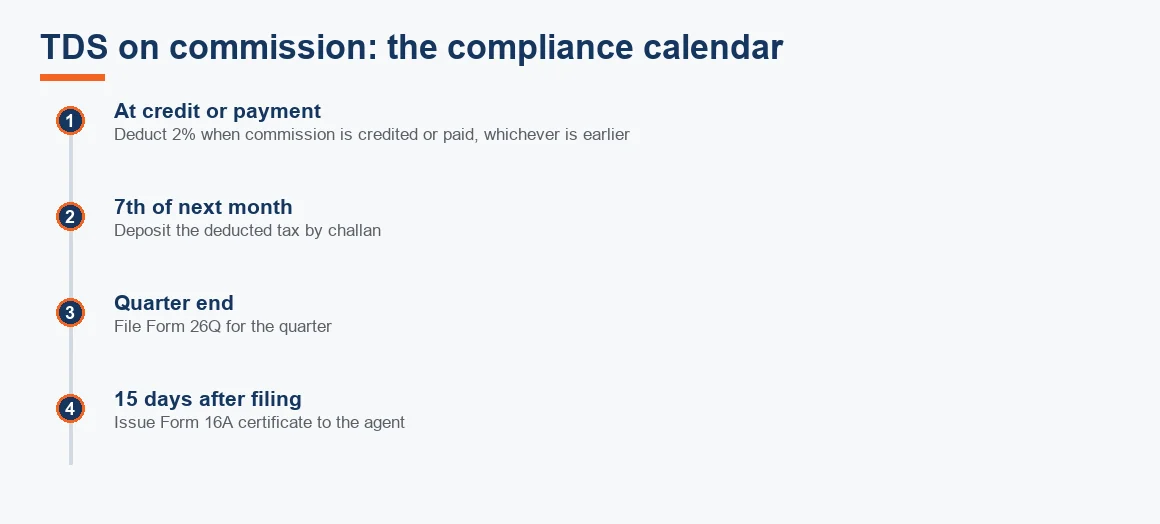
Yes. Commission or brokerage paid to a travel agent falls under section 194H of the Income-tax Act, and the deductor must withhold tax before releasing payment. The rate is 2 percent, reduced from 5 percent with effect from 1 October 2024. Tax is deducted at the time the commission is credited in the payer's books or actually paid, whichever is earlier. Individuals and Hindu undivided families are outside section 194H unless they were liable to tax audit in the preceding financial year, so a small proprietor booking the occasional ticket does not normally have to deduct. The statutory text and rates are published by the Income Tax Department.
How much TDS is deducted, and on what value?
The 2 percent applies to the gross commission, excluding the GST component where the tax is charged separately on the invoice, following CBDT Circular 23 of 2017. So on commission of Rs 50,000 plus 18 percent GST of Rs 9,000, TDS is 2 percent of Rs 50,000, that is Rs 1,000, not 2 percent of Rs 59,000. Where the agent collects the full fare and keeps commission before remitting the balance, deduction applies only to the retained commission, never to the fare paid over to the airline.
What is the TDS limit for agent commission?
No deduction is required under section 194H where the total commission or brokerage paid to one person during a financial year does not exceed Rs 20,000. This threshold was raised from Rs 15,000 with effect from 1 April 2025. The test is cumulative across the year and against a single PAN, so a series of Rs 6,000 payments to the same agent will cross the line on the fourth payment and TDS is then due on the whole amount credited, not merely on the excess.
Section 194H or 194C: which section applies?
Confusion between the two sections is the single biggest source of short-deduction notices in this sector. Section 194H covers commission and brokerage. Section 194C covers a contract of work, such as an agent engaged to arrange transport or run a ground-handling job for a fixed charge. Payment for the ticket or the hotel room itself, made to the airline or hotel, falls outside both. The table below summarises the split.
| Nature of payment | Section | Rate (from 1 Oct 2024) | Annual threshold |
|---|---|---|---|
| Commission or brokerage on bookings | 194H | 2% | Rs 20,000 |
| Contract of work (e.g. arranging transport) | 194C | 1% individual/HUF, 2% others | Rs 30,000 single / Rs 1,00,000 annual |
| Fare or room charge paid to airline/hotel | None | Nil | Not applicable |
The GST treatment sits alongside this and is explained in our note on GTA under GST for the transport side, while overseas package collections carry their own TCS obligation covered in TCS on overseas tour packages.
Commission journal entry for a travel agent
In the agent's own books, commission income is recognised gross and the TDS suffered is parked as an advance tax asset that will be set off against the year's liability. If a supplier credits Rs 3,000 commission and deducts Rs 60 (2 percent), the agent records income of Rs 3,000, a receivable or bank of Rs 2,940 and TDS receivable of Rs 60. Recording only the net Rs 2,940 as income is wrong: it understates turnover and orphans the Rs 60 sitting in Form 26AS, which then cannot be claimed. A clean journal entry keeps the gross and the tax credit visible.
Worked example: recording commission and TDS in the payer's books
Assume a tour operator pays a travel agent commission of Rs 50,000 (indicative, Exl GST) for a corporate booking, with 18 percent GST charged separately. TDS under section 194H is 2 percent of Rs 50,000, that is Rs 1,000. GST of Rs 9,000 is fully creditable subject to the usual conditions. The entry in the payer's books is set out below.
| Particulars | Debit (Rs) | Credit (Rs) |
|---|---|---|
| Commission expense | 50,000 | |
| Input CGST | 4,500 | |
| Input SGST | 4,500 | |
| TDS payable (section 194H) | 1,000 | |
| Travel agent (payable) | 58,000 | |
| Total | 59,000 | 59,000 |
The agent is paid Rs 58,000 in cash, the Rs 1,000 is deposited with the government by the 7th of the following month, and the Rs 9,000 GST flows into the payer's input credit after it matches in GSTR-2B.
Do travel agents pay GST, and is it compulsory?
GST registration becomes compulsory once an agency's aggregate turnover crosses the registration threshold, and for the commission itself the relevant turnover is the commission income, not the gross fare collected on behalf of principals. Air travel agents may charge 18 percent on their service fee, or opt for the special valuation rules that tax a deemed percentage of the basic fare. Online aggregators face a further layer of platform-level deductions explained in the glossary entry on OTA deductions. The current rate schedules and valuation options are maintained by the CBIC and the GST portal. The key accounting discipline is to keep the GST on your own commission separate from any GST that belongs to the airline or hotel.
Separating pure-agent recoveries from commission income
Under the GST pure-agent concept, amounts an agent recovers from a customer purely as reimbursement of a supplier's charge (the ticket price, the visa fee paid to the consulate) are excluded from the value of the agent's own supply, provided the agent is authorised to pay on the customer's behalf, the payment is shown separately, and the services procured are in addition to the agent's own service. This is the accounting mirror of the TDS point: money that is not your income does not attract TDS in your hands and does not swell your turnover. Post these recoveries to a control account, not to sales, and reconcile the control account to supplier statements at month end alongside your accounts receivable.
Step by step: deducting and depositing TDS on commission
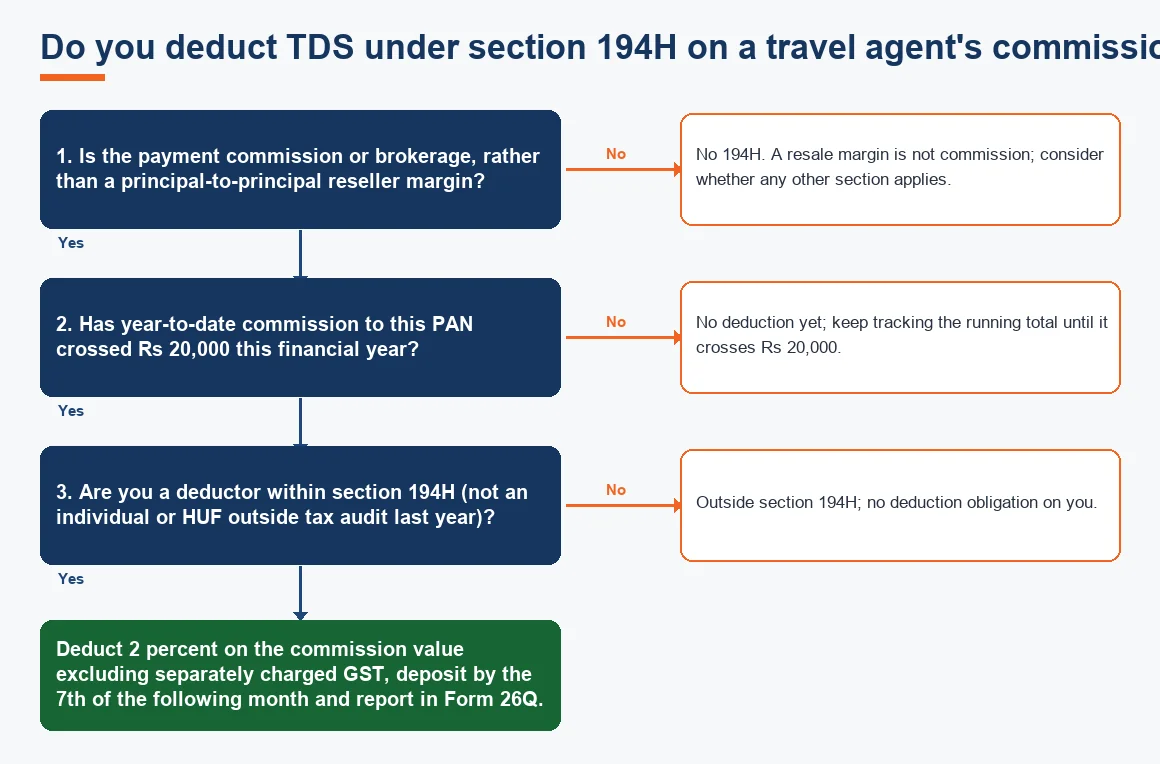
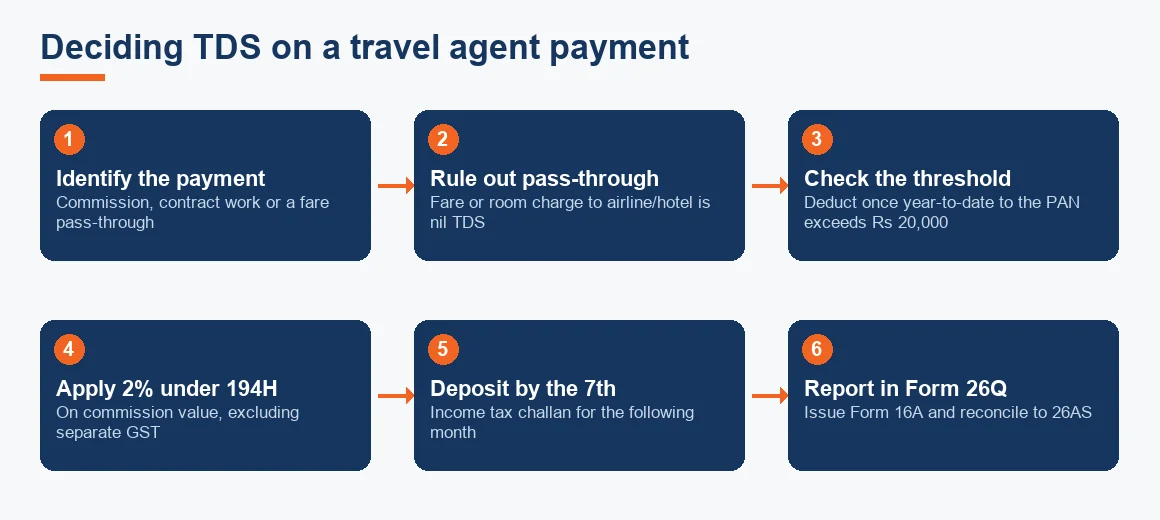
- Confirm the payment is commission or brokerage, not a fare pass-through or a principal-to-principal margin.
- Check the year-to-date total to that PAN; deduct only once it exceeds Rs 20,000.
- Apply 2 percent to the commission value, excluding separately charged GST.
- Deposit the tax by the 7th of the following month through an income tax challan.
- Report the deduction in the quarterly Form 26Q and issue Form 16A to the agent.
- Reconcile the deducted amount to the agent's Form 26AS so the credit is not lost.
Agencies that also run transport fleets can extend the same discipline to trip-level margins, as set out in our piece on trip-wise profitability for transport operators. Software and platform-led travel businesses often overlap with the concerns covered under SaaS accounting, IT and software company accounting and, for younger ventures, startup accounting. A quick provisioning check for deferred items can be run through our deferred tax calculator.
Key terms
- Journal Entry: the paired debit and credit record of a single transaction.
- General Ledger: the master record where commission, payables and advances sit in separate heads.
- Section 194Q TDS on Goods: a separate withholding on purchases of goods, distinct from 194H on commission.
- OTA Deductions: platform-level charges and taxes withheld by online travel aggregators.
Key takeaways
- Travel agent commission attracts TDS at 2 percent under section 194H from 1 October 2024.
- No TDS until year-to-date commission to one PAN exceeds Rs 20,000, effective 1 April 2025.
- Deduct on the commission only, excluding separately charged GST, and never on the fare or room charge.
- Record commission gross in the agent's books and carry the TDS as a receivable to protect the Form 26AS credit.
- Keep pure-agent recoveries out of turnover in a control account reconciled each month.
Handled consistently, travel agent commission accounting is not complicated: recognise the real income, park the pass-through, deduct the right tax on the right base, and reconcile to Form 26AS and GSTR-2B. The wording of the agency contract, not the label on the invoice, decides whether section 194H bites, so keep those agreements current and let the ledger follow the substance.
Decision guide