In this guide
TCS on a foreign tour package is a tax the seller of the package collects from the buyer at the time of booking, under Section 206C(1G) of the Income Tax Act. Since 1 April 2025 the rate is 5% on the first Rs 10,00,000 a buyer pays for overseas tour programme packages in a financial year, and 20% only on the amount above that threshold. It is not an extra cost: the buyer claims it back as a tax credit when filing a return. This guide explains the 20% rule, who has to collect, how to deposit and report it, and how a traveller recovers it. For the commercial side of running a travel desk, our Travel & Logistics Accounting Services team handles collection, filing and reconciliation end to end.
What is TCS in an overseas tour package?
Tax Collected at Source (TCS) is a mechanism where the seller adds a small percentage to the sale price, collects it from the buyer and pays it to the government against the buyer's PAN. On an overseas tour programme package, Section 206C(1G) makes the person who sells the package responsible for this collection. An overseas tour programme package means a package that includes travel to a country outside India, plus at least one of boarding, lodging or any similar expense, sold as a bundle. A pure air ticket bought on its own is not a package, which is an important distinction we return to below.
The point of TCS here is visibility, not punishment. The government wants a record of large foreign spends flowing through the annual information statement, so the amount collected is fully creditable against the traveller's own tax. Nothing is lost as long as the buyer files a return and quotes a valid PAN.
What is the TCS rate for international travel? The 20% rule explained
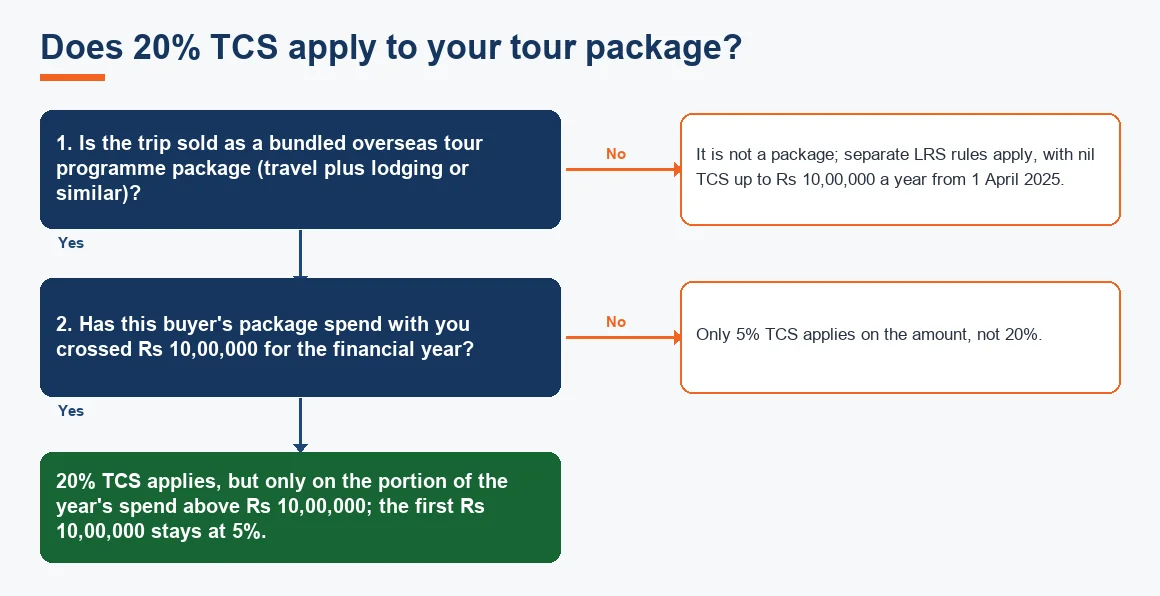
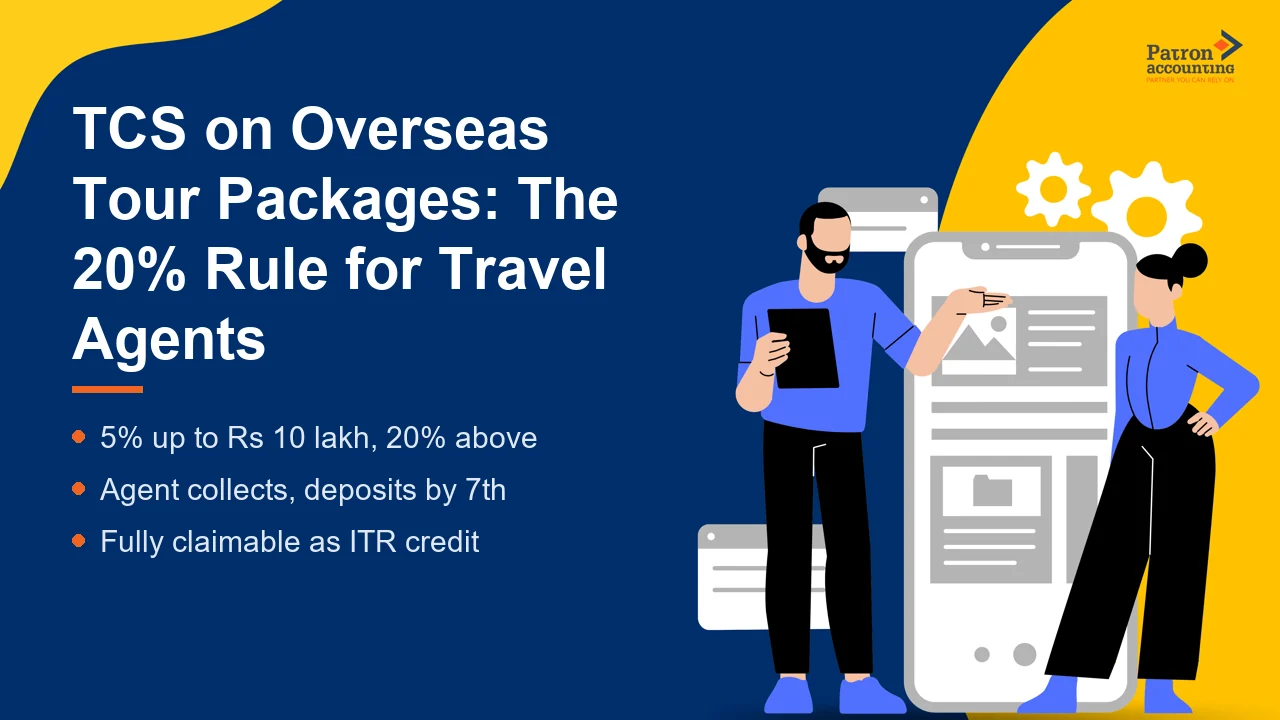
The headline figure that worries travellers is 20%, but it rarely applies to the whole package. The rate works in two slabs per buyer per financial year:
- 5% on the aggregate package amount up to Rs 10,00,000.
- 20% on the portion of the aggregate that exceeds Rs 10,00,000.
The Rs 10,00,000 threshold was raised from Rs 7,00,000 with effect from 1 April 2025, so smaller and mid-sized packages now sit entirely inside the 5% band. A Rs 4,00,000 Europe package attracts Rs 20,000, not Rs 80,000. The 20% figure only bites once a single buyer's tour spend for the year crosses ten lakh. If the buyer does not furnish a PAN, higher-rate provisions can apply, so agents should always capture PAN at booking.
Who has to collect the TCS, and when?
The seller of the overseas tour programme package is the collector. In practice that is the travel agent or tour operator who invoices the customer for the bundled package. The collector needs a valid TAN (Tax Deduction and Collection Account Number), collects the TCS at the earlier of debiting the buyer's account or receiving payment, and stands accountable for depositing it on time. This duty sits alongside the agent's other withholding obligations, such as TDS on the commission paid to sub-agents, which we cover separately in Travel Agent Commission Accounting and TDS Under Section 194H.
Do not confuse this income-tax TCS with Section 52 TCS under GST, which is collected by e-commerce operators on supplies made through their platform. They share a name but are entirely different levies with different returns.
How to deposit, report and certify the TCS: step by step
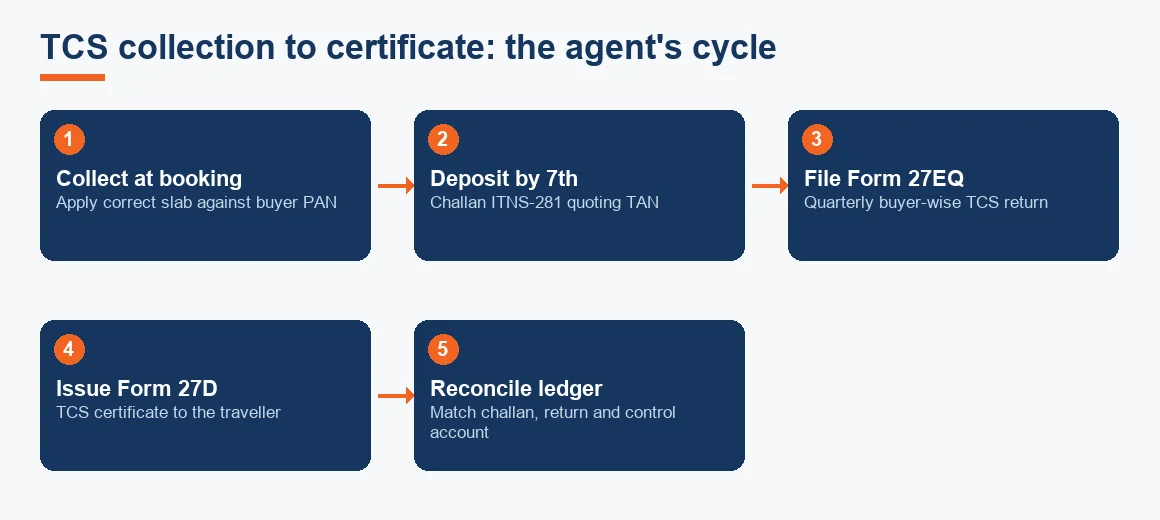
Once collected, the TCS follows a fixed compliance cycle. Miss a step and interest or penalties follow, so treat it as a monthly routine.
- Collect at booking. Apply the correct slab against the buyer's PAN and show the TCS as a separate line on the invoice.
- Deposit by the 7th. Pay the collected amount using challan ITNS-281, quoting your TAN, by the 7th of the month following collection.
- File Form 27EQ quarterly. Report all collections buyer-wise in the quarterly TCS return.
- Issue Form 27D. Hand the buyer their TCS certificate so they can trace the credit.
- Reconcile. Match challans, the return and your general ledger control account each quarter.
Late deposit attracts interest at 1% a month under Section 206C(7), and failure to file Form 27EQ on time carries a late fee. The rules and challan formats are published by the Income Tax Department, and the statutory text of Section 206C sits on the same portal.
Worked example: TCS on a Rs 14,00,000 honeymoon package
Assume a couple books a single Rs 14,00,000 European package through one agent in the same financial year, and this is their only overseas tour spend. The TCS splits across the two slabs as follows (figures indicative).
| Component | Amount (Rs) | Rate | TCS (Rs) |
|---|---|---|---|
| Package value in 5% band | 10,00,000 | 5% | 50,000 |
| Package value above threshold | 4,00,000 | 20% | 80,000 |
| Total package | 14,00,000 | , | 1,30,000 |
The buyer pays Rs 15,30,000 in all: Rs 14,00,000 for the trip and Rs 1,30,000 of TCS. That Rs 1,30,000 is not gone. It lands in the buyer's Form 26AS and is set against their income tax for the year, refundable in full if their final liability is lower. The effective TCS on the whole package is about 9.3%, well below the scary 20% headline.
How to claim a TCS refund on foreign travel
TCS behaves like advance tax paid in the traveller's name. Recovery is straightforward:
- The collected amount appears in Form 26AS and the annual information statement (AIS) against the buyer's PAN.
- It is claimed as a tax credit while filing the income tax return, reducing the tax payable rupee for rupee.
- Where the credit exceeds the total tax liability, the excess is refunded with the usual return processing.
There is no separate foreign-travel field to fill; the credit flows from the pre-filled tax paid schedule. Salaried travellers have a faster route since 1 October 2024: reporting the TCS to the employer in Form 12BAA lets the credit be adjusted against monthly salary TDS under Section 192, so take-home pay recovers the cash within the year rather than at return filing.
Package versus separate bookings: TCS and the LRS route
Because the levy attaches to a bundled overseas tour programme package, how a trip is bought changes the TCS position. Booking flights and hotels separately moves the spend under the Liberalised Remittance Scheme (LRS) rather than the package rule. The Reserve Bank of India governs LRS limits, while the collection rates are set in the Income Tax Act.
| Basis | Overseas tour package | Separate bookings under LRS |
|---|---|---|
| Governing rule | Section 206C(1G) package | Section 206C(1G) LRS |
| TCS up to Rs 10,00,000/year | 5% | Nil (from 1 April 2025) |
| TCS above Rs 10,00,000/year | 20% on excess | 20% on excess |
| Who collects | Tour operator / agent | Authorised dealer bank |
| Credit in ITR | Yes | Yes |
Education and medical remittances are treated more gently: amounts above Rs 10,00,000 are charged at 5%, not 20%. The practical takeaway is that a self-arranged holiday under Rs 10,00,000 can carry no TCS at all, whereas the same trip sold as a package carries 5%. Neither is a loss to the traveller, but it does change the cash outlay at booking.
Foreign travel and your income tax return
Spending on a foreign trip can trigger a filing obligation on its own. The seventh proviso to Section 139(1) makes filing a return compulsory for anyone who spends more than Rs 2,00,000 on foreign travel for themselves or any other person during the year, even where total income is below the basic exemption limit. There is no dedicated foreign-trip box in ITR-1 or ITR-2; the requirement is simply that a return must be filed, and the related TCS entries already surface in the AIS. If you fund a relative's overseas trip above that figure, the obligation attaches to you as the person who bore the expense.
How travel agents should record TCS in the books
For the agency, clean bookkeeping is what keeps the deposit funded and the reconciliation painless. Record the TCS through double-entry bookkeeping as a liability at the moment of collection, never as revenue. A simple journal entry debits the customer or bank for the gross receipt and credits a "TCS Payable (206C(1G))" liability ledger for the collected tax, which is then cleared when the challan is paid. Agents that sell through aggregators should also watch their OTA deductions so platform commissions and TCS are not tangled in the same settlement line. Where a trip is billed in foreign currency, the receivable should be tracked as foreign currency receivables and revalued at period end. Robust books here matter as much for a logistics operator watching trip-wise profitability as for a tour desk, and the same discipline underpins GST decisions on transport. Growing travel-tech and booking platforms often lean on our SaaS accounting, IT and software company accounting and startup accounting teams for exactly this. If depreciation on office and fleet assets needs a check while you are closing the books, our depreciation calculator and the AS vs Ind AS matrix are quick references.
Key terms
- Section 52 TCS under GST: a separate GST levy collected by e-commerce operators, not the same as income-tax TCS on tour packages.
- Journal Entry: the paired debit and credit that records collected TCS as a liability rather than income.
- General Ledger: the master record where the TCS payable control account is reconciled each quarter.
- Foreign Currency Receivables: amounts owed in a foreign currency, revalued at period end for accurate books.
- OTA Deductions: commissions and charges an online platform withholds from a booking settlement.
Key takeaways
- TCS on an overseas tour package is 5% up to Rs 10,00,000 a year per buyer, and 20% only on the excess, since 1 April 2025.
- The seller collects, deposits by the 7th on challan ITNS-281, files Form 27EQ quarterly and issues Form 27D.
- The buyer loses nothing: TCS is a fully claimable, refundable credit visible in Form 26AS and the AIS.
- Separate LRS bookings can carry nil TCS up to Rs 10,00,000, but the spend still shows in the AIS.
- Foreign travel above Rs 2,00,000 makes filing an income tax return compulsory under Section 139(1).
Decision guide