In this guide
The choice between GTA reverse charge and forward charge comes down to two rates for the same road freight: 5% under reverse charge, where the customer pays the GST and the transporter claims no input credit, or 12% under forward charge, where the goods transport agency charges the tax on its own bill and claims full credit on trucks, tyres, spares and repairs. Neither rate is automatically better. Which one suits you depends on whether you are the transporter or the customer, and on how much input credit is at stake. This explainer sets out the rule, the deadline and the arithmetic so you can see the position clearly.
What is the GTA category in GST?
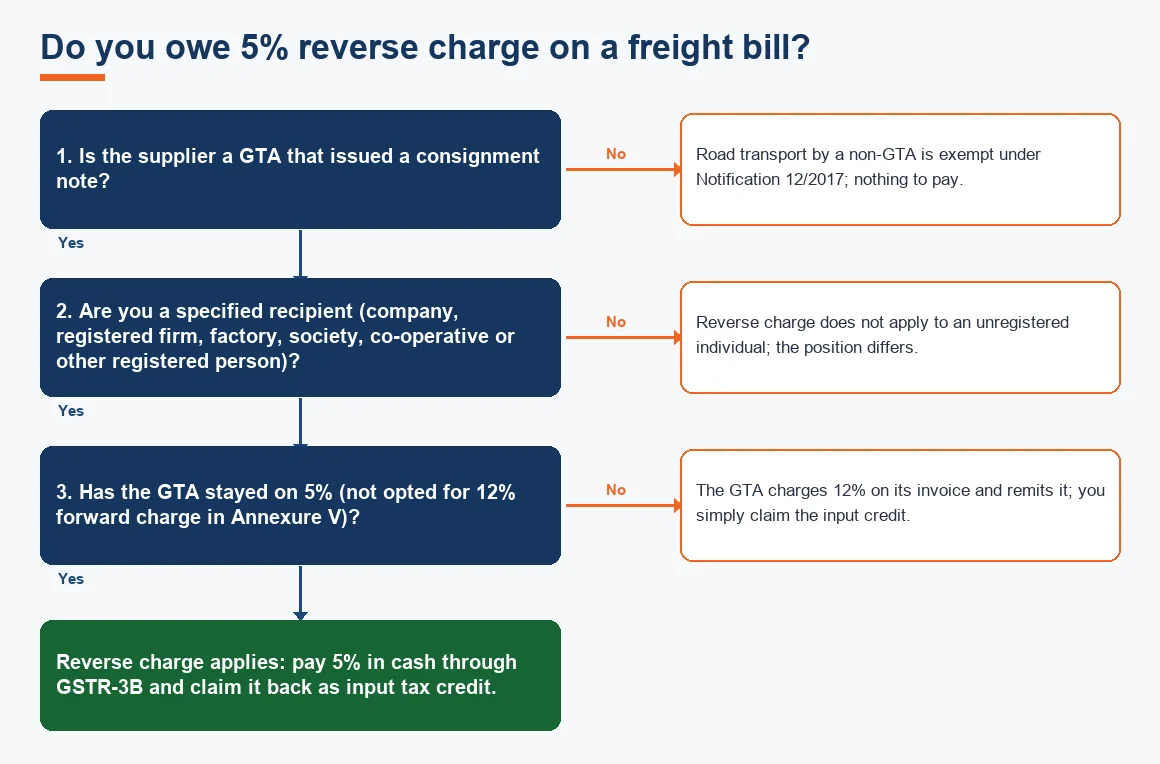
A goods transport agency is any person who transports goods by road and issues a consignment note. That consignment note is the deciding factor. A lorry owner who simply hauls goods without issuing one is not a GTA, and transport of goods by road by anyone who is neither a GTA nor a courier agency is exempt under Notification 12/2017. Once a consignment note is issued, the service becomes taxable and the GTA rules apply. If your logistics business is unsure where it sits, our Travel & Logistics Accounting team can map your billing before a GST notice does it for you.
So GST is applicable on GTA services; the only question is at what rate and who deposits it. That is where reverse charge and forward charge diverge.
Is GST on transportation charges under RCM 5% or 12%?
Both rates are live, and they attach to different mechanisms rather than to different services.
The 5% rate is the reverse charge route. Here the GTA charges nothing for GST on its bill, and the recipient of the service deposits GST at 5% directly to the government. The catch built into this rate is that the GTA cannot claim input tax credit on its own costs.
The 12% rate is the forward charge route. The GTA adds 12% to its invoice, collects it from the customer and remits it, exactly like an ordinary supplier. In exchange, the GTA is allowed full input tax credit on its trucks, tyres, spares and repairs, though not on diesel, which stays outside GST; clean fuel fleet card reconciliation still pays off by keeping that non-creditable spend visible.
This is why the same freight can carry either figure. A transporter that runs a heavy fleet with large truck and maintenance credits often prefers 12%, because the credit it recovers outweighs the extra tax on its invoice. A small operator with almost no input credit tends to stay on 5% under reverse charge, since it has little credit to lose.
Is RCM applicable on GTA services?
Yes, reverse charge applies wherever a GTA has not opted for forward charge and the recipient is one of the specified persons. Under Notification 13/2017, the recipient pays 5% under reverse charge when it is a company, a registered partnership or firm, a factory, a society, a co-operative or any other registered person. In those cases the GTA issues a bill with no GST, and the customer is responsible for the tax.
Reverse charge does not apply where the recipient is an unregistered individual. So a household paying a transporter to shift furniture is outside this net; a registered manufacturer paying inward freight is squarely inside it. The distinction between reverse charge as a method of paying tax and input tax credit as the right to recover it is worth keeping straight, and we return to it in the worked example below. Sibling reads such as Trip-Wise Profitability Accounting for Transport Operators cover the operating economics; here we stay on the tax election.
How does the 5% reverse charge actually work?
The mechanics are simple once you separate payment from credit. On inward freight taxed under reverse charge, the recipient self-assesses 5% GST, pays it in cash through the electronic cash ledger in GSTR-3B, and then claims the same amount as input tax credit in the same return, provided the freight relates to business supplies (expenses) that are not blocked. Payment and credit therefore fall in the same return period, and both legs post to the freight and GST heads in your general ledger.
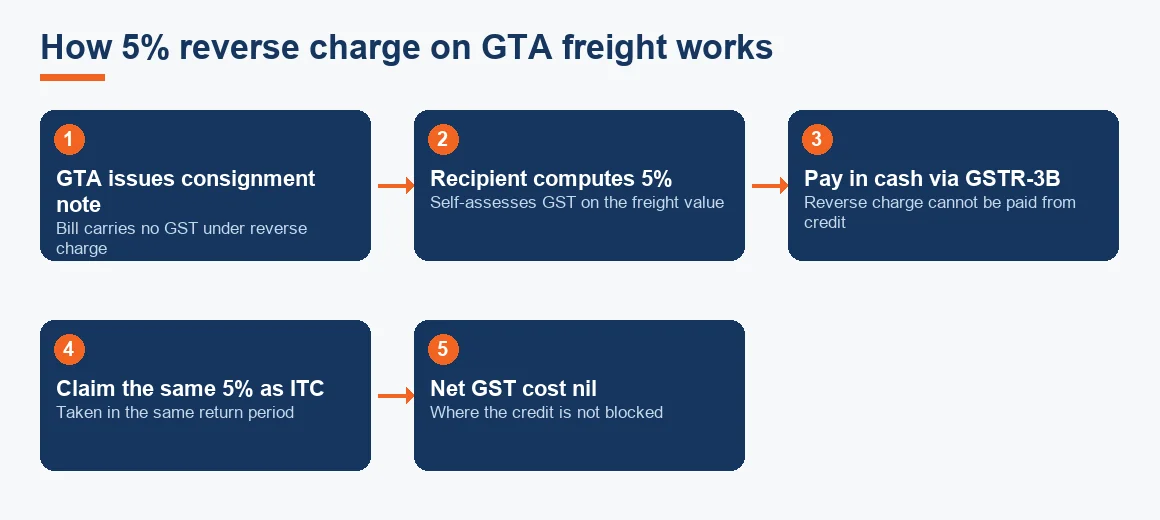
The important sequencing point is that reverse charge tax cannot be paid using existing credit. It must be discharged in cash first; only then does the corresponding credit become available. This is a cash-flow timing effect rather than a permanent cost, because for most businesses the credit is recovered in the very next line of the same return. Reconciling that credit against the auto-populated figures matters, which is where GSTR-2B input tax credit matching earns its keep.
What is the forward charge for GTA in GST, and how do you opt in?
Forward charge is the 12% route, and it is a deliberate election, not a default. A GTA that wants to charge 12% with full input tax credit files a declaration in Annexure V on the GST portal by 15 March before the start of the financial year. Once filed, the option runs for that entire financial year and cannot be switched mid-year. It continues automatically into later years until the GTA withdraws it by filing Annexure VI, again by 15 March.
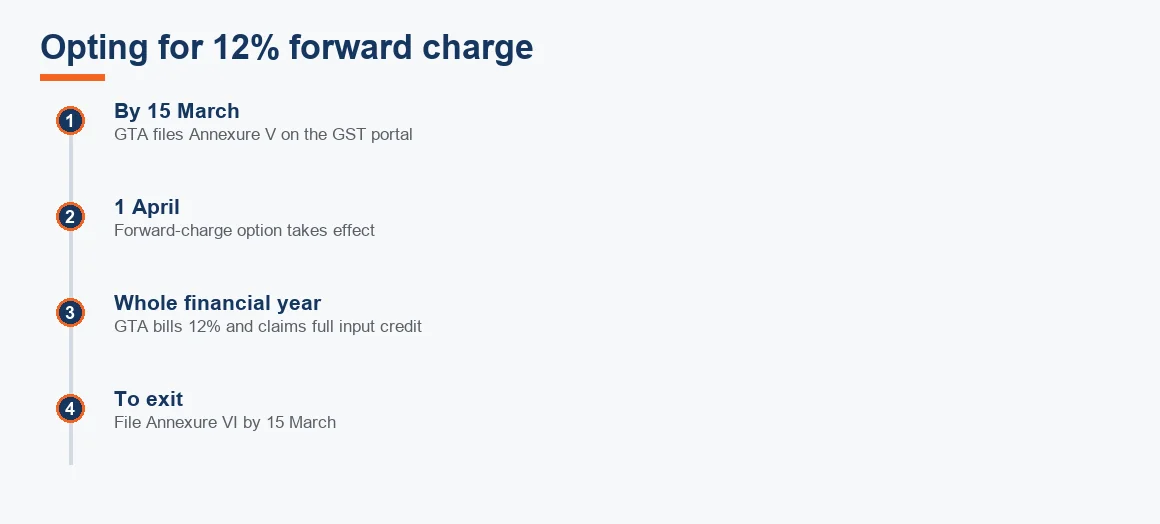
A GTA on forward charge should also state on its invoices that it has opted to pay tax under forward charge, so that recipients know not to pay reverse charge on the same freight. For the customer, a 12% forward-charge bill behaves like any normal taxable purchase: pay the vendor, claim the input credit, done. For the transporter, the pay-off is the ability to recover GST on capital-heavy costs, which for a growing fleet can be substantial. If your books do not yet track that fleet credit cleanly, a depreciation calculator alongside your GST ledger helps you see the true cost of each truck after credit.
Who chooses what, in practice
The election really belongs to the GTA, because it controls the Annexure V filing. Customers cannot force a transporter onto 12%; they can only ask. This is why a logistics business planning its year should decide the position early, well before the March deadline, rather than discovering the consequence when the first freight bill of April arrives.
5% RCM vs 12% forward charge: a side-by-side comparison
The table below summarises the two routes for a registered recipient. Note how, for a recipient with fully eligible credit, the net GST cost is the same under both; the difference bites on the transporter's side and on cash flow.
| Feature | 5% under reverse charge | 12% under forward charge |
|---|---|---|
| Who deposits GST | The recipient | The GTA (supplier) |
| GST shown on the GTA bill | Nil | 12% added to the invoice |
| How the recipient pays | 5% in cash via GSTR-3B | 12% to the GTA within the bill |
| Recipient's input credit | Available on the 5% paid | Available on the 12% paid |
| GTA's own input credit | Not available | Fully available |
| Election needed | None (default) | Annexure V by 15 March |
| Suits | Small operators, low input credit | Fleets with heavy truck and maintenance credit |
Worked example: the same freight bill under both routes
Take a registered manufacturer receiving a freight bill of Rs 1,00,000 (indicative, Exl GST) from a GTA. The figures below trace what happens under each route, assuming the manufacturer's credit is not blocked.
| Particulars | 5% under reverse charge | 12% under forward charge |
|---|---|---|
| Freight value | Rs 1,00,000 | Rs 1,00,000 |
| GST on the bill | Nil (paid by recipient) | Rs 12,000 |
| Cash outflow for GST | Rs 5,000 in cash via GSTR-3B | Rs 12,000 paid to the GTA |
| Input tax credit to recipient | Rs 5,000 | Rs 12,000 |
| Net GST cost to recipient | Rs 0 | Rs 0 |
| GTA's input credit position | Nil | Full credit on inputs |
On a Rs 1,00,000 freight bill under reverse charge the recipient pays Rs 5,000 in cash and, if eligible, claims the same Rs 5,000 back, leaving no net cost. Under forward charge the recipient routes Rs 12,000 through the GTA and recovers all of it. The recipient is broadly neutral. The genuine winner or loser is the transporter, whose input credit is switched off at 5% and switched on at 12%. That is the real fork in this decision.
Key terms
- Goods Transport Agency (GTA) RCM: the reverse-charge mechanism under which the recipient, not the transporter, deposits GST on road freight.
- GSTR-2B Input Tax Credit Matching: reconciling claimed credit against the auto-drafted GSTR-2B before taking it in GSTR-3B.
- Journal Entry: the double-entry record posting the reverse-charge liability and the matching credit in the same period.
- Accounts Payable: the ledger where inward freight bills sit until the GST treatment is settled.
What are the disadvantages of reverse charge for the recipient?
The main drawback is cash flow, not permanent tax. Because reverse charge must be paid in cash and only then claimed as credit, a business with a large freight spend parks money with the government for the gap between paying and using the credit. There is also a compliance burden: you must self-identify every reverse-charge bill, self-invoice where the supplier is unregistered, and record the liability correctly, since the transporter's silence does not remove your obligation. Get any of this wrong and the credit can be delayed or denied even though the tax was genuinely due. Related filings such as those covered in Travel Agent Commission Accounting and TDS Under Section 194H and TCS on Overseas Tour Packages: The 20% Rule for Travel Agents show how easily these self-assessed items slip through weak books.
For a transporter, the disadvantage of staying on 5% is the loss of input credit, and the disadvantage of moving to 12% is a headline rate that some price-sensitive customers dislike, even though those customers usually recover it. This is a business call as much as a tax one, and it is worth taking alongside your wider Startup Accounting Services India or, for asset-light tech logistics platforms, your SaaS Accounting Services (IT & SaaS) and IT & Software Company Accounting Services planning.
Key takeaways
- A GTA is defined by the consignment note; road transport without one is exempt.
- 5% means the recipient pays under reverse charge and the GTA loses input credit; 12% means the GTA bills, remits and keeps full credit.
- Reverse charge tax is paid in cash first, then claimed as credit in the same GSTR-3B, so it is a timing cost, not usually a real one.
- The 12% forward-charge election is made in Annexure V by 15 March and locks in for the whole financial year.
- Most recipients are cost-neutral between the two; the transporter's input credit position decides which route makes sense.
The rates, notifications and Annexure V mechanism sit within GST law that changes from year to year, so confirm the current position on the CBIC GST portal and file declarations through the official GST portal before you act. For a full read of how freight, credit and trip economics tie together across a logistics book, our Travel & Logistics Accounting service is the right next step.
Decision guide