In this guide
Transfer pricing for IT companies is the set of rules that decides what price an Indian software or IT enabled services unit must charge its overseas parent or group company, so that the profit taxed in India reflects an arm's length outcome rather than an internal book price. Because most Indian captives sell almost entirely to related parties abroad, this is not a niche concern: it governs how much of the group's global margin stays, and is taxed, in India. This guide explains who is caught, the five methods, how a captive is benchmarked, and the documentation that supports the number. For the commercial side of running a development centre, see our IT & Software Company Accounting Services.
On which companies is transfer pricing applicable?
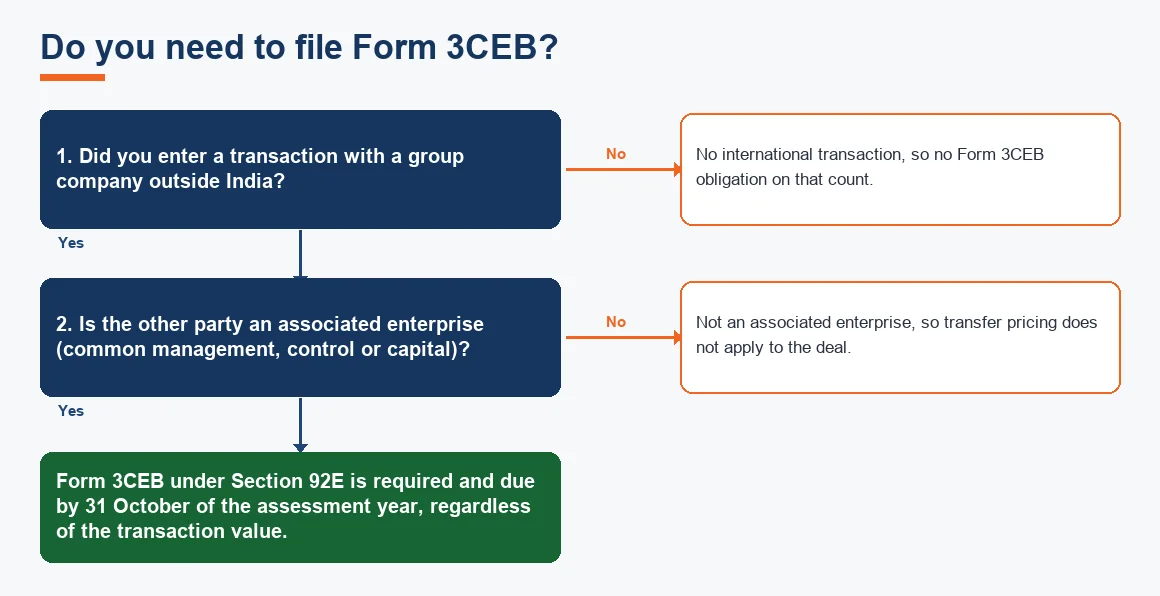
Transfer pricing under Sections 92 to 92F of the Income-tax Act applies to any international transaction between associated enterprises. There is no minimum value: a single intercompany invoice, a management fee, an interest charge on a group loan or a cost recharge all attract arm's length testing. Two enterprises are associated when one participates in the management, control or capital of the other, or when a common third party does, so a wholly owned Indian subsidiary of a foreign parent is always caught.
Specified domestic transactions enter the net only when their aggregate value crosses Rs 20 crore in the year. For captive service centres, though, the international limb bites from the first billing. If you also export software, the pricing question sits alongside your STPI or SEZ status and your zero-rated GST treatment, but transfer pricing is a separate, income-tax discipline that runs on its own rules.
Why IT captives sit squarely in the net
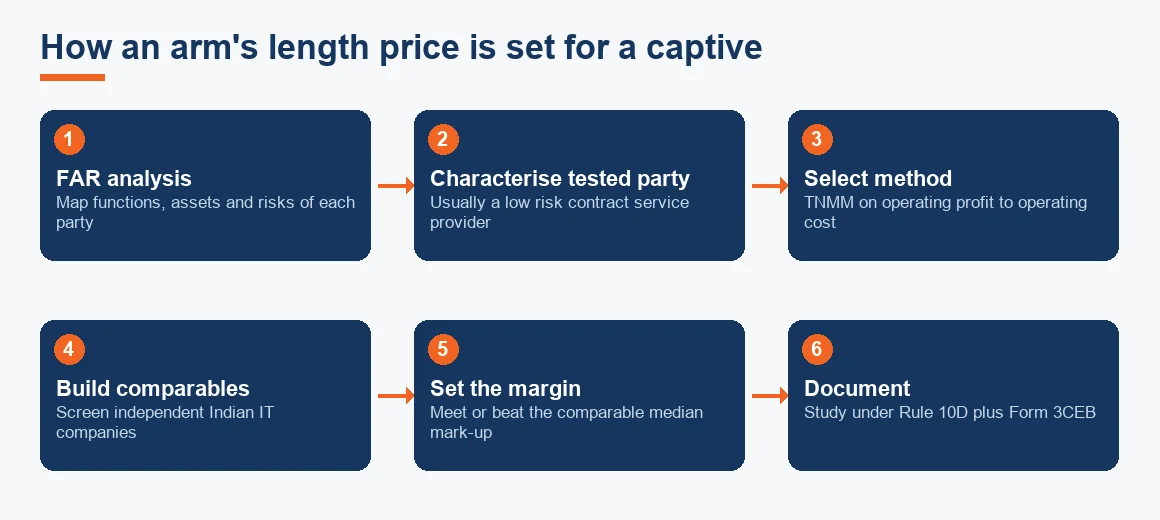
A captive is an Indian entity that performs software development or back-office work almost exclusively for its own group. Because it has one customer, its parent, the profit it books is entirely a function of the intercompany price, which is exactly what the tax department wants to test. The starting point is a FAR analysis: the functions performed, assets employed and risks assumed by each side. It is documented so the assessing officer can see who does what.
Most captives are characterised as low risk contract service providers. The Indian unit writes code or runs a process, while the parent bears market risk, credit risk, product risk and owns the intellectual property. On that reading the captive earns a stable, guaranteed margin regardless of whether the group product succeeds, and it is benchmarked on the cost of doing the work plus a mark-up. Getting the characterisation right is the single most important judgement in the study, because it dictates the method and the comparables.
What are the 5 methods of transfer pricing?
Rule 10B prescribes five methods, and the arm's length principle requires you to apply the most appropriate one to the facts. There is no fixed hierarchy; you choose the method that best fits the transaction and the data available.
| Method | Short form | How it works | Typical use |
|---|---|---|---|
| Comparable Uncontrolled Price | CUP | Compares the actual price of the intercompany deal with the price in a comparable third-party deal | Commodities, royalties, interest |
| Resale Price Method | RPM | Starts from the resale price to an unrelated buyer and works back a normal gross margin | Distributors, resellers |
| Cost Plus Method | CPM | Adds a normal gross mark-up to the direct and indirect cost of production | Manufacturers, some service providers |
| Profit Split Method | PSM | Splits the combined profit of both parties by their relative contribution | Integrated operations, unique intangibles |
| Transactional Net Margin Method | TNMM | Compares a net profit margin (such as operating profit to operating cost) against comparable companies | IT and ITeS captives, most services |
Note that CPM and the Cost Plus Method share initials in casual use but are distinct: CPM here means the Cost Plus Method, which tests a gross mark-up, while TNMM tests a net margin. The three broad approaches people refer to are traditional transaction methods (CUP, RPM, CPM), transactional profit methods (PSM, TNMM), and, informally, the arm's length range that ties them together.
Which method fits an IT captive
For a low risk software or ITeS captive, TNMM is the most common method and the most common value used is the operating margin, expressed as operating profit over operating cost (OP/OC), also called a cost plus mark-up. It is preferred because reliable gross margin data for pure comparables is scarce in India, whereas net operating margins of independent IT service companies can be drawn from public filings. The captive becomes the tested party, a set of comparable Indian IT companies is assembled, and their median margin sets the benchmark the captive must meet or beat.
The comparable search, the financial screening and the margin computation together form the study. Intercompany balances that flow from this pricing then have to tie out cleanly, which is where a disciplined inter-company ledger reconciliation earns its keep at year-end.
Transfer pricing example: a captive cost plus computation
Consider a captive software development centre that bills its US parent on a cost plus basis. Assume the comparable set produces a median arm's length mark-up of 15 percent on operating cost. The working below shows how an adjustment arises if the captive under-bills. Figures are illustrative.
| Particulars | Amount (Rs) |
|---|---|
| Total operating cost for the year | 40,00,00,000 |
| Arm's length mark-up at 15 percent of operating cost | 6,00,00,000 |
| Arm's length revenue (cost plus 15 percent) | 46,00,00,000 |
| Revenue actually billed to parent (cost plus 10 percent) | 44,00,00,000 |
| Transfer pricing adjustment added to taxable income | 2,00,00,000 |
Because the captive billed only a 10 percent mark-up, its declared revenue of Rs 44 crore falls short of the arm's length figure of Rs 46 crore. The Transfer Pricing Officer can add the Rs 2 crore shortfall to taxable income, and that upward adjustment is taxed without any matching deduction abroad, so the group effectively pays tax twice on the same slice of profit. This is exactly the outcome the study is meant to prevent by pricing correctly in the first place.
Safe harbour rules: a prescribed shortcut for IT and ITeS
Safe harbour rules let a taxpayer declare a prescribed minimum margin that the department accepts without scrutiny, removing the need to defend a comparable search. Under Rule 10TD, software development services and IT enabled services qualify for a safe harbour where the operating margin is at least 17 percent on operating cost for transaction value up to Rs 100 crore, and 18 percent for value between Rs 100 crore and Rs 200 crore. Knowledge process outsourcing is tested on employee cost ratios, with margins from 18 to 24 percent depending on the ratio. You opt in by filing Form 3CEFA before the return due date.
In the worked example above, opting for safe harbour would have required a 17 percent mark-up (revenue of Rs 46.8 crore), higher than the 15 percent benchmark, so safe harbour trades a slightly higher tax cost for certainty and no litigation. Whether that trade suits you depends on scale and appetite for scrutiny. The current safe harbour margins are notified by the Central Board of Direct Taxes and extended periodically, so confirm the rate for the relevant year on the Income Tax Department portal before relying on it.
Documentation, Form 3CEB and the compliance calendar
Two obligations run in parallel. First, the transfer pricing study under Section 92D and Rule 10D: it covers the group structure, the FAR analysis, method selection, the comparable search with financial data and the margin computation. It must be kept where international transactions exceed Rs 1 crore, and preserved for eight years from the end of the assessment year. Second, the accountant's report in Form 3CEB under Section 92E, signed by a chartered accountant and filed by 31 October of the assessment year. This is separate from, and additional to, the tax audit.
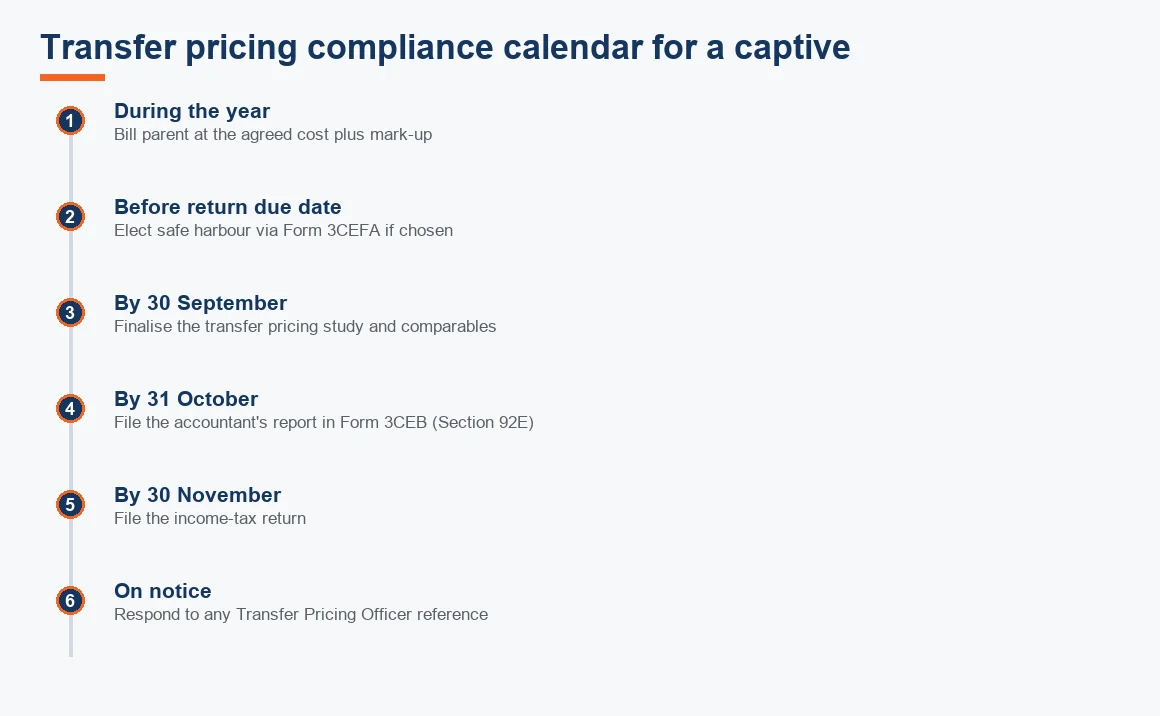
A case may then be referred to a Transfer Pricing Officer for a detailed review. Failure to furnish Form 3CEB attracts a penalty of Rs 1 lakh under Section 271BA, and further penalties apply for under-reporting or for not maintaining documentation. The statutory framework and the report forms are published by the Income Tax Department, and the professional standards for the accountant signing Form 3CEB are set by the ICAI.
How this sits with the rest of your finance stack
Transfer pricing does not stand alone. The mark-up you agree drives your revenue, which flows into your foreign currency receivables and your export documentation. If you run a SaaS or product model rather than a pure captive, the characterisation is different and the pricing question shifts, which is why our SaaS Accounting Services and Startup Accounting Services handle those cases distinctly, and cross-border groups selling online should read alongside our E-Commerce Accounting Services. Payments the other way, to a foreign group company, raise withholding questions covered in our note on Section 195 TDS on foreign software payments, and exporters chasing refunds should see our LUT filing guide. To model how a transfer pricing adjustment feeds a deferred tax position, our Deferred Tax Calculator gives a quick working, while the Ind AS Applicability Checker tells you which reporting framework your captive falls under.
Key terms
- Transfer Pricing for IT Services: arm's length pricing of intercompany software and ITeS work between group entities.
- Foreign Currency Receivables: amounts due from overseas group customers, restated at year-end exchange rates.
- Software Export Revenue (Section 10AA SEZ): export income of an SEZ unit eligible for a tax deduction.
- STPI / SOFTEX Export Filing: the export declaration route for software services shipped abroad.
- Parent-Subsidiary Consolidation: combining a subsidiary's accounts into the group parent's financial statements.
Key takeaways
- Every international transaction with an associated enterprise is caught, with no monetary threshold.
- An Indian IT captive is usually a low risk contract service provider benchmarked on a cost plus mark-up using TNMM.
- The five methods are CUP, RPM, CPM, PSM and TNMM; the operating margin is the value most commonly used for captives.
- Under-billing lets the Transfer Pricing Officer add the shortfall to income, taxing the same profit twice.
- File Form 3CEB by 31 October, keep the study for eight years, and consider safe harbour via Form 3CEFA.
Decision guide