In this guide
GST on software export works on a simple principle: exports are not taxed. When an Indian company designs, develops or licenses software for a client abroad and is paid in foreign currency, that supply is treated as a zero-rated supply under Section 16 of the IGST Act. No GST is charged on the export invoice, and the exporter can still recover the tax paid on its own costs. The catch is in the conditions and the paperwork, which is where most software exporters trip up. This explainer walks through the rate, the qualifying tests and the refund routes, written for the person actually preparing the invoices and returns. For the commercial side of setting all this up, our IT & Software Company Accounting Services team handles the end-to-end filing.
Is software goods or services under GST?
Under GST, software delivered electronically is treated as a service, not goods. Custom development, design and programming fall under SAC 998314 (information technology design and development services). Licensing the right to use software or a SaaS subscription is also a service. Only software supplied on physical media, such as a boxed disc, is classified as goods under HSN 8523. For almost every modern software exporter, the electronic delivery route means you are supplying a service, and the export rules for services apply. This distinction matters because the place-of-supply tests for services differ from those for goods, and it decides whether your remittance evidence is a FIRC or a shipping bill.
What GST rate applies to software: domestic vs export
Domestically, IT and software services carry GST at 18 percent. Sell the same service to a client in India and you add 18 percent (either IGST, or CGST plus SGST) to the invoice. Export the identical service and the effective rate is nil, because a zero-rated supply is taxed at zero while still allowing input tax credit. This is the crucial difference between zero-rated and exempt: an exempt supply blocks credit, whereas a zero-rated export lets you reclaim the GST paid on rent, cloud hosting, laptops and professional fees. The 18 percent figure is confirmed in the rate schedules published by the CBIC.
What makes a software supply an export of services?
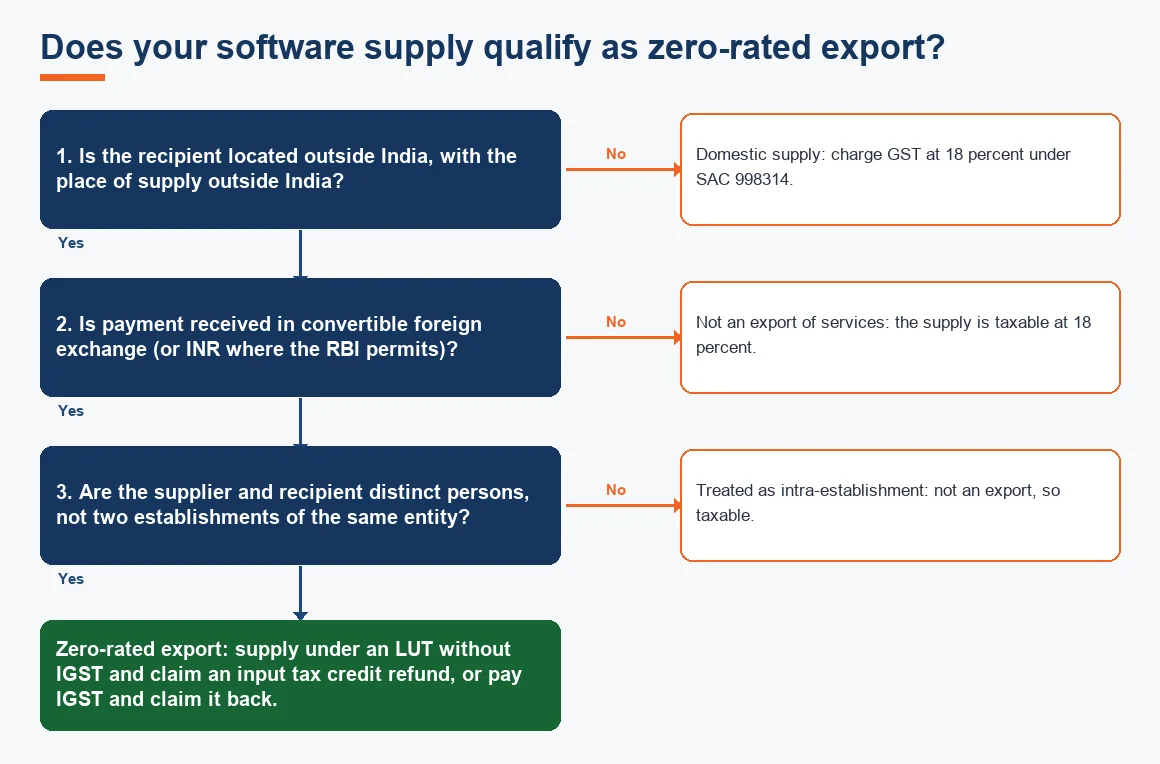
Section 2(6) of the IGST Act sets five tests, and all five must be met for the supply to qualify as export of services:
- the supplier is located in India;
- the recipient is located outside India;
- the place of supply is outside India;
- payment is received in convertible foreign exchange, or in Indian rupees where the RBI permits; and
- the supplier and the recipient are not merely two establishments of the same person.
That last condition catches Indian captive centres billing their own overseas parent. If the two are branches of one legal entity, the supply is not an export and is instead taxable, a point we cover in Transfer Pricing for IT Captives and MNC Subsidiaries in India. A genuinely distinct foreign client, paying from abroad in foreign currency, satisfies the test.
Why is GST not charged on export?
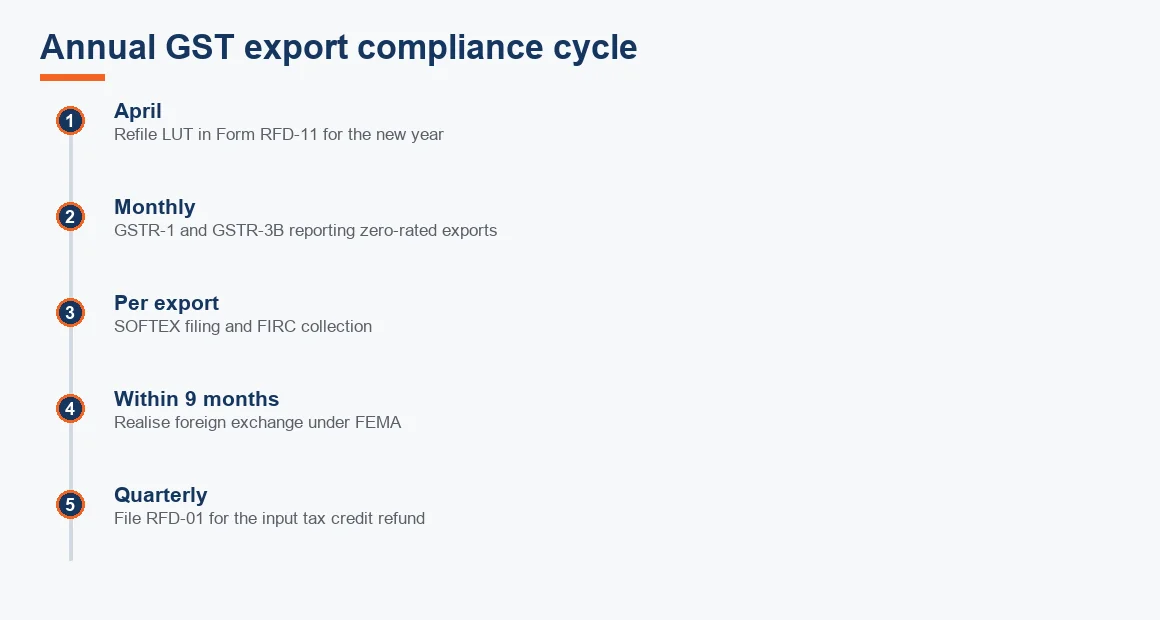
The policy logic is that GST is a destination-based consumption tax. Software consumed abroad should bear the tax of that country, not India's. Charging Indian GST on an export would make Indian services costlier in world markets and effectively export our taxes. So the law zero-rates exports and, unlike an exemption, preserves the input tax credit chain. This is why an exporter under a Letter of Undertaking pays nothing on the output side yet still receives cash back for the GST embedded in its costs. If you also earn foreign exchange, remember the receivable must be realised within the RBI-prescribed period, generally nine months from the date of the invoice, under the FEMA framework administered by the RBI.
The two export routes: LUT vs pay and refund
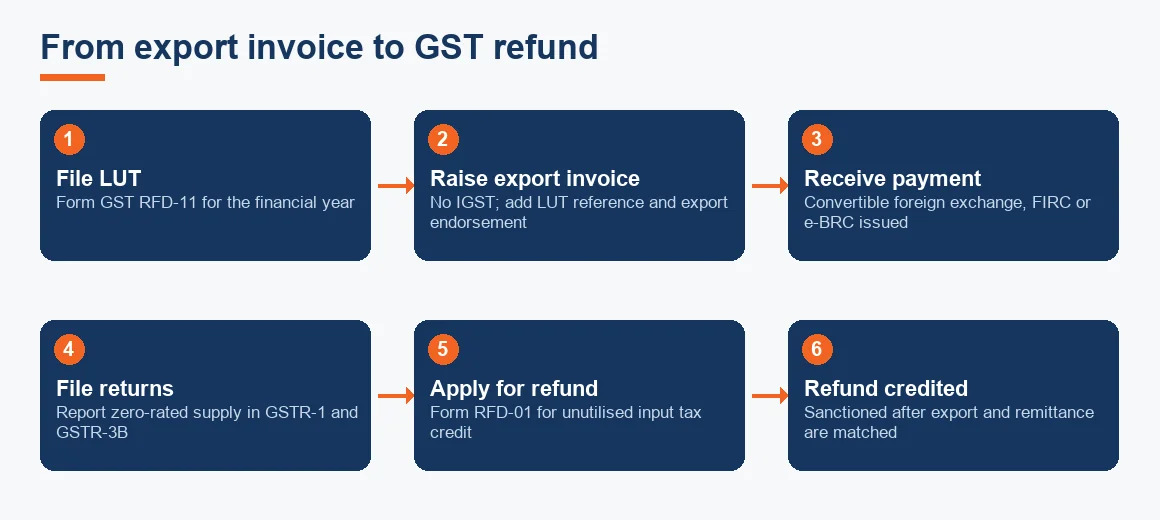
Section 16(3) gives exporters two ways to handle the zero-rating. Route one is to file a Letter of Undertaking in Form GST RFD-11 and export without paying IGST, then claim a refund of the unutilised input tax credit. Route two is to pay IGST on the export invoice and claim that IGST back as a refund. Most software exporters prefer the LUT route because it does not lock up working capital in tax that has to be reclaimed later. The comparison below sets out the practical difference.
| Feature | LUT route (without IGST) | Pay-and-refund route (with IGST) |
|---|---|---|
| Form required | RFD-11 (LUT), filed yearly | None upfront; pay IGST on invoice |
| Cash outflow | Nil on export invoice | 18 percent IGST blocked until refunded |
| What is refunded | Unutilised input tax credit | The IGST paid on the export |
| Refund application | Form RFD-01 on the portal | Form RFD-01 on the portal |
| Best for | Regular exporters, tight cash flow | Occasional exporters, low input credit |
The LUT is valid for one financial year and lapses on 31 March, so a fresh one is filed every April on the GST portal. Our step-by-step walkthrough of the whole refund cycle sits in LUT Filing for IT Exporters: A Step-by-Step Refund Guide.
Evidence: FIRC, invoice endorsement and the SOFTEX filing
Zero-rating is a claim you must be able to prove. Three documents do most of the work. First, the export invoice itself must carry the LUT reference and the endorsement that the supply is meant for export without payment of IGST. Second, a Foreign Inward Remittance Certificate (FIRC) or an e-BRC evidences that payment arrived in convertible foreign exchange. Third, software exporters registered with STPI file a SOFTEX form for each software export, which the authorised dealer bank reconciles against the remittance. Keep these together per invoice, because the refund officer will match your export turnover to realised foreign exchange. Businesses weighing their unit structure should read STPI vs SEZ for IT Companies: Tax and Compliance Compared before committing.
What is the 0.1 percent notification for exporters?
This question comes up often and is usually misapplied to services. The 0.1 percent rate comes from Notification 40/2017-Central Tax (Rate) and 41/2017-Integrated Tax (Rate), which let a merchant exporter buy goods at a concessional 0.1 percent GST for onward export, instead of the full rate. It is a goods scheme designed to stop working capital being trapped in tax on goods bought only to be re-exported. A pure software services exporter does not supply goods, so this notification generally does not apply to the software itself. It can matter only if the exporter also procures physical goods for export. For the software service, the correct treatment remains full zero-rating under Section 16, not a 0.1 percent rate.
Registration, LUT eligibility and IEC in brief
GST registration becomes compulsory once aggregate turnover crosses Rs 20 lakh (Rs 10 lakh in special category states). Below that an exporter may stay unregistered, but then cannot file an LUT or claim an input tax credit refund, so most software exporters register from the first invoice to preserve the refund. An Importer Exporter Code is not needed for a pure export of services unless Foreign Trade Policy benefits such as RoDTEP are claimed, though banks often ask for one anyway. Startups setting up their first compliance stack will find the groundwork in Startup Accounting Services India, and SaaS-specific revenue treatment in SaaS Accounting Services (IT & SaaS).
Worked example: refund of unutilised input tax credit
Assume a software exporter operating under an LUT during a quarter. It has both export and a little domestic revenue, and has built up input tax credit on rent, cloud subscriptions and professional fees. The refund of accumulated credit is capped by the formula in Rule 89(4): refund equals net input tax credit multiplied by zero-rated turnover divided by adjusted total turnover. All figures are indicative and Exl GST.
| Item | Amount (Rs) |
|---|---|
| Export turnover of services (zero-rated) | 80,00,000 |
| Domestic taxable turnover | 20,00,000 |
| Adjusted total turnover | 1,00,00,000 |
| Net input tax credit for the period | 5,00,000 |
| Maximum refund = 5,00,000 x 80,00,000 / 1,00,00,000 | 4,00,000 |
The exporter can claim up to Rs 4,00,000 as a refund of accumulated credit, while the remaining Rs 1,00,000 stays available to set off the 18 percent GST on the domestic turnover (Rs 20,00,000 at 18 percent is Rs 3,60,000, so this leftover credit offsets only part of that liability and the balance is paid in cash). Match the input side against your GSTR-2B before filing, because any credit not reflecting there will be disallowed.
How software export accounting connects to the rest of your books
The GST treatment is only one layer. The same export invoice also drives your income-tax position (Section 10AA for SEZ units, or ordinary taxation for STPI units after the sunset of Section 10A), your transfer-pricing documentation where a related party is involved, and your withholding on payments abroad, covered in TDS Under Section 195 on Foreign Software Payments. Exporters that also sell through overseas online platforms should keep the two revenue streams separate, as marketplace settlements follow different rules to direct client billing, a theme we treat in E-Commerce Accounting Services. Where forex gains create timing differences between book and tax profit, a quick pass through our Deferred Tax (DTA/DTL) Calculator keeps the year-end provision honest.
Key terms
- STPI / SOFTEX Export Filing: the per-export declaration software firms file so banks can reconcile the invoice against inward remittance.
- Software Export Revenue (Section 10AA SEZ): the income-tax deduction available to eligible SEZ software units on export profits.
- Foreign Currency Receivables: export invoices awaiting realisation, restated at the closing rate under accounting standards.
- Transfer Pricing for IT Services: arm's-length pricing rules for software billed to related overseas entities.
Key takeaways
- Software delivered electronically is a service under SAC 998314; domestic supply is 18 percent, export is zero-rated.
- All five Section 2(6) tests must hold, especially payment in foreign exchange and distinct parties, or the supply is taxable.
- Choose the LUT route to avoid blocking IGST, and refile Form RFD-11 every April.
- The 0.1 percent notification is a goods concession for merchant exporters, not for software services.
- Keep the FIRC, LUT reference and SOFTEX filing per invoice to secure the input tax credit refund.
Decision guide