In this guide
The core of the STPI vs SEZ benefits question is this: both are export promotion routes for Indian IT companies, but an STPI (Software Technology Park) unit can operate from any office in the country while an SEZ (Special Economic Zone) unit must sit inside a notified zone and run under a Development Commissioner. Since the Section 10AA income tax holiday closed to units starting after 31 March 2020, the choice today turns on customs and GST procurement benefits, compliance overhead and location, not on a headline tax break. This explainer sets out how each regime works so an exporter can decide with eyes open, then send the actual set-up work to a specialist. For the commercial engagement, our IT & Software Company Accounting Services team handles registration and ongoing filings.
What is the difference between STPI and SEZ?
STPI and SEZ are two separate schemes with two different legal parents. STPI is an autonomous society registered under the Societies Registration Act 1860 and administered by the Ministry of Electronics and Information Technology. It runs the Software Technology Park scheme, certifies Softex forms and offers incubation and data communication services. Crucially, an STPI unit can be set up anywhere, so a small services exporter can register its existing city office as a unit without relocating.
An SEZ, by contrast, is created under the SEZ Act 2005 and the SEZ Rules 2006. A unit must physically operate inside a notified zone, and the Development Commissioner is the single-window authority for approvals, bonding and periodic reporting. The trade-off is straightforward: SEZ gives deeper duty-free procurement and single-window clearance in exchange for a fixed location and heavier oversight; STPI gives location freedom with a lighter, filing-based footprint. Both require the unit to be a net foreign exchange earner over a block of years.
What are the benefits of an STPI unit, and who is eligible?
Any company, LLP or firm that exports computer software or IT-enabled services can apply for STP registration; there is no minimum investment or turnover gate, which is why the route suits early-stage and mid-sized exporters. The working benefits are duty-free import of capital goods against the STP customs framework, Softex certification that lets authorised dealer banks close export entries, and access to STPI data communication and incubation facilities. What an STPI unit does not get is a direct income tax holiday: the old Section 10A benefit for STP units sunset on 31 March 2011, so no STP unit claims an income tax deduction today.
Eligibility also carries an obligation. An STPI unit must maintain positive net foreign exchange earnings and file regular performance reports, covering exports, imports, employment and remittances. Persistent non-filing can lead to suspension or cancellation. If your firm bills overseas clients in dollars, the mechanics of foreign currency receivables and inward remittance tracking sit at the centre of that reporting.
What are the SEZ tax benefits in India, and why is an SEZ called tax free?
The "tax free" label is a hangover from the Section 10AA income tax holiday, which gave SEZ units a fifteen-year deduction on export profits: 100 per cent for the first five years, 50 per cent for the next five, and a reinvestment-linked 50 per cent for the last five. That holiday required the unit to begin operations on or before 31 March 2020, so no new claims are possible; only units that started before that date continue to run out the benefit. The Income Tax Department sets out the section at incometax.gov.in. For units still inside the window, the interaction with the deferred tax position and reinvestment reserve needs careful working.
For a new SEZ unit the real benefits are customs and GST. Import and domestic procurement for authorised operations come in duty free, supplies received by the unit are zero-rated under GST against Form A-1 and A-2 endorsement, and there is single-window clearance and exemption from certain state levies. So an SEZ is not literally income-tax free any more; it is a duty-free and GST-relieved procurement bubble with a single regulator. The zero-rating of supplies to an SEZ is governed by the IGST framework published at cbic-gst.gov.in.
STPI vs SEZ at a glance
The table below summarises the two regimes as they stand for a new IT exporter in 2026. Treat it as a decision starter, not a substitute for a unit-specific review.
| Feature | STPI unit | SEZ unit |
|---|---|---|
| Legal basis | STP scheme, Societies Registration Act 1860 society under MeitY | SEZ Act 2005 and SEZ Rules 2006 |
| Location | Any office, anywhere in India | Inside a notified zone only |
| Income tax holiday | None (Section 10A closed 31 Mar 2011) | Section 10AA, closed to units starting after 31 Mar 2020 |
| Customs on capital goods | Duty-free import under STP framework | Duty-free import and procurement for authorised operations |
| GST on inward supplies | Normal GST, input credit claimed | Zero-rated against Form A-1 / A-2 |
| Regulator | Jurisdictional STPI Director | Development Commissioner (single window) |
| Core obligation | Positive NFE, Softex, performance reports | Positive NFE, Softex, LUT/APR to Development Commissioner |
Are STPI and EOU the same?
No. An Export Oriented Unit (EOU) is set up under the Foreign Trade Policy and is administered as part of the customs and DGFT framework. STP is a parallel, sector-specific scheme for software and IT services, run by the STPI society. They share DNA: both allow duty-free import, both demand positive net foreign exchange, and both certify exports. But the administering body, the application route and the reporting channel differ. In practice a pure software exporter almost always chooses STP over EOU because STPI is the natural certifier for Softex and understands the IT export cycle. The distinction matters when you fill in registrations, because quoting the wrong scheme delays approval.
Compliance and filings under each regime
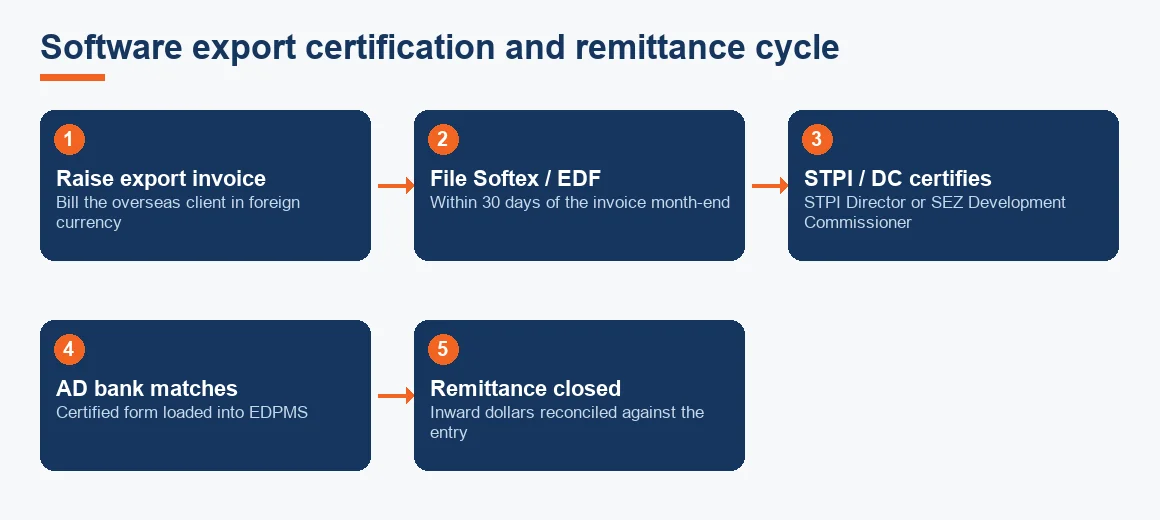
Whichever regime you pick, the export declaration cycle is the recurring workload. Software exported over data links is declared in Form Softex, certified by STPI or the SEZ Development Commissioner within 30 days from the end of the month in which the invoice is raised, and the certified form lets your authorised dealer bank close the export entry against the inward remittance in the EDPMS system. From 1 October 2026 the Softex form is being replaced by a monthly Export Declaration Form (EDF) under FEMA 23(R)/2026, with AD banks and STPI certifying on the same footing; the RBI framework is at rbi.org.in. The mechanics of this filing are covered in our STPI / Softex export filing glossary entry.
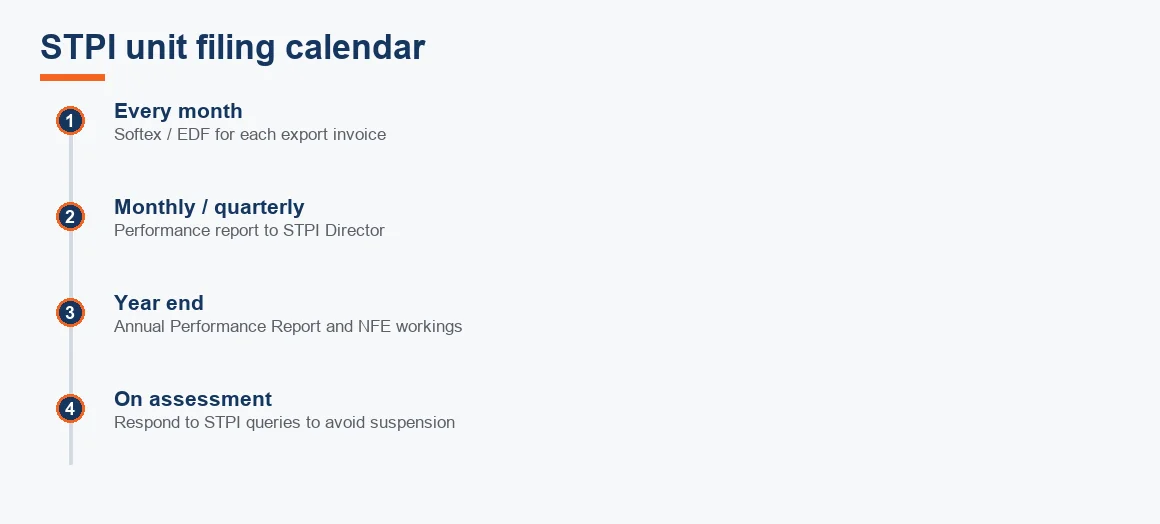
On top of the export declaration, an STPI unit files monthly, quarterly and annual performance reports with its jurisdictional STPI Director, while an SEZ unit files its returns and annual performance report to the Development Commissioner. Both need a clean set of books and a positive NFE workings ready at year end. If your billing runs through zero-rated exports, the refund route in our guide to LUT filing for IT exporters and the treatment set out in GST on IT and software services both feed the same reconciliation.
Worked example: GST refund a software exporter recovers
Because IT service exports are zero-rated under both STPI and SEZ, the refund of accumulated input tax credit is often the largest single benefit in cash terms. The refund is worked under Rule 89(4): eligible refund equals turnover of zero-rated supply divided by adjusted total turnover, multiplied by net input tax credit. Take a unit with quarterly zero-rated export turnover of Rs 4,00,00,000, total adjusted turnover of Rs 5,00,00,000 (it also does some domestic billing) and net ITC of Rs 30,00,000. Figures are indicative and exclude GST on inputs already claimed.
| Line item | Amount (Rs) |
|---|---|
| Zero-rated export turnover | 4,00,00,000 |
| Adjusted total turnover | 5,00,00,000 |
| Export ratio (4,00,00,000 / 5,00,00,000) | 0.80 |
| Net input tax credit for the period | 30,00,000 |
| Eligible refund (0.80 × 30,00,000) | 24,00,000 |
The Rs 24,00,000 is the credit the exporter can claim back rather than leave blocked in the electronic credit ledger. The domestic-linked balance of Rs 6,00,000 stays available to set off against domestic output tax. This calculation is identical whether the unit is registered under STPI or sits inside an SEZ, which is why the regime choice rarely turns on GST refunds and more often on customs saving and location.
Key terms
- STPI / Softex Export Filing: the declaration and certification of software exports that lets a bank close the remittance entry.
- Software Export Revenue (Section 10AA SEZ): the export profit that qualified for the now-closed SEZ income tax deduction.
- Foreign Currency Receivables: overseas invoices awaiting inward remittance, tracked for NFE and EDPMS closure.
- Transfer Pricing for IT Services: arm's-length pricing rules where the unit bills a related overseas parent.
- GIFT City IFSC Tax Holiday: the separate IFSC unit deduction, distinct from the SEZ Section 10AA route.
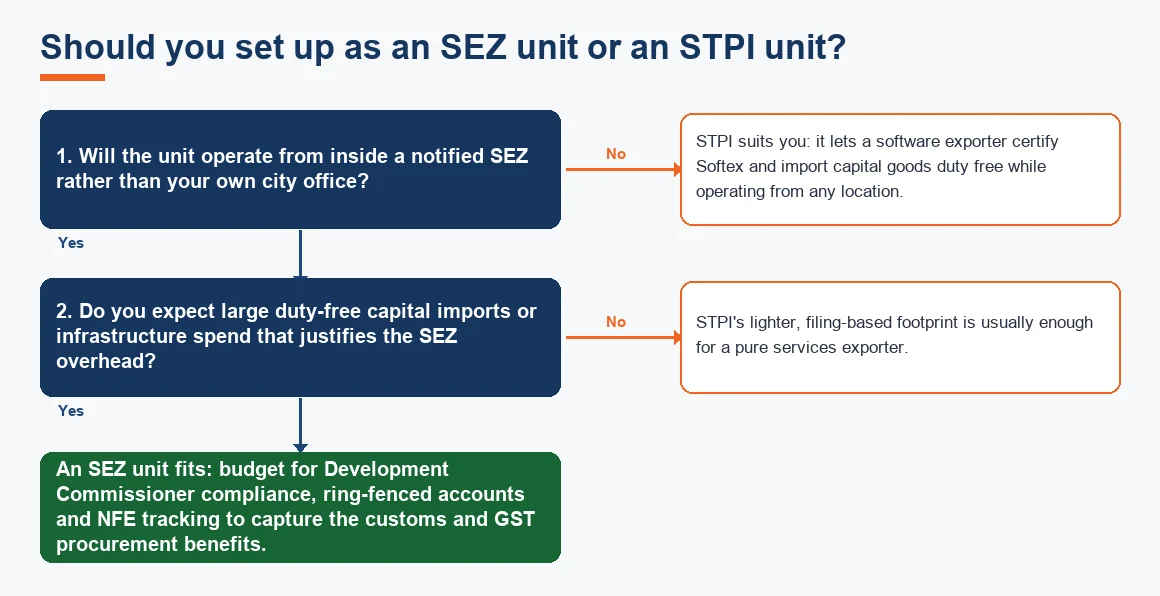
Which regime fits your IT company?
For a lean services exporter that bills clients directly and does not import much hardware, STPI usually wins on simplicity: you keep your city office, certify Softex and stay compliant with performance reports. For a firm building a large delivery centre with heavy capital imports and infrastructure spend, the SEZ procurement bubble and single-window clearance can justify the fixed location and Development Commissioner overhead. A captive that bills a related overseas parent should also weigh transfer pricing for IT captives and, where it pays for foreign software, TDS under Section 195, since these apply whichever regime you choose. If you also compare against a location like Udyog Vihar SEZ versus DTA compliance, the same customs-versus-freedom trade-off shows up.
The set-up, registration and ongoing filings are commercial work rather than something to attempt blind. Growth-stage teams can start with our startup accounting services, SaaS exporters with SaaS accounting services, and platform businesses with e-commerce accounting services; the fixed-asset side of a duty-free import plan can be sanity-checked with our depreciation calculator.
Key takeaways
- STPI lets a software exporter operate from any office; an SEZ unit must sit inside a notified zone under a Development Commissioner.
- The Section 10AA income tax holiday is closed to units that started after 31 March 2020, so new set-ups compete on customs, GST and compliance, not tax.
- Both regimes require positive net foreign exchange, Softex certification (an EDF from 1 October 2026) within 30 days of month-end, and periodic performance reports.
- IT service exports are zero-rated under both, so the GST refund of accumulated input credit is the same either way.
- STP is a sector-specific software scheme, not the Foreign Trade Policy EOU route, though the two share duty-free and NFE features.
Decision guide