In this guide
LUT filing for export of services is how an IT exporter supplies clients abroad without paying IGST on the invoice. Export of services is zero-rated under GST, and a Letter of Undertaking (LUT) in Form GST RFD-11 is the declaration that lets you invoice tax-free instead of paying IGST and waiting to claim it back. This guide explains what the LUT is, who must file it, how to file it, what happens if you miss it, and how the input-tax-credit refund actually works for a software or SaaS business. For the commercial side of running these books, see our IT & Software Company Accounting Services.
What is an LUT in GST, and who has to file it
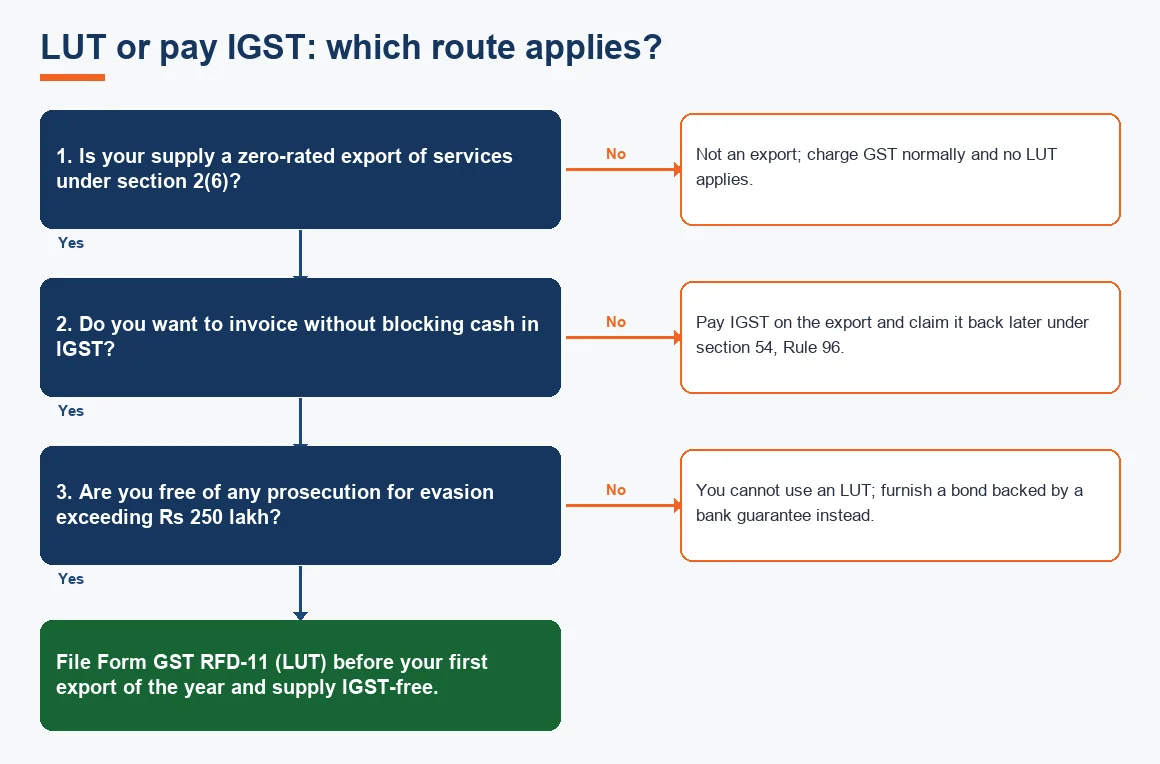
An LUT is a Letter of Undertaking filed in Form GST RFD-11 in which an exporter promises to fulfil all the conditions of a zero-rated supply. Once accepted, it allows you to export goods or services without payment of integrated tax (IGST). The benefit of an LUT under GST is straightforward: instead of charging IGST on an export invoice, paying it to the government and then claiming a refund months later, you invoice at zero tax from day one. That keeps working capital in the business rather than parked with the department.
Any registered person who exports goods or services, or supplies to a Special Economic Zone, can furnish an LUT. There is one carve-out: an exporter who has been prosecuted for any offence where the tax evaded exceeds Rs 250 lakh cannot use the LUT route and must instead furnish a bond backed by a bank guarantee. For a clean, tax-compliant software exporter this rarely bites, so the LUT is the normal path. IT businesses that also run a domestic arm should read our note on GST on IT and software services: domestic versus export to keep the two streams separate.
Can services be exported under LUT? The five conditions
Yes, services are exported under an LUT in exactly the same way as goods. But a supply only qualifies as an export of services under GST when it meets all five conditions in section 2(6) of the IGST Act:
- the supplier of the service is located in India;
- the recipient of the service is located outside India;
- the place of supply of the service is outside India;
- payment for the service has been received in convertible foreign exchange, or in Indian rupees wherever the Reserve Bank of India permits; and
- the supplier and recipient are not merely establishments of the same person.
The last condition is the one that catches Indian development centres billing their overseas parent. If your entity is only a branch or establishment of the same legal person abroad, the supply is not an export, and the LUT does not help. That is a transfer-pricing and structuring question, covered in our piece on transfer pricing for IT captives and MNC subsidiaries. The fourth condition is why foreign currency receivables and their realisation certificates sit at the heart of every export file. Firms operating from a bonded park also track software export revenue separately for the income-tax holiday; the STPI-versus-SEZ choice is compared in our STPI versus SEZ guide.
How to file an LUT under GST, step by step
The LUT is filed entirely online on the GST portal. The process takes a few minutes once the details are ready:
- Log in and go to Services, then User Services, then Furnish Letter of Undertaking (RFD-11).
- Select the financial year for which the LUT is being filed.
- If you filed an LUT offline for an earlier period, upload that acknowledgement; otherwise proceed.
- Read and tick the three self-declaration boxes accepting the conditions of the undertaking.
- Enter the name, address and occupation of two independent witnesses.
- Sign with the authorised signatory's digital signature (DSC) or through EVC, and submit.
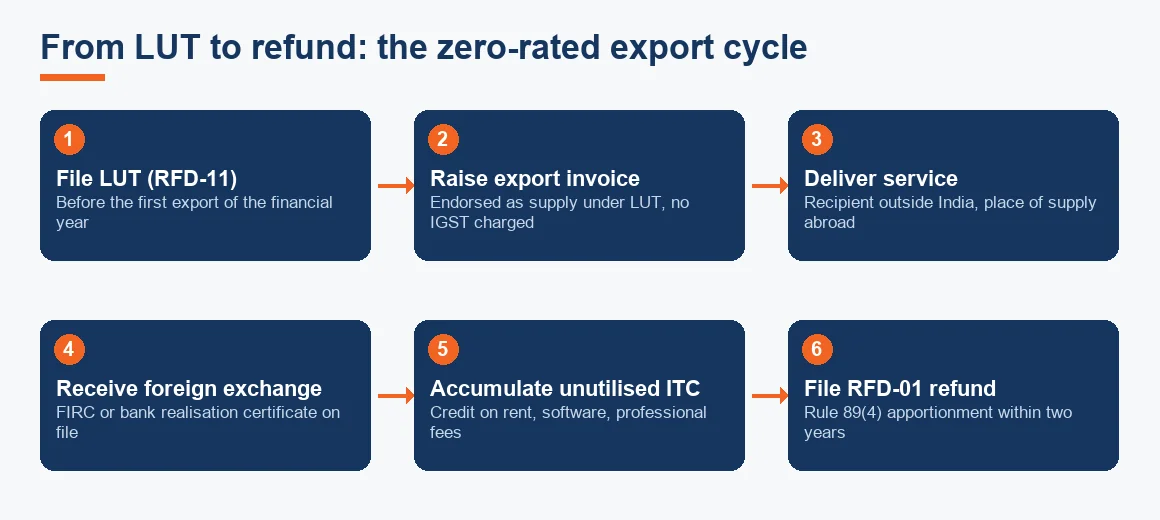
An Application Reference Number is generated and the LUT acknowledgement can be downloaded at once. There is no physical submission and no departmental approval to wait for. Keep the acknowledgement, because every export invoice for the year has to carry an endorsement that the supply is meant for export under LUT without payment of integrated tax, and the acknowledgement is filed with any later refund claim.
LUT validity in GST and the last date to apply
An LUT is valid for one financial year only. A fresh LUT has to be furnished for each new year, so how long a LUT is valid in GST is simply: from filing until 31 March. Because the benefit starts only from the date of filing, exporters normally file on or shortly after 1 April so that no export slips through the gap. There is no separate statutory "last date" as such; the practical deadline is your first export invoice of the year. Any export raised before the LUT is on file for that year does not enjoy the LUT benefit for that period, and you are pushed into the pay-IGST-and-refund route for those invoices.
What happens if you export without an LUT
Exporting without a valid LUT does not make the supply illegal; it changes the mechanics. You must charge IGST on the export invoice at the applicable rate, pay it in cash or from credit, and then claim it back as a refund of tax paid on zero-rated supply. Nothing is lost in the long run, but the cash is blocked with the department until the refund is processed, which is exactly the working-capital drain the LUT is designed to avoid. This is why the LUT and the refund are two sides of the same coin: the LUT front-loads the benefit, the refund recovers it after the fact.
Here is how the two routes compare for a services exporter.
| Feature | Export under LUT | Export on payment of IGST |
|---|---|---|
| IGST on export invoice | Not charged | Charged and paid |
| What you claim back | Unutilised input tax credit | The IGST paid |
| Governing provision | Section 54(3), Rule 89(4) | Section 54, Rule 96 |
| Working-capital impact | Nil, tax never leaves the business | Cash blocked until refund |
| Prerequisite | Valid LUT filed for the year | None |
Claiming the GST refund on export of IT services
An exporter operating under an LUT accumulates input tax credit that it cannot use, because its output supplies carry no tax. That unutilised credit is refundable under section 54(3). For a software or SaaS firm the credit pool is built from office rent, cloud and software subscriptions, professional fees, internet and similar overheads, so clean GSTR-2B credit matching directly sizes the refund. The refund is not the full credit balance; it is apportioned by the formula in Rule 89(4), which scales the net credit by the share of turnover that is export turnover.
The claim is filed in Form RFD-01 with Statement 3 (invoice-wise export details), together with the bank realisation certificates or FIRCs for the period, a copy of the LUT acknowledgement, a declaration that no drawback or IGST refund has been claimed on the same supplies, and a chartered accountant certificate where the refund exceeds Rs 2 lakh. The claim covers a period of not less than one month and must be filed within two years of the relevant date under section 54(1). For export of services the relevant date is the date convertible foreign exchange is received (evidenced by a FIRC or bank realisation certificate), or the date of invoice where payment was received in advance. Note that ITC on capital goods is excluded from Net ITC in the refund formula, so those assets are simply depreciated in the books; our depreciation calculator handles that side. Because so much of the file rests on foreign-exchange proof, keep the accounts receivable ledger reconciled to bank credits throughout the year.
The refund route is common to other export-heavy models too; e-commerce sellers exporting through platforms deal with a parallel set of issues covered in our E-Commerce Accounting Services, while cross-border software payments raise withholding questions handled in our note on section 195 TDS on foreign software payments. SaaS subscription billing has its own revenue-timing wrinkles, set out under our SaaS Accounting Services.
Key terms
- STPI / SOFTEX Export Filing: the monthly declaration of software export value to the authorities, separate from GST but drawn from the same export data.
- GSTR-2B Input Tax Credit Matching: reconciling purchase credits against the auto-drafted 2B statement so only eligible credit enters the refund pool.
- Working Capital: the cash tied up in day-to-day operations that an LUT protects by avoiding upfront IGST.
- Foreign Currency Receivables: export invoices awaiting realisation in convertible foreign exchange, the trigger for the refund relevant date.
Worked example: refund of unutilised ITC under Rule 89(4)
Assume an IT services firm exporting under an LUT for a quarter. The Rule 89(4) formula is: Refund Amount = (Turnover of zero-rated supply of services x Net ITC) / Adjusted Total Turnover. The figures below are indicative and Exl GST.
| Item | Amount (INR) |
|---|---|
| Export (zero-rated) turnover for the quarter | 80,00,000 |
| Domestic taxable turnover | 20,00,000 |
| Adjusted total turnover | 1,00,00,000 |
| Net ITC (unutilised credit, excluding capital goods) | 3,60,000 |
| Refund = (80,00,000 / 1,00,00,000) x 3,60,000 | 2,88,000 |
The firm recovers Rs 2,88,000 of the Rs 3,60,000 credit, because 80 per cent of its turnover is export. The remaining Rs 72,000 stays in the electronic credit ledger to be set off against domestic output tax. Had the firm exported without an LUT, it would instead have charged and paid IGST on the Rs 80,00,000 and claimed that tax back under Rule 96, blocking far more cash in the meantime.
Key takeaways
- The LUT in Form GST RFD-11 is the tax-free export switch; file it fresh every financial year before your first export.
- A supply is an export of services only if it meets all five conditions of section 2(6), including receipt in convertible foreign exchange.
- Miss the LUT and you pay IGST then claim it back; the LUT simply spares you the cash block.
- Under an LUT you refund unutilised ITC via Rule 89(4); the refund is proportionate to your export turnover.
- File RFD-01 within two years of receiving foreign exchange, with FIRCs, Statement 3 and a CA certificate above Rs 2 lakh.
The LUT and the refund together turn the zero-rating promise into real cash flow. Get the annual filing habit right, keep the foreign-exchange evidence clean, and the refund becomes a routine quarterly recovery rather than a year-end fire drill. For statutory wording, always check the current rules on the CBIC GST site and confirm foreign-exchange treatment against RBI guidance, since thresholds and formats are updated from time to time.
Decision guide