In this guide
TDS on a foreign software payment turns on one question: is the payment chargeable to tax in India? Section 195 of the Income-tax Act requires any person paying a non-resident a sum that is taxable in India to withhold tax at the time of credit or payment, whichever is earlier. There is no minimum threshold, so even a small remittance is covered. The practical answer for software depends on whether the payment is royalty, and since the Supreme Court ruling in Engineering Analysis (2021), a plain licence to use standard software usually is not.
Is TDS applicable on foreign software payments?
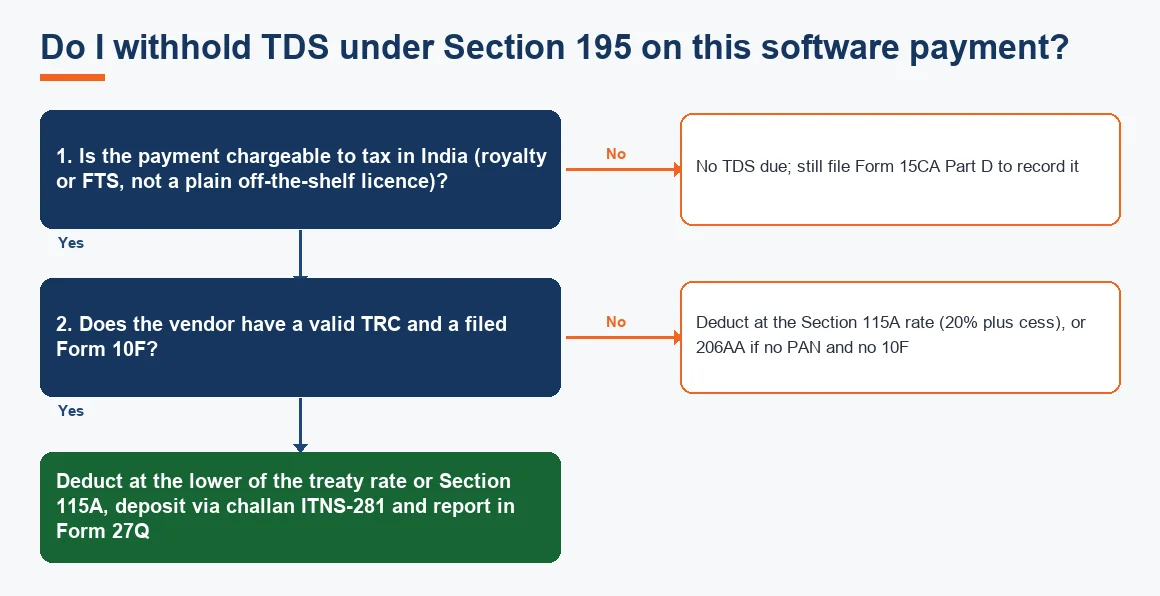
Sometimes, and it hinges on the character of the payment rather than the mere fact that money leaves India. If you buy a shrink-wrapped or downloadable software licence for your own use, that payment is now generally treated as business income of the foreign vendor, not royalty. Where the vendor has no permanent establishment in India, business income is not chargeable here, so no tax needs to be withheld. If, instead, you pay for the right to commercially exploit the copyright (to reproduce, modify or resell the code), the payment is royalty, is chargeable in India, and TDS under Section 195 applies. The same logic answers the common queries about SaaS and a Microsoft 365 subscription: a standardised subscription that grants only the right to use, with no transfer of copyright, usually falls outside royalty.
What Section 195 actually requires
Section 195 casts the obligation on the payer, not the payee. You must deduct at the rates in force when you credit the vendor's account or make payment, whichever comes first. Booking the invoice as a payable therefore triggers the deduction even before the remittance goes out, which is why the timing of your accrual entries matters. Unlike most domestic TDS sections, there is no exemption limit: the section applies from the first rupee. Two escape routes exist where you are unsure of the taxable portion. The payer can apply under Section 195(2) for a certificate fixing the amount on which tax is to be deducted, or the non-resident can apply in Form 13 under Section 197 for a nil or lower deduction certificate. Getting this wrong is expensive, because Section 40(a)(i) disallows the whole expense if tax that was due is not deducted or deposited.
When a software payment is (and isn't) royalty
The turning point is the Supreme Court decision in Engineering Analysis Centre of Excellence Pvt Ltd v CIT (2021). The Court held that amounts paid by Indian resellers and end users to foreign suppliers for shrink-wrapped, off-the-shelf or distributor software are not royalty under the relevant tax treaties, because the buyer receives a copyrighted article, not the copyright itself. No transfer of the right to reproduce or exploit the work means no royalty, and so no obligation to deduct under Section 195. This is why the type of licence, not the label on the invoice, decides the outcome. The table below sets out the common cases.
| Payment type | Is it royalty / chargeable? | TDS position under Section 195 |
|---|---|---|
| Off-the-shelf or shrink-wrapped licence | No (Engineering Analysis) | No TDS; report the remittance in Form 15CA |
| Right to reproduce, modify or resell the code | Yes, royalty | Deduct at lower of treaty rate or Section 115A |
| SaaS or cloud subscription, use only | Generally no, business income | Usually no TDS if the vendor has no permanent establishment |
| Microsoft 365 or similar standard subscription | Generally no, use right only | Usually no TDS; document the licence terms |
| Bundled technical services (fees for technical services) | Yes, chargeable as FTS | Deduct at the applicable FTS rate |
TDS rate on software payment: Act rate versus treaty rate
Where a software payment is royalty, you deduct at the lower of two rates: the rate under the Income-tax Act or the rate in the Double Taxation Avoidance Agreement with the vendor's country. Under Section 115A, royalty and fees for technical services paid to a non-resident are taxed at 20% (increased from 10% by the Finance Act 2023), plus the 4% health and education cess and any surcharge. Most treaties cap royalty at 10% to 15%, so the treaty is usually the cheaper route. To claim the treaty rate you need a valid tax residency certificate from the vendor and an electronically filed Form 10F. Without a PAN, Section 206AA would ordinarily force a 20% floor, but Rule 37BC removes that floor for royalty and fees for technical services if the non-resident supplies the TRC, Form 10F, address and tax identification number. Foreign vendors also feature in transfer pricing for IT services where they are associated enterprises, so keep the two analyses separate.
How to deduct and deposit TDS under Section 195
The mechanics are the same discipline you apply to any withholding, with extra documentation for the cross-border element.
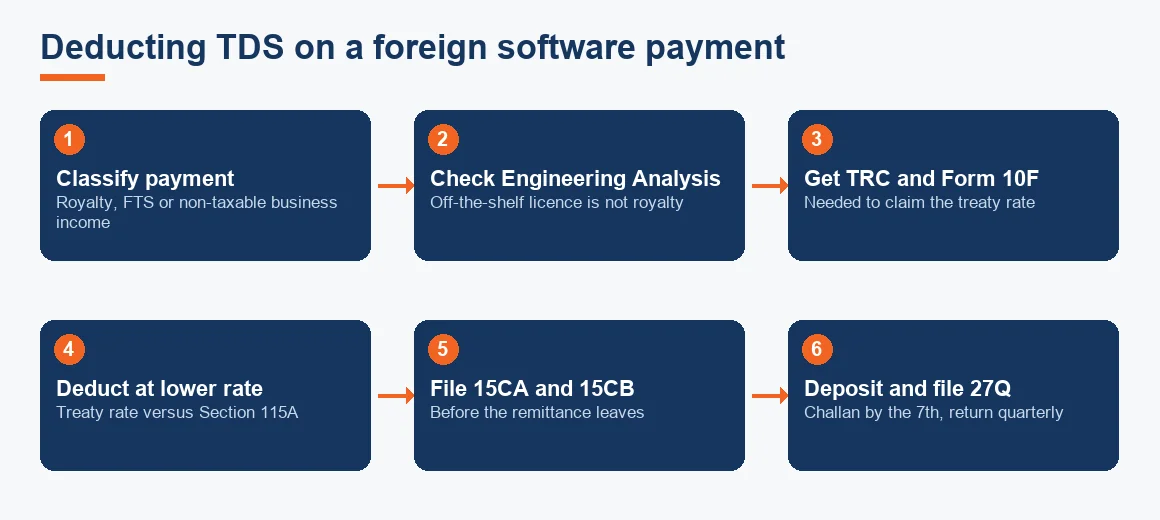
- Classify the payment: royalty, fees for technical services, or non-taxable business income, using the licence terms and Engineering Analysis.
- If chargeable, obtain the TRC and file Form 10F to fix the applicable rate.
- Deduct at the lower of the treaty or Section 115A rate at credit or payment, whichever is earlier.
- File Form 15CA (and Form 15CB where required) before the remittance.
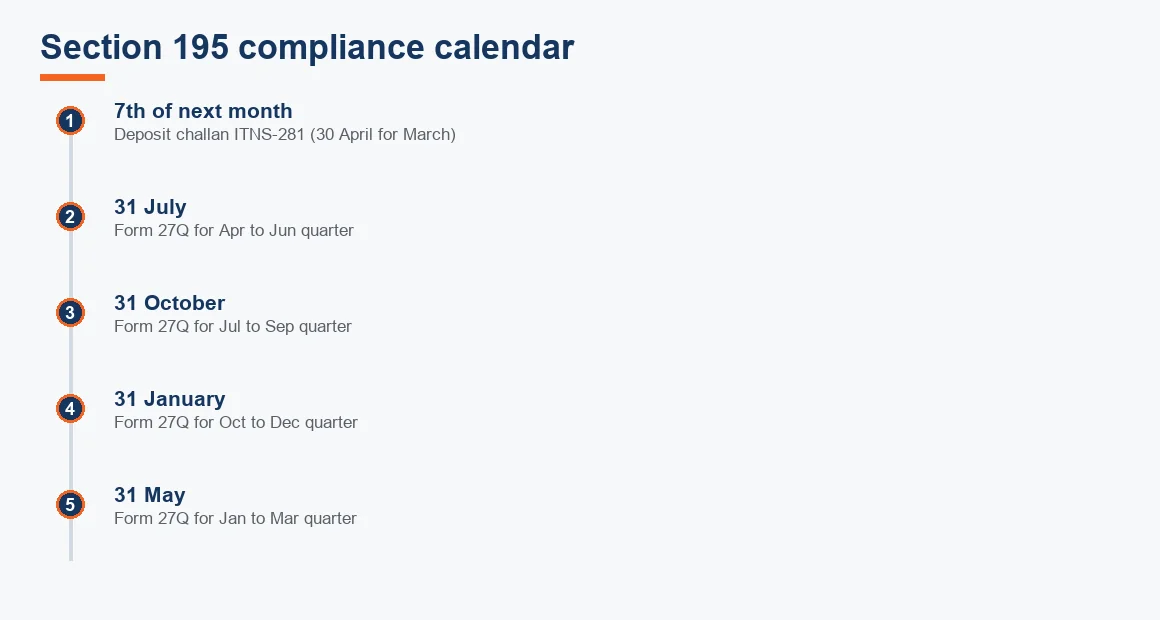
- Deposit the tax through challan ITNS-281 on the income tax e-pay tax portal, quoting your TAN and the non-company or company deductee code, by the 7th of the following month (30 April for March deductions).
- Report the deduction in the quarterly Form 27Q return and issue Form 16A from TRACES.
Late deposit is not a soft deadline. Interest runs at 1% a month under Section 201(1A) for failure to deduct and 1.5% a month for failure to deposit tax already deducted, and the expense can be disallowed until you set things right. You can read the statutory text and access the challan on the Income Tax Department portal.
Form 15CA and Form 15CB for software remittances
Most software remittances abroad need Form 15CA, filed by the remitter on the income tax portal, and often Form 15CB, a certificate from a chartered accountant. Form 15CB is required where the payment is chargeable to tax and the aggregate to that vendor exceeds Rs 5,00,000 in the financial year. Rule 37BB exempts a specified list of purposes from these forms, but software licence and royalty remittances are not on that list, so budget for the certificate. If the payment is not chargeable at all, you still complete Form 15CA (Part D) to record why no tax was withheld. Your bank will ask for the acknowledgement number before it processes the outward remittance, and the RBI framework for such payments is set out on the Reserve Bank of India site.
Filing the TDS return: Form 27Q and deadlines
Payments to non-residents are not reported in Form 26Q. They go in Form 27Q, the quarterly return for non-resident deductees, due 31 July, 31 October, 31 January and 31 May for the four quarters. Each record must carry the payee's country, the nature of remittance, the treaty article relied on and the Form 15CA acknowledgement number. Once the return is processed, download Form 16A for the vendor from TRACES. The 27Q discipline sits alongside your wider export compliance, so IT exporters often manage it in the same cycle as LUT filing for refunds and the GST treatment of software exports.
Worked example: withholding on a royalty-bearing licence
Assume an Indian company pays a US vendor USD 20,000 for a licence that grants the right to modify and resell the code, so it is royalty. Convert at Rs 83 to the dollar, giving a gross remittance of Rs 16,60,000. The figures below compare the withholding across documentation scenarios. Rates are indicative and the arithmetic is illustrative.
| Scenario | Rate applied | TDS on Rs 16,60,000 |
|---|---|---|
| Off-the-shelf licence (not royalty) | Nil | Rs 0 |
| Royalty, treaty benefit (India-US, TRC and Form 10F) | 15% | Rs 2,49,000 |
| Royalty, no treaty documents (Section 115A 20% plus 4% cess) | 20.8% | Rs 3,45,280 |
| Royalty, no PAN and no Form 10F (Section 206AA) | 20% | Rs 3,32,000 |
The gap between the treaty row and the no-documents row, close to Rs 96,000 on a single invoice, is the entire commercial case for collecting the TRC and Form 10F up front.
Key terms
- Section 194Q TDS on Goods: the domestic TDS on purchase of goods, a useful contrast to the non-resident regime under Section 195.
- Foreign Currency Receivables: cross-border balances that raise the same conversion and documentation questions as outward software payments.
- Transfer Pricing for IT Services: the arm's length pricing rules that apply where the foreign vendor is a related party.
- Accounts Payable: the ledger where a foreign invoice is credited, the event that can trigger deduction before payment.
Where this fits in your software accounting
A capitalised software licence bought outright is recorded as an asset and written down over its life, so the same invoice that raises a TDS question also feeds your depreciation schedule. On the revenue side, exporters weigh the STPI versus SEZ choice and account for software export revenue under the relevant regime, with transfer pricing for IT captives layered on where a group entity is involved. Keeping withholding, export incentives and pricing analyses in one file avoids the classic error of treating each foreign transaction in isolation.
Key takeaways
- Section 195 has no threshold, but tax is due only if the payment is chargeable in India.
- Standard off-the-shelf software is not royalty after Engineering Analysis, so it usually carries no TDS.
- For royalty, deduct at the lower of the treaty rate or the 20% Section 115A rate, backed by a TRC and Form 10F.
- Form 15CA is near universal for software remittances; Form 15CB applies above Rs 5,00,000 of taxable payment.
- Report non-resident payments in Form 27Q every quarter and deposit tax by the 7th of the following month.
This blog is a general explainer, not advice on a specific remittance. To have the classification, withholding and 15CA/15CB documentation handled end to end, speak to our IT and software company accounting services team, or explore our SaaS accounting services, startup accounting services and e-commerce accounting services for related cross-border work.
Decision guide