In this guide
TPA reconciliation for a hospital means tracking every insurance claim from the day it is billed to the day the money lands, matching the amount the Third Party Administrator (TPA) approves against what was billed, and recording the difference the payer deducted. Because most inpatient revenue in India now flows through cashless networks and reimbursement claims, a hospital that does not reconcile claim by claim ends up with a receivables ledger that overstates cash and hides real leakage. This guide explains what a TPA does, how the claim process works, and how to keep the books clean, with a worked example and an ageing method you can copy.
What is a TPA in a hospital?
A Third Party Administrator is an IRDAI licensed intermediary appointed by a health insurer to run the claims side of a policy. It issues health cards, gives cashless pre-authorisation to network hospitals, checks admission and discharge papers against the policy terms, decides deductions and processes settlement to the hospital or the policyholder. What it does not do is set the premium or underwrite the risk: those stay with the insurer. For the hospital's accounts department, the TPA is effectively the paying party you raise the receivable against and chase, even though the money ultimately belongs to the insurer.
There are two broad types you will deal with. Standalone TPAs are licensed companies that service many insurers, while some large insurers run in-house claims desks that behave like a TPA. Either way, the accounting treatment is identical: a claim is a receivable, a settlement is a receipt, and a disallowance is a deduction you must recognise and, where possible, recover.
How the TPA claim process works
There are two settlement routes, and they hit the hospital's books very differently. In a cashless claim the hospital raises the receivable against the TPA at admission and never bills the patient for the covered portion. In a reimbursement claim the patient pays the hospital in full and then recovers from the TPA, so the hospital carries no insurance receivable at all. Reconciliation work concentrates on the cashless book, because that is where your money sits with a third party for weeks.
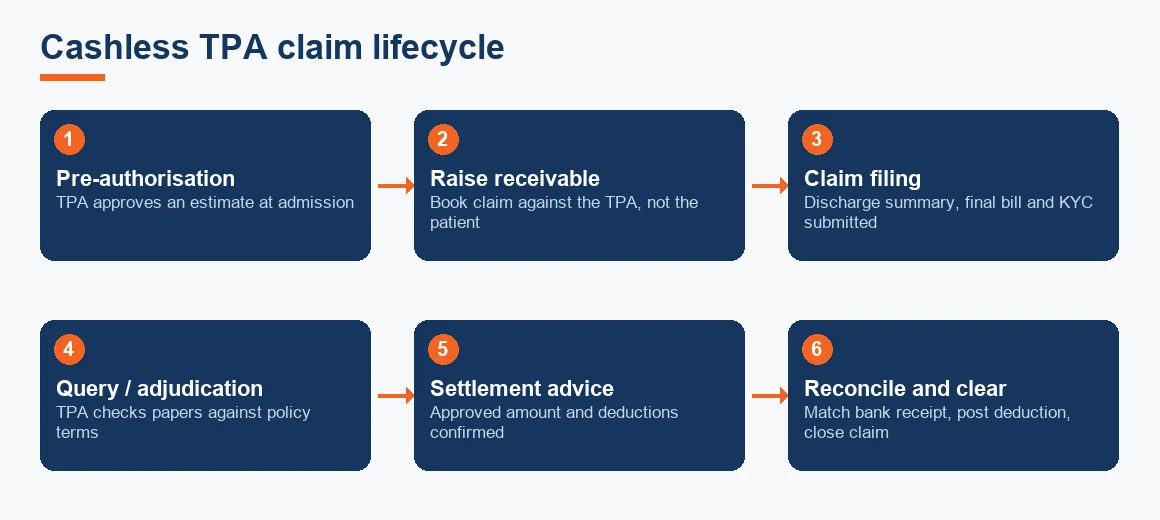
The cashless flow runs from pre-authorisation at admission, through enhancement requests during the stay, to a final claim filed at discharge with the discharge summary, itemised and final bills, investigation reports and KYC. The TPA then queries, approves in part or in full, and remits with a settlement advice that lists the deductions. Every one of those stages carries a date, and capturing those dates is the whole basis of a clean ageing schedule. If you want to see how department-level revenue ties into this, our note on setting up department-wise P&L for a hospital shows where TPA income lands by cost centre.
Why TPA receivables need dedicated reconciliation
An ordinary trade debtor either pays your invoice or does not. A TPA almost always pays less than billed, and the shortfall is a mix of contractual tariff caps, non-payable consumables, policy sub-limits and document queries. If you only match the bank receipt to the total claim value, the deduction quietly disappears into the receivable balance and your accounts receivable never clears. Reconciling claim by claim forces every rupee into one of three homes: received, recoverable on re-submission, or a genuine loss to be provided or written off.
This is a specialist strand of receivables discipline. If your in-house team is stretched, the underlying capability sits within our Healthcare Accounting Services, and the same claim-to-cash rigour applies across sectors we support such as startup accounting services India, IT and software company accounting services and SaaS accounting services (IT & SaaS), where marketplace and subscription settlements raise the same match-and-deduct problem.
How to record TPA billing and deductions in the books
The rule is simple and it protects both your revenue figure and your recovery rights: recognise the full billed amount as revenue when the service is rendered, and post the disallowance separately when the TPA settles. Never edit the original invoice to match the approved amount, because package rates, statistics and any GST workings on taxable side-lines depend on the original bill staying intact.
At admission for a cashless case you raise the receivable. On settlement you split the credit into cash received and deduction recognised. A short journal entry discipline keeps the leakage on its own ledger line where management can see it and finance can chase it. Track each deduction against a reason code, because tariff mismatch and missing documents are usually the two largest recoverable categories, and you cannot recover what you have not classified.
The main deduction reasons and whether they are usually worth chasing are summarised below.
| Deduction reason | Typical cause | Usually recoverable? |
|---|---|---|
| Tariff / package mismatch | Billed above the agreed network rate card | Partly, on re-submission with the tariff sheet |
| Missing or illegible documents | Investigation report or signature not attached | Yes, if resent within the query window |
| Non-payable items | Consumables, gloves, administrative charges | Rarely, these are contractual exclusions |
| Policy sub-limit breach | Room rent or procedure cap exceeded | No, this is a policyholder liability |
| Pre-authorisation shortfall | Final bill above the approved estimate | Sometimes, with a justified enhancement note |
Building a claim-wise ageing schedule
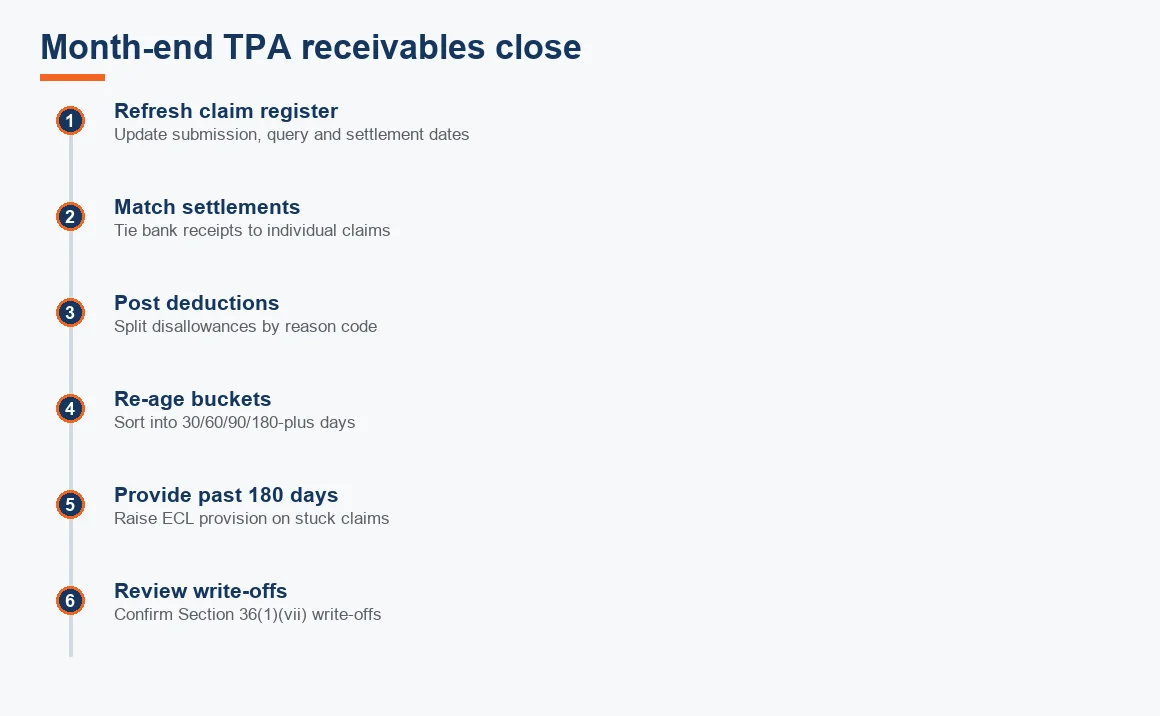
Age each open claim from the date of bill submission, capturing the query date and the settlement date along the way, and sort into buckets of 30, 60, 90 and over 180 days. An accounts receivable ageing schedule built claim wise tells you exactly which files to escalate and which have crossed into provision territory. Watching your days sales outstanding (DSO) on the TPA book alone, separate from self-pay and corporate debtors, is the single best early-warning metric a hospital CFO can run.
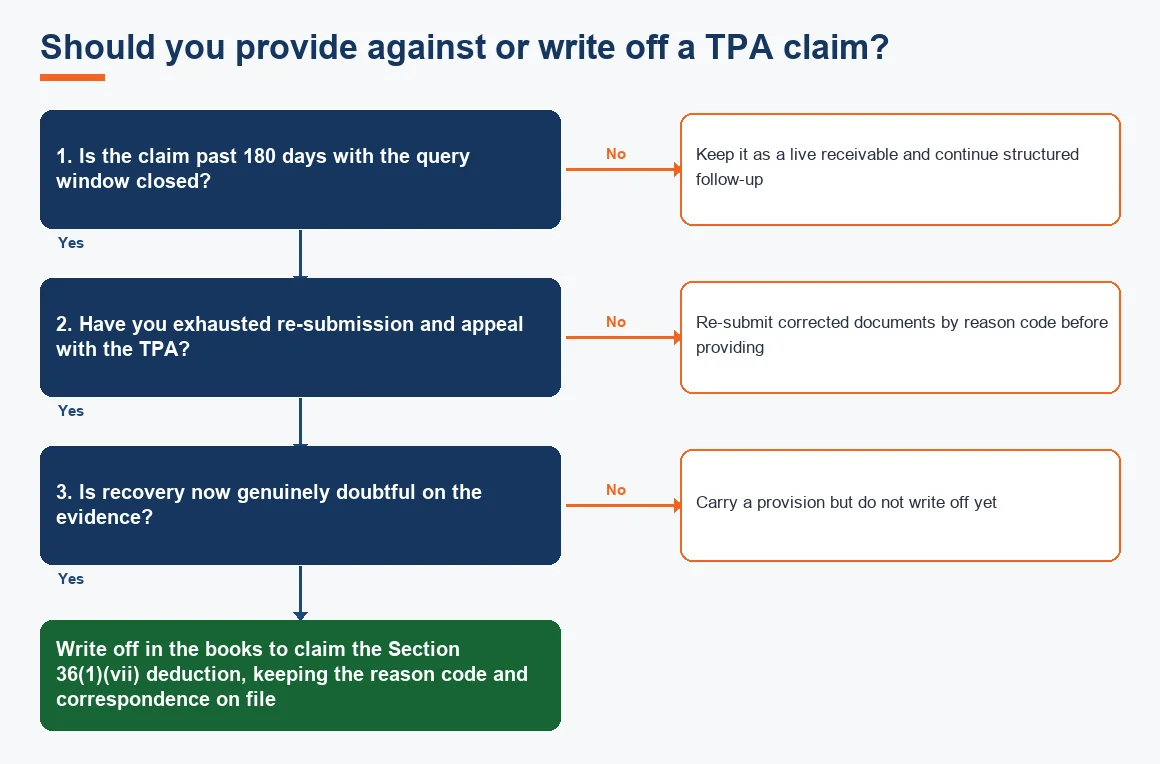
Claims sitting past 180 days with no settlement date need a provision, because the probability of full recovery has fallen materially. For hospitals reporting under Ind AS, an expected credit loss model is the right frame, and our ECL Estimator (Ind AS 109 simplified approach) gives a defensible provision percentage per bucket.
Worked example: recording a cashless claim and its deduction
Take a cashless inpatient case billed at Rs 1,80,000. The TPA approves Rs 1,62,000 and deducts Rs 18,000, made up of Rs 12,000 tariff mismatch and Rs 6,000 non-payable consumables. Because inpatient treatment by a clinical establishment is GST exempt, no tax is added. All figures are indicative and Exl GST on any taxable side-services. The entries run as follows.
| Stage | Account | Debit (Rs) | Credit (Rs) |
|---|---|---|---|
| At admission (cashless) | TPA / Insurer Receivable | 1,80,000 | |
| Hospital Revenue (IPD) | 1,80,000 | ||
| On settlement | Bank | 1,62,000 | |
| Claim Deduction (Disallowance) | 18,000 | ||
| TPA / Insurer Receivable | 1,80,000 |
Revenue stays at the full Rs 1,80,000, the receivable clears to nil, and the Rs 18,000 leakage sits on its own line. The finance team then splits that Rs 18,000 by reason code: the Rs 12,000 tariff portion goes into the recoverable re-submission queue, while the Rs 6,000 consumables portion is accepted as a contractual loss. That single split is what turns a reconciliation into a recovery workflow.
GST on hospital bills settled through a TPA
There is no GST on the inpatient bill. Healthcare services provided by a clinical establishment are exempt under Notification 12/2017 Central Tax (Rate), and that exemption holds whether the patient pays directly or a TPA settles the claim. What is taxable is the TPA's own service charge to the insurer, at 18 per cent, but that is the TPA's supply, not the hospital's. Hospitals still register and file where they have taxable income such as pharmacy sales to walk-in outsiders or canteen and rental income, so the exemption on treatment does not remove the GST registration question entirely. The line between exempt and taxable healthcare income is set out in our explainer on which healthcare services are GST exempt vs taxable in India, and you can confirm the notification text on the CBIC GST portal.
Provisioning and writing off unrecoverable claims
A provision and a write-off are not the same event. Once a claim crosses 180 days, prudence requires a provision against it, which is a book estimate that reduces profit but keeps the receivable on the balance sheet while you still pursue it. A write-off is the final step, and it matters for tax: a bad debt is deductible under Section 36(1)(vii) of the Income-tax Act only once it is actually written off in the books of account, subject to the conditions in Section 36(2). You cannot claim the deduction on a mere provision. Keep the reason code and the correspondence trail on file, because that is your evidence the debt was genuinely irrecoverable. The statutory wording is available on the Income Tax Department portal.
Doctor payouts add a parallel compliance point on the cost side: consultant fees carry TDS, covered in our note on TDS on doctor professional fees and consultant payouts, and solo practitioners should read our piece on Section 44ADA presumptive taxation for doctors.
Key terms
- Third-Party Administrator (TPA) Receivables: amounts due to a hospital from insurers via a TPA for cashless claims.
- Accounts Receivable Aging Schedule: a bucketed report of debtor balances by age, run here claim by claim.
- Days Sales Outstanding (DSO): the average time to collect a receivable, tracked separately on the TPA book.
- Dunning Letters: structured follow-up reminders sent to a payer to chase overdue claims.
- Revenue: the full billed value recognised on service, before any TPA deduction.
Key takeaways
- Reconcile every cashless claim from billing to bank receipt and record the deduction as a separate line, never by editing the invoice.
- Keep the receivable claim wise with submission, query and settlement dates so ageing and DSO are meaningful.
- Classify each deduction by reason code; tariff mismatch and missing documents are the recoverable categories worth chasing.
- Inpatient bills are GST exempt whether paid directly or via a TPA; only the TPA's charge to the insurer is taxable at 18 per cent.
- Provide against claims past 180 days, but claim the Section 36(1)(vii) deduction only when the debt is actually written off.
Decision guide