In this guide
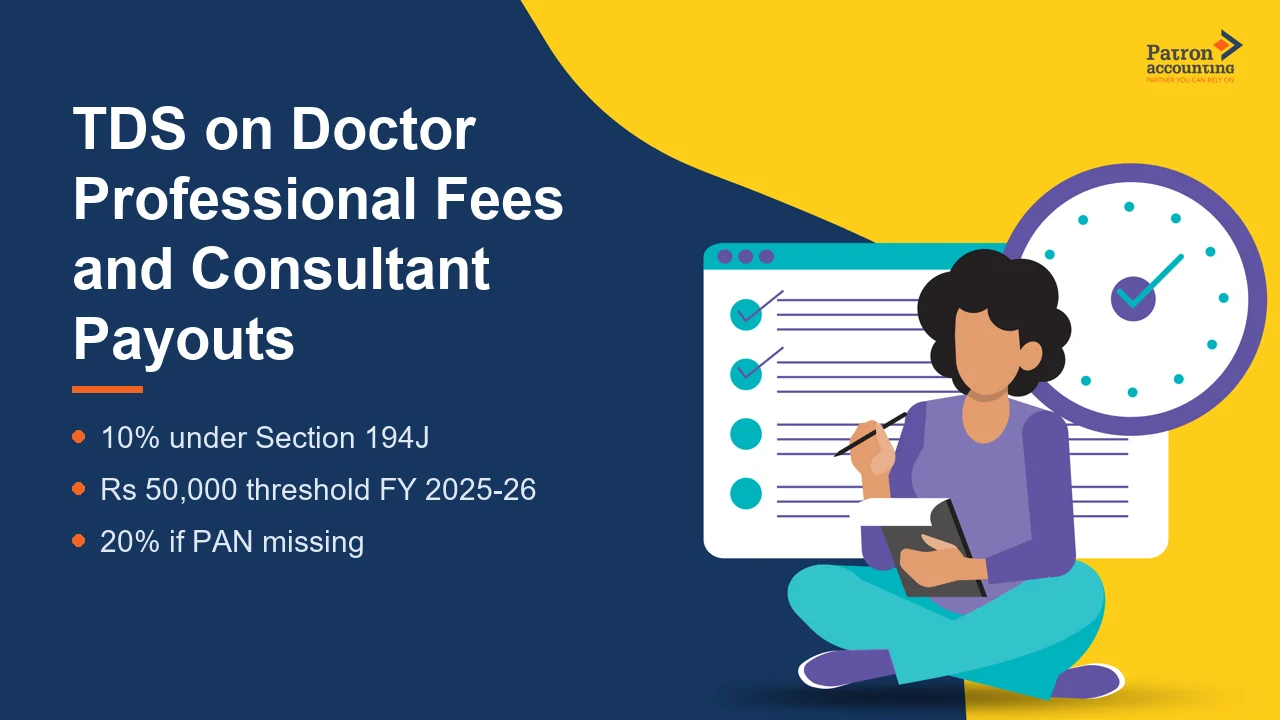
TDS on doctor fees is deducted at 10% under Section 194J of the Income Tax Act, because payment for medical consultancy is a fee for professional services. A hospital or clinic that pays a visiting consultant deducts the tax at credit or payment, whichever is earlier, deposits it with the government, and issues a TDS certificate the doctor later adjusts against the annual tax bill. The rule reads simply, yet the classification and the GST treatment trip up finance teams often enough to invite notices. This explainer sets out the working, not just the section number.
What Section 194J covers and why doctor fees sit inside it
Section 194J applies to any resident payment that is a fee for professional services, a fee for technical services, royalty, or a director's sitting fee. The Act defines professional services to include the medical profession by name, so a payment to a doctor for clinical work is squarely within it. A hospital paying a retainer to an anaesthetist, a diagnostic centre paying a radiologist to report scans, and a clinic paying a visiting dermatologist are all deducting under the same head. This is the tax layer that sits on top of routine Healthcare Accounting Services, and getting it wrong shows up first in a mismatched Form 26AS.
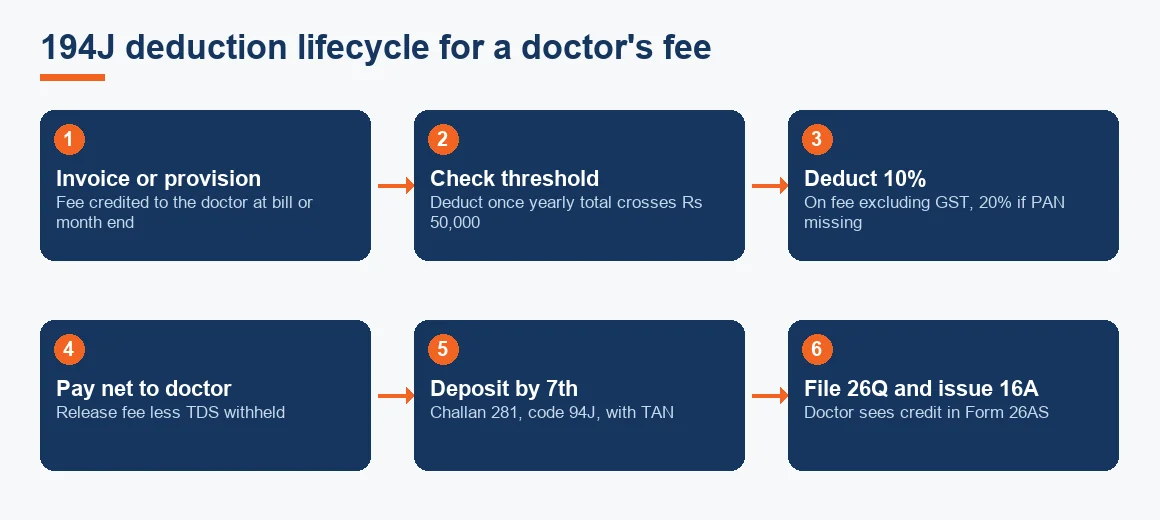
The deduction is triggered when the amount is credited to the doctor's account in the books or actually paid, whichever comes first. Booking a provision at month end therefore starts the clock even before the cheque is released. Recording that provision correctly relies on ordinary double-entry bookkeeping, with the expense debited and both the payable and the TDS liability credited in the same voucher.
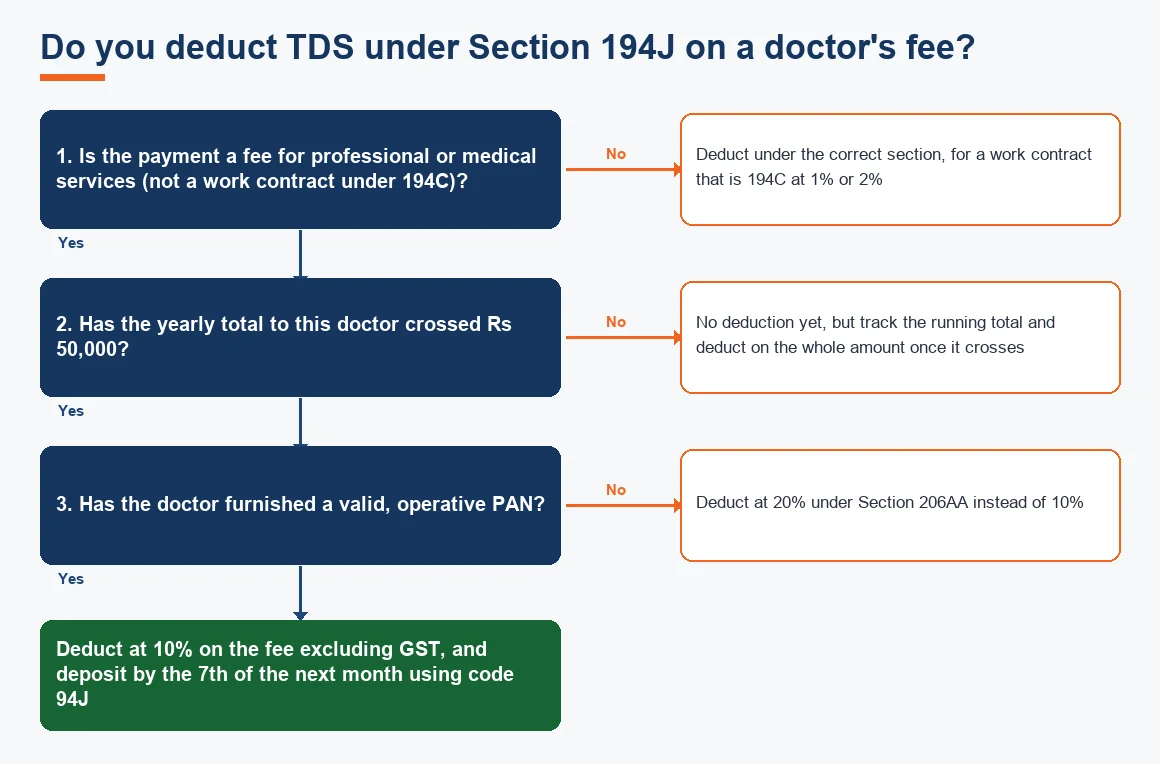
TDS rate on doctor consultancy: 10%, 2%, or 20%?
Search results muddle three rates, so it is worth separating them. The professional-services rate under 194J is 10%. The 2% rate under the same section applies only to fees for technical services and to payments to call centres, not to a doctor's clinical fee. The 7.5% figure that still circulates online was a temporary Covid-era concession that lapsed on 31 March 2021 and no longer exists. So the answer to whether TDS on professional fees is 7.5 or 10 is a flat 10%.
The 20% rate is the penalty rate under Section 206AA. If the doctor does not furnish a PAN, or the PAN has become inoperative because it is not linked with Aadhaar, tax is deducted at the higher of the section rate or 20%. For a professional fee that means 20%, and the deductor, not the doctor, carries the risk of a short-deduction demand if this is missed.
The Rs 50,000 threshold for FY 2025-26
No TDS is required where the total professional fee to a single doctor in a financial year does not exceed Rs 50,000. The Finance Act 2025 lifted this limit from Rs 30,000 with effect from 1 April 2025, so for FY 2025-26 the working figure is Rs 50,000. The limit is applied per person for the whole year, not per bill.
The catch is what happens on crossing the line. Once cumulative payments exceed Rs 50,000, tax is deducted on the entire amount from the first rupee, including bills already settled, not merely on the excess. A doctor paid Rs 20,000 in April and Rs 40,000 in July has crossed the threshold in July, and TDS is then due on the full Rs 60,000, with the deduction on the July payment absorbing the tax on the April one too.
194J versus 194C: the classification error hospitals make
The single most common error is running visiting-consultant payouts through Section 194C, the contractor section, at 1% or 2%, instead of Section 194J at 10%. The temptation is understandable, because the hospital signs a contract with the doctor and the word contract nudges people toward 194C. But 194C covers work contracts such as housekeeping, security, catering, and equipment maintenance, where the payment buys a service performed to a specification. A doctor is paid for professional skill and judgement, which is exactly what 194J is written for.
The consequence of misclassifying is a short deduction of eight or nine percentage points, and under Section 40(a)(ia) thirty per cent of the expense can be disallowed until the shortfall is made good. The table below sets the two sections side by side.
| Feature | Section 194J (professional) | Section 194C (contract) |
|---|---|---|
| Typical payee | Doctor, lawyer, architect, CA | Housekeeping, security, catering vendor |
| Nature of payment | Fee for professional skill | Payment for a work contract |
| Rate (with PAN) | 10% | 1% individual/HUF, 2% others |
| Annual threshold FY 2025-26 | Rs 50,000 | Rs 1,00,000 aggregate (Rs 30,000 single bill) |
| Rate without PAN | 20% | 20% |
This mirrors the reasoning behind Section 194Q TDS on goods: the character of what is being bought, not the label on the agreement, decides the section.
How TDS on professional fees is calculated
TDS is computed on the professional fee excluding GST, provided the GST component is shown separately on the invoice. This follows a long-standing CBDT circular and it materially lowers the deduction. If GST is not shown separately, tax is deducted on the gross bill. So the invoice format the doctor uses directly affects the cash the hospital withholds. Healthcare treatment itself is exempt from GST, but a consultancy or retainer arrangement can still attract GST depending on the structure, which is covered in which healthcare services are GST exempt versus taxable.
The entry then flows into two ledgers: the fee to a professional-charges expense account and the tax withheld to a TDS-payable account, tracked as an ordinary accounts payable line until deposited. Both postings share a single voucher so the general ledger stays balanced.
Worked example: TDS on a visiting consultant's bill
Assume a hospital receives an invoice from a visiting cardiologist for Rs 1,20,000 in professional fees plus GST at 18%, with GST shown separately. The cumulative payment to this doctor has already crossed Rs 50,000, so the threshold is not in play.
| Line | Amount (Rs) |
|---|---|
| Professional fee | 1,20,000 |
| Add: GST at 18% (shown separately) | 21,600 |
| Invoice total | 1,41,600 |
| Less: TDS at 10% on fee of 1,20,000 | (12,000) |
| Net paid to the doctor | 1,29,600 |
The hospital pays the doctor Rs 1,29,600, keeps Rs 12,000 as TDS, and deposits that Rs 12,000 with the government by the 7th of the following month. Note that TDS is Rs 12,000, not Rs 14,160, precisely because it is charged on the fee and not on the GST-inclusive total. Recording this as a single journal entry keeps the payable and the tax liability visible in one place.
How to deposit and report 194J TDS
Once deducted, the tax is deposited through Challan 281 on the income-tax portal, using the deductor's TAN and the nature-of-payment code 94J for professional fees. The deadlines run as follows.
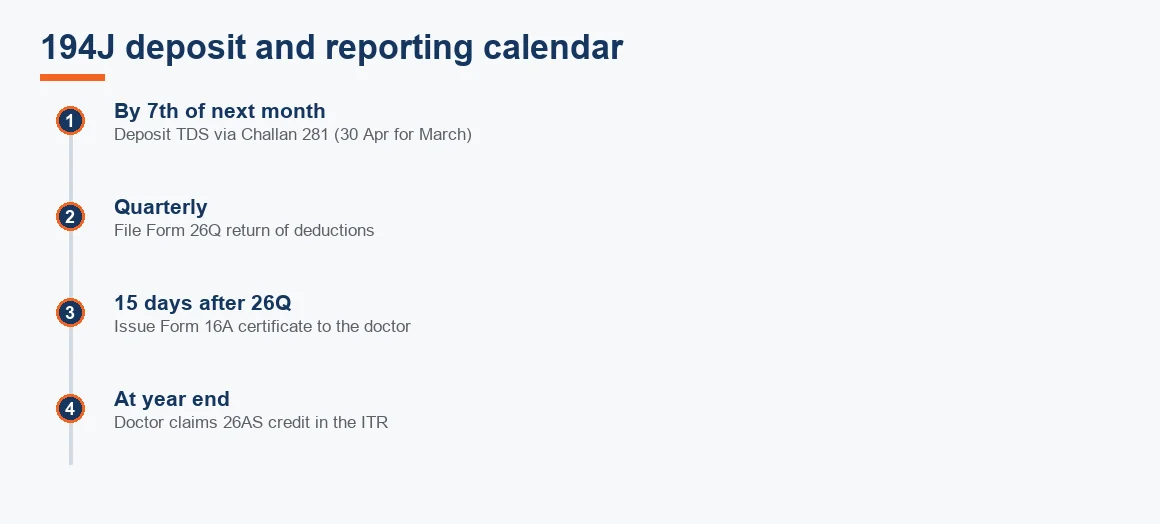
Deposit is due by the 7th of the month after deduction, except for tax deducted in March, which may be deposited up to 30 April. The quarterly return in Form 26Q is then filed, after which the doctor sees the credit in Form 26AS and receives a Form 16A certificate. Late deposit attracts interest at 1.5% per month under Section 201, and late filing of 26Q draws a fee of Rs 200 a day under Section 234E. The official rules and challan sit on the Income Tax Department portal, and the GST exemption for healthcare is set out on the CBIC notifications page.
How doctors reclaim 194J TDS and show it in ITR
For the doctor, the 10% withheld is not a final tax, only an advance credit. A doctor in independent practice usually reports the fee income under the head profits and gains of business or profession, and many are eligible for presumptive taxation under Section 44ADA, which is explained in Section 44ADA presumptive taxation for doctors and defined by the Section 44ADA presumptive cap. The TDS appearing in Form 26AS is claimed in the return against the total tax computed on actual or presumptive income.
Where the tax deducted exceeds the final liability, the excess is refunded after the return is processed. There is no separate application: the refund flows automatically from filing the ITR with the 26AS credit picked up correctly. Doctors who consult across several hospitals should reconcile every Form 16A against 26AS before filing, because a single hospital's late 26Q filing can leave credit missing and delay the refund. Hospitals settling large consultant panels alongside insurer receipts face the mirror-image reconciliation, covered in how hospitals reconcile TPA and insurance receivables and setting up department-wise P&L for a hospital.
The same 194J discipline applies wherever professional retainers are paid, whether under SaaS accounting services, broader IT and software company accounting, or startup accounting services, and a simple deferred tax calculator helps model the timing effect where a provision straddles the year end.
Key terms
- Section 194Q TDS on Goods: the goods-purchase counterpart to 194J, useful for seeing how the character of the payment fixes the section.
- Journal Entry: the single voucher that records the fee, the payable and the TDS liability together.
- General Ledger: the master record where the professional-charges and TDS-payable accounts settle.
- Section 44ADA Presumptive Cap: the turnover limit up to which a doctor can declare income on a presumptive basis.
- Third-Party Administrator (TPA) Receivables: the insurer-linked receivables that sit alongside consultant payouts in hospital books.
Key takeaways
- Doctor professional fees are deducted at 10% under Section 194J, never at the 2% technical-services rate.
- The FY 2025-26 threshold is Rs 50,000 per doctor per year, and crossing it pulls earlier bills into charge.
- Deduct on the fee, not the GST, when GST is shown separately on the invoice.
- A missing or inoperative PAN pushes the rate to 20% under Section 206AA, at the deductor's cost.
- Deposit by the 7th of the next month using code 94J, then file Form 26Q so the doctor can claim the credit and any refund through the ITR.
Decision guide