In this guide
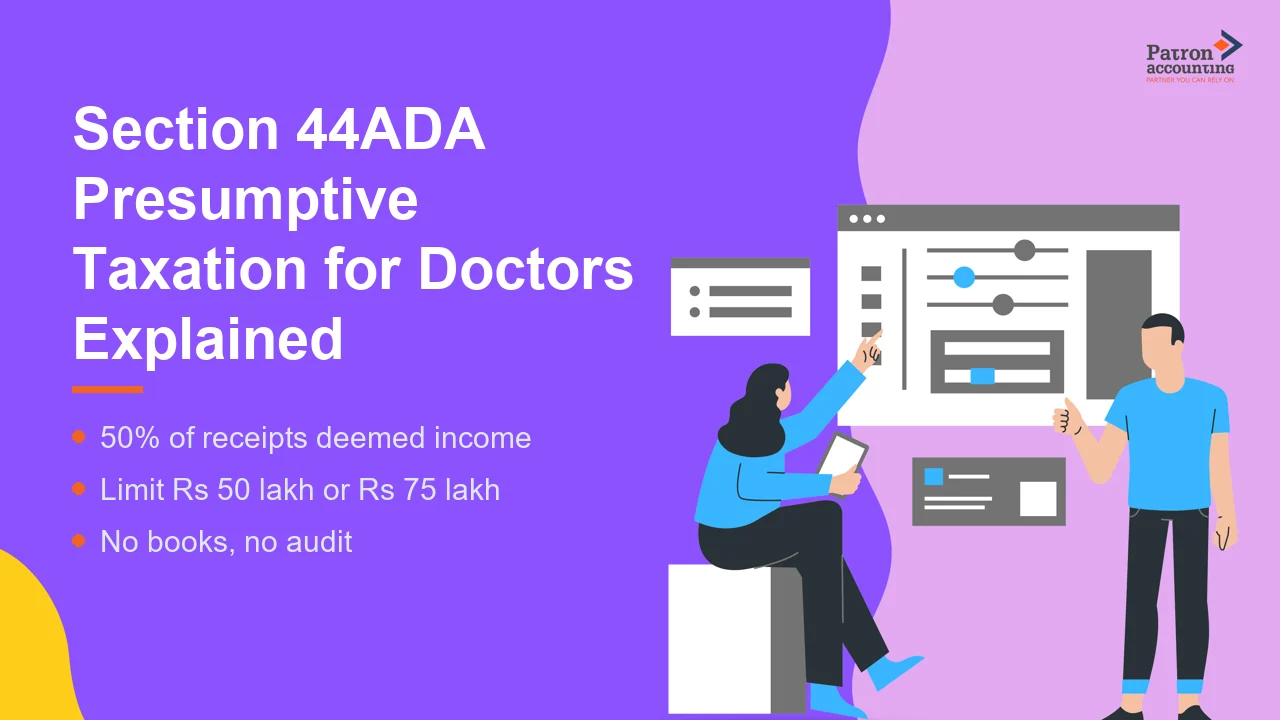
Section 44ADA is the presumptive taxation scheme that lets a resident doctor in private practice declare 50% of gross receipts as taxable professional income, without maintaining detailed books of account or facing a tax audit. A doctor billing Rs 40 lakh in a year simply offers Rs 20 lakh to tax and files a short return. It exists to spare independent professionals the compliance load that Section 44AA otherwise imposes. This guide explains who qualifies, where the receipts limit sits, how 44ADA differs from 44AD, and where the scheme can quietly work against you.
What is Section 44ADA for doctors?
Under Section 44ADA, a doctor treats 50% of gross professional receipts as income and the balance is presumed to cover every expense: clinic rent, staff salary, consumables, equipment upkeep and travel. You do not add up actual costs, and you do not prove them to the assessing officer. The deemed figure is the floor, not a cap, so you may voluntarily declare more than 50% if your real margin is higher, but you cannot declare less unless you keep full books and get them audited. For a doctor whose practice runs lean, the 50% presumption is often generous. Detailed practice accounting still matters for owners of larger clinics, which our Healthcare Accounting Services guide covers, but the tax return itself stays simple.
Are doctors eligible for 44ADA?
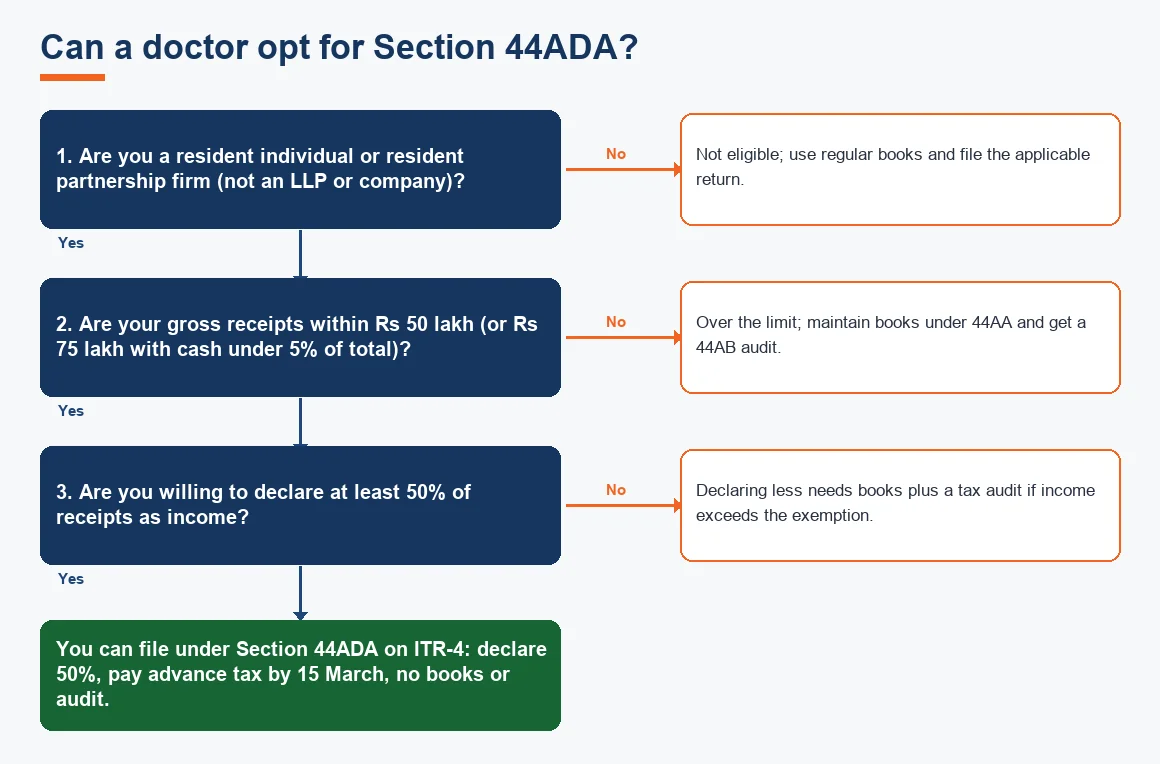
Yes. Medical practice is one of the professions notified under Section 44AA(1), alongside legal, engineering, architectural, accountancy, technical consultancy, interior decoration, film artists and company secretaries. A doctor in independent practice is squarely inside the scheme. The eligibility gates are straightforward:
- You must be a resident individual or a resident partnership firm. A non-resident cannot use 44ADA.
- An LLP or a company cannot opt in, even if it carries on a medical profession.
- Gross professional receipts for the year must stay within the limit (covered next).
A salaried doctor is not shut out. If you draw a hospital salary and also earn consultation or visiting-fee income on the side, the salary is taxed under the head salaries with TDS under Section 192, while the professional receipts, which usually carry TDS under Section 194J, go into the 44ADA computation. Both sit comfortably in the same return.
What is the gross receipts limit for 44ADA?
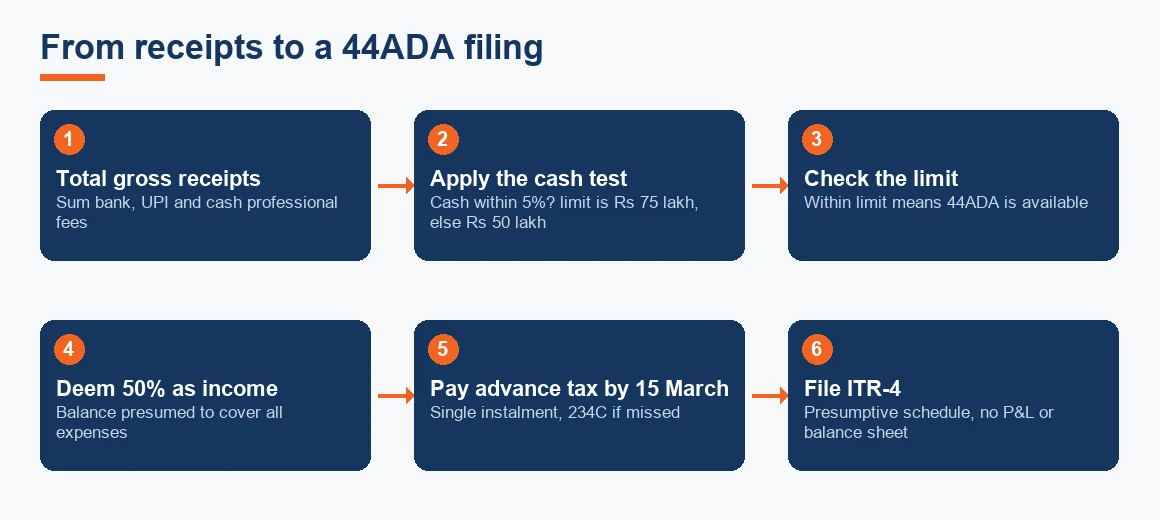
The base limit is Rs 50 lakh of gross receipts. The Finance Act 2023 raised this to Rs 75 lakh where cash receipts do not exceed 5% of total receipts, a nudge towards digital collection. A doctor collecting Rs 70 lakh with only Rs 2 lakh in cash (well under 5%) therefore stays eligible; the same doctor taking Rs 10 lakh in cash would breach the 5% test and fall back to the Rs 50 lakh ceiling. For this test, receipt through cheque or bank draft that is not account-payee is treated as cash. You can confirm the current thresholds on the Income Tax Department portal. Cross the applicable limit and 44ADA closes: you must then keep regular books under Section 44AA and, in most cases, get a tax audit under Section 44AB.
44ADA vs 44AD: how they differ
The two presumptive sections are often confused. Section 44AD is for eligible businesses and presumes 8% of turnover as income (6% on digital receipts). Section 44ADA is for the notified professions and presumes 50%. A doctor running a practice uses 44ADA; a doctor who also runs, say, a diagnostic-equipment trading business would look at 44AD for that separate stream. The table below sets the two side by side.
| Feature | Section 44ADA (professionals) | Section 44AD (business) |
|---|---|---|
| Who it covers | Notified professions, including doctors | Eligible resident businesses |
| Presumptive rate | 50% of gross receipts | 8% of turnover (6% on digital) |
| Receipts / turnover limit | Rs 50 lakh (Rs 75 lakh if cash within 5%) | Rs 2 crore (Rs 3 crore if cash within 5%) |
| Five-year lock-in | No lock-in | Yes, opting out triggers a five-year bar |
| Return form | ITR-4 | ITR-4 |
Do you need to maintain books under 44ADA?
No. That is the whole point of the scheme. Once you opt in, you are relieved of the Section 44AA obligation to keep detailed books, and you skip the Section 44AB audit as well. You still record enough to substantiate gross receipts, and the return itself asks for four closing balances: debtors, creditors, stock (rare for a doctor) and cash in hand. If you would rather run proper double-entry records anyway, perhaps because your bank or a lender wants clean statements, nothing stops you, and the difference between cash accounting and accrual accounting starts to matter. But the law does not compel it under 44ADA.
Advance tax and the ITR-4 return
A doctor under 44ADA declares income on ITR-4 (Sugam). Gross receipts and the presumptive figure go into the presumptive schedule; no profit and loss account or balance sheet is attached. Advance tax is the one deadline to watch. Instead of the four instalments a regular taxpayer pays across the year, a 44ADA professional pays the entire advance tax in a single instalment by 15 March of the financial year. Miss it and interest under Section 234C runs at 1% a month on the shortfall. So a doctor declaring Rs 20 lakh of presumptive income computes the whole year's liability and clears it by that one date. The precise mechanics are set out by the Income Tax Department.
Is 44ADA compulsory for five years?
No, and this is the most common crossover error from 44AD. The five-year lock-in, where opting out bars you from the scheme for the next five assessment years, lives in Section 44AD(4) and applies to business presumptive income only. Section 44ADA carries no such rule. A doctor may use 44ADA in one year, keep books and file a regular return the next, and return to 44ADA the year after, purely on what suits each year's numbers. That flexibility is a genuine advantage of the professional scheme.
What are the disadvantages of 44ADA?
The scheme is not always the cheaper route. A few things to weigh:
- The 50% presumption can overstate income. A doctor with heavy fixed costs (a leased scanner, a large clinical team) may have a real margin below 50%. Under 44ADA the excess is still taxed.
- Declaring below 50% needs books plus audit. If your actual profit is genuinely lower and your total income crosses the basic exemption, you must maintain books under Section 44AA and get a Section 44AB audit, which removes the compliance saving entirely.
- No carry-forward of a low year. Because you are not computing actual profit, a lean year cannot generate a business loss to set off later.
- Depreciation is deemed absorbed. Equipment depreciation is treated as already allowed within the 50%, so a year of heavy capital purchase gives no extra relief. If you later exit to regular books, our Depreciation Calculator helps rebuild the written-down values.
None of this makes 44ADA a bad choice; it makes it a choice worth running the numbers on each year, especially as receipts approach the limit.
Worked example: presumptive versus regular books
Take a doctor with Rs 44 lakh of gross receipts and Rs 15 lakh of genuine, provable practice expenses. The table compares the taxable professional income under each route. Figures are illustrative.
| Particulars | Presumptive (44ADA) | Regular books |
|---|---|---|
| Gross professional receipts | Rs 44,00,000 | Rs 44,00,000 |
| Less: allowable expenses | Not applicable | Rs 15,00,000 |
| Deemed income at 50% | Rs 22,00,000 | Not applicable |
| Taxable professional income | Rs 22,00,000 | Rs 29,00,000 |
| Books and audit required | No | Yes, if declaring this lower figure |
Here presumptive taxation lands the doctor Rs 7 lakh lower, with no books and no audit. Flip the expenses to Rs 28 lakh and the picture reverses: regular books would show Rs 16 lakh against a deemed Rs 22 lakh, and keeping records becomes worth the effort. The scheme rewards a lean, digitally collected practice and quietly penalises a capital-heavy one.
Key terms
- Section 44ADA Presumptive Cap: the Rs 50 lakh / Rs 75 lakh receipts ceiling beyond which the professional presumptive scheme no longer applies.
- Cash Accounting: recognising income when money is received, the basis most solo practices track receipts on.
- Accrual Accounting: recognising income when earned rather than when paid, relevant if you leave the presumptive scheme.
- Accounts Receivable: fees billed but not yet collected, one of the closing balances ITR-4 still asks a presumptive filer to report.
Doctors who work through hospitals or third-party payers face a further wrinkle in how receipts are recognised: our note on TDS on doctor professional fees and consultant payouts explains the Section 194J deductions that show up in your 26AS, and reconciling TPA and insurance receivables matters for anyone billing insurers. If your practice has grown into a clinic with departments, department-wise P&L and the split between GST-exempt and taxable healthcare services become the next things to get right. Commercial questions, choosing a structure or setting up ongoing books, sit with our Startup Accounting Services team, and industry-specific guides such as SaaS Accounting Services and IT company accounting follow the same presumptive-versus-books logic for other professions.
Key takeaways
- Section 44ADA taxes 50% of a doctor's gross receipts, with no books and no audit.
- The limit is Rs 50 lakh, or Rs 75 lakh only if cash receipts stay within 5% of the total.
- Resident individuals and partnership firms qualify; LLPs and companies do not.
- Advance tax is due in one instalment by 15 March, and there is no five-year lock-in.
- Run the numbers yearly: a capital-heavy practice may pay less under regular books.
Decision guide