In this guide
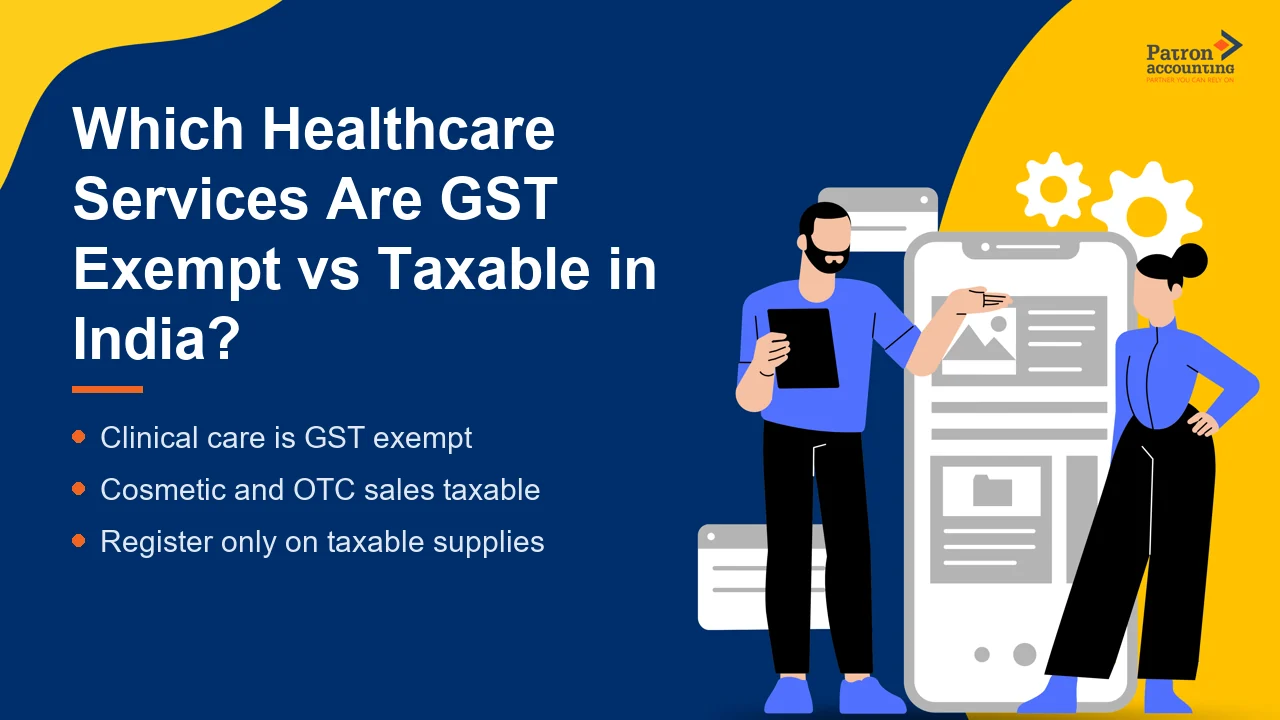
Yes and no: most healthcare is exempt from GST, but not all of it. Core clinical services provided by a clinical establishment, an authorised medical practitioner or paramedics are exempt under Notification No. 12/2017-Central Tax (Rate), Serial No. 74. The tax only appears at the edges of a hospital, on things such as cosmetic procedures, retail pharmacy sales and equipment hire. This guide sets out where the line sits, so that a clinic, a nursing home or a multi-speciality hospital can classify each receipt correctly and know whether GST registration is even required. For the wider bookkeeping picture of a medical practice, see our Healthcare Accounting Services overview.
Is GST applicable on healthcare services in India?
For genuine clinical work, no. The exemption at Sr. No. 74 covers "services by way of health care services by a clinical establishment, an authorised medical practitioner or para-medics". Health care services are defined as the diagnosis, treatment or care for illness, injury, deformity, abnormality or pregnancy in any recognised system of medicines in India, and the definition even extends to transporting the patient to and from the establishment. The important point is that the exemption follows the status of the provider and the nature of the service, not the size of the bill. A Rs 500 consultation and a Rs 5,00,000 cardiac surgery are equally exempt.
A recognised system of medicines means allopathy, Ayurveda, Yoga, Naturopathy, Unani, Siddha and Homeopathy. So an Ayurvedic clinic and an allopathic hospital sit on the same footing for the exemption.
Is GST payable on doctors' fees?
No. A doctor consulting patients, whether in an own clinic or as a visiting consultant to a hospital, supplies exempt healthcare services, so consultation fees carry no GST. This is also why a doctor with only professional income often stays outside the GST net entirely. Many practitioners instead report income under the presumptive scheme; we cover the mechanics in Section 44ADA Presumptive Taxation for Doctors Explained. Where a hospital pays a consultant, the concern shifts to TDS rather than GST, explained in TDS on Doctor Professional Fees and Consultant Payouts.
Which healthcare services are taxable?
Several revenue streams inside a clinical establishment fall outside the exemption and attract GST at the rate for that supply:
- Cosmetic and plastic surgery: elective procedures are taxable at 18 percent. The exemption returns only when the surgery restores or reconstructs anatomy or functions affected by congenital defects, developmental abnormalities, injury or trauma. Reconstruction after an accident or a mastectomy stays exempt; an elective nose job does not.
- Over-the-counter pharmacy sales: medicine sold across the counter to an out-patient, an attendant or a walk-in customer is a supply of goods, taxable at the medicine's own rate (most medicines at 5 percent).
- Room charges above Rs 5,000 per day: room rent exceeding Rs 5,000 per day per patient, excluding ICU, CCU, ICCU and NICU, is taxable at 5 percent without input tax credit.
- Equipment rental and manpower supply: hiring out a diagnostic machine or supplying staff to another establishment is a taxable service at 18 percent.
- Wellness, spa and cosmetic packages: a spa, salon or corporate wellness package sold separately from treatment is taxable at 18 percent because it is not the diagnosis or treatment of an illness.
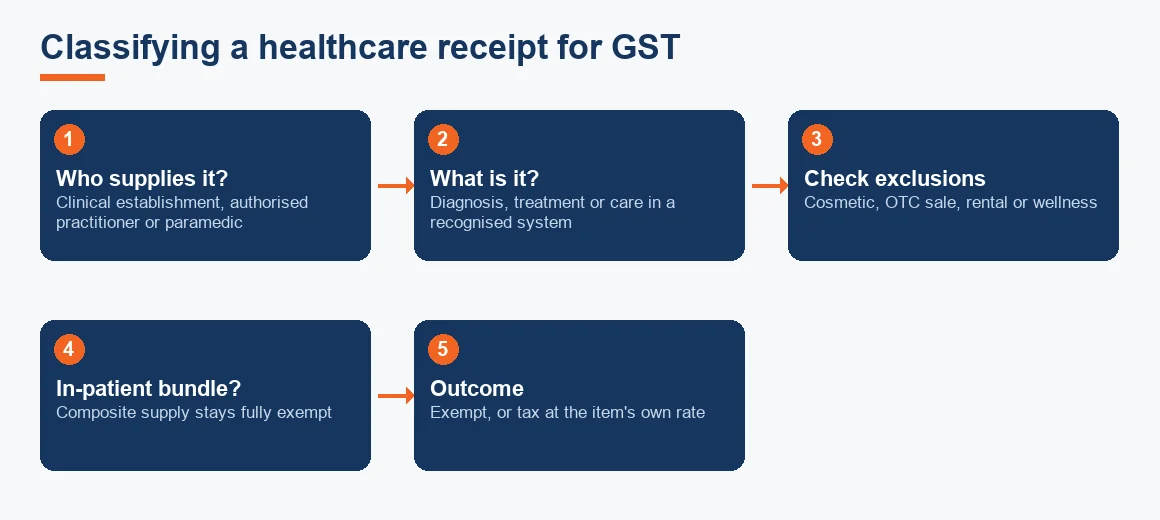
The composite supply rule for in-patients
When a patient is admitted, the bill usually bundles medicines, implants, consumables, room, nursing, food and the procedure itself. CBIC Circular No. 32/06/2018-GST clarified that this bundle is a single composite supply of healthcare services, with the treatment as the principal supply, so the entire in-patient bill is exempt. You do not carve out the pharmacy or the room and tax it separately. The same strip of tablets, however, sold from the hospital pharmacy to an out-patient is a standalone taxable supply. The differentiator is admission: inside the treatment package it is exempt, sold on its own it is taxed. You can read the circular on the CBIC GST portal.
Exempt vs taxable at a glance
The table below summarises where common healthcare receipts land. Treat the rates as indicative and confirm the current notification before billing.
| Supply | Position | Indicative GST rate |
|---|---|---|
| Doctor consultation and OPD | Exempt | Nil |
| In-patient treatment bundle (composite) | Exempt | Nil |
| Diagnostic and pathology tests by a clinical establishment | Exempt | Nil |
| Ambulance and patient transport | Exempt | Nil |
| Reconstructive surgery after injury or defect | Exempt | Nil |
| Elective cosmetic or plastic surgery | Taxable | 18% |
| Pharmacy OTC sale to out-patient | Taxable | 5% (item rate) |
| Non-ICU room above Rs 5,000 per day | Taxable, no ITC | 5% |
| Equipment rental or manpower supply | Taxable | 18% |
| Spa, salon or standalone wellness package | Taxable | 18% |
GST on medicines and on health insurance
Which medicines carry 5 percent GST? The large majority of formulations and medicaments sit at 5 percent, a small list of lifesaving drugs is at nil, and a narrow band of items sits higher. This matters only for the retail pharmacy counter and for the hospital's own procurement, never for medicines dispensed inside an exempt in-patient bundle. Expiry and stock discipline at the pharmacy is a separate control point, covered by our note on Pharmacy Stock Expiry Audit.
How much GST is charged on health insurance? Following the September 2025 rate rationalisation, individual life and health insurance policies are exempt from GST. This is a relief for patients rather than a matter the hospital bills, but it is the answer people are searching for, so it is worth stating plainly. Group and other commercial covers should be checked against the current position before assuming the same treatment. For a charitable hospital run under a trust, income also interacts with the income tax exemptions we summarise in Section 12A / 80G Annual Upkeep.
Why reverse charge quietly raises a hospital's costs
Because the main outward supply is exempt, a hospital cannot claim input tax credit. That turns every rupee of GST it pays into a cost. It bites hardest under reverse charge, where the hospital itself must pay GST in cash on inward supplies such as security services, goods transport, legal services and rent of commercial property from an unregistered landlord. That reverse charge tax cannot be recovered as credit and lands straight on the expense head. The transport element in particular is worth understanding through Goods Transport Agency (GTA) RCM, and where a hospital does have some taxable output, tracking eligible credit against GSTR-2B Input Tax Credit Matching stops recoverable tax leaking into cost.
Does a healthcare provider need GST registration?
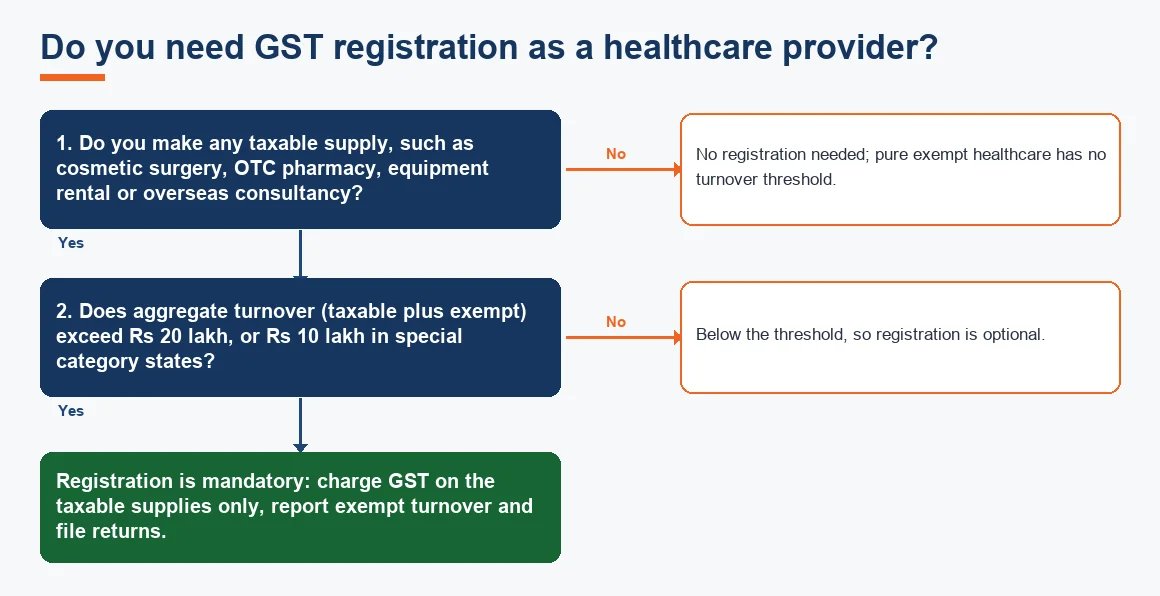
A provider making only exempt healthcare supplies is not required to register, whatever the fee income. Registration becomes necessary once taxable supplies exist and aggregate turnover crosses the threshold. The steps are:
- List every revenue stream and tag each as exempt or taxable using the table above.
- Compute aggregate turnover for the year, which includes exempt supplies as well as taxable ones.
- Check the threshold: Rs 20 lakh of aggregate turnover, or Rs 10 lakh in the special category states.
- If any taxable supply exists and the threshold is crossed, register on the GST portal and start charging GST on the taxable lines only.
- File returns and pay tax on taxable supplies while reporting exempt turnover for disclosure.
The receivables side, especially insurer and TPA settlements, is a common source of reconciliation pain regardless of GST status; we walk through it in How Hospitals Should Reconcile TPA and Insurance Receivables and in the glossary entry on Third-Party Administrator (TPA) Receivables.
Worked example: monthly GST for a mixed hospital
Take a mid-sized hospital with a busy pharmacy and a cosmetic wing. The exempt clinical revenue carries no GST, but the taxable lines create an output liability. Figures are indicative and Exl GST where a rate applies.
| Revenue stream | Value (Rs) | GST rate | Output GST (Rs) |
|---|---|---|---|
| In-patient and OPD clinical care (exempt) | 40,00,000 | Nil | 0 |
| Elective cosmetic procedures | 3,00,000 | 18% | 54,000 |
| Pharmacy OTC sales to out-patients | 5,00,000 | 5% | 25,000 |
| Diagnostic equipment rented to a partner clinic | 1,00,000 | 18% | 18,000 |
| Non-ICU room charges above Rs 5,000 per day | 2,00,000 | 5% (no ITC) | 10,000 |
| Total taxable supplies | 11,00,000 | 1,07,000 |
Aggregate turnover for the month is Rs 51,00,000 (exempt plus taxable), so registration is clearly mandatory: taxable supplies exist and the Rs 20 lakh annual threshold is passed many times over. Output GST of Rs 1,07,000 is payable, reduced by input tax credit on the pharmacy and cosmetic inputs, but not on the Rs 5,000-plus room line, which carries no ITC. Capital items such as the diagnostic machine also need correct capitalisation and depreciation, which you can size with our Depreciation Calculator.
Key terms
- Third-Party Administrator (TPA) Receivables: amounts due from insurers routed through a TPA against cashless hospital claims.
- Goods Transport Agency (GTA) RCM: reverse charge on freight, an irrecoverable cost for an exempt hospital.
- Pharmacy Stock Expiry Audit: periodic check that dated medicines are provisioned and written off.
- Section 44ADA Presumptive Cap: the receipts ceiling for doctors opting into presumptive taxation.
- GSTR-2B Input Tax Credit Matching: reconciling claimed ITC against the auto-drafted statement.
Key takeaways
- Clinical care by a clinical establishment, authorised practitioner or paramedic is GST exempt regardless of value.
- Cosmetic surgery, OTC pharmacy, equipment rental and non-ICU rooms above Rs 5,000 per day are taxable.
- An admitted patient's bundled bill is a composite supply and stays fully exempt (Circular 32/06/2018).
- Being exempt means no input tax credit, so reverse charge tax becomes a permanent cost.
- Register only when taxable supplies push aggregate turnover past Rs 20 lakh, or Rs 10 lakh in special category states.
Healthcare classification sits alongside the same discipline other sectors need; if you also run technology or early-stage ventures, see our guides on SaaS Accounting Services, IT and Software Company Accounting and Startup Accounting Services, or the broader accounting services hub. For a considered view on structuring a hospital's books end to end, the parent Healthcare Accounting Services page is the right place to take a commercial conversation forward.
Decision guide