In this guide
Three-way matching in accounts payable is a control that compares three documents (the purchase order, the goods receipt note and the vendor invoice) on quantity, rate and value, and releases payment only when all three agree. It is the single most common check that stops a business paying for goods it never ordered, never received, or is being billed too much for. This guide explains what the three documents are, how the match runs step by step, how it differs from two-way and four-way matching, and how Indian teams fold GSTR-2B into the same routine.
What is 3-way matching in accounts payable?
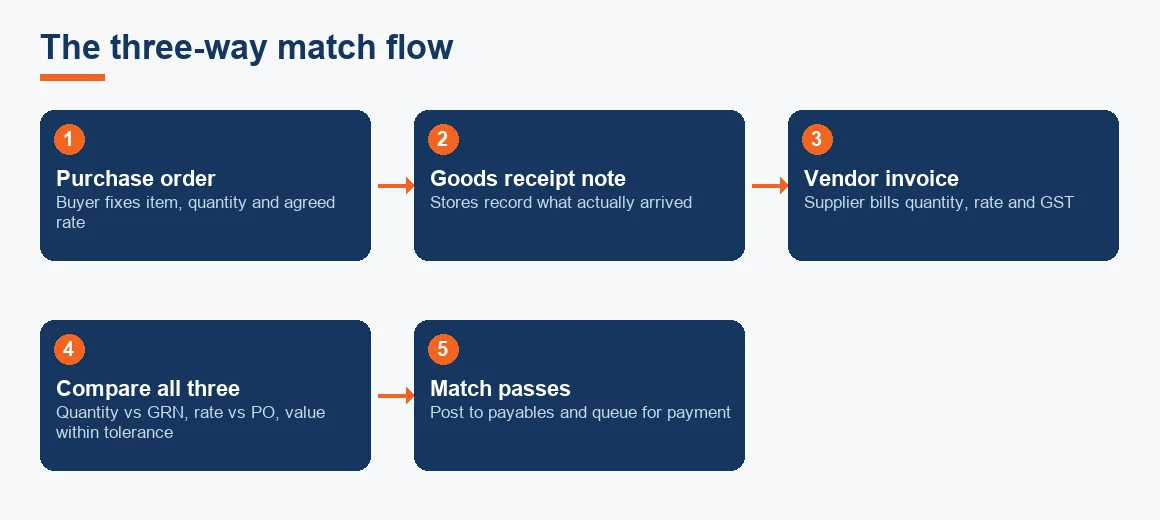
Think of it as three independent versions of the same transaction that have to line up. The purchase order says what you agreed to buy and at what price. The goods receipt note (GRN) records what actually arrived at your stores. The vendor invoice states what you are being asked to pay. In a clean three-way match, the quantity on the invoice does not exceed the quantity on the GRN, and the rate on the invoice equals the rate on the purchase order. When both hold, the invoice is posted to accounts payable and queued for payment. When either fails, the invoice is parked as an exception and nobody is paid until it is cleared. This sits at the heart of the wider accounts payable process across the full P2P cycle.
What documents are needed for a 3-way match?
You need exactly three source documents, each owned by a different function so that no one person controls the whole chain:
- Purchase order: raised by the buyer or requisitioner, it fixes the item, quantity, agreed rate, delivery terms and the vendor GSTIN.
- Goods receipt note: raised by stores or the warehouse when material physically lands, it records the quantity actually received and any short or damaged supply.
- Vendor invoice: raised by the supplier, it carries the billed quantity, rate, taxable value, GST break-up and invoice number.
Can you do 3-way matching without an invoice? No. Without the invoice there is nothing to pay against, so at most you have a two-way check of PO against GRN to confirm receipt. The match only becomes a three-way match once the bill arrives.
How to do 3-way matching in accounts payable, step by step
The routine is the same whether it is done by hand in a spreadsheet or automatically inside an ERP. Larger teams reduce the manual effort with AP automation that cuts invoice processing costs, but the logic below does not change.
- Pull up the vendor invoice and locate the purchase order number quoted on it.
- Retrieve the matching purchase order and the goods receipt note for that PO.
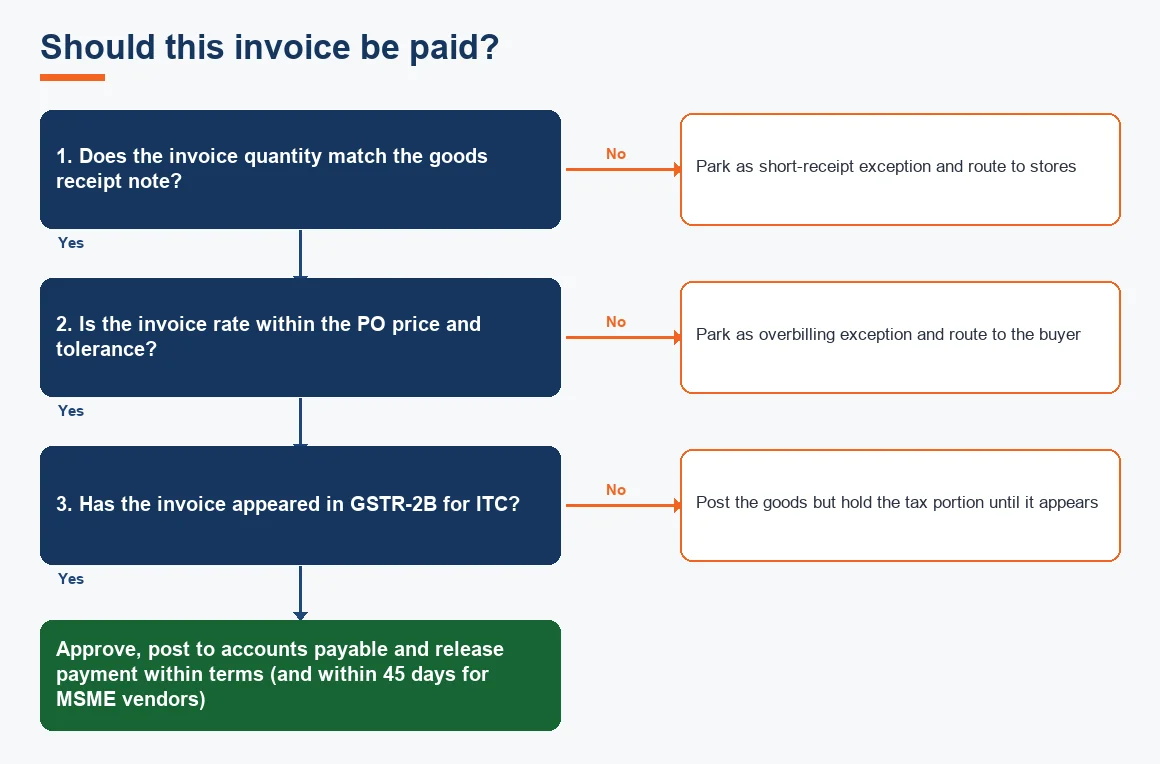
- Compare invoice quantity against GRN quantity. The invoice must not bill more units than were received.
- Compare invoice rate against PO rate. The rate must not exceed the agreed price.
- Recompute the taxable value (quantity times rate) and check it against the invoice value within your written tolerance.
- Check the GST break-up, the vendor GSTIN and the invoice number for duplicates.
- If everything agrees, approve and post the invoice; if anything fails, park it as an exception and route it to the right owner.
2-way vs 3-way vs 4-way matching
The right level of matching depends on whether goods physically arrive and whether they need to be tested before acceptance. Two-way matching is used where nothing is received, so there is no GRN to check: services, rent, utilities, subscriptions and professional fees. Four-way matching adds an inspection or quality report and is used where material is accepted only after testing.
| Match type | Documents compared | Typical use | Control replacing the missing document |
|---|---|---|---|
| Two-way | PO + Invoice | Services, rent, subscriptions, professional fees | Requisitioner's written approval (no goods received) |
| Three-way | PO + GRN + Invoice | Physical goods, raw materials, consumables | None; standard control for goods purchases |
| Four-way | PO + GRN + Invoice + Inspection report | Pharma inputs, engineering components, food ingredients | Quality acceptance report clears the batch before payment |
You will sometimes see this described as "2, 3 and 4 way matching": the numbers simply count how many documents have to agree. A GRN three-way match is just the everyday name for the three-document version applied to goods.
Why is the 3-way match considered an internal control?
It is a control because it enforces segregation of duties. Three different people in three different roles create the three documents: the buyer raises the PO, stores raise the GRN, the vendor issues the invoice. For a fraudulent or careless payment to slip through, all three would have to be wrong in the same direction at the same time, which is far harder to arrange than a single fake bill. That is why the three-way match appears in almost every list of financial internal controls and in most audit checklists. It also gives a clean audit trail: an auditor can pick any payment and walk it back to an order and a receipt.
Who is responsible for performing the 3-way match, and what tolerance limits apply?
The match itself is usually performed by the accounts payable team, but the evidence comes from others: the buyer owns the PO, stores own the GRN, and AP simply confirms the three agree before posting. In a fully automated set-up the ERP performs the match and only routes the exceptions to a human. Whoever runs it, the tolerances must be written into a standard operating procedure rather than decided invoice by invoice.
A common Indian practice is to auto-clear quantity differences up to 2 per cent of value or Rs 1,000, whichever is lower, and to allow no positive tolerance at all on rate above the PO price. Freight and rounding get their own small limits. These sit inside a wider purchase order tolerance policy that everyone follows the same way.
What are common 3-way matching errors, and what happens when a match fails?
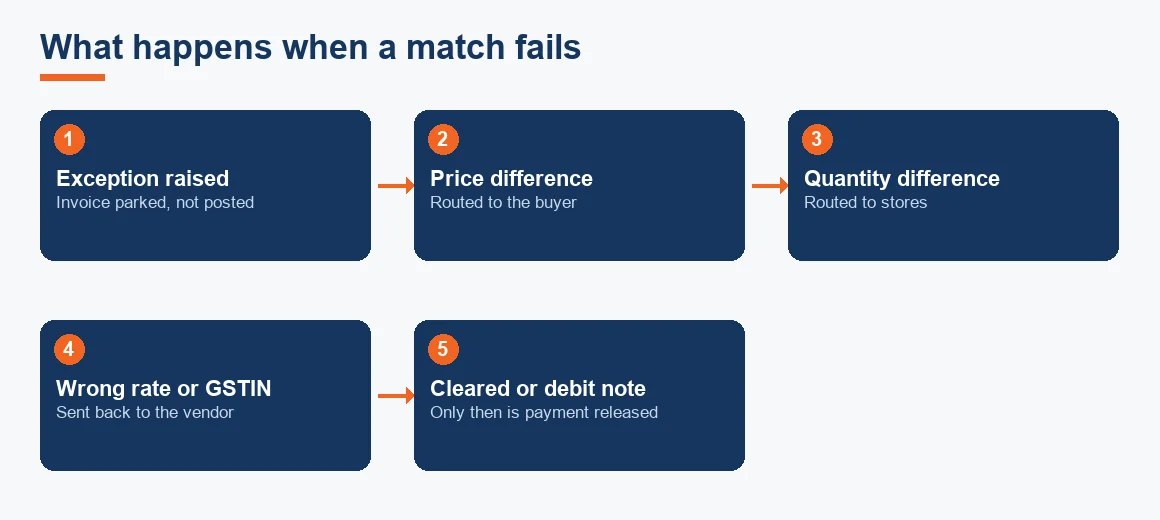
Most failures fall into a handful of buckets: the invoice bills more units than the GRN records (short receipt), the rate is above the PO price (overbilling), the same invoice number is submitted twice (duplicate), the vendor GSTIN is missing or wrong, or the PO reference is simply not quoted. When a three-way match fails, the invoice is parked as an exception instead of being posted, and it is routed to the owner of the problem: to the buyer for a price difference, to stores for a quantity difference, or back to the vendor for a wrong rate or missing GSTIN. Nothing is paid until the exception is cleared or a debit note is raised, and exception ageing is reviewed at every month end. This overlaps with, but is not the same as, vendor reconciliation, which matches supplier statements to your ledger after invoices are posted.
How GSTR-2B reconciliation fits into invoice matching
Indian teams add a fourth check that has nothing to do with goods and everything to do with tax. Input tax credit can be claimed only on invoices the supplier has actually reported, which appear in your GSTR-2B input tax credit matching statement, under the condition in section 16(2)(aa) of the CGST Act. So an invoice can pass a clean three-way match on goods and still have its tax portion held until it shows up in GSTR-2B on the GST portal. The credit itself has to be claimed by 30 November following the financial year, per the timelines the CBIC publishes. Two other statutory points ride alongside the match: TDS under section 194Q on purchases of goods above the annual threshold, which the Income Tax Department governs, and the section 43B(h) rule that payments to MSME vendors must clear within 45 days to stay deductible.
Worked example: a 3-way match with a price and quantity mismatch
A distributor orders 100 boxes at an agreed Rs 250 each. Stores receive only 98 boxes. The vendor then bills 100 boxes at Rs 260. Here is how the three documents line up (values are indicative and Exl GST).
| Document | Quantity | Rate (Rs) | Value (Rs) | Result of match |
|---|---|---|---|---|
| Purchase order | 100 | 250 | 25,000 | Agreed baseline |
| Goods receipt note | 98 | - | - | 2 boxes short received |
| Vendor invoice | 100 | 260 | 26,000 | Fails: overbilled and short received |
| Correct payable | 98 | 250 | 24,500 | 98 received at PO rate |
The invoice fails on two counts. The rate of Rs 260 is Rs 10 above the PO price, and no positive rate tolerance is allowed, so the whole invoice is parked. The billed quantity of 100 also exceeds the 98 actually received. AP holds the Rs 26,000 invoice, routes the rate query to the buyer and the short-receipt query to stores, and asks the vendor for a revised invoice or a debit note. The most that should ever be paid without correction is Rs 24,500 (98 boxes at Rs 250), and only once a matching credit or fresh invoice arrives.
Key terms
- Three-Way Matching: agreeing PO, GRN and invoice on quantity, rate and value before payment.
- Purchase Order (PO) Tolerance: the written limits within which small differences are auto-cleared.
- GSTR-2B Input Tax Credit Matching: checking a purchase invoice against the auto-drafted GSTR-2B before claiming ITC.
- Segregation of Duties (SoD): splitting a task across people so no one controls the whole chain.
- Section 43B(h) MSME Clock: the 45-day window to pay MSME vendors for the expense to stay deductible.
Where the match fits in your wider payables control
The three-way match is one link in a longer chain. It sits after ordering and receipt and before payment, and it feeds into month-end reconciliation. Teams that fall behind on posting often rebuild the match discipline through backlog bookkeeping and catch-up work, while the payment side is closed off by bank and credit card reconciliation and the receivables mirror image is handled through accounts receivable outsourcing. If the volume of exceptions is more than a small team can carry, the whole function, including matching, can be run through accounts payable outsourcing so the control runs the same way every day.
Key takeaways
- A three-way match approves an invoice only when the PO, GRN and invoice agree on quantity, rate and value.
- Use two-way matching where no goods are received and four-way matching where a quality report is required.
- The control works because three roles own the three documents; never let one person hold all three.
- Write your tolerances into an SOP; allow no positive tolerance on rate above the PO price.
- Add GSTR-2B as a fourth check, and mind section 194Q TDS and the 43B(h) 45-day MSME clock alongside the match.
Decision guide