In this guide
The accounts payable process is the set of steps a business uses to capture, verify and pay the bills it receives from suppliers. It is the back half of the wider procure to pay (P2P) cycle, which starts when someone raises a purchase requisition and ends when the supplier is paid and the account reconciled. Procurement owns the ordering side; accounts payable owns everything from the moment the invoice arrives, including the two checks that are unique to India, namely the correct TDS deduction and the input tax credit match. This guide walks through each step, who needs a formal process, and the numbers that decide how it runs.
What the accounts payable process actually covers
At its simplest, accounts payable is the short term money a business owes to trade suppliers for goods and services it has already received but not yet paid for. The process around it is the discipline that makes sure each of those amounts is real, correctly valued, approved by the right person and settled on time. Get it right and you protect cash, claim the tax credit you are entitled to and keep suppliers on side. Get it loose and you end up paying duplicate invoices, missing statutory deadlines or losing credit you cannot recover.
It helps to separate two things people often blur together. There are the two types of payable: trade payables, which arise from your normal purchases, and non-trade or accrued payables, such as utilities, rent or a professional fee bill. The process below applies to both, though trade payables are where purchase order matching does most of the work.
The P2P cycle from requisition to payment
The full cycle is best seen as a chain of handoffs, each with its own control. Procurement handles the first half, raising the requisition and the purchase order and confirming that goods or services arrived. Accounts payable takes over at invoice receipt and carries it through to a cleared payment and a reconciled ledger.
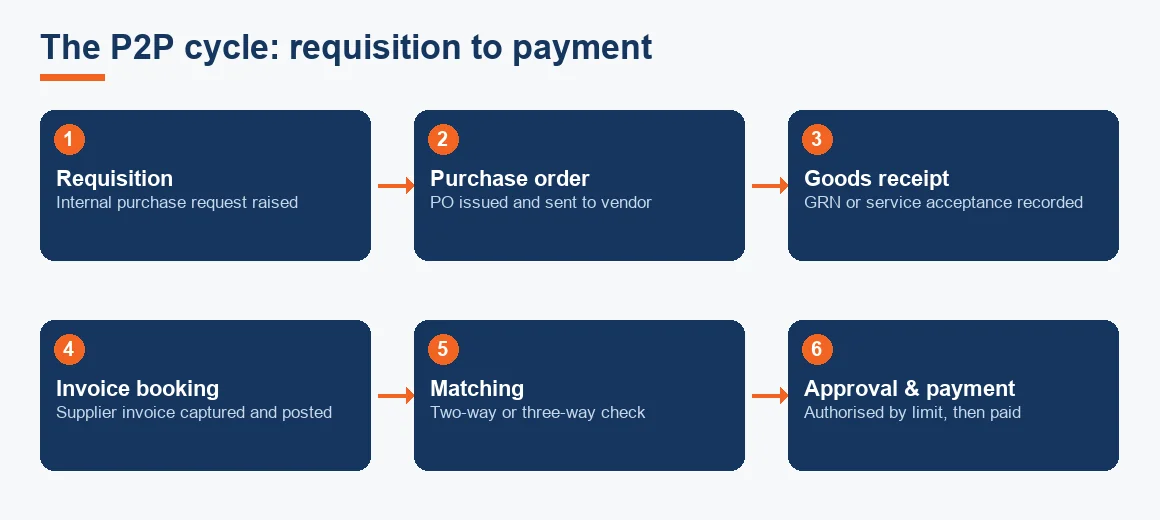
The value of drawing it this way is that responsibility never falls into a gap. Every arrow is a point where one team hands work to the next with a document that proves the step was done, whether that is an approved requisition, a signed purchase order or a goods receipt note.
The steps in the accounts payable process
Full cycle AP processing, the phrase you will see in job descriptions, simply means owning every one of these steps rather than a single slice of them.
- Receive and capture the invoice. Log the supplier invoice the day it arrives, whether it comes by email, portal or e-invoice feed, and record the invoice number so a duplicate cannot slip through later.
- Book it against the right ledger. Post the bill as a journal entry to the correct expense or asset head and supplier account in the general ledger, so the liability is visible from the day it is recognised.
- Match it. Compare the invoice to the purchase order and, for physical goods, the goods receipt note, checking that item, quantity, rate and total agree within an agreed tolerance.
- Apply the Indian tax checks. Decide the TDS section and rate, and confirm the invoice appears in your GSTR-2B before you rely on the input tax credit.
- Route for approval. Send the invoice to the authorised approver based on value limits, so no one both raises and clears the same payment.
- Pay and record. Release the payment through the bank, then post it against the supplier account so the payable clears.
- Reconcile. Periodically match the supplier statement to your ledger to catch missing bills, unapplied credit notes and short payments.
Two-way and three-way matching
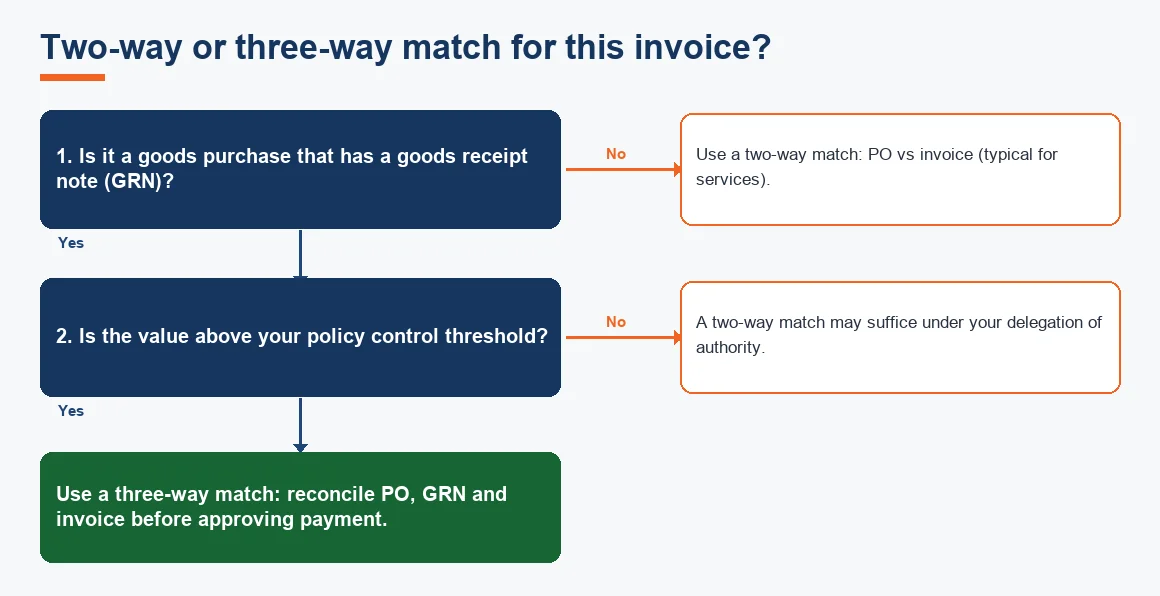
Matching is the control that stops you paying for what you did not order or did not receive. Two-way matching compares the supplier invoice against the purchase order alone, checking item, quantity, rate and value. It is used for services and other spend where no goods receipt note exists. Three-way matching adds the goods receipt note and is the norm for physical goods, since it also proves the quantity actually turned up. If you want the mechanics of the three document check in detail, our companion piece on three-way matching in accounts payable works through a full example, and the term itself is defined in the three-way matching glossary entry.
A worked three-way match
To see the control in action, take a single purchase order with two line items and follow it through the goods receipt note and the vendor invoice. The match holds on the first line and fails on the second, where the invoice bills for more than was received, so accounts payable clears the agreed amount and holds the difference until the short delivery is resolved. Rates are indicative and Exl GST.
| Line item | PO qty | PO rate (Rs) | PO value (Rs) | GRN qty received | Invoice qty | Invoice value (Rs) | Matched amount (Rs) | Result |
|---|---|---|---|---|---|---|---|---|
| A4 paper (reams) | 100 | 500 | 50,000 | 100 | 100 | 50,000 | 50,000 | Matched, cleared for payment |
| Toner cartridges | 20 | 4,000 | 80,000 | 18 | 20 | 80,000 | 72,000 | Exception: invoice bills 20 but only 18 received, Rs 8,000 held |
| Total | 1,30,000 | 1,30,000 | 1,22,000 | Rs 8,000 on hold pending a credit note or the balance delivery |
Only the amount that clears all three documents, Rs 1,22,000, is released; the Rs 8,000 gap on the toner line stays flagged until the supplier sends the missing two units or a credit note. That is exactly what the tolerance rule protects, and it is why the goods receipt note, not the invoice, sets the quantity you actually pay for.
Who needs a formal AP process
Any business that buys on credit needs one, but the pain point differs by size. A young company with a handful of suppliers can manage on a shared inbox and a spreadsheet, though it still has to deduct TDS and reconcile GST from its very first vendor bill. As the invoice count climbs into the hundreds a month, informal handling breaks down: duplicates creep in, approvals stall, and the month-end close drags. That is usually the point at which founders either build an internal AP function or move it to a specialist, and it is the same trigger behind accounts payable outsourcing. Businesses coming out of a period of neglected books often pair that decision with a backlog bookkeeping and catch-up exercise to clear the arrears first.
The Indian tax checks built into AP
This is where an Indian accounts payable process differs from the textbook version. Two statutory checks sit inside the flow and cannot be skipped.
The first is TDS. When you book or pay a vendor invoice, whichever is earlier, you may have to deduct tax at source depending on the nature of the expense, then deposit it with the Income Tax Department by the 7th of the following month. The section and rate turn on what you bought.
| Section | Nature of payment | Common rate |
|---|---|---|
| 194C | Contract or works | 1% (individual/HUF), 2% (others) |
| 194J | Professional fees | 10% |
| 194J | Technical services | 2% |
| 194I | Rent of plant and machinery | 2% |
| 194I | Rent of land or building | 10% |
| 194Q | Purchase of goods over Rs 50 lakh | 0.1% |
The second check is input tax credit. Under the GST rules you can only claim credit on a purchase once the supplier has reported it and it appears in your auto-drafted GSTR-2B. So a disciplined AP team reconciles each vendor invoice against GSTR-2B before treating the credit as available, and chases suppliers who have not filed. Doing this at invoice booking, rather than at the return deadline, is what keeps working capital from leaking. Automating both checks is a topic in its own right, covered in our note on how AP automation reduces invoice processing costs.
The month-end AP sequence
Beyond the daily flow, accounts payable has a monthly rhythm that has to line up with the statutory calendar.
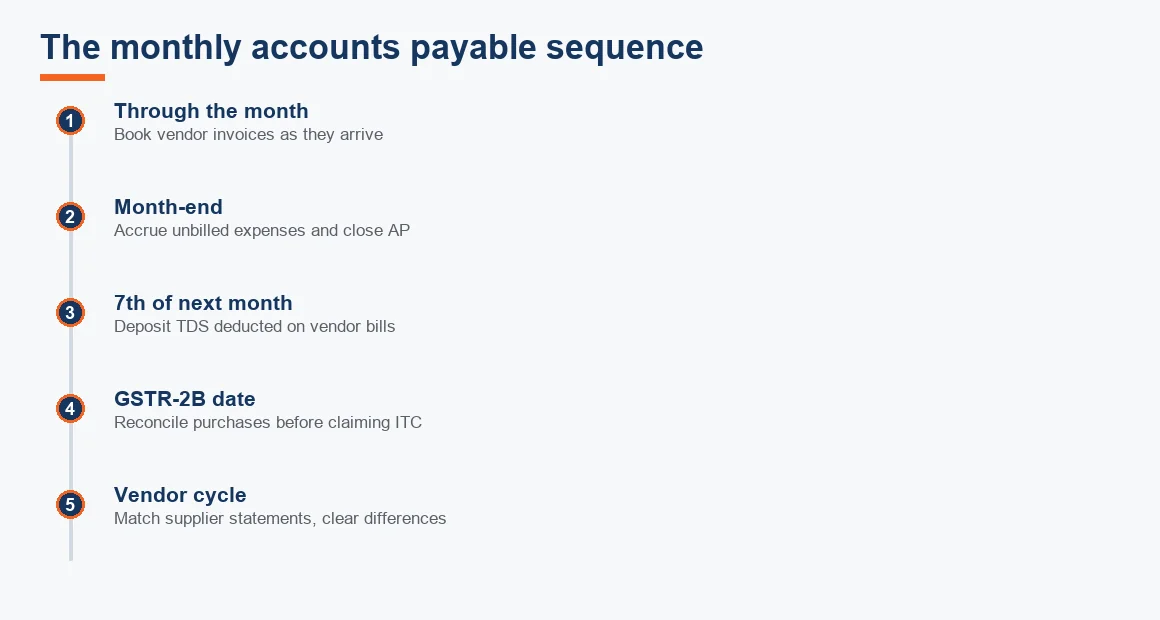
Missing any one of these dates has a cost. A late TDS deposit attracts interest and can disallow the expense; an unreconciled GSTR-2B means credit claimed today may have to be reversed later. Building the sequence into a repeatable close checklist is what stops the scramble.
Days payable outstanding and the MSME clock
Once the process runs cleanly, the question becomes how long to take before paying. Days payable outstanding (DPO) measures exactly that: average trade payables divided by annual purchases, multiplied by 365. A firm with average payables of Rs 60 lakh against purchases of Rs 3.6 crore has a DPO of about 61 days. A higher DPO frees up cash, which is why finance teams watch it closely.
There is a hard limit, though. If a supplier is registered as a micro or small enterprise, the MSMED Act requires payment within the period agreed in writing, which cannot exceed 45 days, and within 15 days where there is no written agreement; section 43B(h) of the Income Tax Act then disallows the expense in the year of purchase if you miss that window. Stretching DPO across such vendors is a false economy, and we cover the rule in full in our guide to paying MSME vendors within 45 days.
Accounts payable and accounts receivable
People often ask about the AP and AR process together because they mirror each other. Accounts payable is money you owe suppliers; accounts receivable is money customers owe you. The two are managed by separate teams under a proper segregation of duties, and both feed the cash flow forecast. The receivables side has its own controls and cadence, handled through accounts receivable outsourcing, and the payment side of AP relies on clean bank and credit card reconciliation so that every released payment ties back to a bank entry. Vendor reconciliation, the final AP step, has enough depth to warrant its own read in our vendor reconciliation guide.
Key terms
- Accounts Payable: the short term amounts a business owes suppliers for goods and services already received.
- Three-Way Matching: checking the invoice against both the purchase order and the goods receipt note before approval.
- GSTR-2B Input Tax Credit Matching: confirming a purchase appears in your auto-drafted GSTR-2B before claiming the GST credit.
- Section 43B(h) MSME Clock: the rule that disallows an expense if a registered micro or small vendor is not paid within 45 days.
Key takeaways
- The accounts payable process is the back half of the P2P cycle, running from invoice receipt to payment and reconciliation.
- Every handoff carries a control, and the single most useful one is matching the invoice to the purchase order, with a goods receipt note added for physical goods.
- Indian AP has two checks the textbook omits: the correct TDS deduction (deposited by the 7th) and a GSTR-2B match before claiming input tax credit.
- Book the invoice as soon as it arrives, not at approval, so payables are never understated at month end.
- DPO tells you how long you take to pay, but the MSMED Act and section 43B(h) cap it at 45 days for registered micro and small vendors.
Decision guide