In this guide
Section 43B(h) of the Income Tax Act, in force from assessment year 2024-25, disallows a deduction for any sum a business owes a micro or small enterprise if the payment is not made within the time limit set by the MSMED Act, 2006. In plain terms, if you buy from a registered micro or small supplier and pay late, the purchase cost is added back to your taxable profit for that year and allowed only in the year you actually settle the bill. The rule turns a routine 43b(h) vendor payment question into a timing problem that belongs inside the monthly payment run, not the year-end close.
What is the MSME 45-day payment rule?
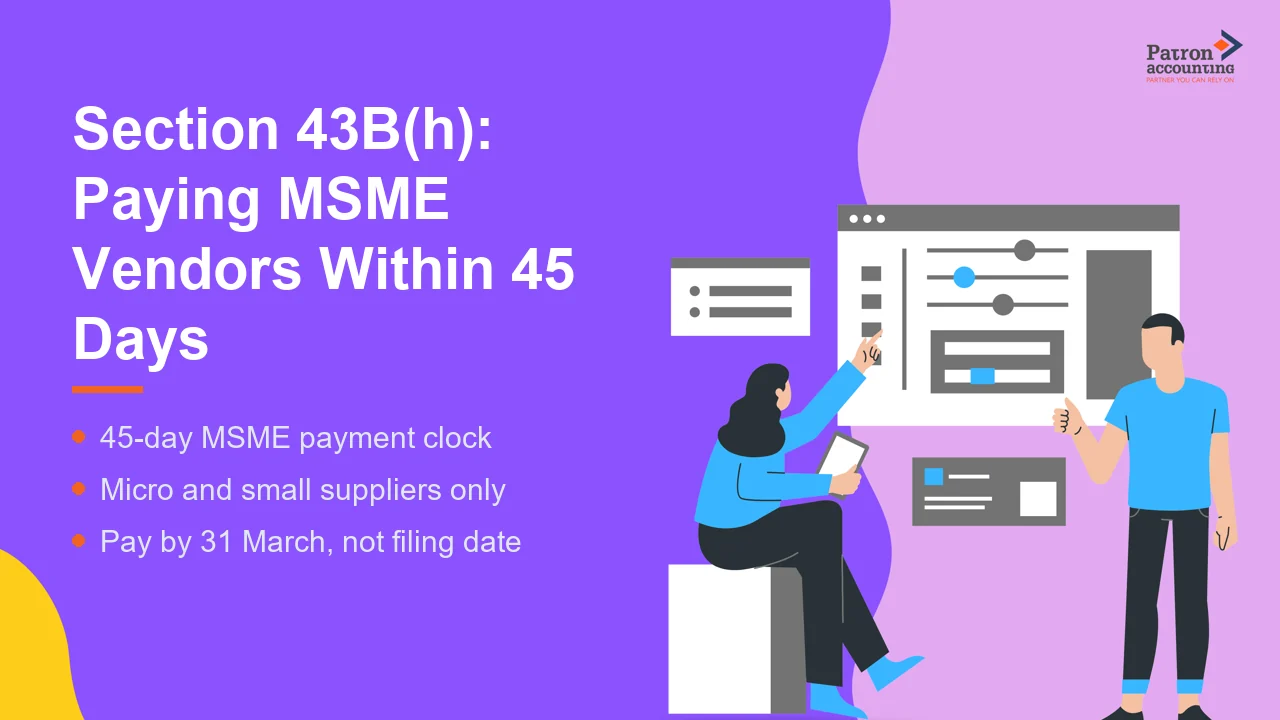
The 45-day figure comes from Section 15 of the Micro, Small and Medium Enterprises Development Act, 2006, not from the Income Tax Act itself. Section 15 fixes the outer limit within which a buyer must pay a micro or small supplier. Section 43B(h) simply borrows that limit and attaches a tax consequence to breaching it. So the two statutes work together: the MSMED Act sets the clock, and the income tax provision decides what happens to your deduction when the clock runs out.
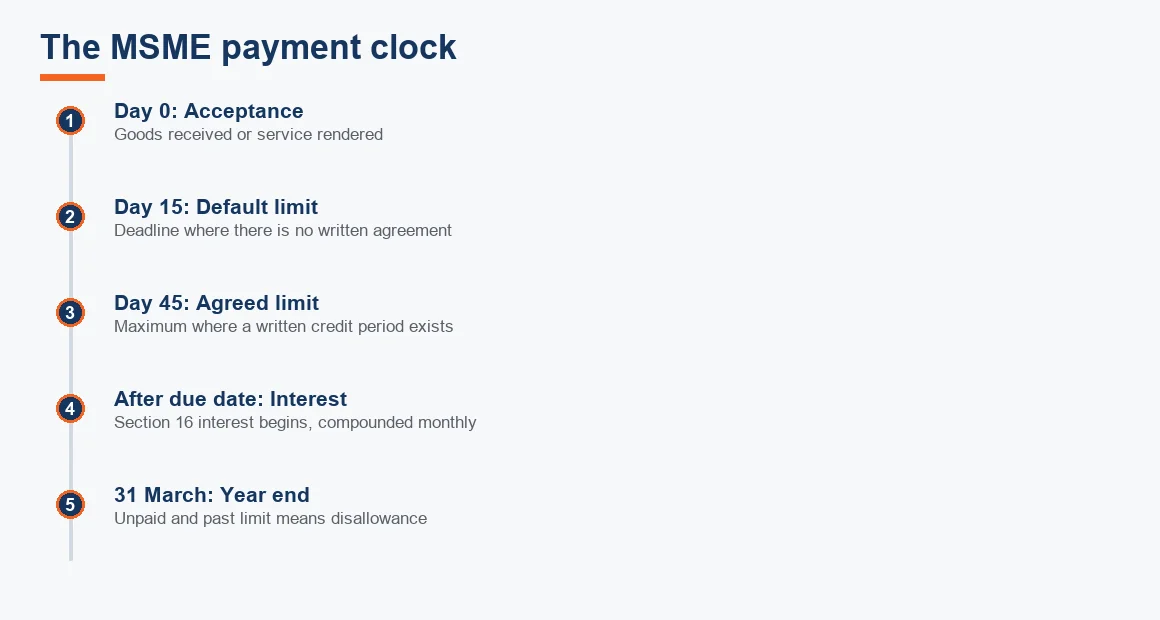
The limit is not always 45 days. Where there is no written agreement on the credit period, the deadline is 15 days from the day the goods are accepted or the service is rendered. Where the parties have agreed a credit period in writing, the buyer gets that longer period, but only up to a hard ceiling of 45 days. A purchase order or signed supply term that promises 60 or 90 days is void for this purpose; the law caps the recognised period at 45 days regardless of what the contract says.
Who is Section 43B(h) applicable to?
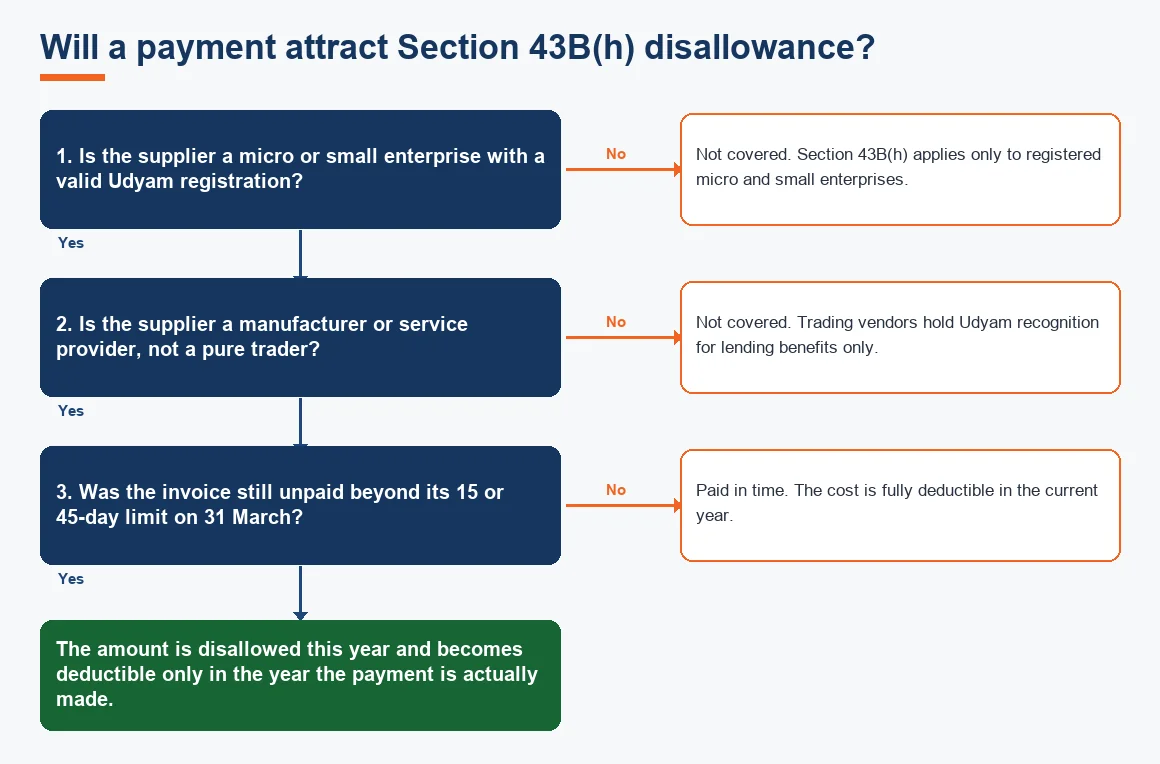
Two conditions decide coverage. First, the supplier must be a micro or small enterprise, not a medium one. Section 43B(h) deliberately leaves medium enterprises out, so a late payment to a medium supplier carries no add-back. Second, the supplier must hold a valid Udyam registration on the date of supply. Without a Udyam number you have no reliable way to classify the vendor, and the burden of proof sits with the buyer claiming the deduction.
Traders are a common trap. A trading enterprise can register on Udyam, but the MSME Ministry office memorandum of 2 July 2021 recognises that registration only for priority sector lending, not for the substantive protections of the MSMED Act. Because Section 43B(h) follows the MSMED Act definition of enterprises engaged in manufacturing or providing services, a delayed payment to a pure trading vendor is not disallowed even if that vendor shows a Udyam number on the invoice. Confirm the activity, not just the certificate. Tracking this cleanly across a large ledger is part of a well-run accounts payable function, and a vendor master that captures Udyam status at onboarding saves a painful sort at year end.
The 15-day versus 45-day clock: which deadline applies?
Getting the deadline right matters because most buyers assume 45 days is automatic. It is not. The default in the absence of a written credit term is 15 days, and many small purchases from local suppliers have no written terms at all. The table below sets out the four situations you will meet in practice.
| Scenario | Payment deadline | Basis |
|---|---|---|
| Micro or small supplier, no written credit agreement | 15 days from acceptance | Section 15 MSMED Act default |
| Micro or small supplier, written credit agreement | The agreed period, capped at 45 days | Agreed period, ceiling under Section 15 |
| Medium enterprise supplier | No 43B(h) limit applies | Only micro and small are covered |
| Trader registered on Udyam | Not covered by 43B(h) | Udyam recognised for lending only |
The clock starts on the day of acceptance, which is the date the buyer receives the goods or service, or, where a written objection is raised within 15 days, the date the objection is resolved. Robust three-way matching between the purchase order, the goods receipt note and the invoice gives you a defensible acceptance date, which is exactly the date the 43B(h) clock hangs on.
What happens if payment is not done in 45 days?
If a covered invoice is still unpaid at the close of the financial year, on 31 March, and the deadline had already passed, the amount is disallowed in that year. It is added back to your business income and increases your tax for the year even though the expense sits in the profit and loss account as usual. The deduction is not lost forever; it returns in the previous year in which the payment is actually made. So a March 2026 disallowance that you clear in May 2026 becomes deductible in the year ending 31 March 2027.
One feature catches many buyers off guard. For most items in Section 43B, paying before the due date for filing the income tax return preserves the deduction. Section 43B(h) is carved out of that first proviso. The only date that saves the deduction is 31 March, the financial year end, not the later return filing date. If the invoice is unpaid on 31 March and past its limit, the add-back stands even if you pay on 1 April.
What is the interest on delayed payment to MSME vendors?
Alongside the tax add-back, the MSMED Act imposes its own penalty. Section 16 makes a late-paying buyer liable to compound interest, with monthly rests, at three times the bank rate notified by the Reserve Bank of India, calculated from the day after the due date until actual payment. This is a commercial liability the supplier can enforce, and it is heavier than ordinary trade interest. To make matters worse, Section 23 of the MSMED Act, read with the income tax law, treats that interest as non-deductible, so you cannot even claim it as an expense. You can confirm the prevailing bank rate on the Reserve Bank of India website before computing any figure.
Interest under Section 16 arises whether or not the supplier raises a demand and whether or not it is recorded in the accounts, so it is a genuine contingent cost of paying late, separate from the deduction timing handled by Section 43B(h).
Worked example: how is MSME delayed payment calculated?
Take a manufacturer that buys packaging from a registered small enterprise. Goods are accepted on 1 February 2026, a written agreement sets a 45-day credit period, so payment is due by 18 March 2026. The invoice of Rs 8,00,000 is still unpaid on 31 March 2026 and is finally settled on 20 May 2026. The table shows the effect on two financial years, using an indicative tax rate of 25 per cent.
| Particulars | FY 2025-26 | FY 2026-27 |
|---|---|---|
| Purchase booked in profit and loss account | Rs 8,00,000 | Nil |
| Disallowance added back under 43B(h) | Rs 8,00,000 | Nil |
| Deduction restored in year of payment | Nil | Rs 8,00,000 |
| Extra tax outflow at 25 per cent (indicative) | Rs 2,00,000 | (Rs 2,00,000) reversed |
The Rs 8,00,000 cost never disappears, but the business funds an extra Rs 2,00,000 of tax a year early purely because the bill was two weeks late. On top of that, Section 16 interest runs from 19 March 2026 at three times the RBI bank rate, compounded monthly, until 20 May 2026. That timing gap is also a deferred tax item: the disallowance creates a deductible temporary difference, and our Deferred Tax (DTA/DTL) Calculator shows how the reversing asset unwinds in the following year.
How to comply with the MSME payment rule
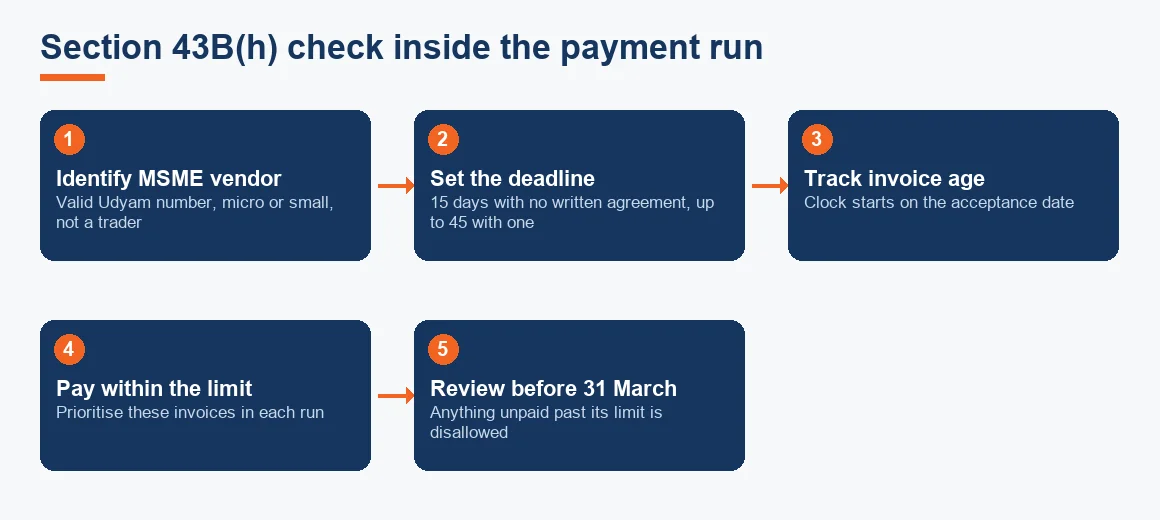
Compliance is a process design question, not a year-end reconciliation. The workable approach tracks the clock inside every payment run so no covered invoice quietly crosses its deadline.
- Flag at onboarding. Capture the Udyam number and enterprise type in the vendor master before the first purchase, and mark micro and small suppliers distinctly.
- Stamp the acceptance date. Record the goods receipt or service completion date on every covered invoice, since that, not the invoice date, starts the clock.
- Set the correct deadline. Apply 15 days where there is no written credit term and the agreed period, capped at 45 days, where there is one.
- Prioritise the run. Sort each payment cycle so MSME invoices approaching their limit are cleared first, ahead of larger non-covered vendors.
- Review before 31 March. Pull an ageing of all unpaid micro and small invoices in the last fortnight of March and clear anything past its deadline before the year closes.
If your books are behind and you cannot even see which invoices are covered, a catch-up bookkeeping exercise to rebuild the payable ledger comes first, followed by regular vendor reconciliation so supplier statements and your ledger agree on what is genuinely outstanding.
What if a buyer delays MSME payments, and is the rule mandatory?
The rule is mandatory. Section 43B(h) is a statutory disallowance that a tax auditor must report and that flows into the tax computation automatically; there is no election to opt out. A buyer who delays a covered payment faces the add-back, the earlier tax outflow, and the Section 16 interest exposure at the same time. The one narrow relief is the presumptive scheme: a business taxed under Section 44AD or 44ADA computes income as a fixed percentage of turnover, so individual expenses are never separately allowed or disallowed and no add-back arises, although the MSMED interest still exists commercially.
For the supplier side of the same coin, chasing your own overdue receivables from customers is handled through accounts receivable outsourcing, and clean bank and credit card reconciliation confirms which payments have actually cleared. To understand where the 43B(h) checkpoint sits in the wider workflow, our guides to the full accounts payable process and to AP automation place it inside the procure-to-pay cycle. The primary law itself is available from the Income Tax Department.
Key terms
- Section 43B(h) MSME Clock: the 15 or 45-day countdown that decides whether a micro or small supplier payment is deductible this year.
- Accounts Payable: the ledger of amounts a business owes suppliers, where the 43B(h) check lives.
- Three-Way Matching: matching the purchase order, goods receipt note and invoice to fix a defensible acceptance date.
- Accrued Liabilities: expenses recognised before payment, which is why a booked purchase can still be disallowed when unpaid.
- Vendor Balance Confirmation: agreeing outstanding balances with a supplier so overdue MSME dues are not missed.
Key takeaways
- Section 43B(h) allows a micro or small supplier cost only in the year of actual payment when the MSMED Act limit is breached.
- The limit is 15 days without a written agreement and up to 45 days with one, never more than 45.
- Only Udyam-registered micro and small manufacturers or service providers are covered; medium enterprises and traders are not.
- Payment must clear by 31 March, not the return filing date, to keep the deduction in the current year.
- Section 16 interest at three times the RBI bank rate runs on top and is itself non-deductible.
Decision guide