In this guide
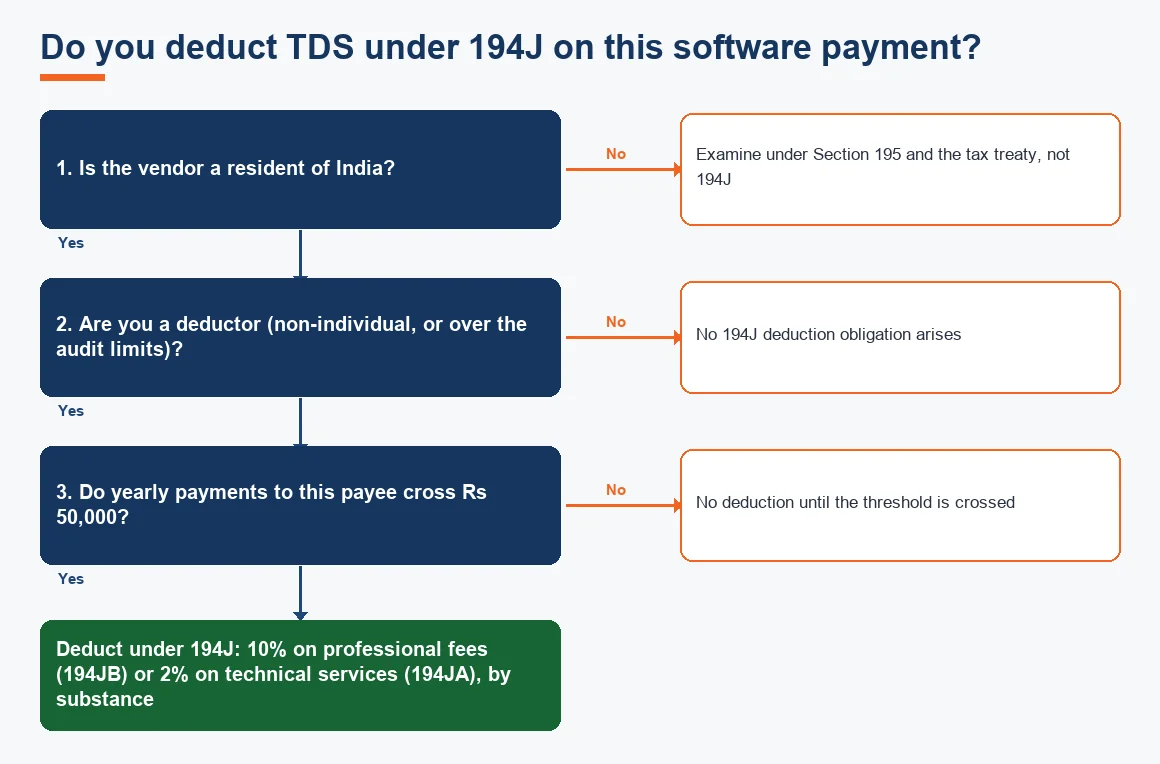
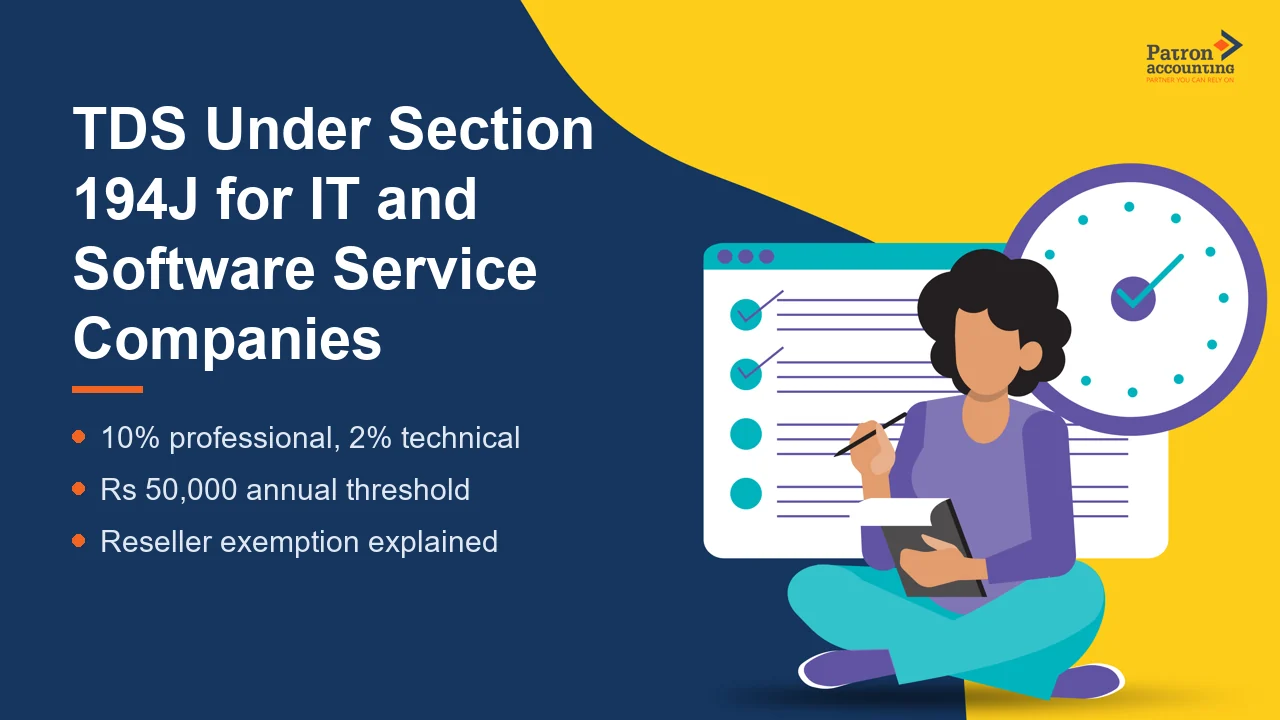
TDS on software services in India is, in most domestic cases, governed by Section 194J of the Income Tax Act. If your company pays an Indian vendor for software development, technical support, consultancy or a licence, you generally deduct 10 per cent on professional fees and royalty, and 2 per cent on fees for technical services, once yearly payments to that vendor cross Rs 50,000. The harder part is not the rate: it is deciding which limb of 194J applies, when 194C is the right section instead, and when no deduction is due at all. This explainer sets out the working, not just the rule.
Is TDS applicable on software payments made in India?
Usually yes, when you pay a resident vendor. Software rarely arrives as a plain good: it comes bundled with development effort, customisation, support or a right to use, and each of those is caught somewhere in the TDS net. The common outcomes are Section 194J for professional or technical services, Section 194C for a maintenance or works contract, and a narrow exemption for genuine off-the-shelf licences bought through a resident reseller. Where the payee is a foreign supplier, the question shifts to Section 195 and tax treaties, and after the 2021 Supreme Court ruling in Engineering Analysis the answer is often no deduction. If you run books for a product company, this sits alongside the wider bookkeeping covered by our SaaS Accounting Services (IT & SaaS) and IT & Software Company Accounting Services pages.
Section 194J in brief: what it covers and the two rates
Section 194J requires TDS on four kinds of payment: fees for professional services, fees for technical services, royalty, and non-compete payments. Two rates run through the section. Fees for professional services and royalty attract 10 per cent. Fees for technical services (and call-centre operators, and royalty on the sale of cinematograph films) attract 2 per cent. From 1 April 2025 the annual threshold per payee rose to Rs 50,000 from the earlier Rs 30,000, so no deduction is needed until cumulative payments in the year cross that figure. The rate and section text are published by the Income Tax Department.
The obligation to deduct is not universal. Every person other than an individual or HUF must deduct, so companies, LLPs, firms and trusts are always covered. An individual or HUF deducts only if business turnover exceeded Rs 1 crore, or professional gross receipts exceeded Rs 50 lakh, in the preceding financial year. Deduct at the time of credit to the vendor's account or at payment, whichever is earlier, and a credit to a suspense account counts as credit.
194JA vs 194JB: the 2 per cent and 10 per cent split
The suffixes are simply how the TDS return and challan software label the two rates inside one section; there is no separate section number in the Act. Section code 194JB carries the 10 per cent professional-fees rate, and 194JA carries the 2 per cent technical-services rate. Choosing the wrong code is a common cause of a short-deduction notice, because the department reconciles the code against the rate applied.
What is the 2 per cent TDS under 194J?
The 2 per cent limb (194JA) was carved out in 2020 to align technical-service payments with the 194C works-contract rate, so that routine outsourced technical work was not taxed at the higher professional rate. It applies to fees for technical services that are not professional services, to call-centre operations, and to royalty on cinematograph film sales.
Is TDS on professional fees 7.5 or 10 per cent?
It is 10 per cent. The 7.5 per cent figure was a temporary COVID-era relief that reduced most non-salary TDS rates by 25 per cent between 14 May 2020 and 31 March 2021 only. That relief has long lapsed, so any 194J professional fee today is deducted at the full 10 per cent.
194J vs 194C: when software work is a contract, not a service
This is the distinction that trips up most software buyers. Section 194J catches skill, expertise or a professional or technical input: bespoke development, system architecture, security consultancy, or technical support that requires domain knowledge. Section 194C catches a works contract, where the vendor carries out a defined job to your specification, such as an annual maintenance contract for hardware, or standardised data entry. The test is the substance of the deliverable, not the wording on the invoice. Where a single vendor bill mixes both, split it by nature and apply each section to its part.
| Feature | 194J(b) Professional | 194J(a) Technical | 194C Contract |
|---|---|---|---|
| Rate (resident payee) | 10% | 2% | 2% (company) / 1% (indiv-HUF) |
| Typical software use | Bespoke development, consultancy, architecture | Outsourced technical support, call centre | Hardware AMC, standardised job work |
| Annual threshold | Rs 50,000 | Rs 50,000 | Rs 30,000 single / Rs 1,00,000 aggregate |
| Nature of test | Skill and expertise applied | Technical input, no professional skill | Job done to specification |
Software licences and the resident reseller exemption
Buying a plain, off-the-shelf software licence from an Indian reseller need not attract TDS. CBDT Notification 21/2012, dated 13 June 2012, exempts a payment for software acquired in a subsequent transfer where the software is bought without any modification, tax was already deducted at an earlier link in the chain (or the software was imported), and the transferee obtains a written declaration to that effect from the transferor along with the transferor's PAN. Hold that declaration on file; without it the exemption does not apply and 194J is back in play. The notification and current TDS rate chart are hosted by the Income Tax Department.
Is TDS applicable on SaaS subscriptions and Microsoft 365?
For a subscription paid to a resident SaaS provider, treat it like any other 194J payment: if the substance is a right to use software or a technical service and yearly payments cross Rs 50,000, deduct. For a foreign SaaS or a Microsoft 365 subscription billed from overseas, the charge is examined under Section 195 and the relevant tax treaty. After the Supreme Court ruling in Engineering Analysis (2021), payments for shrink-wrapped and distributor software are not royalty under those treaties, so Section 195 often does not require deduction. The 2 per cent equalisation levy on e-commerce supply, which some treated as an alternative charge, was withdrawn with effect from 1 August 2024. Where you buy the same subscription through an Indian reseller, the reseller's invoice is a domestic payment and the Notification 21/2012 analysis above applies. GST on these cross-border subscriptions is a separate question we cover in GST on SaaS Exports: Zero-Rating and LUT Filing Explained.
What is the TDS rate for software development?
Custom software development for an Indian client is a Section 194J payment. Whether it sits in the 10 per cent professional limb or the 2 per cent technical limb depends on the input: pure coding and technical build tends towards technical services at 2 per cent, while design, consultancy and architectural advice sit in professional services at 10 per cent. Many development contracts contain both, so a defensible split, documented in the purchase order, is safer than forcing the whole fee into one rate. If the developer is an individual offering the amount under presumptive taxation, that affects their return, not your deduction rate.
How to decide the section and rate: step by step
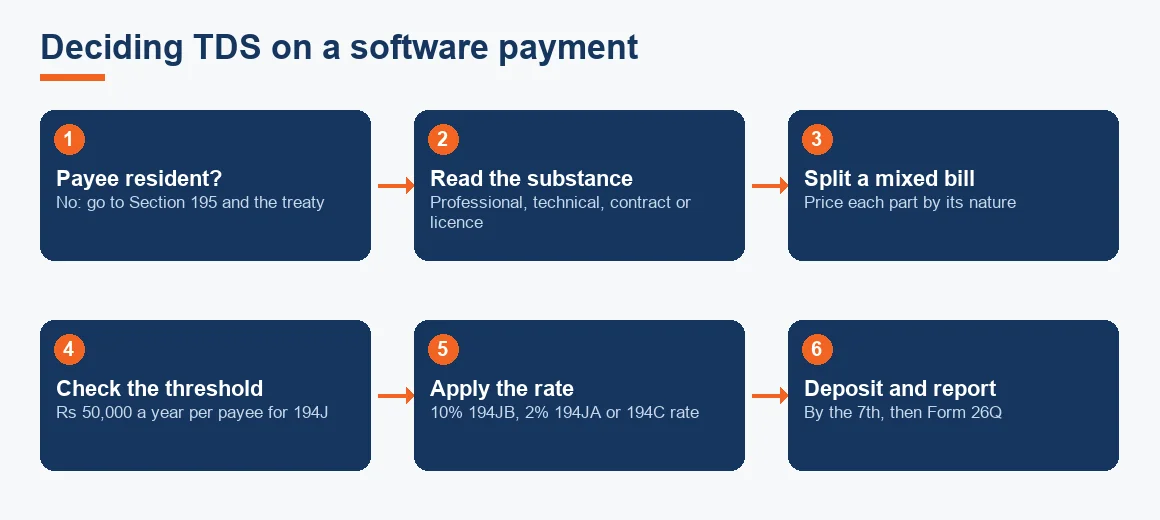
- Identify the payee: resident or non-resident. Non-resident goes to Section 195 and the treaty, not 194J.
- Confirm you are a deductor: any non-individual, or an individual or HUF over the audit limits.
- Read the substance of the bill: professional input, technical input, a works contract, or a plain licence.
- Split a mixed invoice by nature and price each part.
- Check the running total to that payee for the year against Rs 50,000 (194J) or the 194C limits.
- Apply 10 per cent (194JB), 2 per cent (194JA) or the 194C rate, and confirm the vendor's PAN to avoid the 20 per cent no-PAN rate.
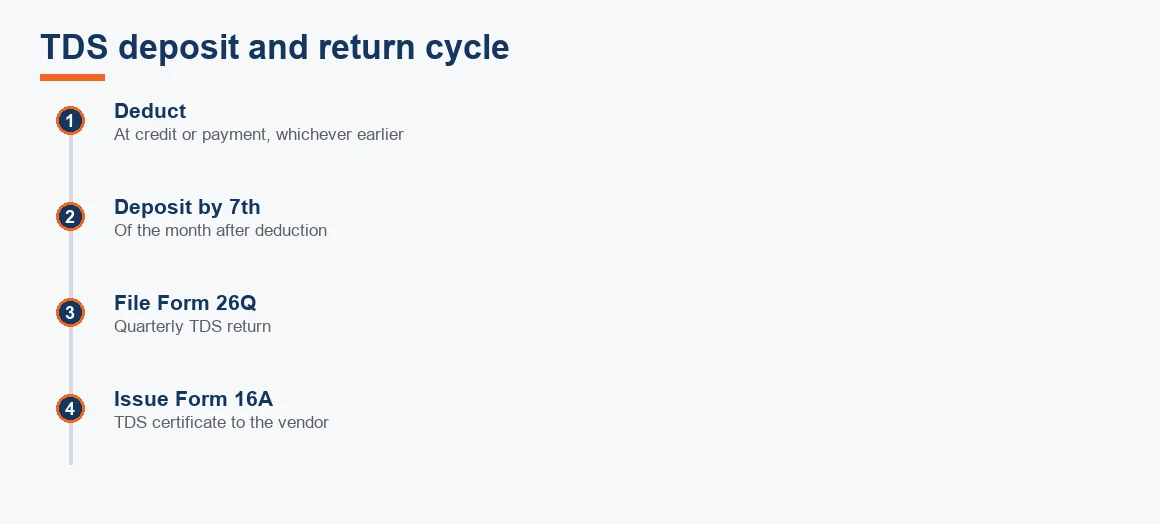
- Deposit by the 7th of the next month and report in the quarterly Form 26Q.
Worked example: TDS on a bundled software vendor bill
Suppose an Indian company receives one invoice from a resident vendor covering four items in the same year. The base values below are indicative and stated Exl GST; TDS is computed on the value excluding GST where GST is shown separately.
| Component | Nature | Section | Rate | Base (Rs) | TDS (Rs) |
|---|---|---|---|---|---|
| Software architecture consultancy | Professional service | 194J(b) | 10% | 2,00,000 | 20,000 |
| Cloud and application technical support | Technical service | 194J(a) | 2% | 3,00,000 | 6,000 |
| Server hardware AMC | Works contract | 194C | 2% | 1,50,000 | 3,000 |
| Off-the-shelf licence (declaration held) | Reseller supply | Notif 21/2012 | Nil | 1,00,000 | 0 |
| Total | 7,50,000 | 29,000 |
Total TDS of Rs 29,000 is withheld, so the net payment to the vendor on the base is Rs 7,21,000 (before adding back GST). Notice how splitting the bill saved cash: had the whole Rs 7,50,000 been treated as professional fees at 10 per cent, the deduction would have been Rs 75,000, tying up an extra Rs 46,000 of the vendor's money until they claimed it back.
Key terms
- Section 194Q TDS on Goods: the parallel 0.1 per cent deduction on purchase of goods over Rs 50 lakh, distinct from 194J on services.
- Deferred Revenue (Unearned Revenue): subscription income billed in advance, relevant when a SaaS invoice spans several months.
- Software Export Revenue (Section 10AA SEZ): the export-income treatment that sits opposite these inbound TDS questions.
- Transfer Pricing for IT Services: pricing rules where the software vendor is a related overseas entity.
Reporting, deposit and reconciliation
Once deducted, deposit the tax by the 7th of the following month (for March, by 30 April) and file the quarterly Form 26Q. The vendor sees the credit in Form 26AS and the annual information statement, and their return schedule must agree with both. If the payee is an individual whose income runs through professional or business heads, they file ITR-3, or ITR-4 under presumptive taxation, not ITR-1. Keeping a clean TDS register alongside the ledger avoids mismatches at year end, which is part of the routine monthly close we describe for founders tracking MRR, ARR and Churn and building a deferred revenue recognition schedule. Revenue-side treatment for the same contracts follows Ind AS 115 / ASC 606 revenue recognition, and matching input credit is a GSTR-2B exercise.
Key takeaways
- Domestic software payments usually fall under Section 194J: 10 per cent professional (194JB), 2 per cent technical (194JA).
- The annual per-payee threshold is Rs 50,000 from 1 April 2025.
- Split mixed invoices by substance; do not force the whole bill to the highest rate.
- An off-the-shelf reseller licence can be TDS-free under Notification 21/2012 only if you hold the declaration.
- Foreign software and SaaS are a Section 195 question, and often no royalty arises after Engineering Analysis.
- For anything beyond routine deduction, send commercial queries to our SaaS accounting team rather than guessing.
If your software costs are large enough to capitalise rather than expense, the depreciation side is worth modelling too; our Depreciation Calculator and Deferred Tax Calculator help with the book and tax split. Product-company founders and startups, and marketplaces on the e-commerce side, often face the same TDS decisions on their technology stack.
Decision guide