
In this guide
Deferred revenue in SaaS is the money you have already collected from a customer for a subscription you have not yet delivered. When a customer pays Rs 1,20,000 for a twelve-month plan on day one, you have the cash but you have earned none of it yet, so the whole amount is parked as a liability and released to income at Rs 10,000 a month as each month of access is provided. The recognition schedule is simply the working that shows, month by month, how that liability is drawn down into revenue. This guide explains what deferred revenue means, when to recognise it, the journal entries, and how to build a schedule your auditor will accept.
What is deferred revenue, and what does it mean for a SaaS business?
Deferred revenue, also called unearned revenue or income received in advance, is payment received before the related service is delivered. For a SaaS company that bills annual or quarterly plans upfront, this is the normal state of affairs rather than an exception. You collect twelve months of cash in one invoice, but your obligation is to keep the software available for twelve months, so revenue is recognised only as that obligation is satisfied. The gap between cash collected and revenue earned is the deferred revenue balance.
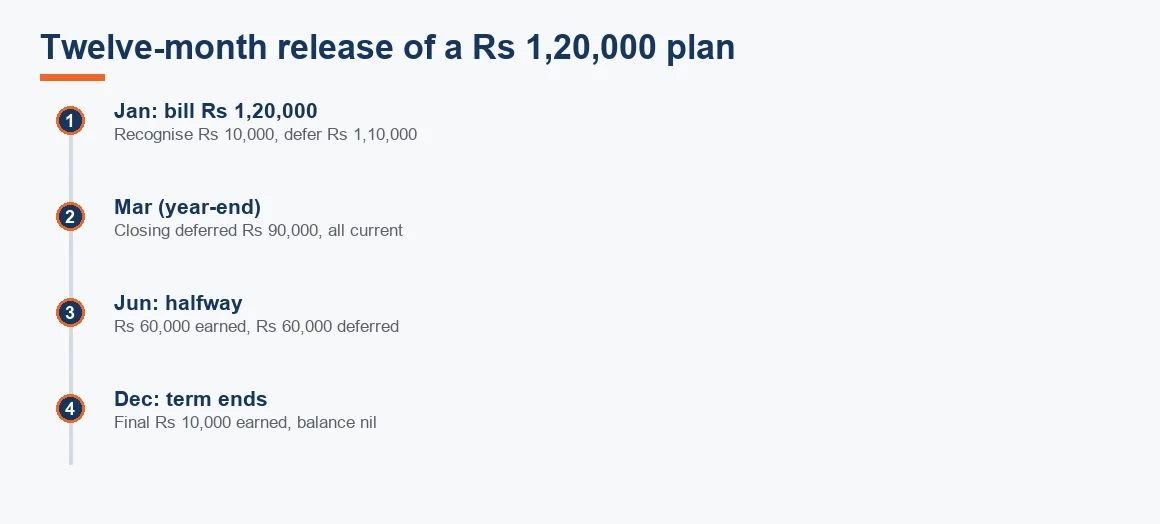
An everyday example: a customer signs up for your Rs 1,20,000 annual plan on 1 January. On that date your bank balance rises by Rs 1,20,000 (plus GST, which is a separate matter), but not a rupee of it is revenue yet. By 31 January you have delivered one month of the twelve, so Rs 10,000 becomes revenue and Rs 1,10,000 stays deferred. This is the discipline of accrual accounting: income is matched to the period in which it is earned, not the period in which cash arrives.
Why do SaaS companies defer revenue, and is it good or bad?
Companies defer revenue because accounting standards require it, not by choice. Recognising a full year of billing as income on day one would overstate the period's revenue and understate the liability owed to the customer. Deferral spreads the income to the periods that actually carry the cost and effort of serving the customer.
A large deferred revenue balance is generally a healthy sign. It means customers have committed cash upfront for services still to come, which is a good indicator of retained, predictable recurring revenue. It is neither an asset nor a badge of profit, though: it is an obligation. The distinction matters when founders read their own balance sheet, because a growing deferred balance funds working capital while the earned revenue in the profit and loss statement grows more steadily. Tracking both alongside your monthly recurring revenue gives a truer picture than either figure alone, a point we cover in our note on MRR, ARR and churn metrics.
Deferred revenue vs unearned revenue vs accrued revenue
Deferred revenue and unearned revenue are two names for the same thing: cash in, service still owed. What often confuses founders is the mirror-image item, accrued or unbilled revenue, where the service has been delivered but no invoice has gone out yet. The table below sets the three side by side.
| Item | Cash position | Service delivered? | Where it sits |
|---|---|---|---|
| Deferred / unearned revenue | Cash received | Not yet | Liability (contract liability) |
| Accrued / unbilled revenue | Cash not received | Yes | Asset (contract asset) |
| Recognised revenue | Either | Yes | Profit and loss statement |
When should you recognise deferred revenue?
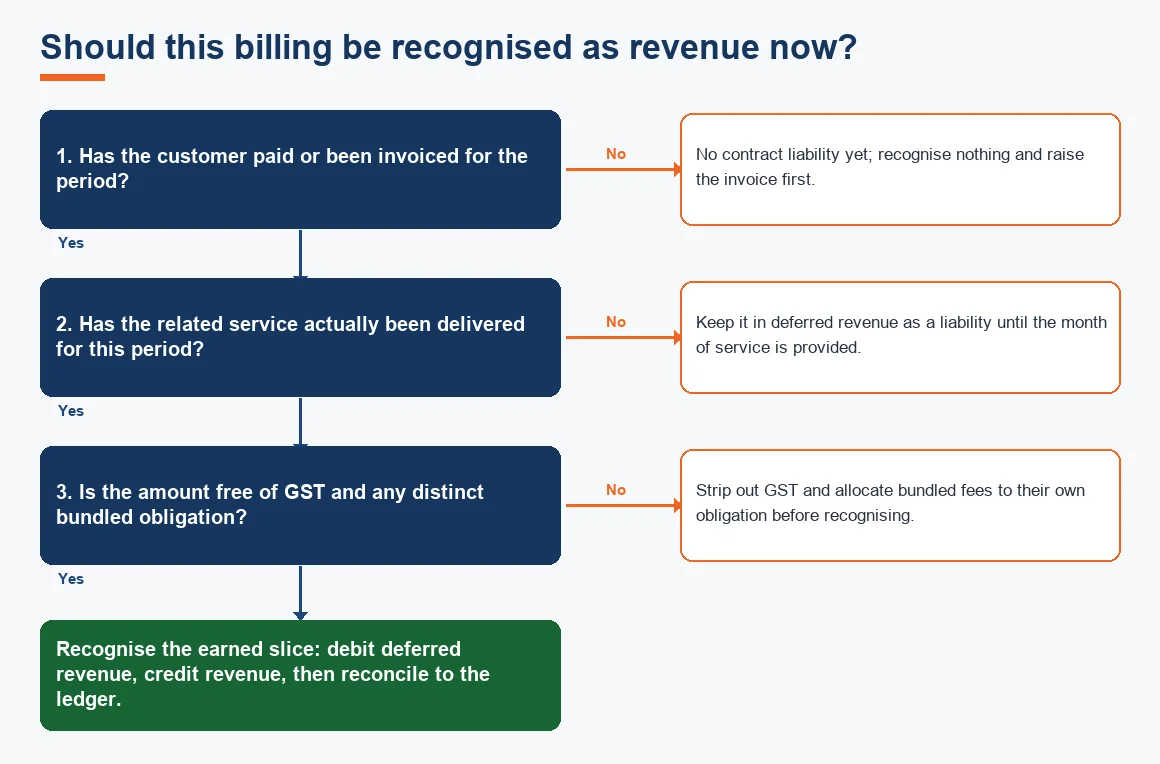
You recognise revenue as you satisfy your performance obligation, which for standard SaaS access is spread evenly across the subscription term because the customer benefits equally each day. Ind AS 115, the Indian revenue standard aligned with the global model, sets out five steps: identify the contract, identify the performance obligations, determine the transaction price, allocate that price to the obligations, and recognise revenue as each obligation is satisfied. For a plain vanilla annual plan this collapses to a simple straight-line release over twelve months. The Institute of Chartered Accountants of India publishes the standard in full at icai.org, and companies below the Ind AS threshold follow AS 9 to broadly the same effect.
Where the contract bundles distinct obligations, such as a one-time onboarding or implementation fee alongside the subscription, each obligation is recognised on its own pattern. The onboarding is earned when delivered; the subscription is earned across the term. We explain the mechanics of the standard for software firms in our companion piece on Ind AS 115 revenue recognition for SaaS.
The deferred revenue journal entry (the double entry)
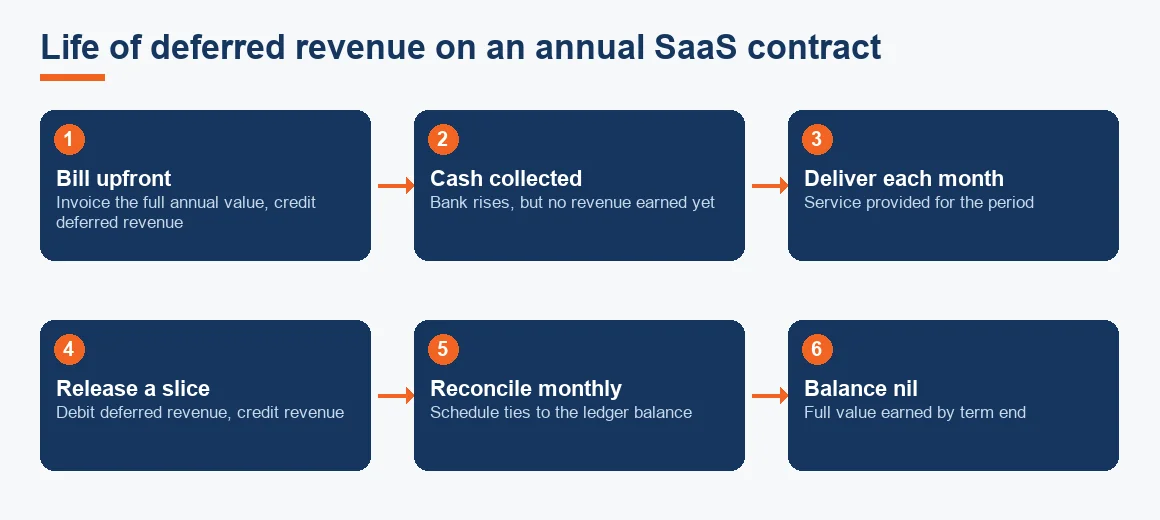
There are three moments to record, and each is a straightforward journal entry built on ordinary double-entry bookkeeping. On billing, you debit the customer (or bank, if paid) and credit deferred revenue. Each month, you debit deferred revenue and credit revenue for the earned slice. At the end of the term the deferred balance for that contract is nil.
- On invoice (1 January): Debit Bank / Accounts Receivable Rs 1,20,000; Credit Deferred Revenue Rs 1,20,000.
- Each month-end: Debit Deferred Revenue Rs 10,000; Credit Subscription Revenue Rs 10,000.
- After twelve postings: Deferred Revenue for the contract is zero and Rs 1,20,000 has flowed through the profit and loss statement.
How to build a deferred revenue recognition schedule step by step
The schedule is a single worksheet, one row per contract per period, that turns the billing into a monthly release and always reconciles back to the ledger. Build it once and the month-end posting becomes a copy of one column.
- List each contract with its start date, end date, term in months and net billing value exclusive of GST.
- Choose a recognition basis, monthly or daily, and apply it to every contract without exception.
- Spread the value across the term: for a twelve-month plan, billing divided by twelve is the monthly amount.
- Set an opening deferred balance equal to the billing, then reduce it by the recognised amount each period so the closing balance rolls forward.
- Post the monthly entry (debit deferred revenue, credit revenue) straight from the schedule.
- Reconcile the total closing balance across all contracts to the deferred revenue figure in your general ledger every month.
Handled well, this schedule also feeds the numbers your financial statement preparation and MIS reporting depend on, so the discipline pays for itself well beyond the audit.
Worked example: a Rs 1,20,000 annual SaaS contract
Assume a customer subscribes to a Rs 1,20,000 annual plan (indicative, Exl GST) starting 1 January, recognised monthly on a straight-line basis. The schedule below shows the first four months and the final month; each row releases Rs 10,000 and the closing balance falls to nil by December.
| Month | Opening deferred (Rs) | Recognised revenue (Rs) | Closing deferred (Rs) |
|---|---|---|---|
| January | 1,20,000 | 10,000 | 1,10,000 |
| February | 1,10,000 | 10,000 | 1,00,000 |
| March | 1,00,000 | 10,000 | 90,000 |
| April | 90,000 | 10,000 | 80,000 |
| December (12th) | 10,000 | 10,000 | 0 |
At 31 March, the reporting date for most Indian companies, this contract shows a closing deferred balance of Rs 90,000. Of that, Rs 90,000 will be earned within the next twelve months, so the entire balance is a current liability here. On a longer or renewing contract, the portion earned beyond twelve months would be split out as non-current.
How do you reconcile deferred revenue each month?
Reconciliation is proving that the schedule and the ledger agree. Take the total closing deferred balance from your schedule, compare it to the deferred revenue control account in the general ledger, and explain any difference. A clean reconciliation follows a simple roll-forward: opening balance, plus new billings in the month, less revenue recognised in the month, equals closing balance. If that closing figure does not match the ledger, the usual culprits are a billing posted straight to revenue, a mid-term change not reflected in the schedule, or GST accidentally sitting inside the deferred figure.
Is deferred revenue a P&L or balance sheet item, and where does it appear?
Deferred revenue is a balance sheet item, not a profit and loss item; only the amount released each period touches the profit and loss statement. It is a liability, because what you owe the customer is service, not cash. Under Schedule III of the Companies Act it is presented within other current liabilities, with any portion to be earned beyond twelve months shown under non-current liabilities. Companies reporting under Ind AS label the same line contract liabilities to match Ind AS 115. The Schedule III format is prescribed by the Ministry of Corporate Affairs at mca.gov.in, so the classification is not a matter of preference. Treating it correctly matters because it is a genuine current liability, not equity and not an asset.
Handling a mid-term upgrade or plan change
When a customer upgrades partway through a term, stop the old schedule at the change date, recognise the revenue earned to that point, then build a fresh schedule for the remaining months at the new price. The unused portion of the original billing is either credited against the new invoice or rolled into the new deferred balance. Ind AS 115 treats this as a contract modification, so keep a short note of the reasoning with the schedule for the auditor. This is exactly the sort of judgement a SaaS accounting service is engaged to document properly, and it applies equally whether you are a funded startup, an established IT and software company, or run a subscription arm inside an e-commerce business.
A final practical note for exporters: recognising revenue in your books is a separate question from the GST treatment of the sale, and cross-border SaaS billing carries its own rules, which we cover in GST on SaaS exports and LUT filing. Withholding on domestic software payments is likewise its own topic, handled in TDS under Section 194J for IT companies.
Key terms
- Deferred Revenue (Unearned Revenue): cash collected before the service is delivered, carried as a liability until earned.
- Ind AS 115 Revenue Recognition: the Indian standard that recognises revenue as performance obligations are satisfied.
- Schedule III Balance Sheet: the Companies Act format that classifies deferred revenue as current or non-current liability.
- Current Liabilities: obligations expected to be settled within twelve months, where near-term deferred revenue sits.
- Monthly Recurring Revenue (MRR): the normalised monthly subscription income a SaaS business earns, distinct from cash billed.
Key takeaways
- Deferred revenue is collected cash you have not yet earned, so it is a liability, not income and not an asset.
- Recognise it as you deliver the service; a standard annual plan releases evenly over twelve months.
- The recognition schedule, one row per contract per period, is the working that proves your revenue to the auditor.
- Pick one recognition basis, keep GST out of the deferred figure, and reconcile the schedule to the ledger every month.
- Under Schedule III and Ind AS 115, split the balance between current and non-current based on when it will be earned.
Decision guide