
In this guide
SaaS metrics for founders are the recurring revenue measures a subscription business tracks in place of one-off sales figures: monthly recurring revenue (MRR), annual recurring revenue (ARR), churn, net revenue retention, customer acquisition cost and the Rule of 40. They tell you whether the business is compounding or leaking, but they come out of the billing system rather than the ledger, so a preparer has to reconcile them to recognised revenue before they are shown to an investor or a lender. This explainer sets out how each metric is defined, how to calculate it and where founders most often overstate it.
Which SaaS metrics should founders track every month?
Most subscription businesses can run a healthy monthly review on a short list. If you track only five, track MRR, churn, net revenue retention (NRR), CAC payback and gross margin. Around those sit the wider set of KPIs that investors ask for, which map loosely to the nine building blocks people cite for SaaS revenue: new MRR, expansion, contraction, churned MRR, reactivations, ARR, retention, unit economics and cash efficiency.
- MRR and ARR: the size and run-rate of the recurring book.
- Customer and revenue churn: how much of that book leaks each month.
- Net revenue retention: whether the existing base grows on its own before any new sales.
- CAC, LTV and CAC payback: what a customer costs to win and how long the cost takes to earn back.
- Rule of 40 and gross margin: whether growth and profitability are in balance.
These sit above the statutory accounts rather than inside them. For the accounting that feeds them, subscription businesses usually lean on SaaS accounting services for IT and SaaS, and a monthly management pack drawn up through MIS reporting services is where these numbers are best kept honest.
How to calculate MRR and ARR
MRR is the sum of the normalised monthly value of every active subscription on a given date. Normalising matters more than anything else here: an annual plan billed once at Rs 1,20,000 is worth Rs 10,000 of MRR, not Rs 1,20,000 in the month the invoice goes out. The steps are straightforward.
- List every active subscription and its contracted value.
- Convert each to a monthly figure: divide annual plans by 12, quarterly plans by 3.
- Strip out anything that is not recurring: one-time setup fees, implementation charges and GST.
- Add the normalised monthly values together. That total is your MRR.
- Multiply MRR by 12 to get ARR.
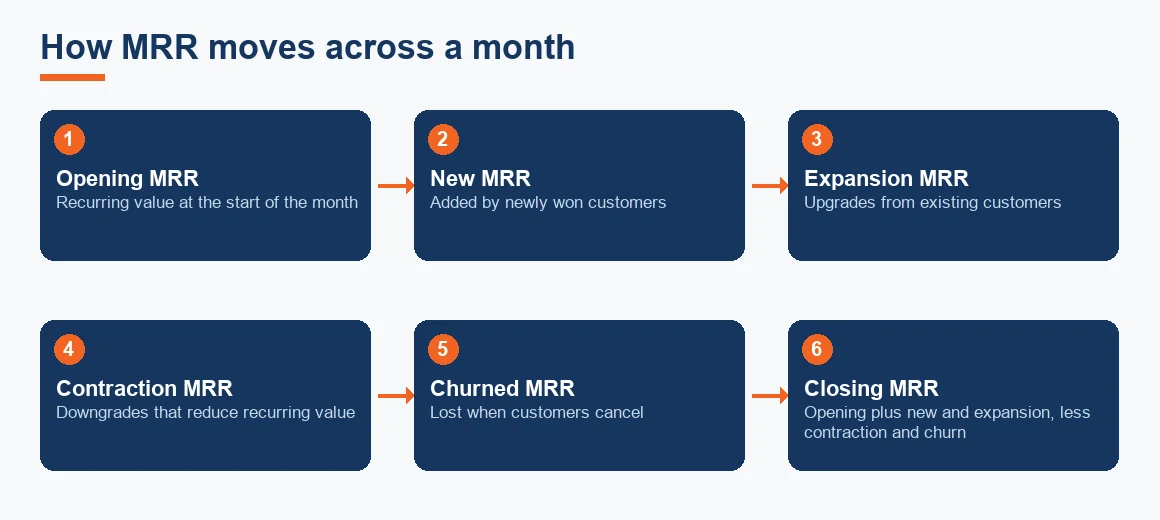
So forty customers each on a normalised Rs 10,000 plan give Rs 4,00,000 of MRR and Rs 48,00,000 of ARR. The diagram below shows how MRR moves across a month, from the opening balance through new and expansion revenue to the contraction and churn that pull it back down.
How to calculate SaaS churn rate
Churn comes in two flavours and founders often confuse them. Customer churn is the count of customers lost during the month divided by the customers you held at the start of the month. Losing 6 of 200 customers is 3 percent monthly churn, which compounds to roughly 31 percent over a year, so a number that looks small monthly is not small annually.
Revenue churn uses lost MRR instead of a customer count, and it is the more useful figure because a single large account leaving hurts more than several small ones. Its mirror image is net revenue retention: opening MRR plus expansion, minus contraction and churn, divided by opening MRR. When upgrades from retained customers exceed the MRR that walked out, revenue churn turns negative and NRR climbs above 100 percent, which is the signal investors like most.
What is the Rule of 40 for SaaS?
The Rule of 40 is a quick health check: your revenue growth rate plus your profit margin should add up to at least 40. A business growing ARR at 25 percent with an 18 percent EBITDA margin scores 43 and passes. One growing at 10 percent with a 5 percent margin scores 15 and does not, which tells you it is buying neither growth nor profit fast enough.
The variants you will hear are the same idea at a higher bar. The Rule of 50 and Rule of 60 apply to faster-scaling or later-stage companies where investors expect the combined figure to reach 50 or 60. The so-called golden ratio for SaaS compares net new ARR to net cash burned, and rewards businesses that add recurring revenue without lighting cash on fire. None of these replaces the Rule of 40; they simply raise the pass mark as the company matures.
What is a good EBITDA and profit margin for SaaS?
There is no single right answer, but the shape of a healthy SaaS profit and loss is well understood. Gross margin should sit high, commonly 70 to 85 percent, because the marginal cost of serving one more subscriber is small. EBITDA margin varies with stage: an early business deliberately runs a negative margin while it spends on acquisition, and a mature one is often expected to reach 20 percent or more. Net profit margin follows once acquisition spend settles. The point of the Rule of 40 is precisely that a low margin is acceptable if growth is high, and only becomes a problem when growth has faded too.
Because these ratios are read off the accounts, the revenue and net profit lines beneath them have to be prepared on a consistent, accrual basis. That is where SaaS-specific accounting comes in, and where a metric dashboard and a set of audited statements should agree to the rupee.
Where founders overstate SaaS metrics
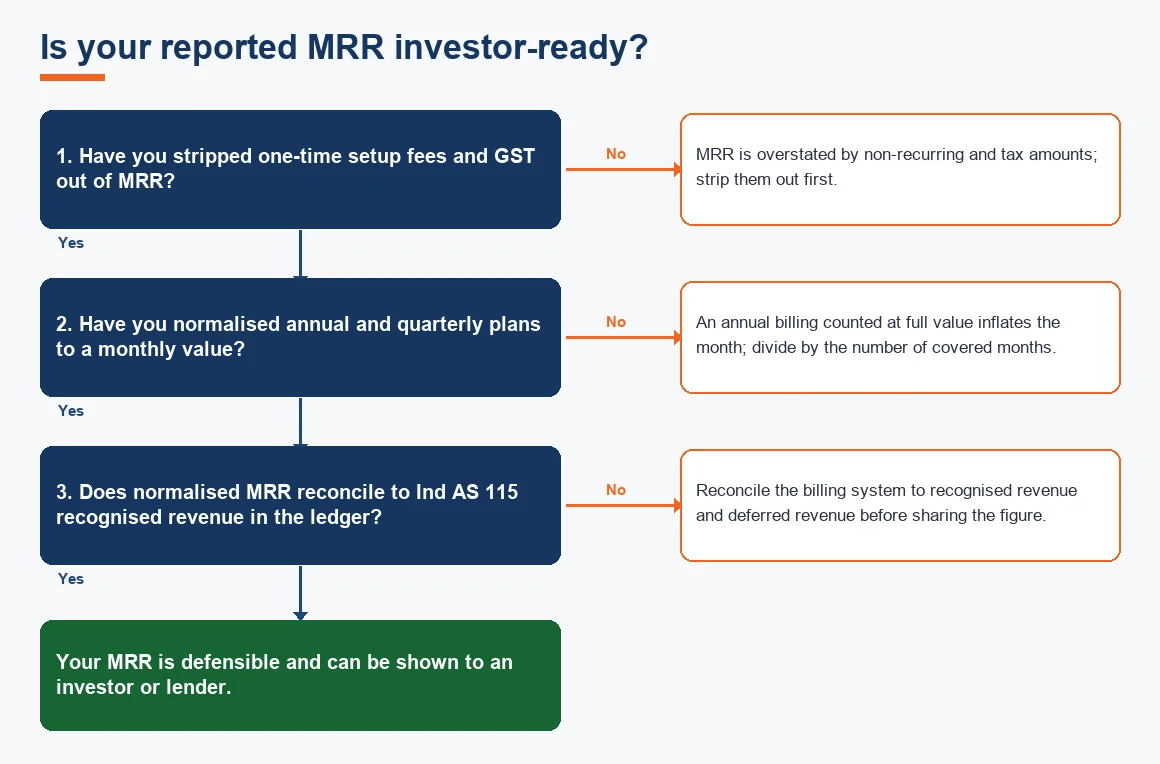
The most common failures are not fraud, they are definition drift. MRR quietly includes setup fees. Annual contracts are counted at full value in the billing month. GST at 18 percent is left inside the recurring number. Trials that have not converted are treated as active. Each inflates the headline, and each is caught the same way: by reconciling the billing system to recognised revenue in the ledger.
Two accounting rules do most of the reconciling work, and both are owned by dedicated guides rather than repeated here. Subscription income is spread over the service period under Ind AS 115, the text of which the Institute of Chartered Accountants of India publishes on the ICAI website, which is why building a deferred revenue recognition schedule matters, and the unearned portion sits on the balance sheet as deferred revenue until it is delivered. Separately, the incremental cost of winning a contract, such as a sales commission, is capitalised and amortised over the expected customer life: a Rs 60,000 commission on a three-year deal is charged at Rs 20,000 a year, not all in month one.
Indirect tax is the other place metrics and statute diverge. A SaaS subscription supplied to an Indian customer attracts GST at 18 percent, which the Central Board of Indirect Taxes and Customs sets out on the CBIC GST portal, while a sale abroad can be zero-rated as an export of services against an LUT. If your invoicing engine reports tax-inclusive figures, MRR will be overstated by the tax fraction until it is stripped out. For the same reason, payments to resident developers or contractors need a Section 194J TDS check before they hit the expense line that feeds your margin.
Founders who want the metric layer to reconcile cleanly to the statutory accounts from the start usually set it up alongside startup accounting services in India or, for a larger engineering-led business, IT and software company accounting services. A subscription platform that also sells through a marketplace should note that the settlement mechanics differ again, closer to e-commerce accounting than to pure SaaS. If you are unsure whether Ind AS even applies to your entity, the Ind AS applicability checker and the AS versus Ind AS comparison matrix settle that before you pick a revenue policy.
Worked example: a one-month MRR, ARR and churn movement
The table below walks a subscription business through a single month. It opens with 200 customers and Rs 4,00,000 of MRR, wins new business, sees some upgrades and downgrades, and loses six customers. Every figure is arithmetically closed so the opening and closing balances tie.
| Line | Customers | MRR (Rs) |
|---|---|---|
| Opening MRR (start of month) | 200 | 4,00,000 |
| Add: New MRR (12 new customers) | +12 | +30,000 |
| Add: Expansion MRR (upgrades) | 0 | +15,000 |
| Less: Contraction MRR (downgrades) | 0 | -5,000 |
| Less: Churned MRR (6 customers lost) | -6 | -12,000 |
| Closing MRR (end of month) | 206 | 4,28,000 |
| ARR (Closing MRR x 12) | - | 51,36,000 |
From these figures the ratios fall out directly. Customer churn is 6 divided by 200, or 3 percent for the month. Gross revenue churn is Rs 12,000 divided by Rs 4,00,000, also 3 percent. Net revenue retention is opening MRR plus expansion minus contraction and churn, that is (4,00,000 + 15,000 - 5,000 - 12,000) divided by 4,00,000, giving 99.5 percent: just below break-even on the existing base, so this business is still relying on new sales to grow. All amounts are indicative and stated Exl GST.
Key terms
- Monthly Recurring Revenue (MRR): the normalised monthly value of all active subscriptions on a date.
- Deferred Revenue (Unearned Revenue): subscription income billed but not yet earned, carried as a liability.
- Ind AS 115 Revenue Recognition: the standard that spreads subscription revenue over the service period.
- EBITDA: earnings before interest, tax, depreciation and amortisation, used in the Rule of 40 margin.
Key takeaways
- MRR is normalised monthly recurring value, with setup fees and GST stripped out; ARR is MRR times twelve.
- Report both customer churn and revenue churn, and watch net revenue retention: above 100 percent means the base grows on its own.
- The Rule of 40 balances growth against margin; the Rule of 50, Rule of 60 and golden ratio simply raise the bar with scale.
- Reconcile the billing dashboard to recognised revenue every quarter, or the metrics will drift away from the audited accounts.
Decision guide