In this guide
SaaS revenue recognition in India follows Ind AS 115, which records revenue when control of the service passes to the customer, not when the invoice is raised. For a hosted subscription the customer consumes the service continuously across the contract, so revenue is spread over the licence period rather than booked upfront on billing. The amount you have billed but not yet earned sits on the balance sheet as a contract liability (deferred revenue) and unwinds month by month. This explainer sets out the rule with the working, so a founder or finance lead can see exactly how each rupee moves.
What is Ind AS 115 and which SaaS companies must apply it?
Ind AS 115, Revenue from Contracts with Customers, is the single Indian standard governing when and how much revenue to recognise. It replaced the older AS 9 and AS 7 approach and is notified by the Ministry of Corporate Affairs under the Companies (Indian Accounting Standards) Rules. You can read the notified text on the MCA portal and the standard itself through the ICAI.
Ind AS applies to all listed companies and to unlisted companies with net worth of Rs 250 crore or more, together with the holding, subsidiary, associate and joint venture companies of any covered entity. Companies with net worth of Rs 500 crore or more adopted first, from 1 April 2016, and the Rs 250 crore phase followed from 1 April 2017. Once you are in, you cannot revert to the older AS. A smaller SaaS startup on plain AS still recognises subscription revenue on a broadly similar time-apportioned basis, but the detailed five step discipline below is an Ind AS 115 requirement. If you are unsure of your position, our Ind AS Applicability Checker walks through the net worth and listing tests.
The five step revenue recognition model
Ind AS 115 applies one model to every contract, and the same five steps answer the common question of how to recognise revenue for SaaS.
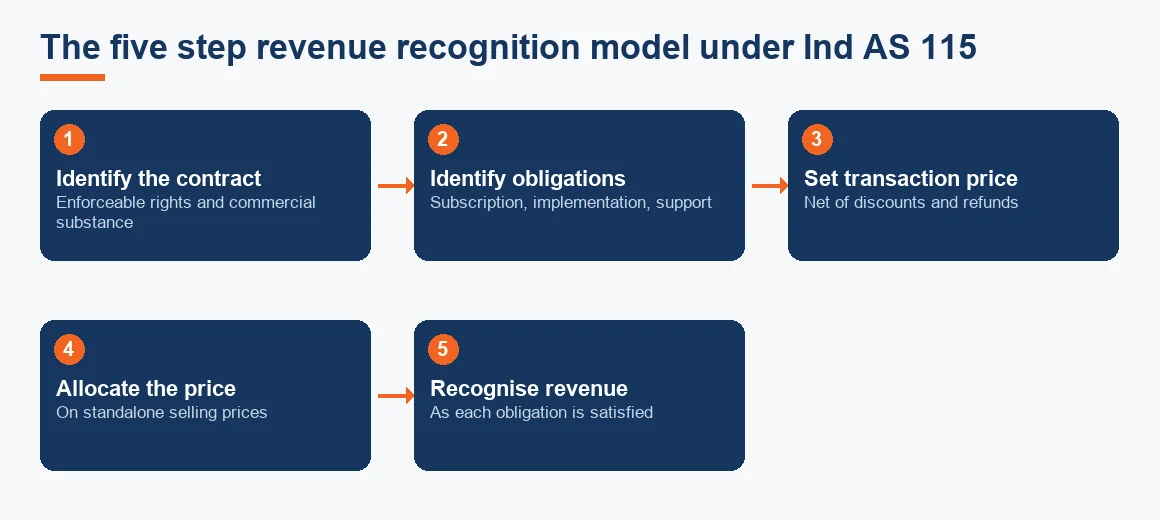
- Identify the contract: a signed order form or master services agreement with enforceable rights and a commercial substance.
- Identify the performance obligations: the distinct promises, typically the hosted subscription, and sometimes a separable implementation, training or premium support line.
- Determine the transaction price: the amount you expect to be entitled to, adjusted for discounts, usage credits, refunds and any significant financing component.
- Allocate the transaction price: split the price across obligations on their standalone selling prices.
- Recognise revenue: book each obligation as it is satisfied, either over time or at a point in time.
People sometimes ask about the four criteria to recognise revenue; that phrasing comes from the older framework. Under Ind AS 115 the gate is control, applied through these five steps, so treat the five step model as the current answer.
How is SaaS revenue recognised: over time or at a point in time?
A SaaS subscription is almost always recognised over time, because the customer simultaneously receives and consumes the benefit of the hosted software as the vendor performs. That satisfies one of the three over-time criteria in the standard, so you spread the fee across the access period on a straight-line basis unless usage is genuinely uneven. This is the accrual principle in action: revenue tracks delivery, not cash. Contrast a perpetual on-premise licence, where control of the software often transfers at a point in time on delivery.
Because billing and delivery diverge, a SaaS ledger runs on two mirror accounts. Cash or receivables record what you have billed; a contract liability holds what you have billed but not yet earned, and it releases to revenue each month. Our companion guide on building a deferred revenue schedule shows the roll-forward in detail, so we keep the mechanics here brief.
SaaS accounting treatment: subscription, implementation and set-up fees
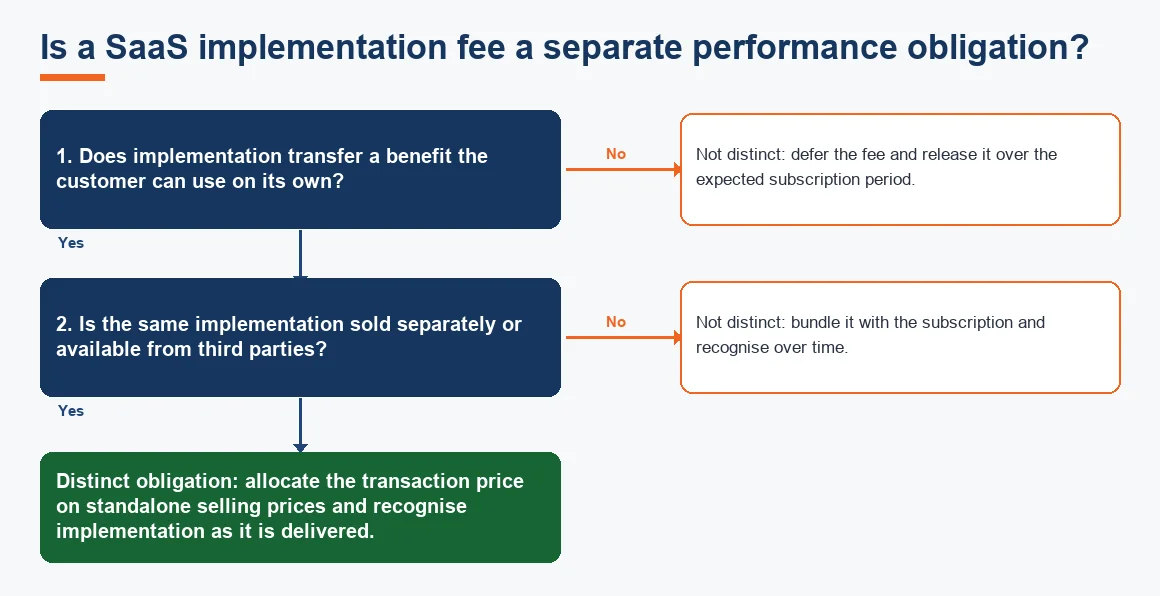
The subscription itself is the straightforward part. The judgement usually sits in the implementation, onboarding or set-up fee. Ask one question: does implementation transfer a separate benefit the customer could obtain on its own or from a third party?
When implementation is not distinct
If onboarding only exists to activate the subscription and delivers no standalone value, it is not a separate performance obligation. The fee is deferred and released over the expected subscription period, including likely renewals, rather than recognised on go-live. A large upfront set-up charge booked as day-one revenue is one of the most common restatement triggers in SaaS audits.
When implementation is distinct
If the same work is sold separately, or third parties routinely perform it, implementation is a separate obligation. You then allocate the transaction price across the subscription and the implementation on their standalone selling prices, and recognise the implementation as that service is delivered.
Is SaaS capitalised or expensed? Is it CapEx or OpEx?
This depends on which side of the contract you sit. For the customer buying SaaS, a hosted subscription with no transfer of a software asset is generally an operating expense (OpEx), recognised over the service period, because the buyer controls no asset. It is not capitalised as a fixed asset the way a perpetual licence might be. For the SaaS vendor, the platform's own development costs follow the intangible asset rules, not Ind AS 115, which governs only the revenue side. So the honest answer to "is SaaS CapEx or OpEx" is: for the typical subscriber, OpEx.
On the four types of revenue that founders often ask about, the useful split for a software business is recurring subscription revenue, usage or transaction-based revenue, services revenue (implementation and training), and one-off or perpetual licence revenue. Each maps onto the same five step model but can satisfy at different times.
Sales commissions and other costs to obtain a contract
Ind AS 115 also governs the cost side of winning a deal. Incremental costs of obtaining a contract, mainly sales commissions payable only if the deal closes, are capitalised as a contract asset and amortised over the period the customer relationship is expected to last, including expected renewals. A practical expedient lets you expense them at once where the amortisation period would be one year or less. Fixed salaries, which you would pay whether or not the deal closed, are expensed as incurred because they are not incremental.
Worked example: recognising a multi-year SaaS subscription
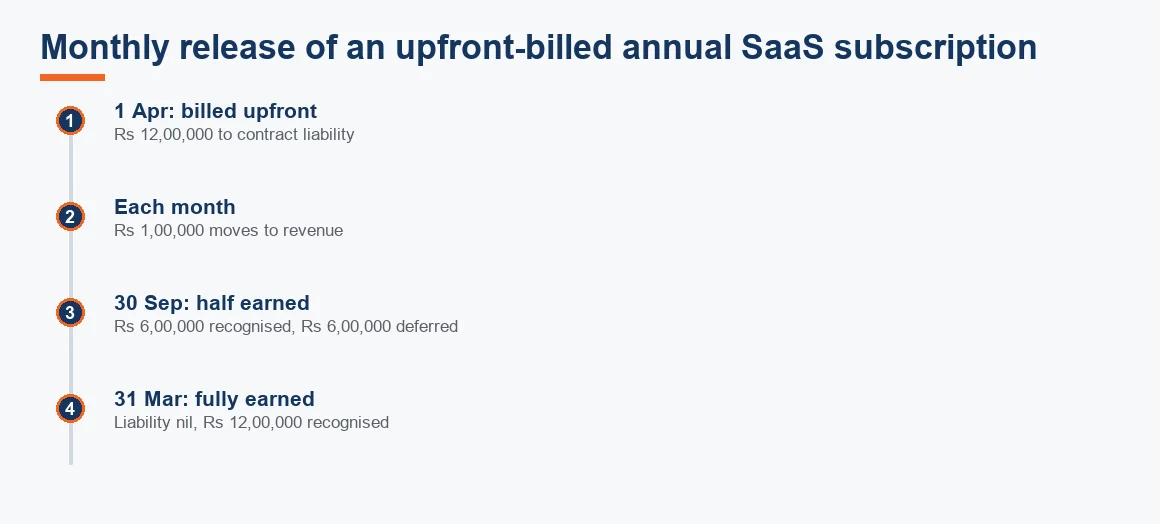
Assume an Indian SaaS company signs a 12-month subscription for Rs 12,00,000 (indicative, Exl GST), billed upfront on 1 April 2026, with no separable implementation. Monthly revenue is Rs 12,00,000 / 12 = Rs 1,00,000. On invoicing, the company debits bank Rs 12,00,000 and credits contract liability Rs 12,00,000; nothing hits revenue yet. Each month it moves Rs 1,00,000 from the liability to revenue. The quarterly roll-forward looks like this.
| Period (FY 2026-27) | Revenue recognised (Rs) | Cumulative revenue (Rs) | Contract liability, closing (Rs) |
|---|---|---|---|
| At inception (1 Apr 2026) | 0 | 0 | 12,00,000 |
| Q1 (Apr to Jun) | 3,00,000 | 3,00,000 | 9,00,000 |
| Q2 (Jul to Sep) | 3,00,000 | 6,00,000 | 6,00,000 |
| Q3 (Oct to Dec) | 3,00,000 | 9,00,000 | 3,00,000 |
| Q4 (Jan to Mar) | 3,00,000 | 12,00,000 | 0 |
The monthly release, shown below, is the same pattern seen in every recurring-revenue ledger, and it is what feeds clean MRR and ARR metrics. Where a subscription runs beyond twelve months and is billed upfront, the portion of the contract liability unwinding after twelve months is classified as non-current, and a significant financing component is assessed once the gap between payment and service exceeds one year.
Ind AS 115 vs ASC 606: how close are they?
Indian SaaS companies with US parents or investors often keep one eye on ASC 606, the US standard. The good news is that the two are substantially converged, having been developed jointly. For a straightforward hosted subscription the recognition outcome is usually identical under both.
| Point of comparison | Ind AS 115 (India) | ASC 606 (US GAAP) |
|---|---|---|
| Core principle | Recognise on transfer of control | Recognise on transfer of control |
| Five step model | Yes, identical structure | Yes, identical structure |
| SaaS subscription timing | Over time, straight-line | Over time, straight-line |
| Costs to obtain a contract | Capitalise and amortise | Capitalise and amortise |
| Collectibility gate | Assessed at step 1 | Assessed at step 1, with some detail differences |
Differences are mostly in disclosure depth and a few edge cases (licences of intellectual property, certain variable consideration), not in the core SaaS answer. GST treatment is separate from both: domestic SaaS is a taxable service, while software exports can be zero-rated under an LUT, which we cover in GST on SaaS exports.
Key terms
- Ind AS 115 Revenue Recognition: the Indian standard that recognises revenue as each performance obligation is satisfied.
- Deferred Revenue (Unearned Revenue): amounts billed but not yet earned, carried as a contract liability.
- Revenue: income earned from delivering goods or services in the ordinary course of business.
- Monthly Recurring Revenue (MRR): normalised recurring subscription revenue for one month.
- Accrual Accounting: recognising income and costs when earned or incurred, not when cash moves.
Getting the treatment right in practice
The recognition rule is simple to state and easy to get wrong in the ledger, because billing, cash and revenue all move on different dates. A well-built contract liability schedule, reviewed each month-end, keeps the three in line and gives you an audit trail. Founders scaling a SaaS or software business often layer this on top of broader startup accounting and, as the entity grows, IT and software company accounting processes. If revenue recognition is becoming a monthly bottleneck, our SaaS accounting services team can own the schedule, the disclosures and the journal entries end to end. Marketplace and platform businesses with a settlement layer may also find our e-commerce accounting guidance useful, and cross-border teams should note the TDS position under Section 194J. To compare the old and new standards side by side, the AS vs Ind AS comparison matrix is a quick reference.
Key takeaways
- Recognise SaaS revenue as the service is delivered over the subscription period, not on the invoice date.
- Park billed-but-unearned amounts in a contract liability and release them month by month.
- Test whether implementation is distinct; if it is not, defer the fee over the subscription life.
- Capitalise incremental sales commissions and amortise them over the expected customer relationship.
- Ind AS 115 and ASC 606 give the same core answer for a standard SaaS subscription.
Decision guide