In this guide
GST on SaaS exports from India works on a simple principle: an export of a service is zero-rated, so a SaaS subscription sold to a customer outside India carries no GST on the invoice, provided the supply qualifies as an export of services and you have filed a Letter of Undertaking. Zero-rating means the tax rate is nil while your input tax credit stays intact and refundable, which is very different from an exemption. The paragraphs below explain the rule, the qualifying test, the LUT filing itself and the points that trip founders up.
Is GST applicable on software exports?
Software and SaaS supplied to an overseas customer are zero-rated under Section 16 of the IGST Act, so no GST is collected, as long as the transaction meets the export of services test. Sold to an Indian customer, the same subscription attracts 18 per cent. Zero-rating gives you two routes: supply without paying IGST under a Letter of Undertaking, or pay IGST and claim it back as a refund. Most product companies choose the LUT route because it avoids parking working capital with the department. The Central Board of Indirect Taxes and Customs sets out both options on the CBIC GST portal.
Is software goods or services under GST?
For GST, a SaaS supply is a service, specifically an online information and database access or retrieval (OIDAR) service, taxed at 18 per cent when the place of supply is in India. Because it is a service you use a SAC, not an HSN code. Custom software development is commonly reported under SAC 998314, while subscription access delivered over the internet falls under the OIDAR headings in group 99843. The label matters less than the place-of-supply logic, but pick one SAC and apply it consistently across invoices and your GSTR-1. If you are still setting up your billing stack, our SaaS accounting services for IT and SaaS businesses cover the invoice and return configuration end to end.
When does a SaaS sale qualify as an export of services?
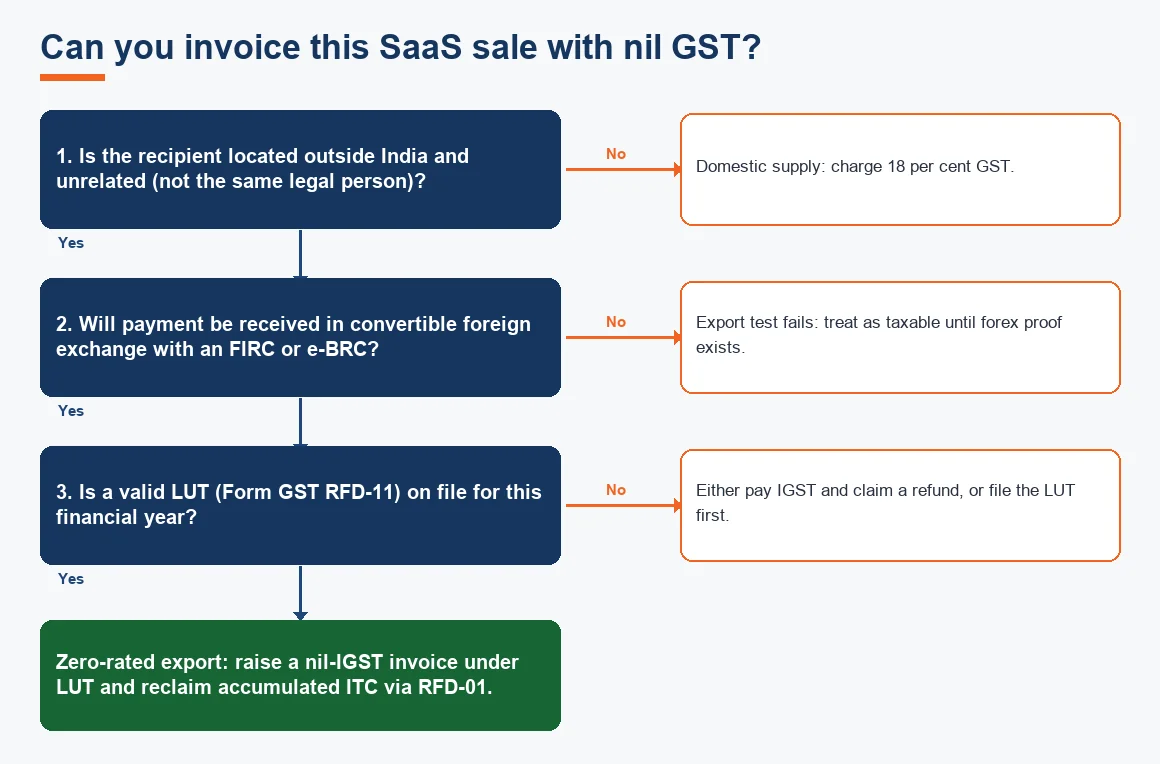
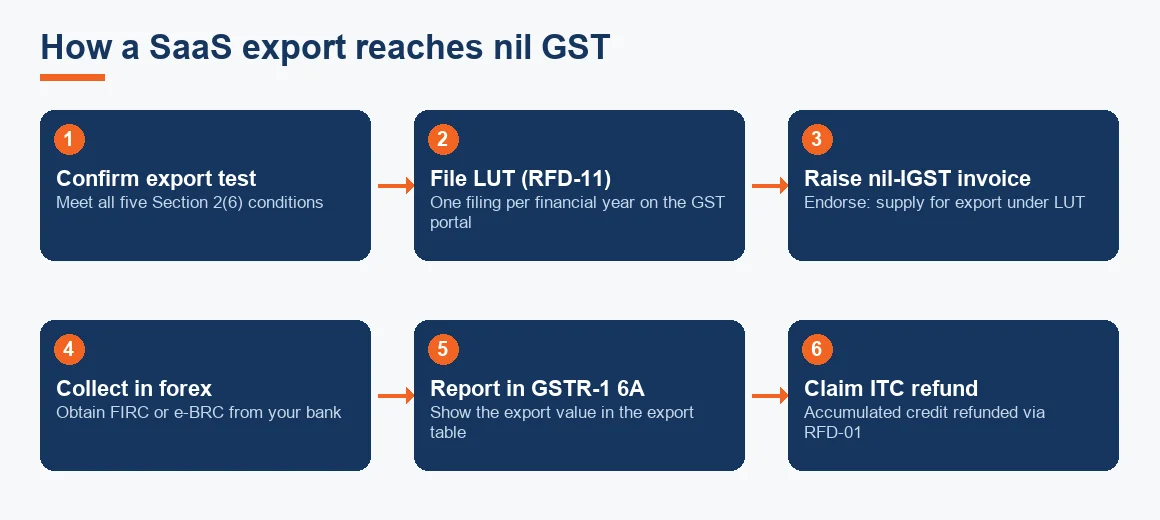
All five conditions of Section 2(6) of the IGST Act must be satisfied at the same time. Miss one and the supply is treated as domestic, with 18 per cent GST due.
- The supplier is located in India.
- The recipient is located outside India.
- The place of supply is outside India.
- Payment is received in convertible foreign exchange (or in INR where the RBI permits).
- The supplier and recipient are not merely establishments of the same person.
The last condition catches Indian development centres that bill their own overseas parent. Where both entities are establishments of one legal person, the supply fails the export test even though money crosses the border, which is where transfer pricing for IT services and the contract structure need careful review. The foreign-exchange condition is evidenced by a bank certificate, so plan your collections around it.
What is an LUT and how do you file it?
A Letter of Undertaking is a declaration in Form GST RFD-11 in which you undertake to complete the export and abide by the IGST conditions. Once accepted it lets you invoice overseas customers without charging IGST for the whole financial year. It is free, filed online and usually acknowledged instantly.
- Log in to the GST portal and go to Services, then User Services, then Furnish Letter of Undertaking (RFD-11).
- Select the financial year for which the LUT applies.
- Enter details of two independent witnesses (name, address and occupation).
- Tick the three self-declaration boxes confirming you will export within the prescribed time and comply with the IGST Act.
- Sign with DSC or EVC and submit. Download the acknowledgement (ARN) and the accepted LUT for your records.
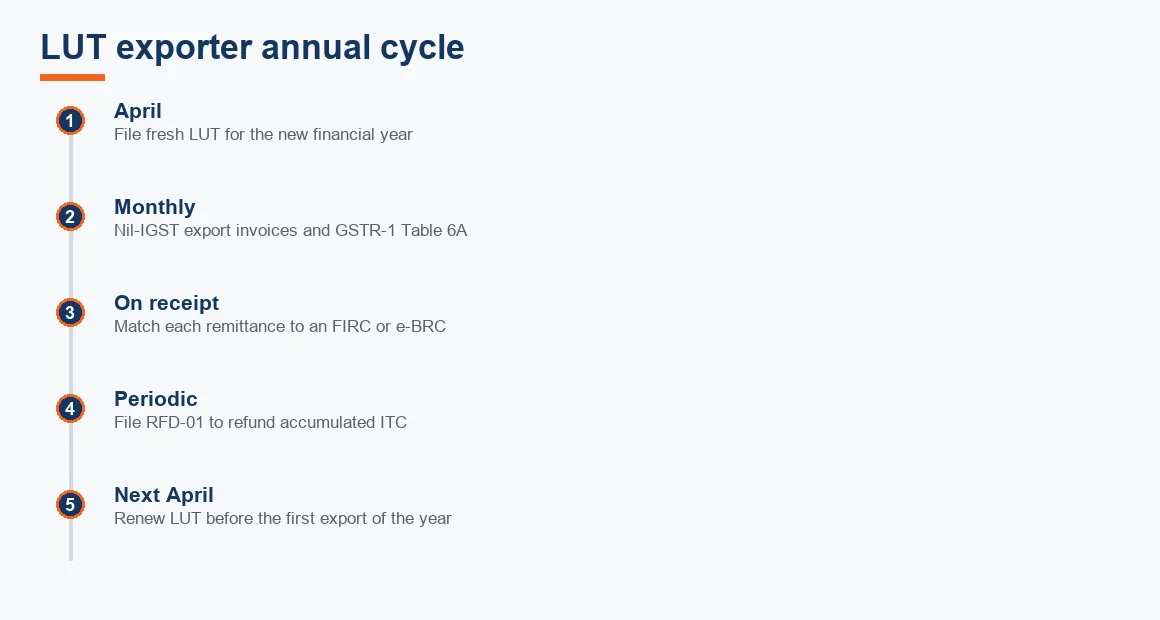
The LUT is valid for one financial year and must be renewed at the start of each new year. If you export before renewing, those invoices are exposed to IGST until a fresh LUT is on file.
LUT route versus paying IGST and claiming a refund
Both routes reach zero net tax, but they treat your cash very differently. The table below summarises the trade-off for a typical product exporter.
| Point | Export under LUT | Export on payment of IGST |
|---|---|---|
| IGST on invoice | Nil | 18 per cent charged, then refunded |
| Working capital | Protected, nothing blocked | Tax paid upfront, locked till refund |
| Refund claimed | Accumulated ITC, via RFD-01 | IGST paid, auto-linked to shipping/FIRC data |
| Paperwork | One LUT per year | Refund application each period |
| Best suited to | Steady SaaS billing in forex | Occasional or one-off exporters |
For a subscription business with monthly recurring revenue in dollars, the LUT route is almost always the cleaner choice. Tracking that recurring line properly also feeds the metrics we cover in MRR, ARR and churn for SaaS founders.
Worked example: one export invoice under LUT versus IGST
Assume a SaaS company raises an annual subscription invoice of USD 10,000 to a US customer, converted at INR 83 to the dollar, giving a taxable value of INR 8,30,000. It has INR 45,000 of input tax credit on hosting and tools for the period. Figures are indicative and Exl GST on the export line by definition.
| Line | Under LUT | On payment of IGST |
|---|---|---|
| Taxable value | INR 8,30,000 | INR 8,30,000 |
| IGST at 18 per cent | INR 0 | INR 1,49,400 |
| Cash paid to department now | INR 0 | INR 1,49,400 (net of ITC of INR 45,000 = INR 1,04,400) |
| Refund route | Refund of INR 45,000 accumulated ITC | Refund of INR 1,49,400 IGST paid |
| Net GST cost after refund | Nil | Nil |
| Cash blocked meanwhile | Nil | Up to INR 1,04,400 |
Both columns end at nil net GST, which is the whole point of zero-rating. The difference is timing: the IGST column ties up cash for weeks until the refund lands, while the LUT column never parts with it.
Why is GST not charged on export, and how does the refund work?
The policy reason is straightforward: GST is a destination-based consumption tax, so a service consumed outside India should not carry Indian tax. Rather than exempt the supply and strand the input credit, the law zero-rates it, which keeps the exporter competitive by letting the tax on inputs flow back. Under the LUT route that refund is of accumulated input tax credit and is claimed through Form RFD-01 on the GST portal. In practice you file the refund for a tax period, upload a statement of export invoices with the FIRC or e-BRC details, and the officer processes it after sanction. Delays almost always trace back to a mismatch between the invoice value declared, the GSTR-1 Table 6A figure and the foreign exchange actually received, so reconcile the three before you apply.
Records a SaaS exporter must keep
Zero-rating is generous, but it is evidence-led. If you cannot prove the export, the department can treat the supply as domestic and raise an 18 per cent demand with interest. Keep the export invoice with its LUT endorsement, the customer agreement or order, the FIRC or e-BRC for each remittance, the bank statement showing the inward credit, and the GSTR-1 and GSTR-3B in which the export was reported. Software exporters filing SOFTEX or STPI returns should keep those acknowledgements alongside, because they corroborate the same remittances. Booking these consistently also matters for your accounts: an advance annual subscription is deferred revenue recognised over the year, not income on the invoice date.
The 0.1 per cent notification and other points founders confuse
The 0.1 per cent concessional GST rate (Notifications 40/2017-Central Tax and 41/2017-Integrated Tax) applies to merchant exports of goods, where a registered supplier sells goods to an exporter at a token rate. It has nothing to do with software or SaaS, which are services and are zero-rated instead. Do not apply the 0.1 per cent rate to a service invoice. Two further points worth settling early:
Is export of services B2B or B2C?
Report exports in Table 6A of GSTR-1 regardless of whether the overseas customer is a business or a consumer. The B2B and B2C split governs domestic reporting; the export table is separate.
Can you claim credit on inputs?
Yes. Accumulated input tax credit on genuine business inputs is refundable under the zero-rated rules, claimed in Form RFD-01. Keep your GSTR-2B input tax credit matching clean, because a refund officer will test the ITC you are reclaiming against it.
SaaS exporters registered in a Software Technology Park or an SEZ also have STPI or SOFTEX filing duties that run alongside GST, and the direct-tax picture (including TDS under Section 194J on Indian vendors) needs its own attention. Our IT and software company accounting services and startup accounting services handle these together, and if you sell through overseas app marketplaces the e-commerce accounting services team covers the settlement side. For where the GST treatment meets your books, tools such as the deferred tax calculator and the Ind AS applicability checker help you keep the numbers consistent.
Key terms
- STPI / SOFTEX Export Filing: the export-declaration filing software exporters make to certify inward remittances, running parallel to GST.
- Software Export Revenue (Section 10AA SEZ): the income-tax deduction available on export profits earned from an SEZ unit.
- Foreign Currency Receivables: export invoices outstanding in USD or other currency, revalued at period end.
- Deferred Revenue (Unearned Revenue): subscription billed in advance that is recognised over the service period, not on invoice date.
The GST answer and the accounting answer are linked but separate. Zero-rating decides what tax sits on the invoice; revenue recognition decides when that subscription hits your profit and loss, which is why annual SaaS billing carries a deferred revenue schedule and follows Ind AS 115 revenue recognition. Getting both right keeps your GST returns and your management accounts telling the same story.
Key takeaways
- SaaS exports are zero-rated under Section 16 of the IGST Act, so no GST is charged on a qualifying export invoice.
- File Form GST RFD-11 (the LUT) before you export, and renew it every financial year to invoice without IGST.
- Confirm all five Section 2(6) conditions, especially receipt in convertible foreign exchange backed by an FIRC or e-BRC.
- Input tax credit stays refundable under zero-rating; claim accumulated ITC through Form RFD-01.
- The 0.1 per cent rate is for merchant exports of goods only and never applies to software or SaaS services.
Decision guide