
In this guide
Stock shrinkage accounting is the way a retailer records the difference between the inventory the books say should be on the shelf and the inventory a physical count actually finds, valued at cost. That gap is real money that has left the business without a sale, so it has to be written out of inventory and charged to the profit and loss account. Handled loosely, it quietly inflates your reported gross margin one month and collapses it the next. This guide explains what shrinkage is, how to calculate it, how to pass the journal entry, what it does to margin, and the GST credit you have to reverse when stock goes missing. For the underlying stock valuation itself, our note on the retail inventory method versus the cost method is the companion read.
What is stock shrinkage?
Stock shrinkage, also called inventory shrinkage, is the loss of stock between the point it is recorded as received and the point it is either sold or counted. If your books show closing stock of Rs 42,00,000 but a physical count finds only Rs 41,10,000 of goods, you have Rs 90,000 of shrinkage. Nobody paid you for that Rs 90,000, so it is not cost of goods sold in the ordinary sense; it is a loss that still has to flow through cost.
Shrinkage is normal in every retail format. A grocery store loses weight on loose grain and vegetables; an apparel store loses tags and samples; a pharmacy loses stock to expiry. The question is never whether you have shrinkage, but whether it sits inside a tolerable band. In Indian retail, 1 to 2 percent of sales is the working range, with grocery and fashion at the top and electronics well below 1 percent. On sales of Rs 5 crore that band is Rs 5 lakh to Rs 10 lakh a year, which is why it deserves a proper accounting treatment rather than a year-end plug.
How to calculate stock shrinkage
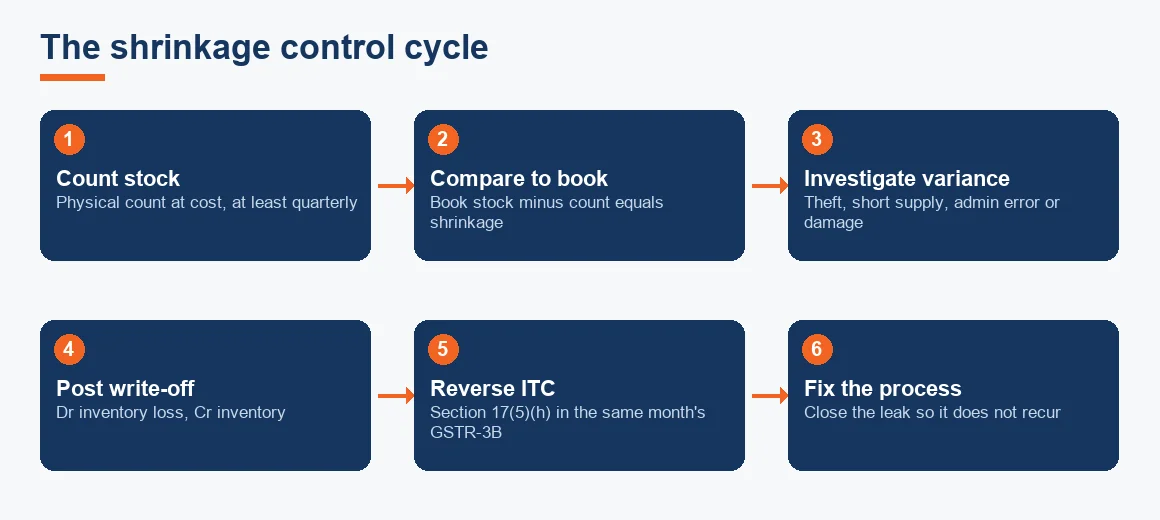
The calculation is a subtraction followed by a ratio. Both halves matter, because the rupee value tells you what to write off and the percentage tells you whether to worry.
- Take book stock at cost. This is the closing inventory figure your system shows after all purchases, sales and returns are posted.
- Take the physical count at cost. Count the shelf and the back store, then value it at the same cost basis your books use, whether that is FIFO or weighted average.
- Subtract. Book stock minus counted stock is the shrinkage in rupees.
- Express as a percentage of sales. Divide the rupee shrinkage by net sales for the same period to get the shrinkage rate.
Using the figures above, Rs 42,00,000 book stock less Rs 41,10,000 counted equals Rs 90,000. Against Rs 60,00,000 of sales for that quarter, the shrinkage rate is 1.5 percent, which sits inside the normal band. Count at least once a quarter; high-value or high-theft categories deserve a monthly cycle count. A disciplined point-of-sale day-end audit and clean daily sales reconciliation shrink the count-to-book gap before it ever reaches your quarterly stocktake.
What are the five causes of shrinkage in retail?
Knowing the number is half the job; knowing where it comes from is what actually reduces it. The five usual sources are:
- Shoplifting: external theft of goods off the shelf, worst in small, high-value, easily concealed items.
- Employee theft: internal pilferage of stock or cash, which is why segregation of duties between the person who receives goods and the person who counts them matters.
- Supplier short supply: being invoiced for 100 units and receiving 96, which becomes shrinkage only if goods receipt is not checked against the delivery.
- Administrative errors: a wrong goods receipt, a unit-of-measure slip, or an unrecorded sales return. In Indian store audits, weighing errors on loose items and unlogged returns explain more of the gap than theft does.
- Damage and expiry: breakage, spoilage and time-expired stock, especially in grocery and pharmacy.
What is the journal entry for shrinkage, and is it a debit or a credit?
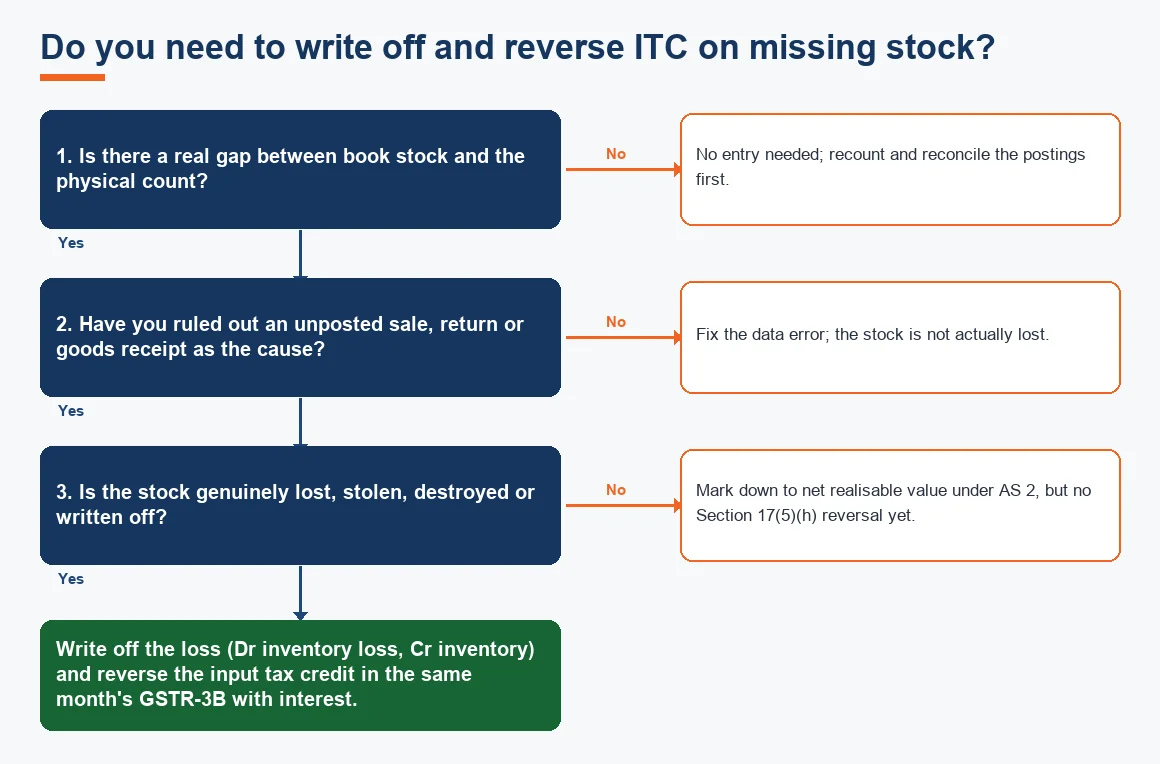
Inventory shrinkage is an expense. It reduces an asset (inventory) and creates a charge in the profit and loss account. So the write-off debits an expense and credits the inventory asset. The debit lands either in a dedicated inventory loss or shrinkage account or directly in cost of goods sold, depending on how granular your chart of accounts is.
For a Rs 90,000 shortfall, the journal entry under double-entry bookkeeping is a debit to Stock Shrinkage / Inventory Loss of Rs 90,000 and a credit to Inventory of Rs 90,000. If you carry a shrinkage provision, the debit instead reduces the provision you built up over the year. Keeping shrinkage in its own ledger line, rather than burying it inside cost of goods sold, lets your MIS reporting show the loss trend cleanly month on month.
How shrinkage hits your gross margin
Every rupee of shrinkage is a rupee added to cost with no matching sale, so it lands squarely on gross profit. Gross margin is sales minus cost of goods sold, divided by sales. When you write off Rs 90,000 of missing stock, cost of goods sold rises by Rs 90,000 and gross margin falls by that amount over the same sales base.
Margin is not markup
Retailers lose money by confusing the two. A product sold at Rs 500 excluding GST that cost Rs 350 earns Rs 150. As a margin that is Rs 150 divided by Rs 500, or 30 percent. As a markup it is Rs 150 divided by Rs 350, or 42.9 percent. Same product, two very different numbers. If you set retail prices on a target margin but measure performance on markup, your reports will never reconcile. Pick margin for reporting, keep it consistent, and let shrinkage show up as the margin erosion it really is. Getting the underlying cost basis right sits with proper inventory accounting and costing.
GST input tax credit reversal on lost or written-off stock
This is the step most retailers miss. When stock is lost, stolen, destroyed or written off, the input tax credit you already claimed on that stock has to go back. Section 17(5)(h) of the CGST Act blocks credit on goods lost, stolen, destroyed, written off or disposed of by way of gift or free sample. So the credit you took at purchase must be reversed in your GSTR-3B, with interest for the period you held it.
On a Rs 90,000 write-off of stock bought at 18 percent GST, that is Rs 16,200 of credit to reverse. This is a genuine cash cost of shrinkage that is separate from the inventory loss itself, and it is exactly the kind of item a GST officer looks for during scrutiny. You can read the blocked-credit provision directly on the CBIC GST portal and file the reversal through the GST portal. For the valuation floor on damaged or slow-moving stock, AS 2 (Valuation of Inventories) issued by the ICAI requires inventory to be carried at the lower of cost and net realisable value, so obsolete stock should be marked down even before it is physically written off.
Worked example: writing off shrinkage and its margin impact
A store closes a quarter with Rs 60,00,000 of sales. Book stock is Rs 42,00,000; the physical count comes to Rs 41,10,000. The stock was largely bought at 18 percent GST. The table shows the shrinkage, the accounting entries and the margin before and after the write-off.
| Item | Amount (Rs) | Note |
|---|---|---|
| Book stock at cost | 42,00,000 | Per system |
| Physical count at cost | 41,10,000 | Stocktake |
| Shrinkage | 90,000 | 1.5% of sales, within normal band |
| Journal: Dr Inventory Loss | 90,000 | Expense |
| Journal: Cr Inventory | 90,000 | Asset reduced |
| ITC reversal in GSTR-3B | 16,200 | 18% of 90,000, Sec 17(5)(h) |
| Gross profit before write-off | 18,00,000 | Margin 30.0% |
| Gross profit after write-off | 17,10,000 | Margin 28.5% |
The write-off of Rs 90,000 pulls gross margin from 30.0 percent to 28.5 percent, a drop of 1.5 points, exactly the shrinkage rate. On top of that sits Rs 16,200 of reversed GST credit as a real cash outflow. That is why shrinkage is worth measuring to two decimal places: a full point of margin on a Rs 6 crore annual run rate is Rs 6 lakh of profit.
Normal loss, abnormal loss and provisioning
Not all shrinkage is equal. Loss inside the normal band (natural wastage, minor count differences) is treated as a normal cost of doing business and absorbed into cost of goods sold. Loss beyond that band, or a one-off event like theft or flood damage, is an abnormal loss and is better shown separately so it does not distort your operating margin trend. Building a small monthly inventory shrinkage provision, sized on your historical rate, smooths the charge across the year instead of landing it all in the quarter you happen to count.
Where this sits in your wider accounting
Shrinkage is one line in the broader discipline of retail accounting, which also covers daily cash-up, GST, and the choice between the retail inventory method and cost method. If you run on the composition scheme, the ITC reversal question changes, so weigh that against our piece on the composition scheme versus regular registration for retailers. The same count-and-reconcile discipline applies whatever your model, whether you run a store, a startup, an IT or software company, or a SaaS business; only the loss category changes.
Key terms
- Inventory Shrinkage Provision: a monthly reserve built to spread expected stock loss across the year rather than in one hit.
- Cost of Goods Sold: the direct cost of stock sold in a period; shrinkage increases it.
- Gross Profit: sales less cost of goods sold, the figure shrinkage erodes.
- Retail Inventory Method: valuing stock at retail price then converting to cost using a cost-to-retail ratio.
- POS Day-End Audit: the daily till and stock check that catches variances before they compound.
Key takeaways
- Shrinkage equals book stock minus physical count at cost; express it as a percentage of sales to judge whether it is normal.
- 1 to 2 percent of sales is the normal band in Indian retail; beyond that, investigate before you write off.
- The write-off debits an expense and credits inventory, raising cost of goods sold and reducing gross margin point for point.
- Reverse the input tax credit on written-off stock in the same month under Section 17(5)(h), or pay interest.
- Report on margin, not markup, and keep the two definitions strictly apart.
Decision guide