
In this guide
The retail inventory method estimates the cost of closing stock by starting from its selling price and applying a cost-to-retail ratio, whereas the cost method records and carries the actual purchase cost of each item. In plain terms, one method values inventory backwards from the price tag, and the other tracks what you actually paid for the goods. Both aim at the same figure for the balance sheet and cost of goods sold, but they suit very different kinds of business. This guide explains how each works, how to calculate the retail method, where Indian accounting standards allow it, and how to decide which fits your store. For the commercial side of running the books, our Retail Accounting Services in India page covers the full engagement.
What is the retail inventory method?
The retail inventory method is a technique for estimating the value of unsold stock without counting the cost of every single item. You know your total goods available for sale at both cost and retail (selling) value, and you know your sales at retail. Subtract sales from goods available at retail, and you have closing stock at retail value. Multiply that by the cost-to-retail ratio, and you arrive at closing stock at cost. It is popular with supermarkets, chemists, apparel chains and any outlet holding thousands of low-value lines where item-by-item costing at the till would be impractical. For a plain-language definition, see our glossary entry on the Retail Inventory Method.
The appeal is speed. A store can produce a reasonable stock figure for a month-end or interim report without a physical count, using figures the point-of-sale system already captures. It also gives a quick check against the physical count when one is done, because a large gap between estimated and counted stock usually points to shrinkage, pricing errors or theft.
What is the cost method of inventory valuation?
The cost method values inventory at what you actually paid, line by line, using a recognised cost formula. Under Indian standards those formulas are first in first out (FIFO), weighted average cost, or specific identification for items that are not ordinarily interchangeable. Each unit or batch carries its own cost, and closing stock is the sum of the costs of the units still on hand. This is the default approach for most trading and manufacturing businesses, and it is what accounting software applies when you maintain item masters with purchase rates. The distinction between the two common formulas is set out in our glossary note on FIFO vs Weighted Average Cost.
The cost method is more precise because it does not rely on an average margin. It is essential where margins vary widely between products, where items are expensive (jewellery, electronics, project-specific goods), or where you need an exact cost of goods sold per line for pricing and profitability analysis. The trade-off is effort: it needs disciplined item-level records and accurate landed cost, which is where structured inventory accounting and costing support pays for itself.
Retail inventory method formula and how to calculate it
The core of the method is one ratio and a short sequence of steps. The retail inventory method formula is:
Cost-to-retail ratio = Cost of goods available for sale / Retail value of goods available for sale.
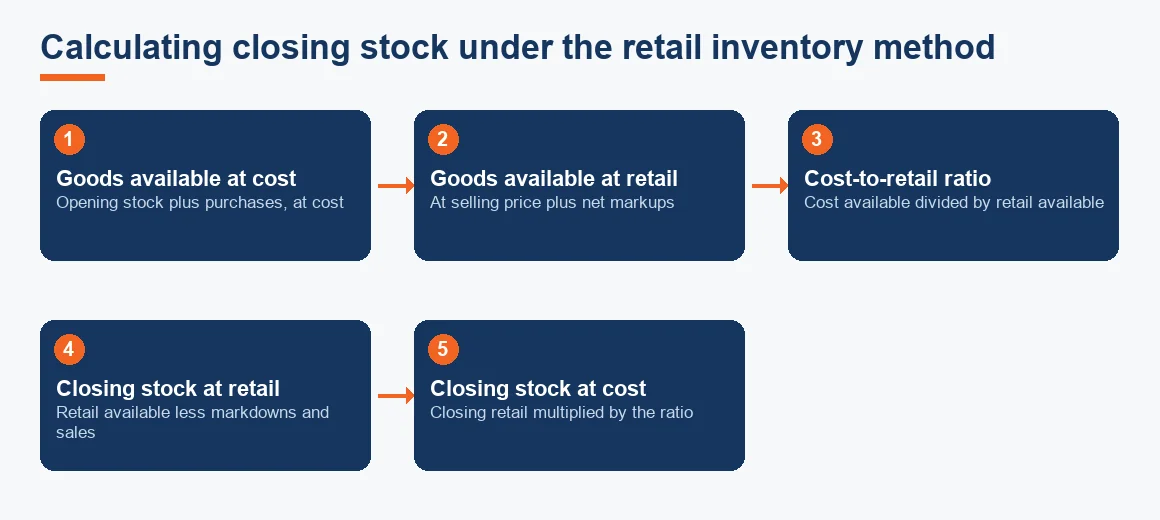
Closing stock at cost is then closing stock at retail multiplied by that ratio. Here is the step-by-step working:
- Add opening stock and purchases at cost to get goods available at cost.
- Add opening stock and purchases at retail (selling price), adjusted for net markups, to get goods available at retail.
- Divide goods available at cost by goods available at retail to get the cost-to-retail ratio.
- Subtract sales (and net markdowns) from goods available at retail to get closing stock at retail.
- Multiply closing stock at retail by the cost-to-retail ratio to get closing stock at cost.
Conventional retail method vs average retail method
The difference between the retail method and the conventional retail method comes down to how you treat markdowns in the ratio. Under the average (or standard) retail method, both markups and markdowns are included in the cost-to-retail ratio, which produces a figure close to average cost. Under the conventional retail method, markdowns are excluded from the ratio, which lowers the ratio and produces a more conservative valuation that approximates the lower of cost and net realisable value.
This matters in India because AS 2 requires stock to be carried at the lower of cost and net realisable value. If you cut a shelf price below cost during a clearance sale and still value the stock on the full ratio, you overstate closing stock and profit. Excluding markdowns from the ratio guards against that. The average retail method, by contrast, answers a different question: what did this stock cost on average, ignoring conservatism. Most retailers preparing statutory accounts lean towards the conventional treatment.
Gross profit method vs retail inventory method
The gross profit method is a close cousin, and the two are often confused. The gross profit method estimates closing stock by applying a historical gross margin percentage to sales to derive cost of goods sold, then working back to closing stock. It uses a single assumed margin from prior periods rather than the current period's actual cost and retail figures. The retail inventory method uses this period's real cost and retail totals, so it is generally more accurate.
The practical divide is this: the gross profit method is a quick estimate for interim reports, insurance claims after a fire or flood, or a sanity check when records are incomplete. The retail inventory method is robust enough to support month-end reporting where the store maintains proper retail and cost columns. Neither replaces a physical count for the year-end statutory position, but both reduce how often you need one. If margins have shifted sharply, the gross profit method (leaning on an old margin) will drift, while the retail method self-corrects because it recomputes the ratio each period. The concept of Gross Profit underlies both, and each ultimately feeds your Cost of Goods Sold.
What are the two types of inventory estimation methods?
When people ask about the two types of inventory estimation methods, they usually mean the retail inventory method and the gross profit method. Both estimate closing stock without a full physical count, and both are approximations rather than exact costing formulas. They sit apart from the cost formulas (FIFO, weighted average, specific identification), which measure actual cost rather than estimate it.
The FIFO variant of the retail method deserves a note. A FIFO retail method excludes opening stock from the cost-to-retail ratio, so the ratio reflects only the current period's purchases. This matches the FIFO assumption that closing stock is made up of the most recent buys, and it keeps the estimate consistent with how you would value stock under a FIFO cost formula. Whichever variant you choose, the standards require you to apply it consistently from year to year.
Where Indian standards stand: AS 2, Ind AS 2 and ICDS II
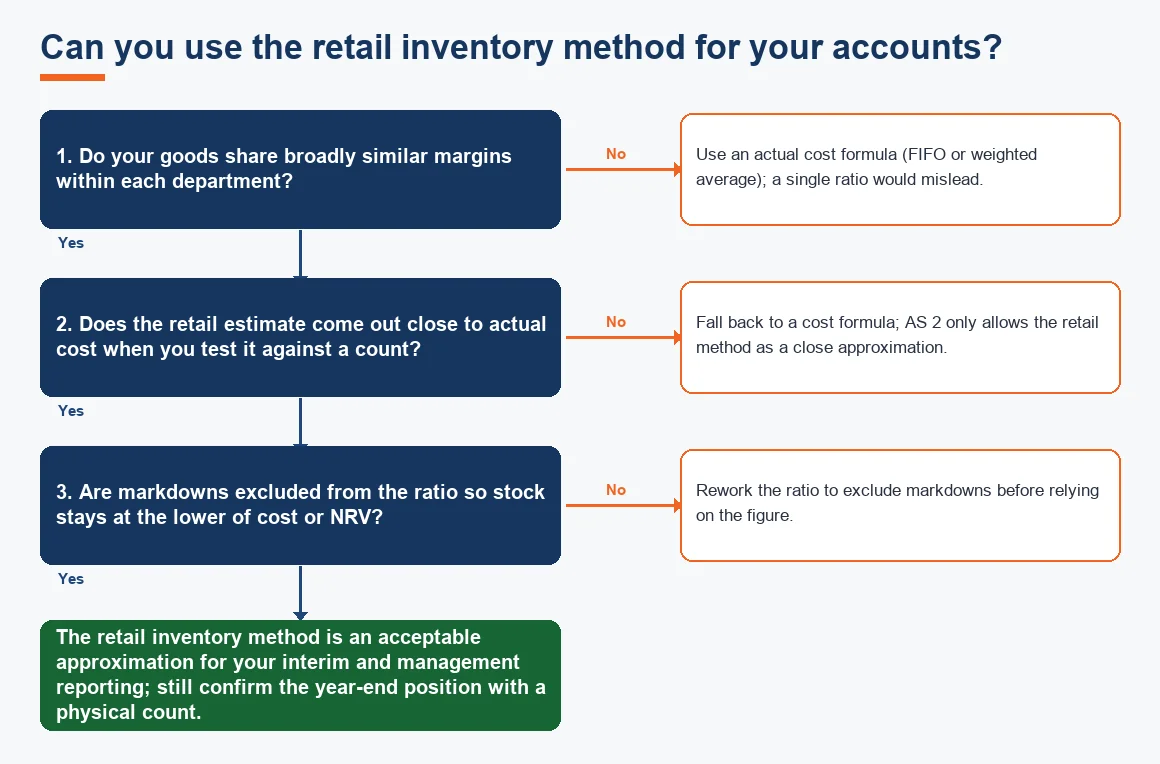
Both AS 2 (Valuation of Inventories) and Ind AS 2 explicitly allow the retail method and the standard cost method as techniques for measuring cost, but only for convenience and only where the results approximate actual cost. If the retail estimate drifts materially from what the goods truly cost, the standard requires you to fall back on an actual cost formula. Neither standard permits LIFO. The permitted cost formulas remain FIFO, weighted average cost and specific identification, the last being mandatory for items that are not ordinarily interchangeable. The ICAI publishes the full text of these standards on its website at icai.org.
On the tax side, Section 145A of the Income Tax Act requires inventory to be valued at the lower of cost and net realisable value, with taxes, duty and cess actually paid included in the value, and ICDS II governs the method for computing business income. Any change of method needs a reasonable cause and is disclosed in the tax audit report in Form 3CD. The statutory position is set out by the Income Tax Department at incometax.gov.in. Because GST is charged on the selling price and the retail method starts from that same price, retailers running the numbers should keep their retail columns net of GST to avoid inflating the valuation; the CBIC guidance at cbic-gst.gov.in is the reference point here. You can confirm whether Ind AS applies to your entity with our Ind AS Applicability Checker and compare treatments in the AS vs Ind AS Comparison Matrix.
Key terms
- Retail Inventory Method: estimating closing stock by applying a cost-to-retail ratio to stock valued at selling price.
- FIFO vs Weighted Average Cost: the two ordinary cost formulas permitted in India for interchangeable stock.
- Cost of Goods Sold: the cost of stock sold during the period, the figure both methods ultimately drive.
- Gross Profit: sales less cost of goods sold, the margin the gross profit method relies on.
- Inventory Shrinkage Provision: the accounting for stock lost to theft, damage or error, revealed when estimates meet counts.
Worked example: retail inventory method (conventional)
Take a single-store apparel retailer for one month. The store maintains cost and retail columns and records net markups and markdowns. The figures below are illustrative. We use the conventional method, so markdowns are excluded from the ratio but subtracted when arriving at closing stock at retail.
| Particulars | Cost (Rs) | Retail (Rs) |
|---|---|---|
| Opening stock | 1,00,000 | 1,50,000 |
| Add: Purchases | 5,00,000 | 7,00,000 |
| Add: Net markups | - | 20,000 |
| Goods available for sale | 6,00,000 | 8,70,000 |
| Cost-to-retail ratio | 6,00,000 / 8,70,000 = 68.97% | |
| Less: Net markdowns | - | (20,000) |
| Less: Sales | - | (6,00,000) |
| Closing stock at retail | - | 2,50,000 |
| Closing stock at cost (2,50,000 x 68.97%) | 1,72,414 | - |
Closing stock is therefore about Rs 1,72,414 at cost. If a physical count later shows stock worth only Rs 1,60,000 at cost, the roughly Rs 12,400 gap is shrinkage and should be recognised as an expense, not buried in margin. Notice that markdowns were kept out of the 68.97% ratio: had they been included, the ratio would rise and the closing stock would be overstated, breaching the lower-of-cost-or-NRV rule.
Retail inventory method vs cost method: a side-by-side
The table below summarises where each approach earns its keep. Many retailers use the retail method for interim months and the cost method, backed by a physical count, at year-end.
| Factor | Retail inventory method | Cost method |
|---|---|---|
| Basis | Estimate from selling price via a ratio | Actual cost per line (FIFO, weighted average, specific ID) |
| Best for | High-volume, low-value, similar-margin SKUs | Fewer, higher-value or dissimilar lines |
| Accuracy | Approximate; depends on uniform margins | Precise per item |
| Effort | Low; uses POS totals | Higher; needs item-level records |
| Indian standards | Allowed as approximation if close to cost | Default under AS 2 and Ind AS 2 |
| Physical count | Reduced frequency, still needed yearly | Still needed to verify records |
Which method should your store use?
Choose the retail inventory method if you hold many low-value lines at broadly similar margins, want quick interim stock figures, and can maintain clean retail and cost columns in your point-of-sale system. Choose the cost method if you carry expensive or dissimilar items, need exact per-line profitability, or your margins vary too much for a single ratio to be honest. Most growing retailers end up using both: the retail method for monthly management accounts and the cost method with a physical count for the statutory year-end. Sound daily discipline underpins either choice, which is why daily sales reconciliation for a retail store and careful handling of stock shrinkage and gross margin matter as much as the valuation method itself. Retailers on the composition scheme should also read our note on GST composition vs regular for retailers, since the scheme changes how you treat input costs.
The same estimation logic recurs across industries, though the drivers differ: a subscription business worries about deferred revenue rather than shelf stock, which is why our guides for SaaS accounting, IT and software company accounting and startup accounting treat inventory very differently. For a full bookkeeping engagement across any of these, our accounting services team can set the method up correctly from day one.
Key takeaways
- The retail method values stock backwards from selling price using a cost-to-retail ratio; the cost method tracks actual cost per line.
- Use the conventional (markdown-excluded) ratio to stay at the lower of cost and net realisable value under AS 2.
- AS 2 and Ind AS 2 allow the retail method only as an approximation close to actual cost; LIFO is prohibited in India.
- The gross profit method uses a historical margin and is best for quick estimates and insurance claims, not statutory year-ends.
- Section 145A and ICDS II require the lower of cost and net realisable value, applied consistently, with any change disclosed in Form 3CD.
- Whichever method you use, reconcile against a physical count and recognise the shrinkage you find.
Decision guide