
In this guide
Daily sales reconciliation for a retail store is the end-of-day check that your POS or till sales equal three things: the cash physically counted, the card and UPI settlements the bank credits, and the sales figure posted to your accounting ledger. It is done every trading day, ideally the same night, because a difference spotted on the day it arises can usually be explained, while the same gap found a week later almost never is. This guide sets out the process, the numbers behind it, and the entries that keep your books and your GST returns honest.
What is daily sales reconciliation in retail?
Retail reconciliation is a daily three-way match. On one side sits what your billing system says you sold. On another sits what you actually collected, split across cash, cards, UPI, wallets and any gift vouchers redeemed. On the third sits what lands in your accounting records and, in time, your bank account. When all three agree, the day is clean. When they do not, the difference is a variance that has to be named and cleared, not carried forward. Alongside the money, a proper day-end also looks at stock movement, returns, discounts and vouchers issued, because each of those moves the figures.
This is an operational discipline that sits underneath your wider books. If you want the fuller picture of how a store's accounts are kept, our overview of Retail Accounting Services in India covers the month-end and statutory layers that build on top of the daily close.
Why reconcile sales every single day?
Retail runs on volume and cash handling, and both invite small leaks. A miskeyed price, a void that was never a genuine return, a counter that is quietly short each evening: none of these announce themselves in a monthly summary. Daily reconciliation surfaces them while the trail is fresh and a staff member can still remember the transaction. It also keeps your output GST correct, because sales are recognised on the billed value regardless of what was collected, and it gives you a clean cash figure to bank the next morning.
What are the first steps in daily revenue reconciliation?
The first steps are always the same, and they happen at the counter before anyone goes home. Print the Z report, count the drawer, and set the float aside. Everything else builds on those three actions.
The night-close sequence
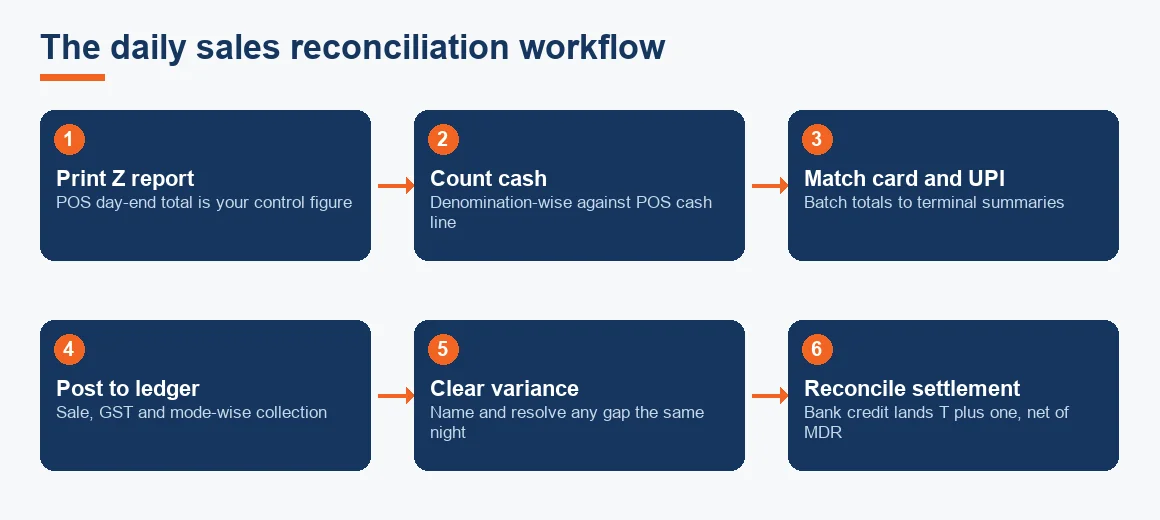
- Print and file the Z report (the POS day-end total). This is your control figure.
- Count cash denomination-wise and compare it to the POS cash sales line.
- Tally card and UPI batch totals against the terminal settlement summaries.
- List every void, return and manager discount with a stated reason.
- Set aside the fixed opening float for tomorrow.
- Record any unexplained difference that night, and sign the day sheet.
This POS day-end audit is a control in its own right, and it is the point where most errors are caught. If any counter is routinely off, that is a supervision matter for the store manager, not something to be smoothed over in the ledger.
How to reconcile daily sales: the full workflow
The counter close gives you a clean set of figures. Reconciliation proper is matching those figures across systems and clearing what does not agree. Work through it in this order.
Match collections to billed sales
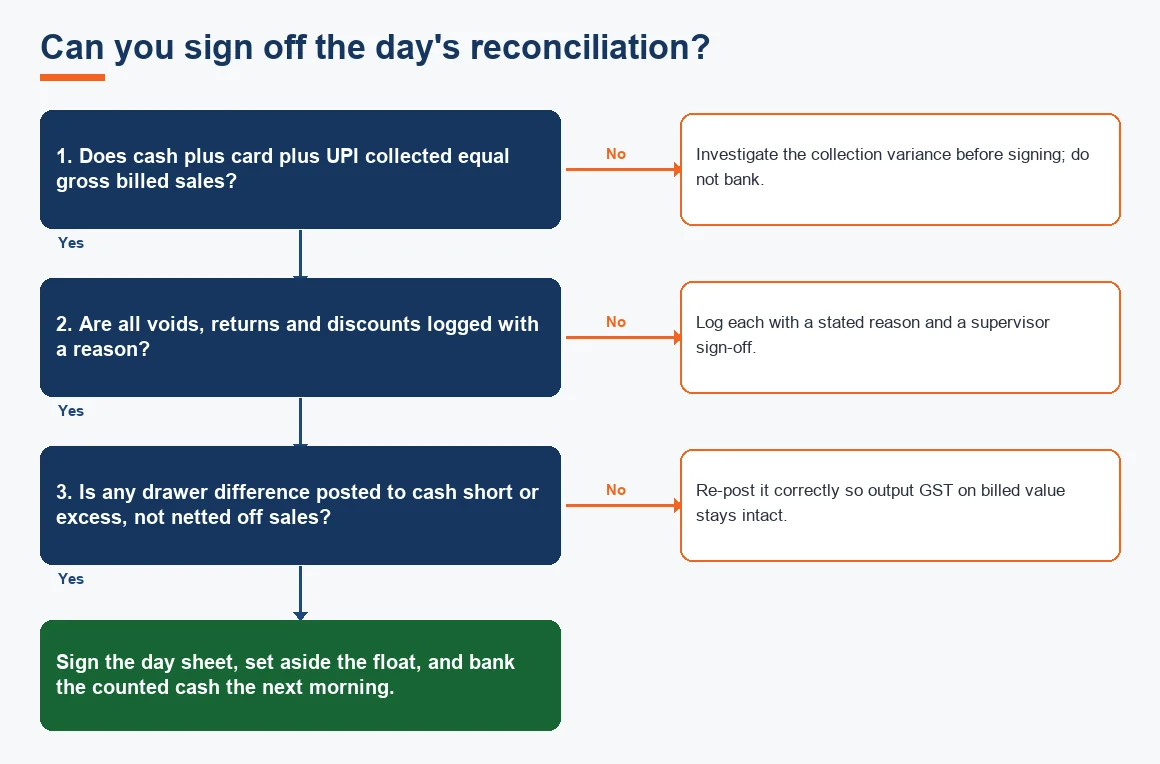
Add cash counted, card batch total and UPI batch total. That sum should equal gross billed sales (net taxable value plus GST) for the day, adjusted for any returns paid out. A gap here is a collection variance and is investigated first.
Match settlements to the bank
Card and UPI money does not arrive on the day of sale. It settles, usually on a T plus one basis, net of the merchant discount rate. So the day's card sales will never equal the bank credit, and that is expected, not an error. You carry the unsettled amount in a payment gateway receivable ledger and clear it when the acquirer settlement report shows the credit. This is where your card and bank reconciliation ties back to sales, and where a formal accounts reconciliation and audit routine keeps the receivable ledger from silting up.
Post to the ledger
The billed sale, the GST, the mode-wise collection and any charges all become a journal entry against your general ledger. Do this daily and your month-end is a review rather than a reconstruction.
How to match card and UPI settlements
Card acquirers deduct a merchant discount rate (MDR) and charge 18 per cent GST on that fee, then credit the net amount. Your job is to book the gross sale, recognise the MDR and its GST as an expense, and reconcile the net credit when it lands. UPI person-to-merchant transactions currently carry nil MDR under the government's mandate, so UPI usually settles at full value, which makes it the easier of the two to match. Always reconcile against the acquirer's settlement report, not a running mental total, because batch cut-off times mean a late-evening sale can slip into the next day's settlement.
How to record a cash shortage or excess
When the drawer is short or over, post the difference to a cash short or excess account on the day it arises, and clear it once the cause is found. Do not reduce the sales figure to make the day balance. GST has already been charged on the billed value, the output liability stands, and netting the shortfall against sales simply hides both the leak and a GST error. A recurring shortage at one counter is an internal control issue, not an accounting entry, and it should be escalated rather than absorbed.
Worked example: a single day's reconciliation
Take a small electronics store with a standard trading day. All figures are illustrative. Net taxable sales are Rs 1,00,000 at 18 per cent GST, giving Rs 18,000 of tax and Rs 1,18,000 gross billed. Customers paid Rs 30,000 cash, Rs 40,000 by card and Rs 48,000 by UPI. The card acquirer charges 1 per cent MDR plus 18 per cent GST on that fee; UPI settles at nil MDR.
| Line item | Amount (Rs) | Note |
|---|---|---|
| Net taxable sales | 1,00,000 | Posted to sales, indicative |
| Output GST (18%) | 18,000 | CGST 9,000 + SGST 9,000 |
| Gross billed | 1,18,000 | Control figure |
| Cash counted | 30,000 | Banked next morning |
| Card collected (gross) | 40,000 | Settles T plus 1 |
| UPI collected | 48,000 | Nil MDR, full value |
| Total collected | 1,18,000 | Matches gross billed, variance nil |
| Card MDR (1%) + 18% GST | 472 | Rs 400 fee + Rs 72 GST, an expense |
| Card bank credit (T+1) | 39,528 | 40,000 less 472 |
The day reconciles: collections of Rs 1,18,000 equal gross billed sales, so the collection variance is nil. The Rs 472 is booked as bank charges with input GST of Rs 72, and Rs 39,528 sits in the card gateway receivable until it clears the next day. Note that sales stay at Rs 1,00,000 net whatever the charges are; the MDR never touches revenue.
Manual till sheet or POS software: which to use
Small stores often start on a spreadsheet and move to POS-linked accounting as volume grows. Both can produce a clean daily reconciliation; they differ in effort and error rate.
| Factor | Manual day sheet (Excel) | POS-linked accounting |
|---|---|---|
| Setup cost | Nil, indicative | Subscription, Exl GST |
| Data entry | Re-keyed by hand | Auto from POS export |
| Error risk | Higher, keying errors | Lower, mapped once |
| GST split | Manual formulas | Rate-wise automatic |
| Best for | Single counter, low volume | Multi-counter or multi-store |
Whichever you use, the discipline matters more than the tool. A retailer weighing GST treatment as turnover grows should also read our note on the GST composition scheme versus regular for retailers, since the scheme you are on changes how the daily sales figure feeds your returns.
How daily reconciliation connects to your wider books
A clean daily close is the raw material for everything above it. Your stock figures feed the choice between the retail inventory method and the cost method, and the gaps that reconciliation throws up often trace to stock shrinkage eating into gross margin. The same discipline underpins other sectors too: subscription businesses running SaaS accounting, product companies using IT and software company accounting, and early-stage firms on startup accounting all reconcile daily takings against settlements in much the same way, only the settlement partner changes.
For the statutory side of collections, the CBIC guidance on GST is the authority worth bookmarking, alongside the live returns dashboard on the GST portal and the detailed material published by CBIC.
Key terms
- Point-of-Sale (POS) Day-End Audit: the counter-level close that produces the Z report and control totals.
- Bank Reconciliation: matching ledger cash and settlement figures to the bank statement.
- Journal Entry: the double-sided posting that records the day's sale, GST and collections.
- Variance Analysis: naming and clearing the gap between billed sales and collections.
- Bank Clearing Account: the holding ledger where settlements sit until the bank credit lands.
Key takeaways
- Reconcile the same day: count cash, tally card and UPI batches, and post to the ledger before you bank.
- Card and UPI settle T plus one, net of MDR, so the bank credit will never equal the day's card sales.
- Book the MDR and its 18 per cent GST as an expense; never let charges touch the sales figure.
- Post shortages to a cash short or excess account, never against revenue, because output GST stands on the billed value.
- A recurring counter shortfall is a control problem to escalate, not a number to bury.
Decision guide