In this guide
For a small retailer the choice between the GST composition scheme and regular registration comes down to one trade-off: a flat 1 percent of turnover with almost no paperwork, against the normal rate on every bill with full input tax credit and monthly returns. Composition suits a shop that sells mostly to walk-in consumers within its own state and wants to keep compliance simple. Regular registration suits a retailer whose customers are businesses, or who sells inter-state or online. This guide sets out the turnover limit, the rate difference, the input credit you give up and how to tell which side of the line your shop sits on.
What the composition scheme is (and what "regular" means)
The composition scheme is a simplified way for a small supplier to pay GST. Instead of charging tax on each sale and filing detailed monthly returns, a composition dealer pays a small flat percentage of turnover, files one challan-cum-statement every quarter in Form CMP-08 and one annual return in Form GSTR-4. The rate is 1 percent for traders and manufacturers (0.5 percent CGST plus 0.5 percent SGST), 5 percent for restaurants not serving alcohol, and 6 percent for the separate service option under section 10(2A).
A regular taxpayer does the opposite. You charge GST at the applicable rate on every invoice, claim input tax credit on your purchases, and file GSTR-1 and GSTR-3B every month (or quarterly under QRMP with monthly tax payment). The regular route is more work, but the tax you charge is your customer's money, not your own, and you recover the GST embedded in your stock and expenses. Getting the retail side of this right sits alongside the wider bookkeeping covered in our Retail Accounting Services in India.
Who is eligible for the composition scheme in GST?
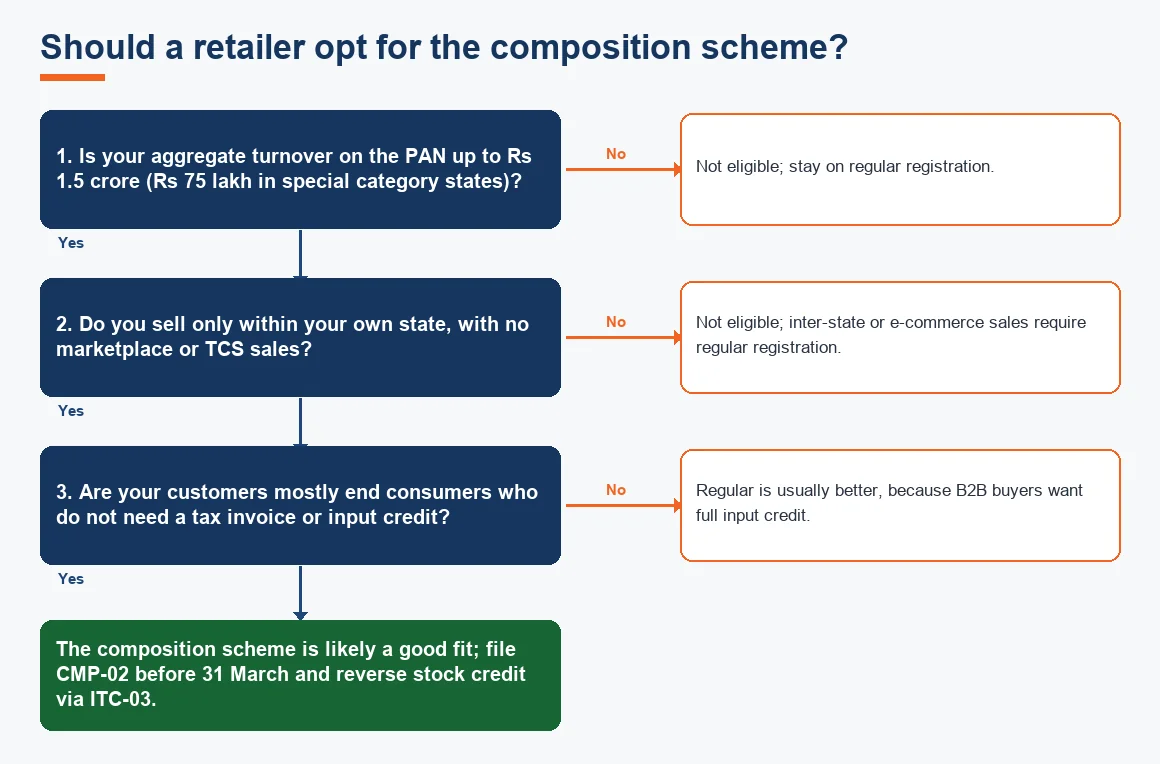
Eligibility turns first on turnover. A supplier of goods with aggregate turnover up to Rs 1.5 crore in the preceding financial year can opt in, reduced to Rs 75 lakh in the special category states. The separate service option under section 10(2A) is capped at Rs 50 lakh. "Aggregate turnover" is measured across every GSTIN on the same PAN, all India, so you cannot split a business to stay under the ceiling.
Several activities disqualify a taxpayer outright, whatever the turnover:
- Making any inter-state outward supply of goods.
- Supplying through an e-commerce operator that collects TCS under section 52.
- Manufacturing ice cream, pan masala or tobacco (and certain other notified goods).
- Supplying goods that are not taxable under GST.
The single most common reason a retailer is pushed out of the scheme is selling on a marketplace. The moment your listings go live on a platform that deducts TCS, composition is off the table for that PAN.
Composition scheme GST rate vs the regular rate
The headline is simple. A composition trader pays 1 percent of turnover. A regular retailer charges the goods' actual rate, which for typical retail lines runs 5 percent, 12 percent or 18 percent, and offsets it against credit on purchases. But the 1 percent is not "cheaper GST", because the two numbers are not measuring the same thing.
Under regular registration the tax on the bill is collected from the customer and passed on, so the dealer's real GST cost is only the tax on the value it adds. Under composition the dealer cannot add any tax to the price at all and pays the 1 percent out of its own gross profit. So the honest comparison is 1 percent of turnover paid by you, versus the applicable rate paid by your customer with credit flowing to you.
The input tax credit you give up
This is the real cost of composition, and it works two ways. First, you get no credit yourself, so the GST paid on your stock, rent, shop fittings and other expenses becomes a permanent cost that lifts your effective purchase price. Second, and often more damaging, your customer gets no credit either. A composition dealer must issue a bill of supply carrying the words "composition taxable person, not eligible to collect tax on supplies", with no tax line on it.
For a shop selling to end consumers that hardly matters, because a household buyer cannot use input credit anyway. For a shop that supplies other GST-registered businesses it matters a great deal: those buyers will prefer a regular dealer who gives them a tax invoice and full credit. This is the core of the disadvantages of the composition scheme, and it is why the decision is really about who your customers are.
Key terms
- GSTR-2B Input Tax Credit Matching: the auto-drafted statement a regular dealer uses to claim credit; a composition dealer cannot use it.
- Section 52 TCS under GST: tax collected by e-commerce operators that automatically disqualifies a supplier from composition.
- Retail Inventory Method: a way of valuing shop stock from selling price and margin, useful for either scheme.
- Point-of-Sale (POS) Day-End Audit: the daily counter reconciliation that keeps your turnover figure clean for the scheme threshold.
Which is better for a retailer, composition or regular?
There is no universal answer, only a fit test. Composition tends to win when the shop sells almost entirely to walk-in consumers, trades within a single state, buys mostly from suppliers who add little tax, and values simple quarterly compliance. Regular tends to win when the shop has business customers who want tax invoices, sells inter-state or through a marketplace, or carries heavily taxed, high-value stock where the lost input credit outweighs the compliance saving.
The comparison below summarises the practical differences. If your business is closer to a distributor than a counter shop, look at how the same trade-off plays out in our note on the retail inventory method versus the cost method, and at day-to-day controls in daily sales reconciliation for a retail store.
| Feature | Composition scheme | Regular scheme |
|---|---|---|
| Turnover limit | Up to Rs 1.5 crore (Rs 75 lakh special states) | No upper limit |
| Rate (traders) | 1 percent of turnover, from your margin | Goods' actual rate, collected from customer |
| Tax invoice | Not allowed; bill of supply only | Tax invoice with GST line |
| Input tax credit | None, for you or your buyer | Full credit on eligible purchases |
| Inter-state / e-commerce sales | Not permitted | Permitted |
| Returns per year | 4 CMP-08 plus 1 GSTR-4 | Monthly GSTR-1 and GSTR-3B plus annual |
How to know whether your GST is composition or regular
Two quick checks settle it. On the portal, open Search Taxpayer by GSTIN on the GST portal and read the "Taxpayer Type" field, which displays either Composition or Regular along with registration date and status. Off the portal, look at the document a supplier gives you: a composition dealer issues a bill of supply with no tax line and the mandatory "composition taxable person" wording, while a regular dealer issues a tax invoice showing CGST and SGST. Always confirm before you claim credit on a purchase, because credit taken against a composition dealer's bill will be reversed with interest.
How to convert composition to regular (and back)
Both directions are simple portal filings, but the timing and the stock adjustment differ. Follow the steps in order.
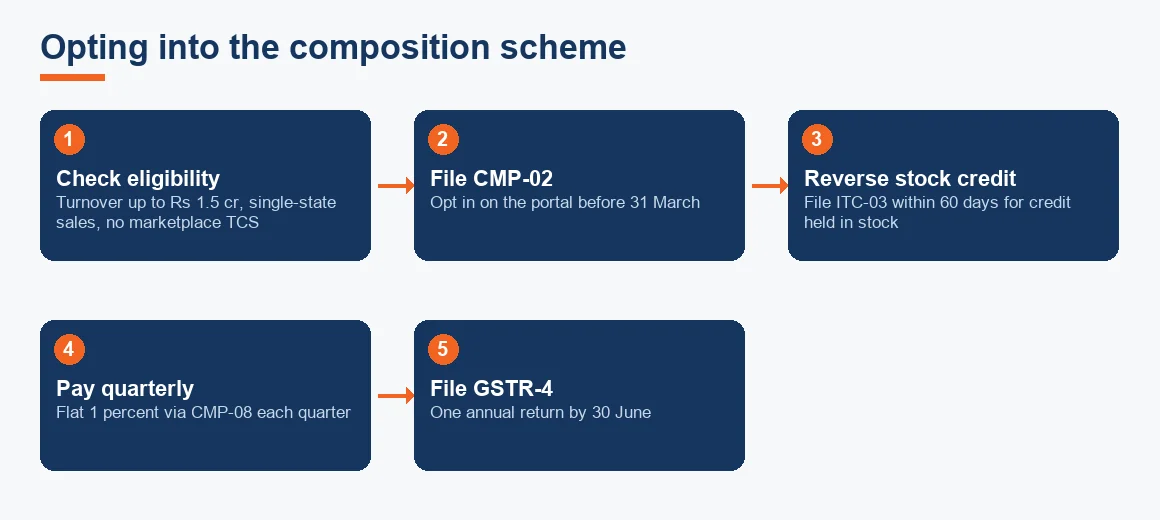
- Regular to composition: file Form GST CMP-02 before the start of the financial year in which the scheme is to apply, that is by 31 March.
- Reverse your stock credit: file Form ITC-03 within 60 days of the start of that year to give back the input credit sitting in your stock, semi-finished and finished goods on the day before the switch.
- Composition to regular: file Form GST CMP-04 to opt out. This can be done at any time, and is compulsory the day your turnover crosses Rs 1.5 crore or you begin a disqualifying activity.
- Claim your opening credit: after moving to regular, file Form GST ITC-01 within 30 days to claim credit on the stock you hold on the date of the switch.
Remember that the option applies to every GSTIN on the same PAN, so you cannot run one branch on composition and another on regular.
Worked example: composition vs regular for a Rs 90 lakh kirana store
Take a single-state grocery shop with annual turnover of Rs 90,00,000, purchases of Rs 72,00,000 (a 20 percent gross margin) and a blended GST rate of 5 percent on both sales and purchases. The table shows where the tax actually falls under each scheme. All figures are indicative.
| Particulars | Regular scheme (Rs) | Composition scheme (Rs) |
|---|---|---|
| Annual turnover | 90,00,000 | 90,00,000 |
| Output tax collected from customers | 4,50,000 (5%) | Nil (cannot collect) |
| Input tax credit available | 3,60,000 | Nil |
| Tax remitted to government | 90,000 (4,50,000 less 3,60,000) | 90,000 (1% of turnover) |
| GST borne by the dealer | Nil (passed to customers) | 90,000 (from margin) |
| Returns filed per year | 25 (GSTR-1 and 3B monthly plus annual) | 5 (4 CMP-08 plus GSTR-4) |
The remittance to government happens to be Rs 90,000 either way at these numbers, but who pays it is the whole story. Under regular the Rs 90,000 is funded by customers; under composition the dealer pays it from its own profit. The composition dealer trades that Rs 90,000 of margin for filing 5 returns instead of 25 and never touching an input-credit reconciliation. For a busy counter shop with no accounts staff, that swap can be worth it; for a shop with wafer-thin margins, it may not be.
Interstate purchase and other frequent doubts
A point that trips up many shopkeepers: the bar on inter-state supply applies only to your outward sales, not your purchases. A composition dealer can freely buy stock from suppliers in other states; it simply cannot sell across a state border. Buying is fine, selling out is not.
The scheme also does not remove other retail housekeeping. You still track stock shrinkage and margins the same way, a subject we cover in handling stock shrinkage and gross margin in retail books. And composition covers only your regular GST liability; any tax under reverse charge is still payable at the normal rate on top of the flat percentage.
The scheme is built for goods retail, so it maps less neatly onto service-led or asset-heavy businesses. If you also run a services arm, or operate as a startup or software business, the credit calculus is different, and it is worth reading how those models handle GST in our notes on SaaS Accounting Services, IT and software company accounting and startup accounting in India. Where capital purchases are involved, the lost credit shows up over time, and a quick pass through a depreciation calculator or a deferred tax calculator helps you see the true carrying cost.
Key takeaways
- Composition is a flat 1 percent of turnover paid from your own margin; regular is the goods' actual rate collected from customers with full input credit.
- The turnover ceiling is Rs 1.5 crore (Rs 75 lakh in special category states), measured across every GSTIN on the PAN.
- Selling inter-state or through a TCS-collecting marketplace disqualifies you from composition, whatever your size.
- A composition dealer issues a bill of supply, gives no input credit and so is unattractive to B2B buyers.
- Opt in with CMP-02 by 31 March and reverse stock credit via ITC-03; opt out any time with CMP-04 and reclaim credit via ITC-01.
For statutory wording, rely on the primary sources: the composition rules and forms on the CBIC GST site, and the taxpayer-type lookup on the GST portal. When the numbers are close, or a marketplace or inter-state plan complicates eligibility, take a quick professional view before you file CMP-02, because the choice locks in for the year.
Decision guide