
In this guide
DPIIT and angel tax compliance for Mumbai startups comes down to three separate things that founders often confuse: getting recognised by the Department for Promotion of Industry and Internal Trade (DPIIT), claiming the Section 80-IAC tax holiday that recognition unlocks, and understanding that angel tax itself no longer exists. This is an explainer for founders and finance leads running a company out of Mumbai, whether you are in BKC, Andheri or a co-working desk in Lower Parel. If you are looking to hand the work over, the commercial route sits with our Startup Accounting Services India team and its Mumbai desk; this piece stays on the how and the why.
What DPIIT recognition actually gives a Mumbai startup
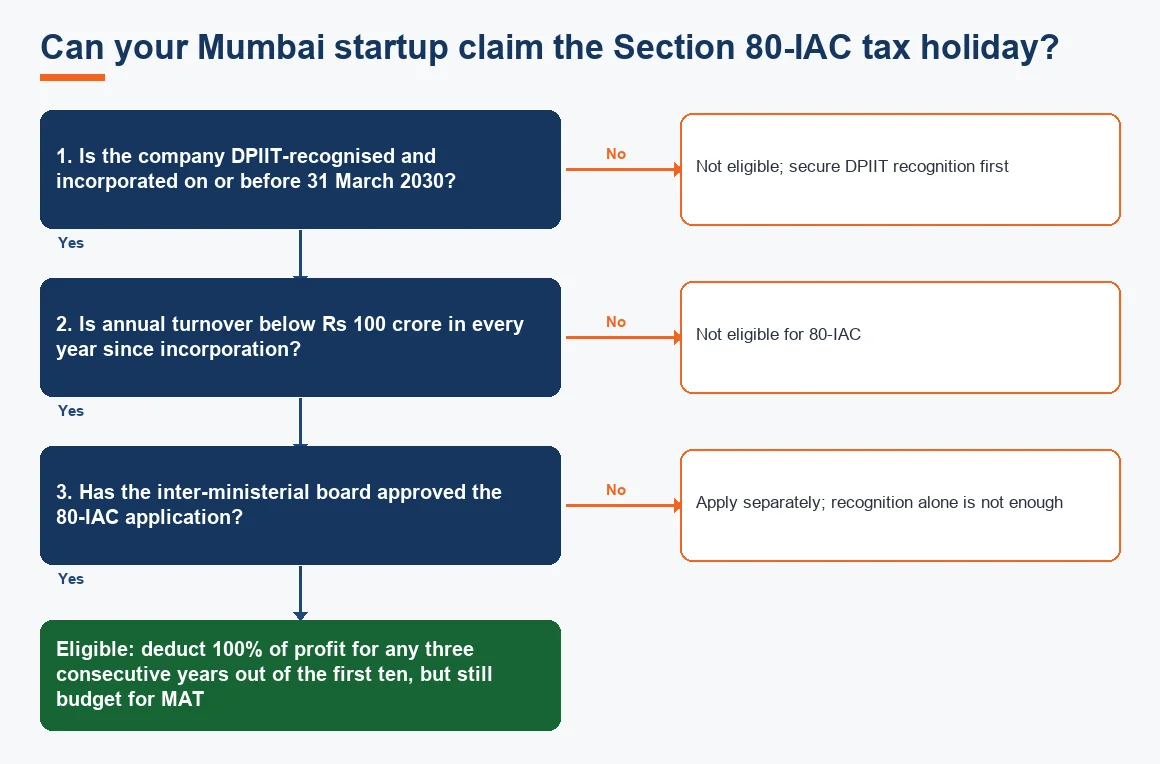
DPIIT recognition is a status granted through the Startup India portal to a private limited company, registered partnership or LLP that is under ten years old and has turnover below Rs 100 crore in every year since incorporation. Recognition on its own is free and does not touch your books. What it opens up is a set of reliefs: eligibility to apply for the Section 80-IAC deduction, self-certification under six labour and three environment laws, faster exit under the Insolvency and Bankruptcy Code, and relief from the Section 79 rule that would otherwise block carry-forward of losses after a change in shareholding.
That last point matters for any funded Mumbai startup. Normally, if more than 49% of the shareholding changes hands, past losses lapse. For a DPIIT-recognised startup, losses can still be carried forward as long as all the original shareholders continue to hold their shares, which protects the loss pool through successive funding rounds. Recognition does not, however, change whether you follow Accounting Standards (AS) or Indian Accounting Standards (Ind AS). That threshold is driven by your net worth and listing status, not your startup badge, and you can sense-check it with the deferred tax calculator once your temporary differences start to build up.
Is angel tax still applicable to Mumbai startups?
No. Section 56(2)(viib), the provision popularly called angel tax, was abolished by the Finance (No. 2) Act 2024 with effect from assessment year 2025-26. Where a closely held company issued shares above fair market value, the excess premium used to be taxed in its hands as income from other sources. From AY 2025-26 that charge is gone for all investors, resident or non-resident, which removes a long-standing worry for Mumbai angel and seed rounds. The Income Tax Department sets out the amended provisions on its portal at incometax.gov.in.
Two things survive the abolition. First, you still need a valuation report for FEMA pricing whenever foreign investment comes in, because the Reserve Bank of India requires the issue price to be at or above fair value under its pricing guidelines. Second, any earlier assessment year already under scrutiny is governed by the old law, so keep your merchant banker or chartered accountant valuation reports on file rather than discarding them.
Section 80-IAC: the tax holiday and how it hits the books
Section 80-IAC allows an eligible DPIIT-recognised startup incorporated up to 31 March 2030 to deduct 100% of its profits for any three consecutive years out of its first ten. The deduction is a tax computation item, not a book entry: you still prepare a full profit and loss account and pay attention to profit, but the eligible profit is deducted while arriving at taxable income. Because the relief is optional in timing, most Mumbai startups pick the first three profitable years, which for a typical SaaS or fintech is well after incorporation.
The accounting subtlety is deferred tax. Under Ind AS 12 and AS 22 you do not create a deferred tax asset on losses you expect to shelter under an 80-IAC holiday, because there will be no tax against which the benefit reverses. Getting this wrong overstates net worth in your Schedule III balance sheet, which investors do read. This is exactly the kind of judgement our audit-readiness checklist for Mumbai businesses flags before a diligence round.
Setting up startup accounting in Mumbai, step by step
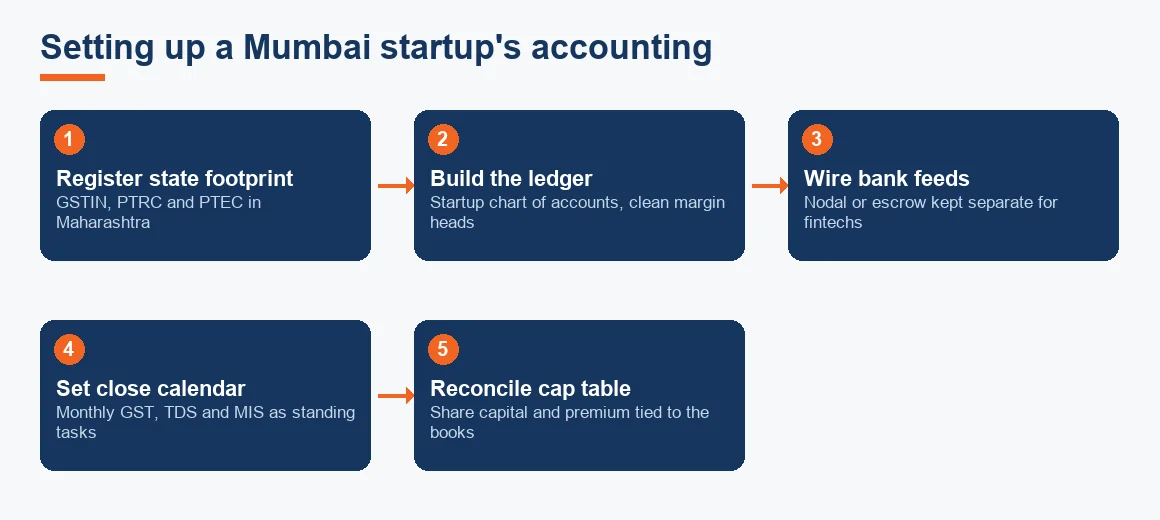
The local build is the same whether you are a fintech near BKC or a D2C brand in Andheri, and it should be in place before your first institutional cheque clears.
- Register the state footprint. Take your Maharashtra GSTIN, and enrol for PTRC and PTEC under state profession tax; the detail sits in our note on Maharashtra professional tax and Shops Act compliance.
- Pick the ledger. Map a startup-ready chart of accounts with clean revenue, cost-of-revenue and operating expense heads so burn and gross margin fall out without rework.
- Wire the bank feeds. Connect current accounts, and for a fintech keep the nodal or escrow account on a separate ledger from day one.
- Set the close calendar. Fix a monthly close with GST, TDS and MIS as standing tasks, so investor reporting is a by-product rather than a fire drill.
- Reconcile the cap table. Tie share capital, securities premium and any convertible instruments in the books to the cap table every month.
Founders comparing quotes for this work will find realistic ranges in our cost of accounting services in Mumbai benchmarks, and the selection questions in how to choose an accountant in Mumbai.
Fintech startups: accounting for money that is not yours
Mumbai is India's fintech capital, and the single most common error in a fintech's books is grossing up flows that belong to customers. Money sitting in a nodal or escrow account is a liability to customers, not revenue and not the fintech's own bank balance. Only the commission or platform fee earned reaches the profit and loss account. Under Ind AS 115, where the platform acts as an agent rather than principal, settlement flows cannot be booked as revenue. RBI nodal-account rules, published at rbi.org.in, require daily reconciliation of the pool account, so the ledger design has to support that. This agent-versus-principal question is the same one our SaaS accounting and IT and software company accounting teams work through for subscription platforms, and it also drives how e-commerce marketplaces treat gross merchandise value.
Cap table, convertible notes and SAFEs
Early Mumbai rounds increasingly use convertible notes and SAFEs (Simple Agreements for Future Equity). A convertible note is carried as a financial liability until it converts; a SAFE is normally a liability too, unless it passes the fixed-for-fixed test for equity classification under Ind AS 32. A company still on plain AS shows the note under unsecured loans with the conversion terms disclosed in the notes to accounts. RBI permits convertible notes for DPIIT-recognised startups above a Rs 25 lakh minimum, which is why recognition and instrument choice are linked. Every round dilutes the founders, so the securities premium in the books and the fully diluted cap table must agree at each close.
Key terms
- Cap Table Dilution: the fall in each shareholder's percentage as new shares are issued in a funding round.
- Ind AS 102 Share-based Payment: the standard governing how ESOP cost is measured and spread over the vesting period.
- Ind AS 115 Revenue Recognition: sets when and how much revenue a platform books, including the agent-versus-principal call.
- Monthly Burn Rate: the net cash a startup consumes each month before fresh funding.
- Cash Runway Calculation: months of operation left at the current burn, given the closing cash balance.
Worked example: Section 80-IAC deduction for a BKC SaaS startup
Assume a DPIIT-recognised SaaS company in BKC, incorporated in FY 2022-23, that turns profitable in FY 2026-27 and elects 80-IAC for that year. All figures are indicative and exclusive of GST. The deduction wipes out the tax on eligible profit, but note how deferred tax and MAT interact.
| Line item | Amount (Rs) | Note |
|---|---|---|
| Book profit before tax | 80,00,000 | From the profit and loss account |
| Eligible profit deducted under 80-IAC | (80,00,000) | 100% of profit for the elected year |
| Taxable income after 80-IAC | 0 | Normal tax payable is nil |
| Book profit for MAT (Section 115JB) | 80,00,000 | 80-IAC does not reduce MAT book profit |
| MAT at 15% plus cess (approx 15.6%) | 12,48,000 | Payable despite the holiday |
| MAT credit carried forward | 12,48,000 | Set off against normal tax in later years |
The lesson for Mumbai founders is that the 80-IAC holiday reduces normal tax to nil but does not remove Minimum Alternate Tax, so a profitable year still carries a cash outflow. That MAT becomes a credit you use once the holiday ends. New-regime companies that have opted out of MAT under Section 115BAA sit outside this, which is a modelling choice worth making early.
DPIIT reliefs, angel tax and 80-IAC at a glance
The three concepts are easy to blur, so this table separates what each one is, what it needs and what it touches in your accounts.
| Item | What it is | Key requirement | Effect on the books |
|---|---|---|---|
| DPIIT recognition | Startup India status | Under 10 years, turnover below Rs 100 crore | None directly; unlocks other reliefs |
| Angel tax | Abolished from AY 2025-26 | No filing; keep old valuations | Share premium no longer taxable |
| Section 80-IAC | 100% profit tax holiday, 3 of 10 years | Inter-ministerial board approval | Tax computation item; MAT still applies |
| Section 79 relief | Loss carry-forward protection | Original shareholders retained | Preserves loss pool through rounds |
Key takeaways
- DPIIT recognition is a gateway, not an accounting change: it unlocks 80-IAC and Section 79 relief but leaves your standards untouched.
- Angel tax is gone from AY 2025-26, yet valuation reports remain necessary for FEMA pricing and open past years.
- The 80-IAC holiday zeroes normal tax but not MAT, so a profitable year still needs cash and generates a MAT credit.
- Fintechs must keep customer money off their own profit and loss and reconcile the nodal account daily.
- Reconcile the cap table to the books at every close, and carry convertible notes as liabilities until conversion.
For hands-on setup or a diligence-ready cleanup in Mumbai, the commercial work sits with the Startup Accounting Mumbai desk and the wider Mumbai accounting and bookkeeping team; this guide is here to help you understand the rules first.
Decision guide