In this guide
Cap table and fund reporting for a PE-backed Gurugram startup means keeping two sets of numbers in step: the investor pack your shareholders agreement asks for, and the statutory record the Ministry of Corporate Affairs and the Reserve Bank of India expect regardless of what the investor wants. The cap table sits at the centre of both. Get it to reconcile with your statutory registers and your filings, and monthly reporting becomes routine; let the two drift apart, and every funding round turns into a scramble. This is an explainer for founders and finance leads in Gurugram on how that reporting actually works, not a services pitch. If you want the commercial side handled, that belongs on our Startup Accounting Services India Gurugram page.
What being PE-backed changes about your books
A private equity backed company is one where a fund holds a significant minority or controlling stake, usually with an exit planned in four to seven years. The money almost always comes in through compulsorily convertible preference shares (CCPS) or compulsorily convertible debentures (CCDs), which India's foreign investment rules treat as equity instruments rather than debt. That single fact reshapes your accounting. The instrument has to be classified correctly, valued by a SEBI-registered merchant banker or chartered accountant at issue, and tracked as it converts. Your books stop being a compliance afterthought and become a monthly product that a sophisticated investor reads line by line. This is separate territory from the day-to-day covered by our Startup Accounting Services India hub, and if you are a software business the revenue nuances sit closer to SaaS Accounting Services (IT & SaaS).
The cap table: what it is and who keeps it
The capitalisation table lists every share and share-equivalent in the company, who holds it, and what percentage each holder owns on a fully diluted basis. Fully diluted means you count not just issued equity shares but the ESOP pool, the convertible instruments and any anti-dilution effects, as if everything that could turn into shares already had. Investors read this version, not the simple issued-shares view, so version control genuinely matters.
In practice the company secretary and finance team keep the cap table, and its job is to reconcile to three statutory anchors: the register of members in Form MGT-1, the return of allotment in Form PAS-3 filed within 30 days of allotment, and the share certificates issued within two months of allotment. If your spreadsheet says one thing and MGT-1 says another, the spreadsheet is wrong until proven otherwise. A clean cap table also drives your understanding of cap table dilution at the next round.
Fund reporting: what a PE investor expects each period
Investor reporting and statutory reporting run in parallel, on different clocks. Most shareholders agreements specify a rhythm along these lines: management accounts shortly after each month end, a fuller quarterly pack, and audited annual accounts within the statutory timeline. The quarterly pack is where the cap table, cash runway and covenant compliance come together in one document. A Gurugram company still files Form AOC-4 and Form MGT-7 with the MCA whatever the investor pack contains, so do not treat the investor deck as a substitute for statutory accounts.
| Report | Typical timing | What it carries |
|---|---|---|
| Management accounts | 15 to 30 days after month end | P&L, balance sheet, burn and bank position |
| Quarterly investor pack | Within about 30 days of quarter end | Cap table, cash runway, covenant compliance, KPIs |
| Audited annual accounts | Statutory timeline | Ind AS or AS financials, notes, auditor's report |
| Statutory MCA filing | AOC-4 and MGT-7 post-AGM | Filed financials and annual return, independent of investor pack |
The monthly discipline behind this is a proper close. If you want the operational checklist a Gurugram finance team follows, our Virtual CFO & Financial-Ops Checklist for Gurugram Startups walks through it step by step, so we will not repeat that here.
Statutory filings that run alongside investor reporting
Foreign PE money brings an RBI dimension on top of the MCA one. When a foreign investor subscribes to shares, Form FC-GPR must be filed within 30 days of allotment through the RBI FIRMS portal. The filing needs a company secretary certificate, a valuation report from a SEBI-registered merchant banker or chartered accountant, and the FIRC and KYC report from the receiving bank. Allotment itself must happen within 60 days of the money arriving, and a late FC-GPR attracts a late submission fee. The framework sits in the RBI's Foreign Exchange Management (Non-debt Instruments) rules, published at the Reserve Bank of India, while the PAS-3 and MGT-7 obligations sit with the Ministry of Corporate Affairs.
Steps after a funding round closes in Gurugram
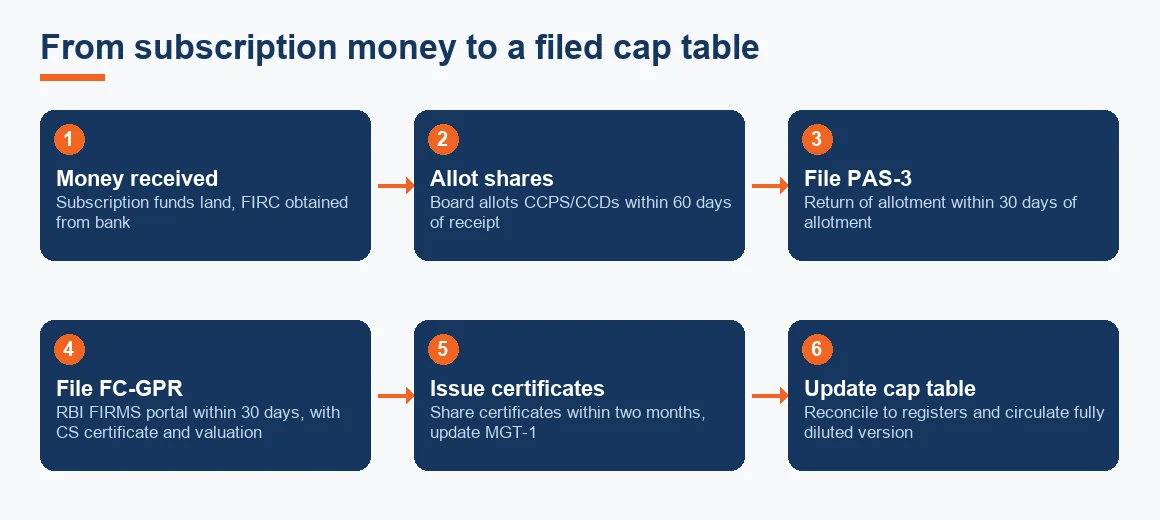
Once the term sheet becomes a signed agreement and money lands, the sequence is fairly mechanical if you run it in order.
- Confirm receipt of subscription money in the company bank account and obtain the FIRC from the bank.
- Hold a board meeting and allot the CCPS or CCDs within 60 days of receipt.
- File Form PAS-3 (return of allotment) within 30 days of the board allotment.
- File Form FC-GPR on the RBI FIRMS portal within 30 days of allotment, with the CS certificate and valuation report.
- Issue share certificates within two months and update the register of members in Form MGT-1.
- Update the master cap table, reconcile it to MGT-1 and PAS-3, and circulate the new fully diluted version to investors.
When Ind AS becomes mandatory
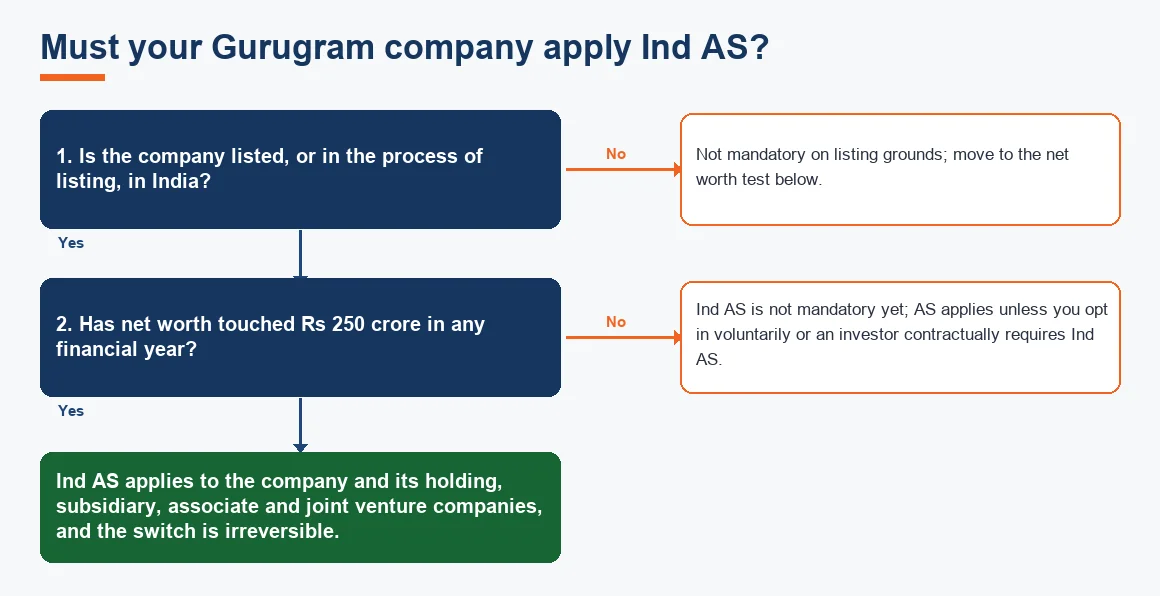
Indian Accounting Standards become compulsory for an unlisted company once its net worth reaches Rs 250 crore in any financial year, and at that point the holding, subsidiary, associate and joint venture companies must apply Ind AS too. The switch cannot be reversed. Below the threshold, Accounting Standards (AS) apply unless the company opts in voluntarily. The practical wrinkle for PE-backed companies is that many investors contractually demand Ind AS or IFRS-aligned reporting long before net worth gets anywhere near Rs 250 crore, because it makes the portfolio comparable and the eventual exit cleaner. Ind AS also pulls in specific treatments a growth company hits early: Ind AS 102 share-based payment for the ESOP charge and Ind AS 115 revenue recognition for subscription and milestone revenue. If you are unsure where you stand, the Ind AS Applicability Checker and the AS vs Ind AS Comparison Matrix will frame the question before you commit. The standards themselves are notified by the MCA and maintained by the Institute of Chartered Accountants of India.
Worked example: dilution when a fund takes 20 percent
Assume a Gurugram company with 8,00,000 founder equity shares and a 2,00,000-share ESOP pool, so 10,00,000 shares on a fully diluted basis before the round. A fund subscribes to CCPS for a 20 percent fully diluted stake. To end at 20 percent, the new shares equal 10,00,000 divided by 0.80, less 10,00,000, which is 2,50,000 new preference shares, taking the post-round fully diluted total to 12,50,000.
| Holder | Shares (pre) | % pre | Shares added | Shares (post) | % fully diluted (post) |
|---|---|---|---|---|---|
| Founders | 8,00,000 | 80.0% | 0 | 8,00,000 | 64.0% |
| ESOP pool | 2,00,000 | 20.0% | 0 | 2,00,000 | 16.0% |
| PE fund (CCPS) | 0 | 0.0% | 2,50,000 | 2,50,000 | 20.0% |
| Total | 10,00,000 | 100% | 2,50,000 | 12,50,000 | 100% |
The founders' shareholding does not change in absolute terms, but their percentage falls from 80 to 64 as the base grows. This is the number an investor watches, and it is why the fully diluted view, not the issued-shares view, is the one that goes in every board pack.
The investor reporting calendar
Beyond the one-off round mechanics, the recurring cadence is what keeps investors comfortable between board meetings. The pattern below is the common shape; your specific shareholders agreement governs the exact days.
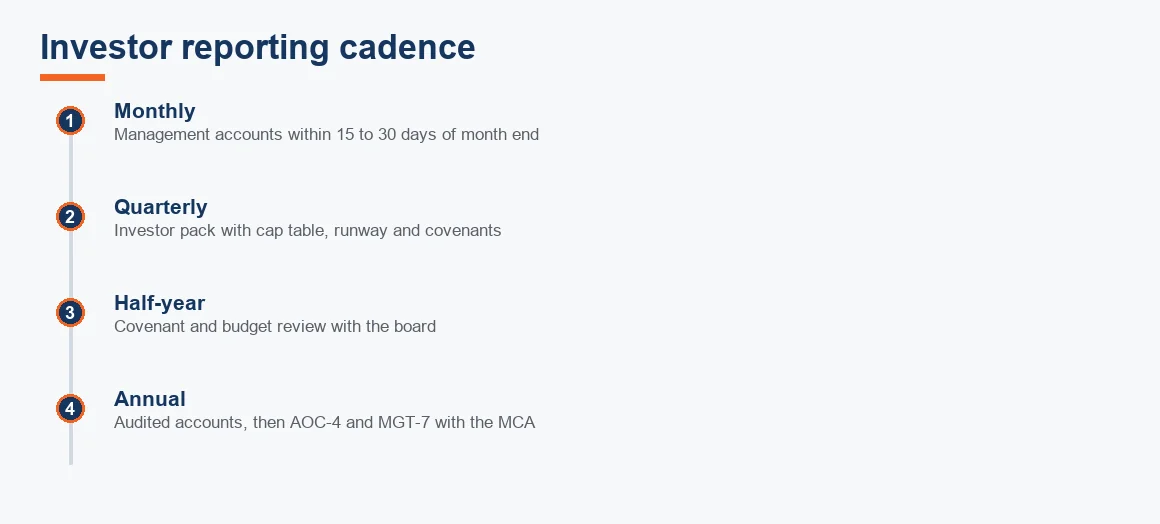
Two metrics anchor almost every pack: monthly burn rate and the cash runway calculation that follows from it. If runway drops below the fundraising lead time, that is the signal to start the next round, and a reporting pack that surfaces it early is doing its job.
The Gurugram angle
Location changes the payroll and state-tax layer rather than the cap table. Haryana levies no professional tax, so a Gurugram company's payroll pack skips a line that Maharashtra or Karnataka companies carry, though Labour Welfare Fund and Shops Act points still apply, as our Haryana compliance guide for employers covers. Many Gurugram startups sit in Udyog Vihar, Cyber Hub or along Golf Course Road, and a good number export software, which brings STPI or SEZ reporting into scope alongside the investor pack. The related-industry mechanics live on our IT & Software Company Accounting Services and E-Commerce Accounting Services pages, and the local costs of running all this are set out in Cost of Outsourced Accounting & Virtual CFO in Gurugram: 2026. If you are still selecting a firm, How to Choose an Accountant in Gurugram and the city bookkeeping options at Accounting & Bookkeeping Services Gurugram and SaaS Accounting Services Gurugram are the practical next reads.
Key terms
- Cap Table Dilution: the fall in an existing holder's percentage as new shares are issued, even when their share count is unchanged.
- Monthly Burn Rate: the net cash a company consumes each month, the base input for runway.
- Cash Runway Calculation: how many months of cash remain at the current burn, before new funding.
- Ind AS 102 Share-based Payment: the standard governing how the ESOP expense is measured and recognised.
Key takeaways
- Run investor reporting and statutory reporting as parallel tracks; neither replaces the other.
- Reconcile the cap table to MGT-1, PAS-3 and FC-GPR after every round, and keep a dated change log.
- Watch two clocks: 60 days from receipt to allotment, 30 days from allotment to FC-GPR.
- Adopt Ind AS early if an investor requires it, rather than converting mid-life.
- In Gurugram, the cap table is standard; the state layer (no professional tax, Shops Act, LWF) is what shifts.
Decision guide