
In this guide
For a Delhi startup, DPIIT recognition and the old angel tax question come down to a few dated facts rather than a sales pitch. DPIIT recognition is a free certificate from the Startup India portal that marks your company as an eligible startup; angel tax under Section 56(2)(viib) of the Income Tax Act has been abolished from Assessment Year 2025-26; and the real tax benefit, the Section 80-IAC profit holiday, is a separate approval that only some recognised startups receive. This explainer sets out what applies to a Delhi-registered company, what does not, and the number that actually decides each step. For the commercial side of setting up your books, see our Startup Accounting Services India page and the local Startup Accounting Services - Delhi page.
What DPIIT recognition means for a Delhi startup
DPIIT recognition is granted by the Department for Promotion of Industry and Internal Trade to entities that meet a fixed test. The entity must be a private limited company, a registered partnership firm or an LLP, incorporated within the last ten years, with annual turnover that has never crossed Rs 100 crore in any year since incorporation. It must be working on innovation, improvement of a product or process, or a scalable model with potential for employment or wealth creation. A company formed by splitting up or reconstructing an existing business does not qualify.
The application itself is short. You upload the certificate of incorporation, a brief note on what makes the business innovative, and the directors' details on the Startup India portal, and the recognition certificate is issued electronically with a DIPP number. There is no government fee. This holds identically whether your registered office is in Nehru Place, Connaught Place, Okhla or Rohini; recognition is a central process and is not decided by your Delhi address. What the Delhi address does decide is your Registrar of Companies (RoC Delhi) and your local licences, which we cover further down.
DPIIT recognition, 80-IAC and Udyam: three certificates, not one
Founders routinely treat these as a single "startup certificate". They are not, and confusing them costs time.
DPIIT recognition is the entry certificate. On its own it gives you self-certification under labour and environment laws, easier public procurement norms and access to the Startup India network, but it does not by itself reduce your income tax. Section 80-IAC is the tax holiday, granted separately by an Inter-Ministerial Board to only a subset of recognised startups. Udyam registration is the MSME record you take on the Udyam portal to claim MSME benefits, including the protection of the 45-day payment rule. A Delhi startup can, and often should, hold all three, but each is applied for on its own portal and each has its own eligibility.
The distinction matters for the money too. Ordinary DPIIT recognition does not let you defer tax on employee ESOP perquisites; only startups holding the 80-IAC eligibility certificate can use the Section 192(1C) deferral. If ESOPs are central to your hiring, that is a reason to pursue 80-IAC rather than stop at recognition. Our GST and TDS health-check for Delhi MSMEs walks through the payroll-side TDS that sits alongside this.
The angel tax position now
For years the headline worry for early-stage founders was angel tax: Section 56(2)(viib) taxed the premium a closely held company received on its shares above fair market value as "income from other sources". DPIIT recognition, through a linked notification, was the main route to exemption for a startup raising an angel round.
That worry has largely gone. The Finance (No. 2) Act 2024 abolished Section 56(2)(viib) with effect from Assessment Year 2025-26. For shares your Delhi company issues on or after 1 April 2024, angel tax does not apply, and it no longer matters whether the investor is resident or non-resident. This does not mean valuation is now irrelevant: your share issue price still feeds your cap table, and the Companies Act valuation report for a private placement is still required. It simply means the specific angel tax penalty on a premium above fair market value is off the table. You can confirm the amending law on the Income Tax Department portal.
Section 80-IAC: the number that decides it
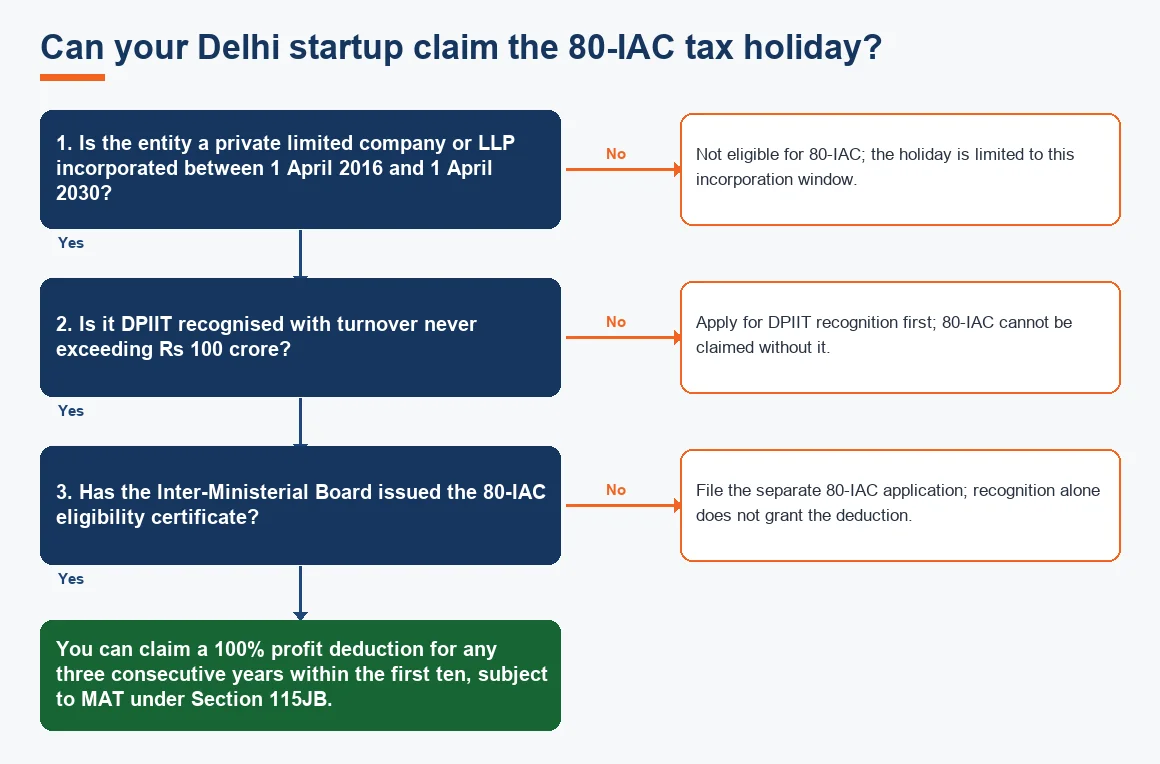
The genuine tax benefit is Section 80-IAC. It gives an eligible startup a 100% deduction of profits and gains for any three consecutive assessment years out of its first ten years since incorporation. You choose which three years, which lets you take the holiday in the years you actually turn profitable rather than wasting it on loss-making early years.
The eligibility gate is narrow. The company must be DPIIT recognised, must be incorporated between 1 April 2016 and 1 April 2030 (the Union Budget 2025 extended the earlier 1 April 2025 cut-off), and turnover in the year of claim must not exceed Rs 100 crore. Crucially, 80-IAC is not automatic on recognition: you apply separately, and an Inter-Ministerial Board reviews and approves the exemption certificate.
How the 80-IAC application runs
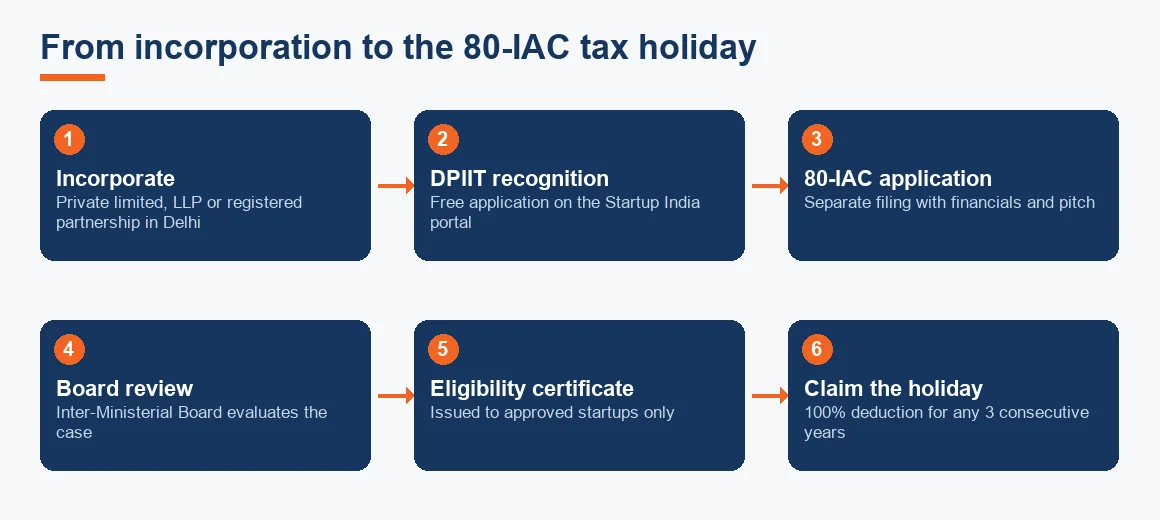
- Obtain DPIIT recognition first; it is a precondition.
- File the Section 80-IAC application on the Startup India portal with your financial statements, ITR acknowledgements and a pitch on innovation and scalability.
- The Inter-Ministerial Board evaluates the application and issues the eligibility certificate to approved startups.
- Claim the deduction in your income tax return for any three consecutive years you choose within the first ten.
Worked example: 80-IAC tax holiday for a Delhi private limited
Assume a Delhi private limited startup, DPIIT recognised and 80-IAC approved, with profit before tax of Rs 42,00,000 in the assessment year it chooses to claim, and turnover under Rs 400 crore so the 25% base corporate rate applies. All figures are indicative and Exl GST.
| Line | Without 80-IAC (Rs) | With 80-IAC (Rs) |
|---|---|---|
| Profit before tax | 42,00,000 | 42,00,000 |
| Less: Section 80-IAC deduction | 0 | 42,00,000 |
| Taxable income | 42,00,000 | 0 |
| Income tax at 25% plus 4% cess (26%) | 10,92,000 | 0 |
| MAT at 15% plus 4% cess (15.6%) on book profit | Not applicable | 6,55,200 |
| Net cash tax for the year | 10,92,000 | 6,55,200 |
The holiday removes the regular tax, but Minimum Alternate Tax under Section 115JB still applies at 15% plus cess on book profit, so the cash saving here is Rs 4,36,800, not the full Rs 10,92,000. The MAT paid is not lost: it becomes a credit you can carry forward for up to fifteen years and set off in later years when normal tax exceeds MAT. A startup that instead opts for the 22% concessional regime under Section 115BAA escapes MAT but also forfeits 80-IAC, so the two choices are mutually exclusive and need modelling before you file.
First-year ROC and compliance calendar for a Delhi startup
Recognition and tax holidays sit on top of ordinary company law, which does not pause for startups. A Delhi private limited company must complete a fixed set of filings with RoC Delhi in its early life.
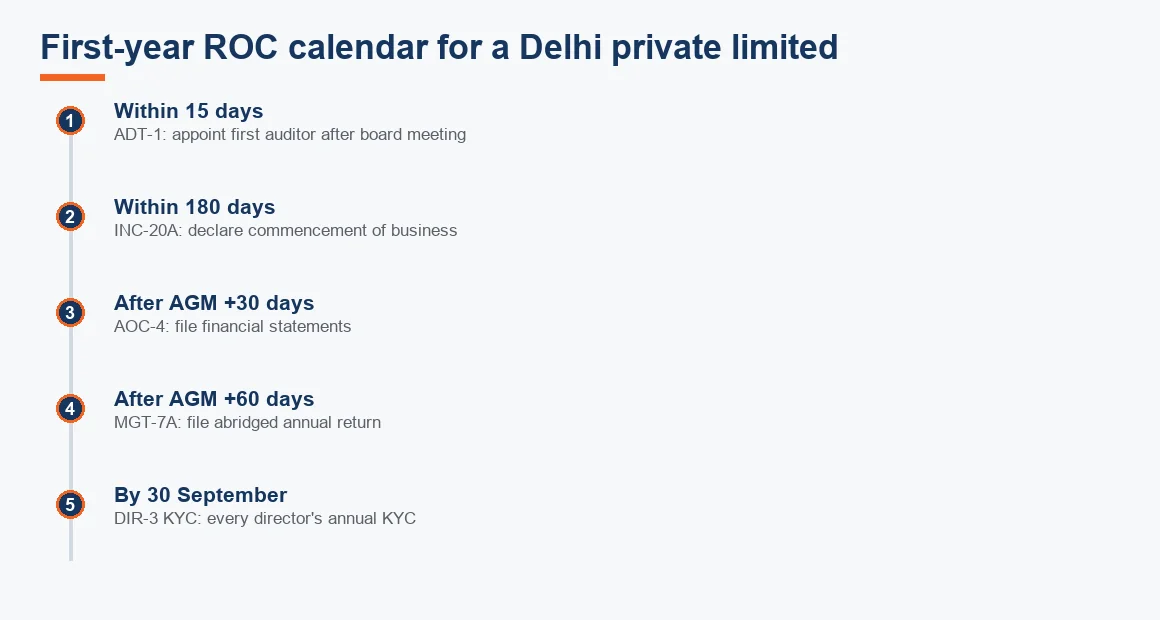
- INC-20A: declaration of commencement of business, within 180 days of incorporation. You cannot start operations or borrow until this is filed.
- ADT-1: appointment of the first auditor, within 15 days of the board meeting that appoints them.
- AOC-4: filing of the financial statements, within 30 days of the annual general meeting.
- MGT-7A: the abridged annual return for small companies and OPCs, within 60 days of the AGM.
- DIR-3 KYC: every director's KYC, by 30 September each year.
These deadlines run on the accrual basis your books are kept on, so clean monthly closing matters from day one. If you are behind, our note on choosing an accountant in Delhi covers what to look for in a firm that can catch you up, and the cost of accounting services in Delhi guide gives a current price range. You can verify every ROC form and its due date on the MCA portal.
What the Delhi local angle actually changes
Recognition and 80-IAC are central and identical across India, but three things about a Delhi base genuinely change your compliance load.
First, Delhi levies no professional tax. Unlike Maharashtra or Karnataka, there is no monthly PT deduction from salaries and no employer PT return, which removes one recurring filing for founders. Our explainer on Delhi Shops and Establishment plus GST and TDS compliance for employers sets out what remains. Second, your registered office fixes your jurisdiction as RoC Delhi and, for GST, as the Delhi state authority, so your GSTIN, e-invoicing and returns follow Delhi rules; you can register and file on the GST portal. Third, a Delhi address may open state-level startup support under the Delhi Startup Policy, which sits alongside, not instead of, central DPIIT benefits.
If your startup is a SaaS or IT services company, the revenue-recognition and export questions matter more than the local ones; those belong on our SaaS Accounting Services (IT and SaaS) and IT and Software Company Accounting Services pages, and a marketplace-led startup should read E-Commerce Accounting Services. For everyday bookkeeping in the city, the general Accounting and Bookkeeping Services - Delhi page carries the commercial detail.
The five elements founders should get right early
Setting aside the certificates, the accounting foundation of a startup rests on five things: a clean chart of accounts, an accrual-based monthly close, a maintained cap table, a tracked cash runway, and a compliance calendar. Get these right and DPIIT recognition, 80-IAC and later diligence all become paperwork rather than fire-fighting. Two of these deserve a tool: model your depreciation and asset schedule with the depreciation calculator, and if you are weighing the 115BAA regime against 80-IAC, the deferred tax calculator helps you see the timing differences before you commit.
Key terms
- Cap Table Dilution: the reduction in founders' ownership percentage as new shares are issued in a funding round.
- Section 43B(h) MSME Clock: the rule disallowing a deduction for payments to registered micro and small suppliers not made within 45 days.
- Delhi Nil Professional Tax Regime: Delhi's position of levying no professional tax on salaries or employers.
- Cash Runway Calculation: the number of months a startup can operate before cash runs out at its current burn rate.
- Ind AS 102 Share-based Payment: the standard governing how ESOP cost is recognised in the accounts over the vesting period.
Key takeaways
- DPIIT recognition is free and central; your Delhi address does not change eligibility, only your RoC and GST jurisdiction.
- Recognition, 80-IAC and Udyam are three separate certificates; hold each on its own portal for its own benefit.
- Angel tax under Section 56(2)(viib) is abolished from AY 2025-26, but valuation reports for private placements still apply.
- Section 80-IAC gives a three-year 100% profit holiday, but MAT still applies unless you leave the regime, and 115BAA forfeits the holiday.
- First-year ROC filings (INC-20A, ADT-1, AOC-4, MGT-7A, DIR-3 KYC) run regardless of startup status, so close your books monthly from day one.
Decision guide