
In this guide
Accounting for a consultancy in Ahmedabad is mostly about one question: when has revenue been earned, and how much of it is still unbilled? Professional-services firms on Ashram Road, SG Highway and around Navrangpura sell time and expertise rather than goods, so their books turn on retainer billing, milestone recognition and work in progress, along with GST and TDS obligations that behave differently for services. This guide explains the local compliance and accounting angle for consultants; when you are ready to hand the monthly books to someone, the commercial side sits with our Service Sector Accounting (Project Billing) page and its Ahmedabad counterpart.
What do consultants actually track in their accounts?
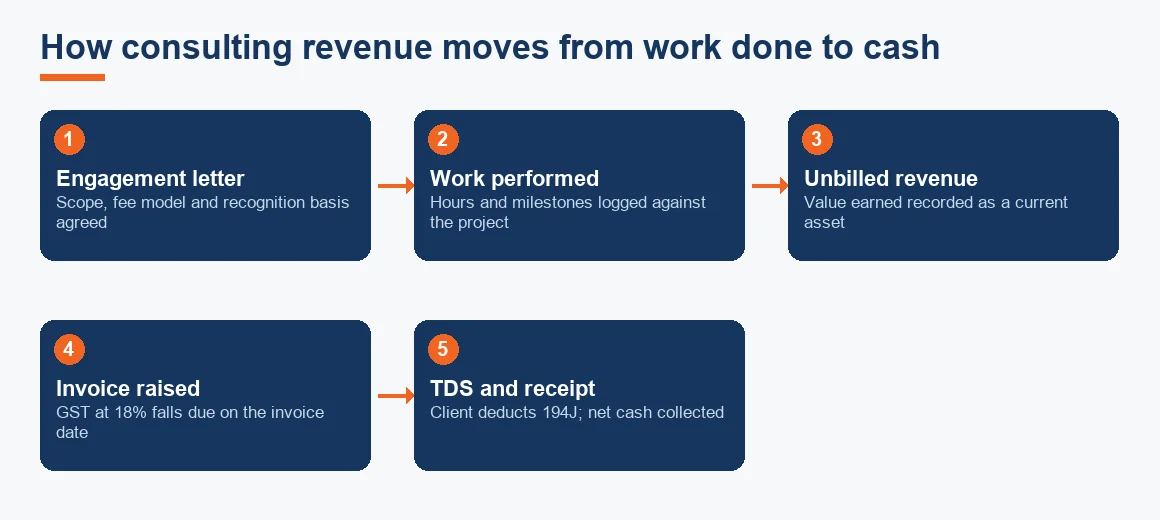
A consultant has no inventory and few fixed assets beyond laptops and office fit-out, so the ledger is dominated by receivables, unbilled revenue and staff cost. The core records are simple: fees invoiced, fees still to be invoiced against work done, direct costs of delivery (subcontractors, travel, software) and overheads. What makes it awkward is timing. An engagement signed in January may be delivered across three months and invoiced in April, which means the accounts must reflect the value earned before the invoice exists. That is why professional firms are far better served by accrual accounting than by a cash view: the cash view flatters a slow month and hides a heavy one.
Because scope, pricing and effort vary by client, the most useful management number is not total turnover but margin per assignment. Tracking project-wise profitability tells you which retainers actually pay and which quietly leak hours. Firms that also do software or product work will recognise the same discipline in our notes on SaaS accounting and IT and software company accounting.
Retainer, milestone and time-based billing: recognising revenue over months
How you bill decides how you recognise. A monthly retainer is earned evenly across the period of service; a milestone contract is earned as each stage is accepted; a time-and-materials engagement is earned as hours are logged. In every case GST is triggered on the earlier of the invoice date or the payment date, so an advance received in March is a supply in March even if the report goes out in May.
| Billing model | When invoice is raised | Revenue recognised | GST trigger | Best suited to |
|---|---|---|---|---|
| Retainer | Fixed periodic (usually monthly) | Evenly over the service period | Earlier of invoice or payment | Ongoing advisory and support |
| Milestone | On acceptance of each deliverable | On stage completion | Earlier of invoice or payment | Defined project work |
| Time and materials | On hours and expenses logged | As hours are worked | Earlier of invoice or payment | Variable-scope engagements |
Unbilled work in progress at 31 March
The single number that decides a professional firm's year-end profit is unbilled revenue. Measure it at the contract value of work performed up to 31 March, using the stage of completion agreed in the engagement letter, and show it as unbilled revenue under current assets. Recognise only the portion reasonably certain to be billed and collected; do not book optimistic scope that the client has not signed. Because no invoice has been raised, no GST is payable on this figure yet. If you want the underlying method in plain terms, see the glossary notes on work-in-progress valuation.
GST for Ahmedabad consultancies: threshold, interstate work and exports
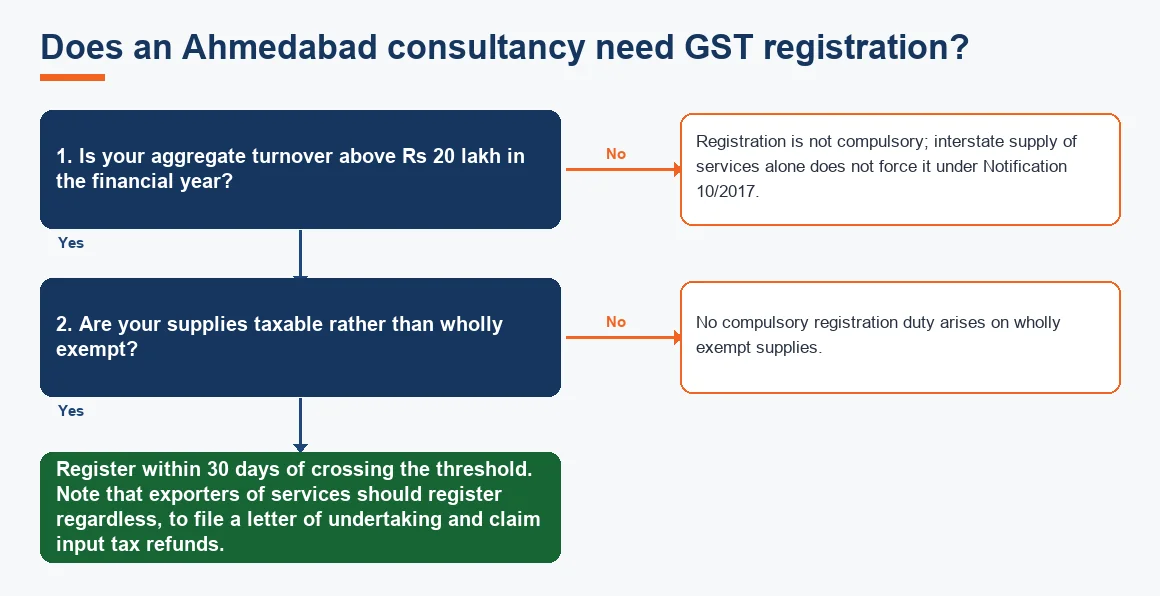
Registration becomes compulsory once aggregate turnover crosses Rs 20 lakh in a financial year for a service provider. A common worry among Ahmedabad firms billing clients in Mumbai, Bengaluru or overseas is that the first interstate invoice forces registration. It does not: Notification 10/2017 Integrated Tax exempts service providers below the threshold from the compulsory registration in Section 24. You can read the current position on the CBIC and GST portal sites. Consultancy services are taxed at 18 per cent once you are registered.
Exports are the exception worth planning for. Many Ahmedabad consultancies invoice foreign clients, and export of services is zero-rated only if you are registered and have filed a letter of undertaking; without registration you cannot file an LUT or claim a refund of input tax. Firms operating from or servicing GIFT City clients should confirm the IFSC treatment separately, because the concessions there are specific. For books cleanup before a first GST filing, our books cleanup and GST reconciliation guide for Ahmedabad SMEs walks through the reconciliation.
Section 44ADA: the presumptive route for professionals
A resident individual or a partnership firm (other than an LLP) carrying on a notified profession such as legal, medical, engineering, architecture, accountancy, technical consultancy or interior decoration can use Section 44ADA. Fifty per cent of gross receipts is offered as income, which removes the need to maintain the full set of books and to get accounts audited, provided receipts stay within the cap. The limit is Rs 50 lakh, extended to Rs 75 lakh where cash receipts are no more than 5 per cent of turnover. The scheme is set out on the Income Tax Department site.
Presumptive taxation is convenient, but it is not automatically the cheaper option. A firm with real margins below 50 per cent (heavy subcontracting or a large salaried team) may pay tax on profit it never made. Model both before choosing, and remember that opting out after opting in has its own consequences for the following years.
TDS under Section 194J and the reimbursement trap
Clients deduct TDS under Section 194J on professional and technical fees, generally at 10 per cent (2 per cent for certain technical services and call-centre work). For a consultancy this means a chunk of every large invoice arrives as a credit in Form 26AS rather than in the bank, so cash planning has to allow for it. Reconcile the TDS credited against the fees billed every quarter rather than at year end, because a mismatch found in April is far harder to correct.
Reimbursements are where firms lose money quietly. An expense you rebill to a client forms part of the taxable value and attracts GST unless every condition of the pure agent rule in Rule 33 of the CGST Rules is met, including that the payment was made on the client's authority and is shown separately on the invoice. On the TDS side, clients often deduct 194J on the whole consolidated amount, reimbursements included, when the invoice bundles fee and cost into a single line. Invoice the two separately and the reimbursement can be kept clean.
Books of account under Rule 6F
A professional whose gross receipts exceed Rs 1,50,000 in all three preceding years must keep the Rule 6F set: a cash book, a journal where the mercantile system is followed, a ledger, carbon copies of bills above Rs 25 and original bills for expenses above Rs 50. Medical professionals also keep a daily case register and a stock record of medicines. The records must be retained for six years. Below the Rule 6F threshold you still need enough to prove income, but not the prescribed set. For the practical build of these ledgers, see our note on choosing the right accountant in Ahmedabad.
The Gujarat state layer: professional tax and Shops Act
Beyond central taxes, an Ahmedabad firm with staff carries state obligations. Gujarat levies professional tax on employers and employees, deducted and deposited by the employer, and firms with a commercial establishment register under the Gujarat Shops and Establishments framework. These are low-value but easy to forget, and penalties accrue quietly. Our Gujarat professional tax and Shops Act guide for employers covers the registration and periodic returns so payroll stays compliant.
Worked example: valuing year-end WIP for a three-project firm
Assume a small Navrangpura advisory practice closes the year with three live engagements. It measures each at the stage of completion in the engagement letter, compares that to what has already been billed, and recognises the difference as unbilled revenue. All figures are illustrative and exclusive of GST.
| Project | Contract value (Rs) | % complete at 31 Mar | Revenue earned (Rs) | Billed to date (Rs) | Unbilled to recognise (Rs) |
|---|---|---|---|---|---|
| Project A (retainer overrun) | 8,00,000 | 60% | 4,80,000 | 3,00,000 | 1,80,000 |
| Project B (delivered) | 5,00,000 | 100% | 5,00,000 | 5,00,000 | 0 |
| Project C (just started) | 6,00,000 | 25% | 1,50,000 | 0 | 1,50,000 |
| Total | 19,00,000 | 11,30,000 | 8,00,000 | 3,30,000 |
The closing journal debits Unbilled Revenue (a current asset) and credits Revenue with Rs 3,30,000, lifting recognised income to the value actually earned. No GST is booked, because no invoice has gone out. When Projects A and C are invoiced in April, each invoice debits the client debtor, credits Unbilled Revenue and adds 18 per cent GST as output tax at that point. The unbilled balance clears as the real invoices replace it.
Key terms
- Unbilled Revenue (WIP Hours): work performed but not yet invoiced, carried as a current asset.
- Milestone vs Retainer Billing: the two dominant fee structures that drive when revenue is recognised.
- Section 44ADA Presumptive Cap: the Rs 50 lakh (or Rs 75 lakh) receipts limit for the professional presumptive scheme.
- Project-Wise Profitability Margin: margin measured per engagement rather than across the whole firm.
A month-end routine that keeps the year end quiet
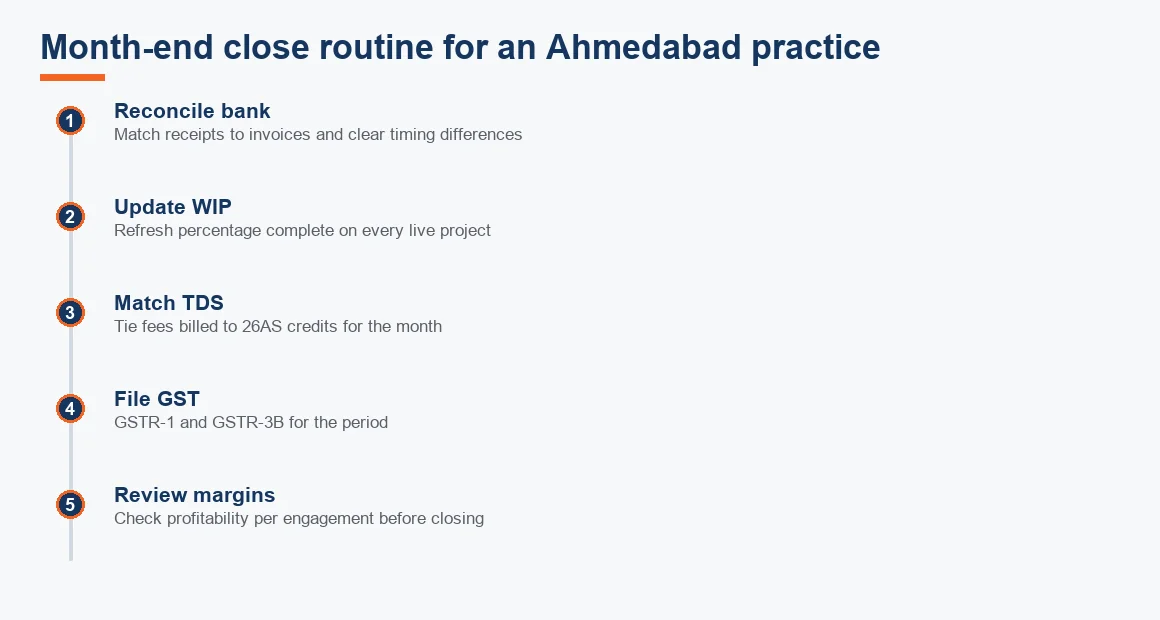
The firms that never scramble in April are the ones that close each month properly. A tight routine takes an afternoon and removes the year-end surprise on WIP and TDS.
Consultants generally have modest fixed assets, but the laptops and office equipment still need a depreciation entry; our depreciation calculator handles the Schedule II working. If you are weighing what all this costs to outsource, the cost of accounting and bookkeeping in Ahmedabad benchmarks and the general Ahmedabad bookkeeping overview give a realistic range. Newer firms may also find the startup accounting notes useful for setting up the ledger from scratch.
Key takeaways
- For a consultancy, the accounting problem is revenue timing and unbilled WIP, not stock.
- GST registration is compulsory only above Rs 20 lakh turnover; interstate services alone do not trigger it, but exporters must register to file an LUT.
- Section 44ADA offers 50 per cent presumptive income up to Rs 50 lakh (Rs 75 lakh on low-cash receipts), but check it against real margins first.
- Value year-end WIP at the stage of completion and book GST only when the invoice is raised.
- Invoice fees and reimbursements on separate lines to keep 194J TDS and GST clean.
Decision guide