
In this guide
For Gujarat employers the professional tax rule is short and easy to apply: nil on monthly wages up to Rs 12,000 and a flat Rs 200 a month once wages cross that line, which comes to Rs 2,400 in a full year. The employer deducts this from each liable employee, deposits it and files a periodic return, while the Constitution caps any one person's professional tax at Rs 2,500 a year. This explainer sets out the current slab, the due dates, how payment works in Ahmedabad, and where the Gujarat Shops and Establishments Act 2019 sits alongside it. It stays on the state-law detail; if you want help running the whole payroll and books, that belongs with our Accounting & Bookkeeping Services in India rather than this page.
Who is liable to pay professional tax in Gujarat?
Professional tax in Gujarat splits into two streams. The first is the employee stream: every employer must deduct professional tax from staff earning above Rs 12,000 a month and deposit it with the authority. The second is the enrolment stream: self-employed persons, professionals such as doctors and consultants, and traders pay their own enrolment tax on their standing to carry on a profession or trade. A business therefore usually holds two identities at once, a registration as a deductor for its employees and an enrolment for itself as an establishment.
The Rs 2,500 annual ceiling set by Article 276 of the Constitution is the outer limit for both streams combined per person, so no slab can ever push an individual past it. It is worth remembering that professional tax is a state subject, which is why the picture differs across the border: the Delhi Nil Professional Tax Regime means Delhi and Haryana levy no professional tax at all, while Gujarat and Maharashtra both do.
Gujarat professional tax slab for employees (2026)
Gujarat charges nil on monthly wages up to Rs 12,000 and Rs 200 a month above that. There is no graded ladder in between: once an employee's monthly wage crosses Rs 12,000, the deduction is a flat Rs 200 for that month regardless of how far above the threshold the salary sits. The Rs 12,000 exemption applies from 1 April 2022, when the earlier slabs beginning around Rs 5,999 were withdrawn, so any old ready-reckoner from before that date will overstate the tax. The table below compares the current Gujarat position with two contrasting states.
| State | Monthly wage exempt (nil below) | Rate above threshold | Annual maximum per person |
|---|---|---|---|
| Gujarat | Up to Rs 12,000 | Rs 200 a month (flat) | Rs 2,400 |
| Maharashtra | Rs 7,500 (men), Rs 25,000 (women) | Rs 200 a month, Rs 300 in February | Rs 2,500 |
| Delhi and Haryana | Not applicable | Nil (no levy) | Nil |
The Maharashtra column shows why a multi-state employer cannot run one common deduction rule: Maharashtra collects up to Rs 2,500 a year with a higher deduction in February to reach the ceiling, whereas Gujarat's flat Rs 200 across twelve months tops out at Rs 2,400. If you operate units in both states, or in a GIFT City IFSC unit, keep the payroll masters state-specific. Firms weighing an office move often look at the wider tax setting too, including the GIFT City IFSC Tax Holiday, but professional tax itself follows the state where the employee works.
Professional tax due dates for Gujarat employers
Professional tax is deducted from wages each month and deposited with the collecting authority, followed by a periodic return that reconciles what was deducted against what was paid. Because Ahmedabad, Surat and Vadodara collect the levy through their municipal corporations, the exact filing cadence and challan format follow the local body rather than a single statewide window, so confirm your ward's schedule when you first enrol. The lifecycle below is the same wherever you sit.
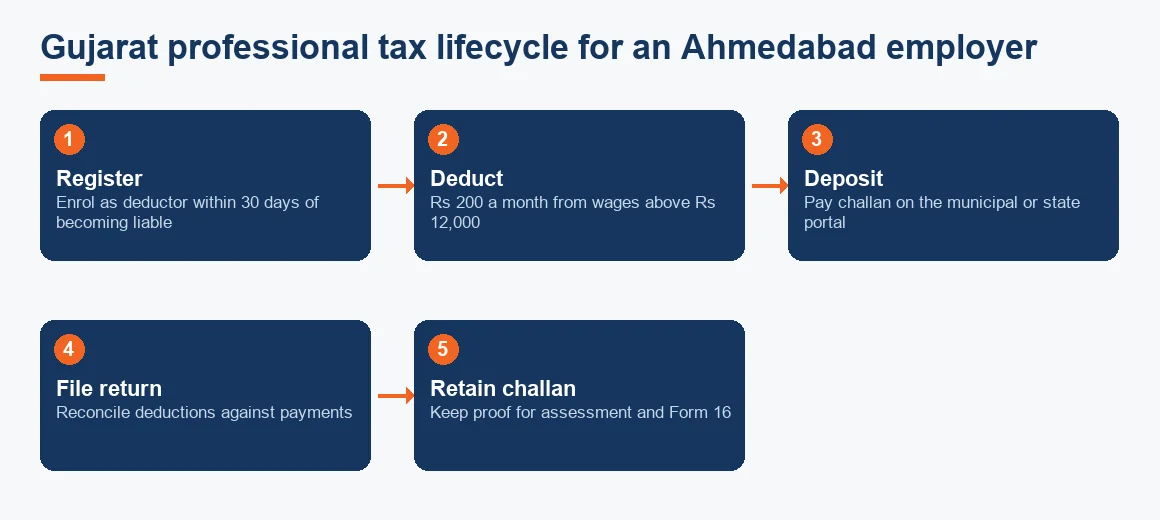
The amount you have deducted but not yet deposited is a statutory dues balance that should sit in your books as an Accrued Liability until the challan clears, alongside your other Current Liabilities. Keeping that ledger clean is exactly the kind of housekeeping covered in our Books Cleanup & GST Reconciliation Guide for Ahmedabad SMEs.
How to pay professional tax online in Gujarat
Payment is made on the Gujarat commercial tax portal where the state administers the levy, or on the municipal corporation portal where the local body collects it, as in Ahmedabad. Log in with the registration or enrolment number, generate the challan for the period, and pay by net banking. Retain the challan against the periodic return, because the acknowledgement is your proof of deposit if the ward later raises a query. Businesses running Tally Prime accounting in Ahmedabad usually record the challan number in the narration so it reconciles cleanly at year-end.
Registration and enrolment: getting on the rolls
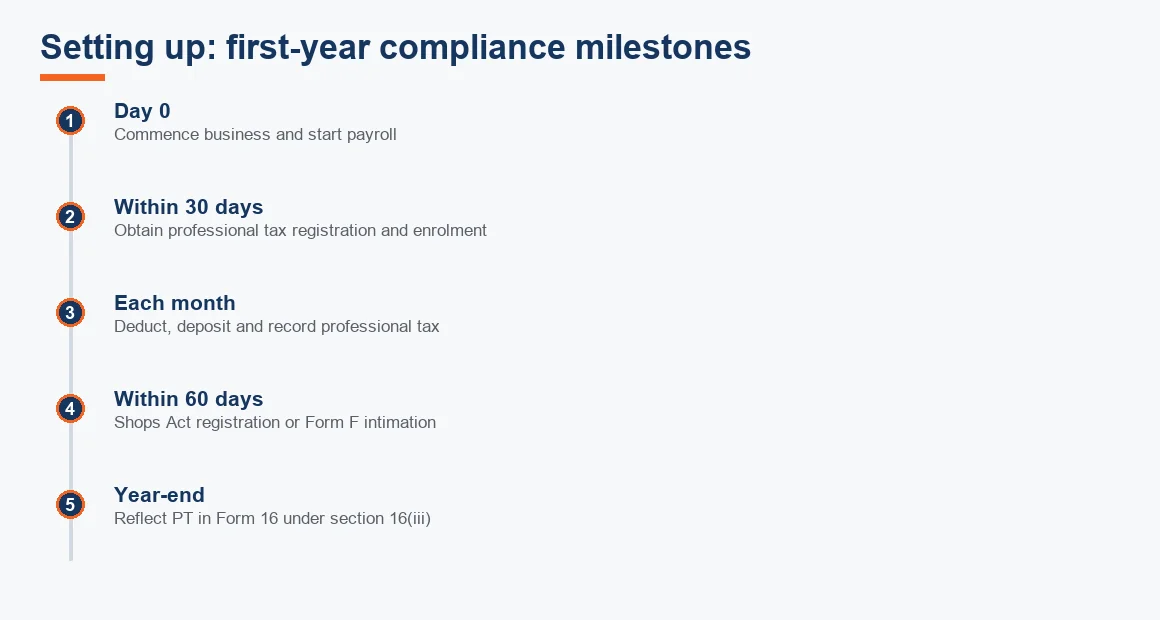
Registration has to be obtained within thirty days of becoming liable, that is, within thirty days of employing your first staff member who crosses the threshold, or of starting the profession or trade for the enrolment stream. The registration certificate identifies you as a deductor; the enrolment certificate covers your own tax as an establishment. A new business in Ahmedabad typically applies for both together when it sets up payroll. If you are choosing an adviser to handle the filings, our guide on how to choose an accountant in Ahmedabad walks through what to check.
Gujarat Shops and Establishments Act 2019 in Ahmedabad
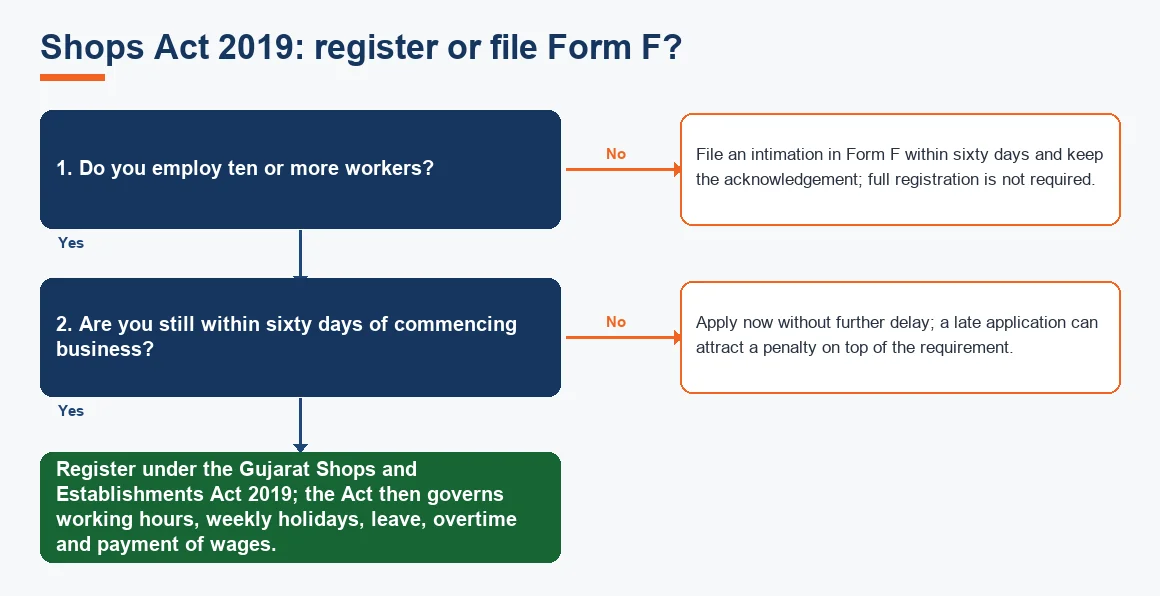
Professional tax and the Shops Act are separate obligations that often start on the same day, so it helps to keep them apart in your mind. Registration under the Gujarat Shops and Establishments Act 2019 is required only where ten or more workers are employed. A smaller establishment does not register; it files an intimation in Form F instead and receives an acknowledgement. The application, whether registration or Form F intimation, is made within sixty days of commencing business.
Once it applies, the Act governs working hours, weekly holidays, leave, overtime and payment of wages for shops and commercial establishments across Ahmedabad, from Ashram Road offices to SG Highway showrooms. Industrial units on the city's fringe may also touch GIDC Industrial Estate Compliance and, at assessment stage, the Gujarat GST Bhavan Assessment process, though those are distinct from the Shops Act itself. Manufacturers around Sanand and Naroda have their own layered compliance, which our manufacturing accounting guide for Sanand & Naroda units and the dedicated manufacturing accounting service for Ahmedabad cover in depth.
Penalties for late professional tax payment in Gujarat
Simple interest of 18 per cent a year runs on the unpaid amount from the due date, and the authority may impose a penalty for failure to register, deduct or pay, in addition to recovering the tax itself. The interest is not discretionary; it accrues automatically on any shortfall, so a small deduction missed across several months can grow into a meaningful balance. Because registration must be obtained within thirty days of becoming liable, a late start compounds the exposure, as both the interest and a registration penalty can apply.
There is a small relief on the other side of the ledger: professional tax actually paid is deductible from salary income under section 16(iii) of the Income-tax Act, so the employee reduces taxable salary by the Rs 2,400 borne in the year. The employer simply reflects the deduction in Form 16, and the employee claims it when filing, as confirmed on the Income Tax Department portal. Professional tax is a payroll-side statutory deduction and sits apart from your fixed-asset and provisioning work, where separate calculators such as our depreciation calculator come into play.
Worked example: monthly professional tax for a Navrangpura establishment
Consider a four-person establishment in Navrangpura, Ahmedabad. Applying the Gujarat slab wage-by-wage gives the following, with every liable employee capped well inside the Rs 2,500 constitutional ceiling.
| Employee | Monthly wage (Rs) | Slab applied | Monthly PT (Rs) | Annual PT (Rs) |
|---|---|---|---|---|
| A | 11,500 | Up to Rs 12,000 (nil) | 0 | 0 |
| B | 16,000 | Above Rs 12,000 | 200 | 2,400 |
| C | 28,000 | Above Rs 12,000 | 200 | 2,400 |
| D | 55,000 | Above Rs 12,000 | 200 | 2,400 |
| Total | 600 | 7,200 |
The employer deducts Rs 600 in total each month and deposits it, so the annual professional tax collected from staff is Rs 7,200. Employee A is never deducted while wages stay at or below Rs 12,000. Separately, the establishment pays its own enrolment tax for the year. None of these figures is a fee for advice; they are the statutory amounts. If you want to benchmark what running this compliance costs alongside full bookkeeping, our cost of accounting in Ahmedabad 2026 benchmarks set out indicative ranges (all Exl GST).
Key terms
- Delhi Nil Professional Tax Regime: the position in Delhi and Haryana, where no professional tax is levied at all.
- GIDC Industrial Estate Compliance: the compliance layer for units in Gujarat Industrial Development Corporation estates.
- Gujarat GST Bhavan Assessment: the state assessment process that a Gujarat business may face at scrutiny stage.
- Accrued Liabilities: dues recognised in the books, such as professional tax deducted but not yet deposited.
Key takeaways
- Gujarat professional tax is nil up to Rs 12,000 a month and a flat Rs 200 above, capped at Rs 2,400 a year per employee.
- The Rs 12,000 exemption has applied since 1 April 2022; older slabs from around Rs 5,999 no longer bind.
- Register as a deductor within thirty days of becoming liable, and enrol the establishment for its own tax.
- In Ahmedabad the municipal corporation collects the levy; keep every challan for the periodic return.
- Shops Act 2019 registration applies only at ten or more workers; smaller units file Form F within sixty days.
- Late payment carries 18 per cent simple interest plus possible penalty, so do not let deductions drift.
For the full picture of how professional tax, the Shops Act and day-to-day books fit together for a city business, see our Accounting & Bookkeeping hub and the dedicated accounting and bookkeeping service for Ahmedabad.
Decision guide