
In this guide
To clean up an accounting backlog for an Ahmedabad SME, you gather every bank statement, sales and purchase invoice, and GST challan for the missing months, reconstruct the books in strict date order, reconcile the GST figures against your GSTR-2B and filed GSTR-3B, and then finalise a trial balance that balances and can be explained line by line. The work is methodical rather than difficult, but it is time-sensitive: most GST corrections for a financial year close on 30 November of the following year. This guide walks a Gujarat trader or manufacturer through the sequence, the deadlines that matter, and how long the cleaned-up records must survive afterwards.
What an accounting backlog looks like for an Ahmedabad SME
A backlog rarely announces itself. A Naroda fabrication unit or an Ashram Road trading firm keeps issuing tax invoices and paying GST, but the underlying books drift: bank entries sit unposted, purchase bills pile up in a drawer, and the GSTR-3B is filed on a rough working rather than a reconciled ledger. Six months later the numbers no longer tie to the bank, the GST portal shows credit the books never recorded, and nobody can produce a clean balance sheet for the loan renewal.
For Gujarat SMEs the pattern usually has three roots: cash-heavy trading where receipts are logged late, job-work movements to and from Sanand or GIDC estates that were never booked as stock transfers, and a switch of accountant or software mid-year that left a gap. The cleanup itself is catch-up bookkeeping, and it is a normal, recoverable exercise. What turns it into a problem is leaving it until a GST notice or a bank query forces the pace.
How to clean up an accounting backlog: a step-by-step approach
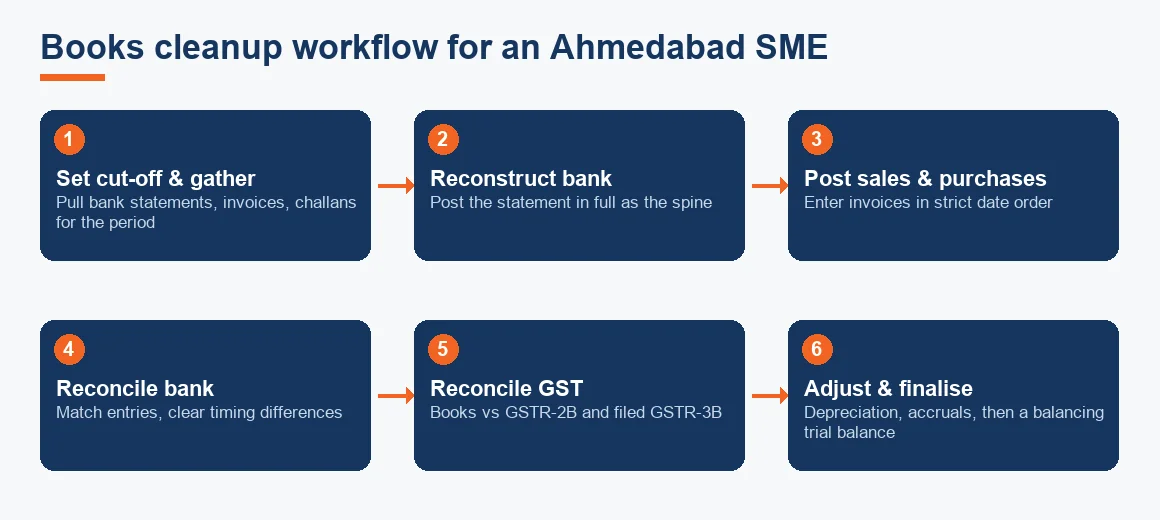
Work one financial year at a time, oldest first, so opening balances carry forward correctly. The sequence below is the same one a practising accountant would follow.
- Fix a cut-off and gather source records. Decide the period to reconstruct and pull every bank statement, cash book, sales invoice, purchase bill, expense voucher and GST challan for those months. A historical data cut-off date stops the scope from creeping.
- Reconstruct the bank first. The bank statement is the one record you cannot fudge, so post it in full. Bank statement reconstruction gives you a spine every other entry hangs off.
- Post sales and purchases in date order. Enter invoices chronologically so GST periods stay clean and the general ledger reflects the real sequence of events.
- Reconcile the bank. Match every posted entry to the statement and clear timing differences, so the closing balance in the books equals the balance on the statement.
- Reconcile GST. Compare the input tax credit in the books against GSTR-2B, and the output tax against what was declared in each GSTR-3B (covered in the next section).
- Book adjustments and finalise. Record depreciation, accruals, prepayments and any prior-period adjustments, then draw a trial balance. If it balances and each material line can be explained, the year is closed.
GST reconciliation: matching your books to GSTR-2B and GSTR-3B
GST reconciliation is where a backlog cleanup earns its keep, because this is what a Gujarat GST officer will test. There are two matches to run. First, input tax credit: the credit in your purchase register must be reconciled against GSTR-2B input tax credit matching, because under section 16(2)(aa) you can only claim credit that appears in your auto-generated 2B. Where a supplier has not filed their GSTR-1, that credit is deferred, not lost, and returns once they file.
Second, output tax: the GST charged in your sales ledger must agree with what each GSTR-3B actually declared and paid. A gap here is either under-reported tax to correct or an over-payment to adjust. Section 35 of the CGST Act and Rule 56 require these accounts (production, inward and outward supplies, stock, credit availed and tax paid) to be maintained at the principal place of business and produced on demand, which is exactly the record a clean reconciliation produces. The statutory wording sits in the CGST Act on the CBIC GST portal.
The 30 November cut-off: why cleanup is time-sensitive
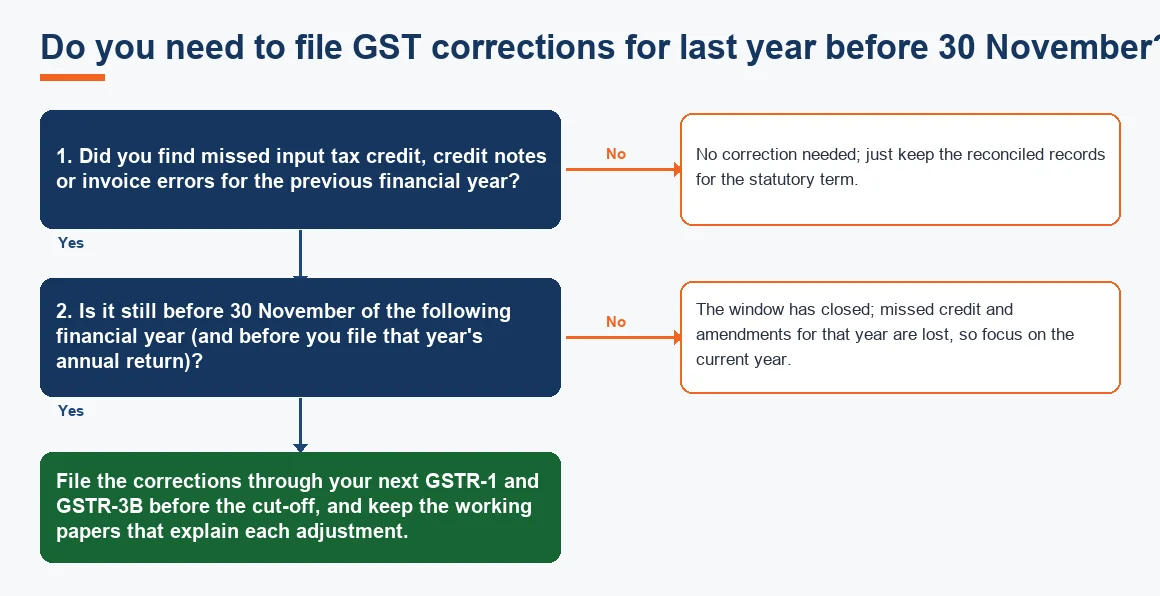
GST has no revised return. Every correction for a financial year runs through a later GSTR-1 or GSTR-3B, and the window closes on 30 November of the following financial year or the date you file that year's annual return, whichever is earlier. That single date governs three things at once: claiming any missed input tax credit under section 16(4), issuing credit notes under section 34, and amending earlier invoice details. Miss it and the credit or adjustment is gone for good.
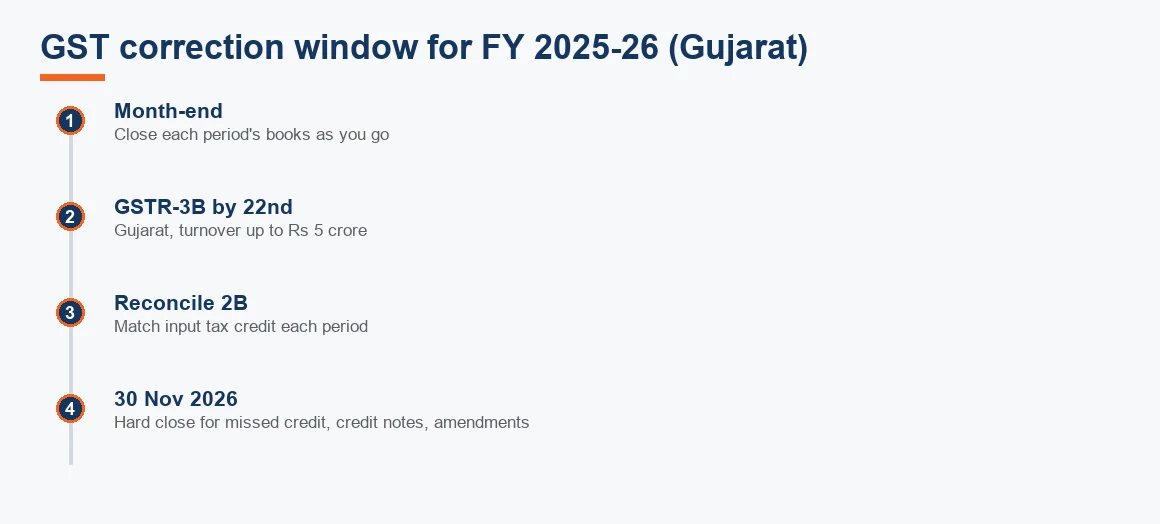
For an Ahmedabad SME cleaning up FY 2025-26, this means the reconstructed books must be good enough to act on well before 30 November 2026, leaving room to file the correcting returns. The staggered filing calendar and amendment rules are published on the GST portal. Treat the cut-off as the real deadline, not the annual return date.
GSTR-3B and QRMP due dates for a Gujarat business
Once the books are clean, filing on time keeps them that way. Gujarat taxpayers with turnover up to Rs 5 crore file monthly GSTR-3B by the 22nd of the following month, because Gujarat sits in the first staggered group alongside Maharashtra. Taxpayers above Rs 5 crore file by the 20th, uniformly across India. Businesses on the Quarterly Return Monthly Payment (QRMP) scheme file the return quarterly but still pay tax in Form PMT-06 by the 25th of each of the first two months of the quarter. Getting the group right matters: a Gujarat trader who assumes the 20th when the 22nd applies simply loses two days of working capital, while one who assumes the 22nd when turnover has crossed Rs 5 crore files late.
Bookkeeping or accounting: which does a cleanup actually need?
Owners often ask whether a backlog needs a bookkeeper or an accountant. Both, in sequence. Bookkeeping is the recording layer that rebuilds the entries; accounting is the interpretation layer that turns them into statements and a defensible tax position. The table summarises the split.
| Aspect | Bookkeeping | Accounting |
|---|---|---|
| Core task | Recording transactions in date order | Classifying, adjusting and reporting |
| Cleanup role | Reconstruct bank, sales, purchases | Reconcile GST, finalise trial balance |
| Typical output | Ledgers and day books | Balance sheet, profit and loss, GST reconciliation |
| Judgement involved | Low to moderate | High (adjustments, provisions, tax calls) |
In a backlog, the two run back to back: the recording is done first, then the accounting judgement is applied. A short overview sits in our note on how to choose an accountant in Ahmedabad, which covers the SG Highway, Navrangpura and Ashram Road options, and typical rates are set out in the 2026 Ahmedabad cost benchmarks.
Worked example: reconciling a quarter's input tax credit
Take a Navrangpura trading firm reconstructing one quarter. The purchase register shows more credit than the GST portal, a classic backlog symptom. The worksheet below shows how the gap is resolved. Figures are indicative and Exl GST.
| Particular | Amount (Rs) |
|---|---|
| Input tax credit per purchase register (books) | 4,80,000 |
| Input tax credit auto-populated in GSTR-2B | 4,52,000 |
| Gap to investigate | 28,000 |
| Less: supplier not yet filed GSTR-1 (defer to a later period) | 20,000 |
| Less: duplicate purchase booking corrected in books | 8,000 |
| Eligible input tax credit to avail this period | 4,52,000 |
The Rs 28,000 gap fully explains itself: Rs 20,000 is real credit stuck because a supplier has not filed, so it waits and returns automatically once they do, and Rs 8,000 was a duplicate the books over-recorded, which the cleanup removes. The firm claims Rs 4,52,000, exactly the 2B figure, and keeps the working paper so the deferred Rs 20,000 is not forgotten before the 30 November cut-off. A bank reconciliation run in parallel confirms the payments behind these purchases actually left the account.
How long must the cleaned-up records be kept?
Finishing the cleanup is not the end; the records then have a shelf life fixed by law. GST records must be retained for 72 months (roughly six years and nine months) from the due date of furnishing the annual return for that year. A company carries a longer obligation under section 128(5) of the Companies Act, which requires books for the eight financial years immediately preceding the current year, so for an incorporated Ahmedabad SME the eight-year rule governs in practice. The Companies Act text is on the MCA portal. Where records are not maintained at all, the officer can determine tax on the unaccounted supplies under section 35(6) with interest and penalty, a general penalty up to Rs 25,000 applies under section 125, and persistent failure is a ground for cancelling registration under section 29, which is the strongest reason to clear a backlog before it is noticed.
Key terms
- Catch-Up Bookkeeping: reconstructing several months of unrecorded transactions to bring the books current.
- GSTR-2B Input Tax Credit Matching: reconciling credit in the purchase register against the auto-generated GSTR-2B before it is claimed.
- Bank Statement Reconstruction: rebuilding the cash book from the bank statement when entries were never posted.
- Trial Balance: a listing of all ledger balances used to prove the books are arithmetically complete.
- Prior-Period Adjustments: corrections booked in the current period for errors that belong to an earlier one.
Where this leaves an Ahmedabad SME
A backlog is a bookkeeping problem with a tax deadline attached. Reconstruct in order, reconcile against the GST portal, act before 30 November, and keep the records for the statutory term. For unit-level costing on job work to Sanand or GIDC, our note on manufacturing accounting for Sanand and Naroda units goes deeper, and employers should read the Gujarat professional tax and Shops Act guide for payroll-side compliance. If you would rather hand the whole exercise to a firm, that is a commercial engagement covered by our accounting and bookkeeping services in Ahmedabad page and the national accounting and bookkeeping services and process, software and industry hub. During finalisation, our depreciation calculator helps get the year-end asset entries right.
Key takeaways
- Clean up one financial year at a time, oldest first, so opening balances carry forward correctly.
- Reconstruct the bank before reconciling GST, so every mismatch is a real reconciliation item.
- Claim input tax credit only to the extent it appears in GSTR-2B; defer the rest, do not drop it.
- Act on corrections before 30 November of the following year, the hard close for missed credit, credit notes and amendments.
- Gujarat SMEs up to Rs 5 crore file GSTR-3B by the 22nd; keep records for 72 months, or eight years if incorporated.
Decision guide