In this guide
If you are asking how much accountants charge in Ahmedabad, the honest answer is a range, not a single number: most small businesses pay between Rs 3,000 and Rs 25,000 a month on a retainer, with statutory audit, ROC filings and one-time clean-up billed on top. All figures here are indicative and Exl GST. This guide explains what sits behind those bands, why a proprietorship and a private limited company are quoted so differently, and how local factors such as GIDC estates and GIFT City change the picture. When you are ready to compare an actual proposal, our Accounting & Bookkeeping Services in Ahmedabad page carries current scope and pricing.
How much do accountants charge in Ahmedabad?
Fees in Ahmedabad broadly track the rest of urban Gujarat, with a modest premium for firms based around Ashram Road, Navrangpura and the SG Highway corridor. For routine monthly work, a very small trader might pay Rs 3,000 to Rs 5,000, a growing services business Rs 8,000 to Rs 15,000, and a compliance-heavy private limited company Rs 15,000 to Rs 25,000 or more. These are professional fees only; government charges, digital signature renewal and out-of-pocket costs are billed at actuals. The single biggest swing factor is not the accountant's rate card but your own transaction volume and the state of your books.
What drives an Ahmedabad accounting quote up or down
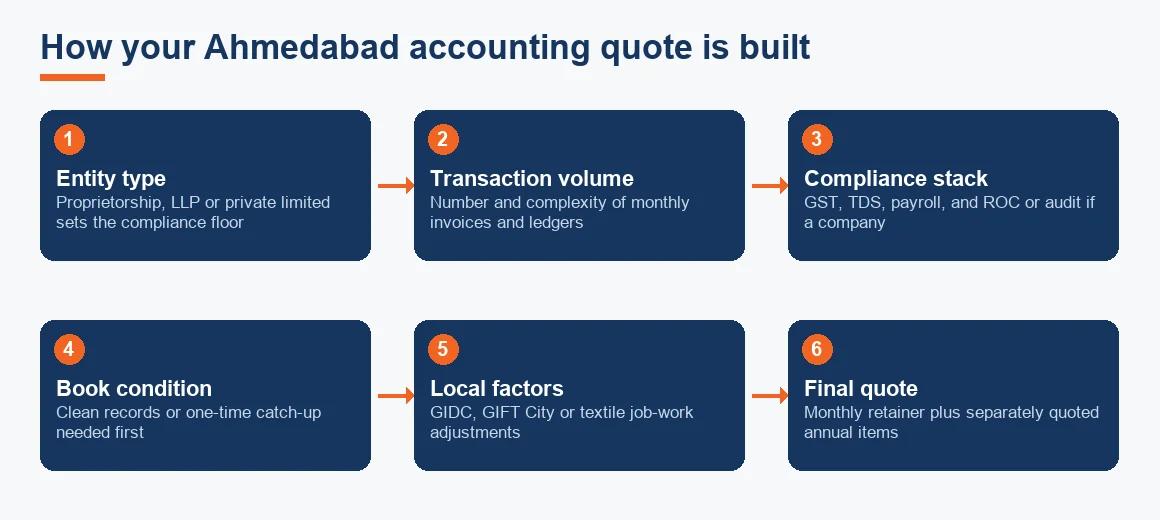
Four variables decide almost every quote. First, entity type: a proprietorship carries no statutory audit or ROC filing, while a company carries both. Second, transaction volume: 40 invoices a month is a different job from 400. Third, the compliance stack you need, which typically means GST returns, TDS, payroll and, for companies, annual filings. Fourth, the condition of your existing records. A business handing over reconciled books pays less than one needing months of catch-up bookkeeping before normal work can even begin.
Volume and complexity, not just size
A textile trader in Maskati Market with high-value but few transactions can cost less to service than a small e-commerce seller with hundreds of low-value orders and marketplace settlements. Complexity, GST rate mix, job-work movements and the number of ledgers to reconcile drives effort more than turnover alone. This is why two businesses with identical revenue can receive quotes that differ by half.
Fee bands by business type in Ahmedabad
The table below sets out indicative monthly and annual ranges by structure. Treat them as starting points for a conversation, not fixed prices; your own volume and compliance needs will move you within each band. All values are Exl GST.
| Business type | Typical monthly retainer (indicative, Exl GST) | Annual add-ons usually quoted separately | Why the difference |
|---|---|---|---|
| Proprietorship / small trader | Rs 3,000 to Rs 8,000 | ITR, GST annual return if applicable | No statutory audit, no ROC filing, lighter documentation |
| Partnership / LLP | Rs 6,000 to Rs 15,000 | LLP Forms 8 and 11, ITR, audit if thresholds crossed | ROC filings apply; audit only above turnover or contribution limits |
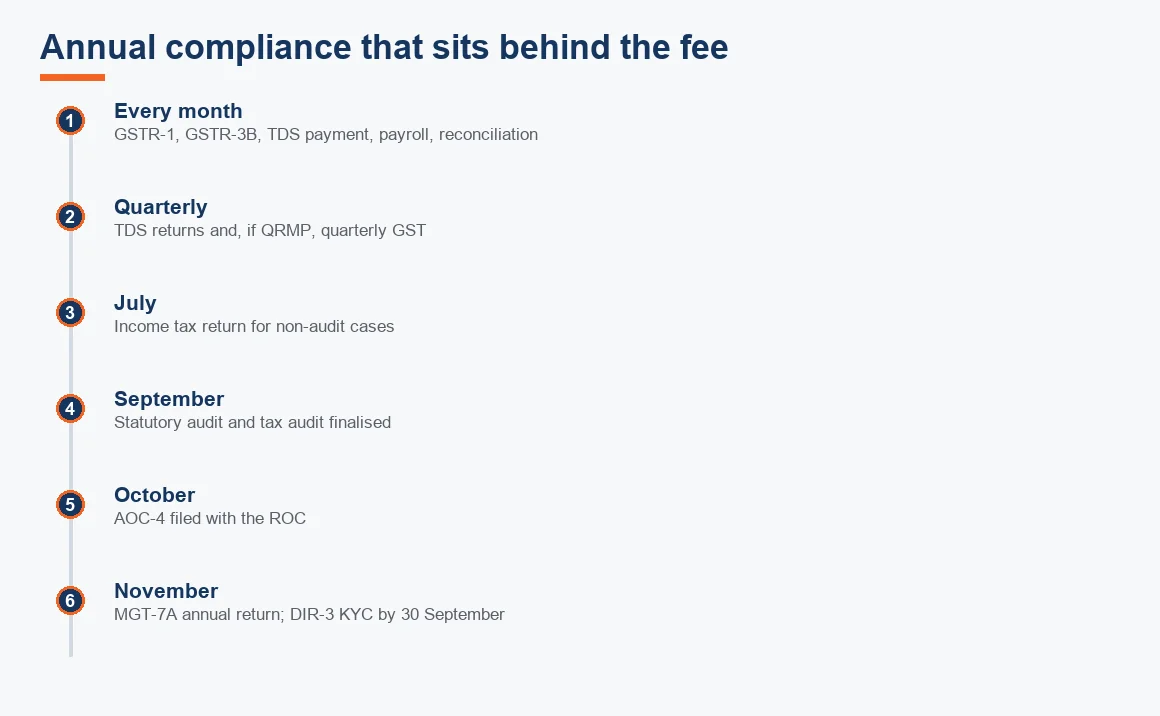
| Private limited company | Rs 10,000 to Rs 25,000+ | Statutory audit, AOC-4, MGT-7A, DIR-3 KYC, ITR | Companies Act audit and ROC compliance are mandatory every year |
The step up to a private limited company is the one that surprises owners most. Because a company carries a mandatory statutory audit, board and register upkeep, and ROC forms that a proprietorship never files, a comparable company quote typically runs two to three times the proprietorship figure.
What a monthly retainer usually includes
A standard Ahmedabad retainer covers the repeating work: voucher entry, bank and ledger reconciliation, GSTR-1 and GSTR-3B preparation and filing, TDS payment and quarterly returns, payroll processing, and a monthly financial summary. What sits outside the retainer, and is quoted separately, is usually statutory audit, tax audit, ROC filings, the income tax return, new registrations and any one-time reconstruction of old books. Knowing this line makes negotiation far easier, because you can see exactly which items are optional in a given month. For a fuller breakdown of process and scope, our Accounting & Bookkeeping hub walks through the standard workflow.
How much should a small business pay for an accountant?
A useful rule of thumb for a small Ahmedabad business is to budget your recurring accounting spend as a modest, predictable line rather than chase the lowest headline rate. For most owner-managed businesses with GST registration and a handful of staff, Rs 8,000 to Rs 15,000 a month buys competent, timely compliance. Paying much less often means the work is being done by a junior with little review, which shows up later as GST mismatches or a messy year-end. Paying much more only makes sense if you genuinely need advisory depth, inventory costing or multi-entity consolidation. Keeping a simple receivables aging schedule and a tidy month-end close reduces the hours an accountant has to spend, which in turn keeps your fee at the lower end of the band.
Fixed monthly fee or hourly: which suits your work
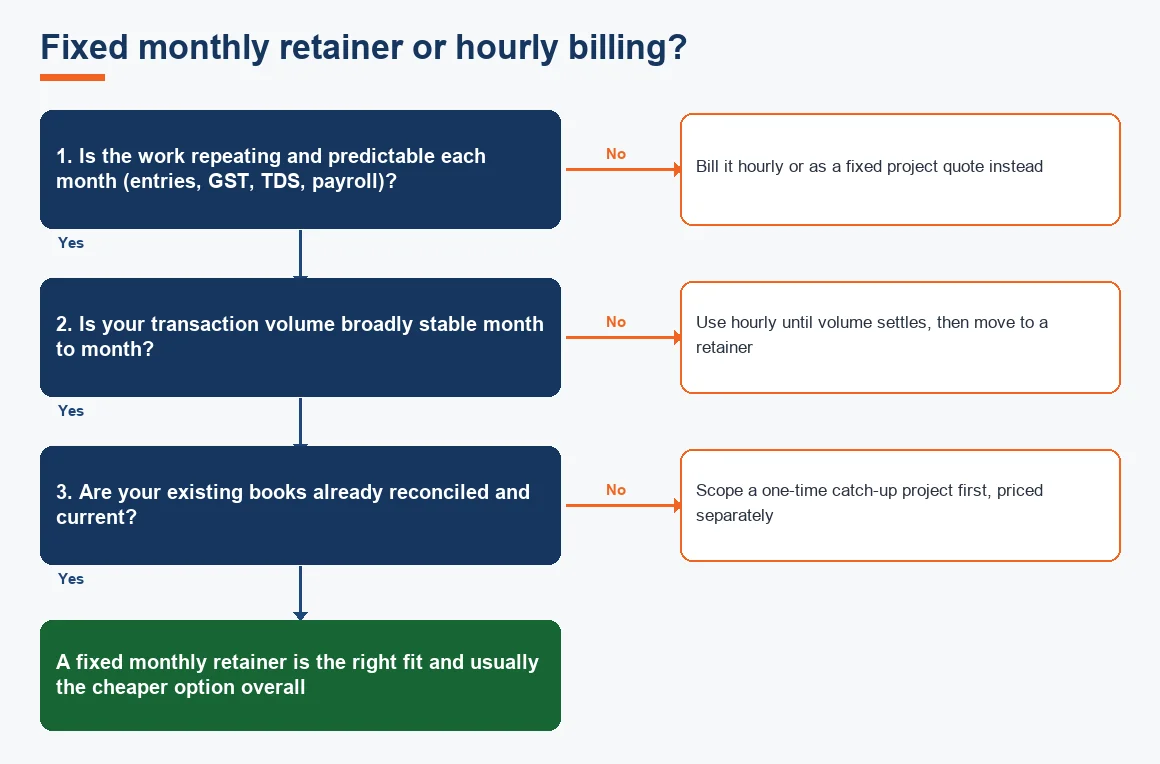
A fixed monthly fee suits predictable, repeating work, routine entries, GST and TDS returns, payroll, because the volume recurs every month and both sides can plan around it. Hourly billing suits one-off jobs where the effort cannot be estimated in advance: reconstructing two years of books, migrating accounting software, or responding to a departmental notice. Many Ahmedabad engagements sensibly use both, a fixed retainer for the routine plus an hourly or fixed quote for defined projects.
Can you negotiate accountant fees?
Yes, within reason. The most effective lever is not haggling on rate but reducing the work: hand over clean, reconciled records, use a single accounting system rather than scattered spreadsheets, and batch your paperwork monthly instead of dumping a year at once. Committing to an annual retainer rather than month-to-month, and keeping your GST and TDS data organised, both give a firm room to hold its price. What rarely helps is pushing the fee below the cost of doing the work properly, because the shortfall reappears as errors you pay to fix.
Ahmedabad specifics: GIDC, GIFT City and textile job-work
Local context genuinely moves fees. A manufacturing unit in a GIDC industrial estate at Sanand, Naroda or Vatva carries inventory valuation, job-work registers and cost-centre accounting that a trading business does not, which lifts the retainer. A business operating in the GIFT City IFSC has a very different tax and reporting profile again, and specialist work is priced accordingly. Ahmedabad's large textile and job-work base means GST job-work tracking and reconciliation feature in many local quotes. For manufacturers specifically, our Manufacturing Accounting Services in Ahmedabad page sets out the costing scope, and the deeper mechanics of costing and Ind AS 2 are covered in our guide to manufacturing accounting for Sanand and Naroda units.
Employer obligations add another local layer. Gujarat professional tax and Shops and Establishment registration create small but real recurring compliance, explained in our note on Gujarat professional tax and Shops Act compliance. And if your books are behind before you even discuss a retainer, the one-time clean-up cost is best understood through our books clean-up and GST reconciliation guide for Ahmedabad SMEs. Choosing the right firm for your locality, whether SG Highway, Navrangpura or Ashram Road, is covered in our guide on how to choose an accountant in Ahmedabad.
TDS on accounting fees: Section 194J in practice
When your business pays an accounting firm, tax is deducted at source under Section 194J at 10 percent on professional fees, once total payments to that firm cross Rs 50,000 in a financial year. That threshold was raised from Rs 30,000 with effect from 1 April 2025. Individuals and HUFs only deduct if their turnover exceeded the tax audit limit in the preceding year. Crucially, TDS is computed on the fee excluding GST, provided the GST is shown separately on the invoice. You can confirm the section and rate directly on the Income Tax Department portal and the underlying GST position on the CBIC site.
Worked example: annual cost for a small Ahmedabad private limited company
Consider a small Ahmedabad private limited company with two directors, modest GST volume and a monthly retainer of Rs 12,000. The worksheet below builds the full annual professional cost and applies 194J TDS. All figures are indicative and Exl GST; GST at 18 percent is billed on top of fees and government charges are extra.
| Item | Basis | Amount (Rs, Exl GST) |
|---|---|---|
| Monthly retainer | Rs 12,000 x 12 | 1,44,000 |
| Statutory audit | Annual, quoted separately | 20,000 |
| ROC filings (AOC-4, MGT-7A) | Annual | 8,000 |
| Income tax return & computation | Annual | 7,000 |
| DIR-3 KYC (2 directors) | Rs 1,000 x 2 | 2,000 |
| Total professional fees | 1,81,000 | |
| 194J TDS to deduct | 10% of 1,81,000 (above Rs 50,000) | 18,100 |
| Net paid to firm (before GST) | 1,81,000 minus 18,100 | 1,62,900 |
| GST on fees (billed to you) | 18% of 1,81,000 | 32,580 |
So the company's total professional spend for the year is Rs 1,81,000 in fees, on which it deducts Rs 18,100 as TDS and deposits it against the firm's PAN, while GST of Rs 32,580 is charged on the invoices and, where eligible, claimed back as input credit. The TDS is not an extra cost; it is your fee, withheld and paid to the government on the firm's behalf.
Key terms
- Catch-Up Bookkeeping: one-time work to bring neglected or backlogged books up to date before regular accounting begins.
- Statutory vs Internal Audit: the mandatory Companies Act audit versus a voluntary review of internal controls.
- Bank Reconciliation: matching your ledger against the bank statement to catch timing gaps and missed entries.
- Milestone vs Retainer Billing: charging by project stages versus a fixed recurring monthly fee.
- Section 43B(h) MSME Clock: the income tax rule disallowing expenses if MSME suppliers are not paid within the statutory window.
Comparing quotes without getting misled
When you hold two proposals side by side, normalise them before comparing. Confirm each is Exl GST, list which annual items are included versus separate, and check the transaction volume each firm has assumed. A cheaper monthly figure that excludes GST returns or assumes half your real volume is not cheaper at all. It also helps to agree scope in writing, so a month-end close checklist and a defined turnaround sit behind the number. Software matters too: if you run Tally, keeping the firm on the same system avoids migration cost, which our Tally Prime accounting services in Ahmedabad page addresses. For year-round planning, tools such as our depreciation calculator and AS vs Ind AS comparison matrix help you understand what work your accounts actually require.
Key takeaways
- Ahmedabad accounting fees range roughly from Rs 3,000 to Rs 25,000+ a month, indicative and Exl GST, driven by entity type, volume, compliance stack and book condition.
- Statutory audit, ROC filings and one-time clean-up are quoted separately from the monthly retainer, so insist on an itemised proposal.
- A private limited company typically costs two to three times a comparable proprietorship because Companies Act audit and ROC filing are mandatory.
- Section 194J TDS at 10 percent applies above Rs 50,000 of fees per financial year (threshold raised 1 April 2025) and is deducted on the fee excluding GST.
- The cheapest way to lower your fee is to hand over clean books and a single system, not to push the rate below the cost of doing the work properly.
Decision guide