In this guide
Section 44AD presumptive taxation lets an eligible trader declare a flat percentage of turnover as taxable income, rather than working out actual profit from full books of account. For a resident individual, Hindu undivided family (HUF) or a partnership firm that is not an LLP, the presumed income is 8 percent of turnover, or 6 percent on the part received through banking and digital modes, as long as turnover stays within the limit. It is a genuine simplification, but it helps some traders and quietly hurts others. This guide sets out the rule, the threshold and the practical traps, so you can judge which side of that line your business sits on.
What is Section 44AD presumptive taxation for traders?
Section 44AD is a presumptive scheme under the Income-tax Act. Instead of computing profit as sales minus purchases minus expenses, the law presumes your income to be a set percentage of your gross turnover or receipts. You do not have to maintain detailed books under section 44AA, and no tax audit under section 44AB is triggered on the strength of turnover alone. Once you declare income at the presumptive rate or higher, deductions for business expenses, depreciation and the like are treated as already allowed; you cannot claim them again on top.
For a trader who buys and sells goods, this collapses a year of purchase registers, stock records and expense vouchers into a single percentage applied to turnover. That convenience is the whole appeal. It also means the scheme suits traders whose real margins are thin only on paper but comfortable in cash terms, and it works against those whose actual net profit is well below the presumed figure. If you run a full trading operation and want the underlying records kept properly regardless, that is a job for your Trading Business Accounting Services team, not something 44AD removes the need for.
Who is eligible for the 44AD presumptive scheme?
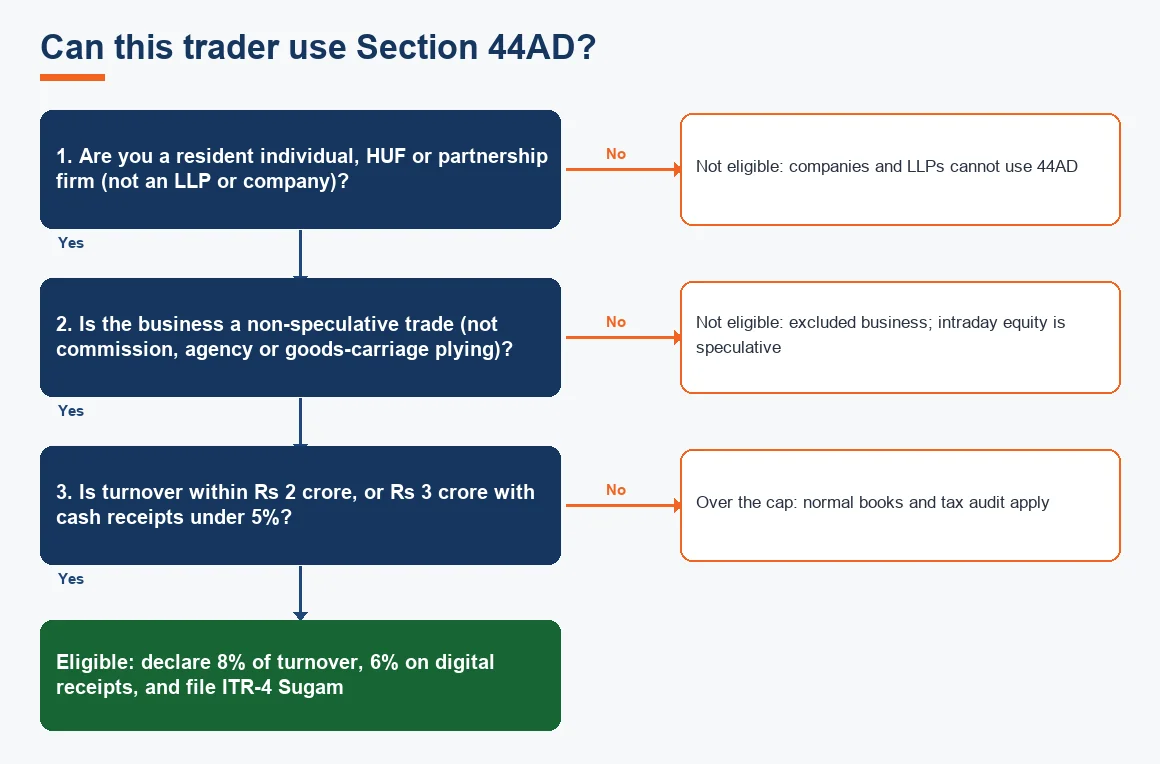
Eligibility turns on who you are and what business you run. The scheme is open to a resident individual, a resident HUF and a resident partnership firm, provided the firm is not a limited liability partnership. Companies and LLPs are shut out entirely. The business can be almost any trade, but there are carve-outs.
- Plying, hiring or leasing goods carriages, which has its own scheme under section 44AE, is excluded.
- A person earning income by way of commission or brokerage cannot use 44AD.
- An agency business is excluded.
- Anyone who has claimed a deduction under sections 10AA or 80-IA to 80RRB in the year is barred.
Professionals such as chartered accountants, lawyers and doctors do not fall here at all; they look to the separate Section 44ADA Presumptive Cap for professions. For an ordinary goods trader who is resident and not incorporated, the door is open. The distinction matters for allied businesses too: a software reseller may qualify as a trader, while a service-led SaaS operation is usually better served by dedicated SaaS Accounting Services (IT & SaaS) and would rarely treat 44AD as its main planning tool.
What is the turnover limit for Section 44AD?
The basic turnover limit is Rs 2 crore. The Finance Act 2023 added a higher ceiling of Rs 3 crore, available only where cash receipts do not exceed 5 percent of total turnover for the year. For this test, an account payee cheque, an account payee bank draft or an electronic clearing system receipt through a bank account counts as non-cash. So a trader who collects almost entirely by bank transfer or UPI can push the eligible turnover up to Rs 3 crore, while a cash-heavy shop stays capped at Rs 2 crore.
Turnover here means the trading turnover of the business, not your total income. Capital gains, interest, rent and salary sit outside 44AD and are taxed under their own heads. Getting the turnover figure right is the whole game, because it drives both eligibility and the presumed income. Traders who reconcile sales to GST returns each month, for example through disciplined GSTR-2B Reconciliation for Traders, rarely have trouble evidencing the number.
What is the difference between 44AD 8% and 6%?
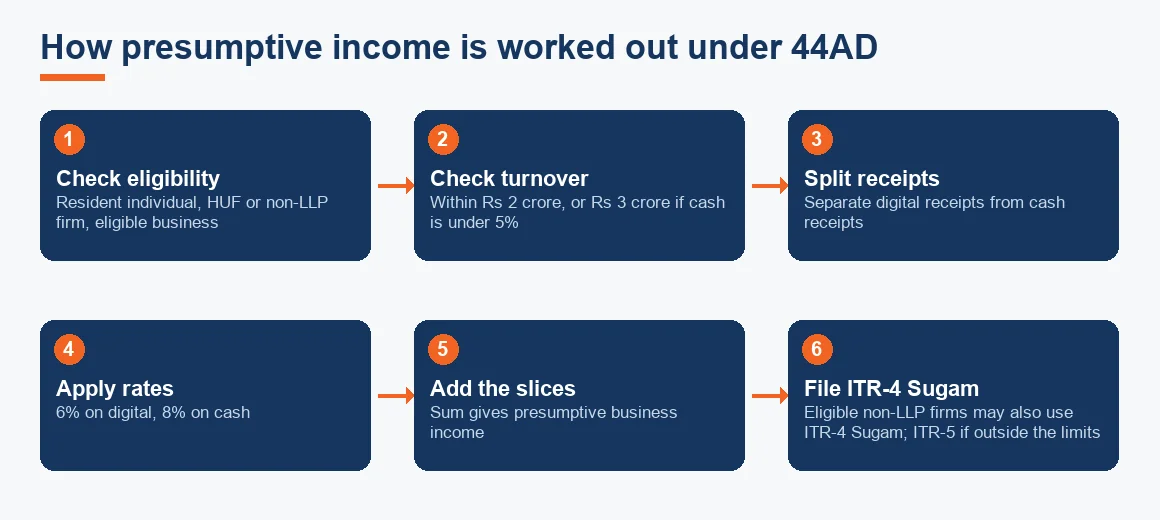
Two rates run side by side. The default presumed income is 8 percent of turnover. A reduced rate of 6 percent applies to the portion of turnover received by account payee cheque, account payee bank draft, electronic clearing system or other prescribed electronic modes, provided it is received during the year or before the due date for filing the return. Cash sales stay at 8 percent. In practice you split your turnover into a digital slice at 6 percent and a cash slice at 8 percent, then add the two.
The 2 percent gap is a deliberate nudge towards banked receipts. For a trader collecting a large share electronically, the saving is real money every year. It also dovetails with the way most traders already operate once TDS and TCS on high-value transactions come into play, such as the interaction explained in 194Q vs 206C(1H) on purchases and sales.
Can a trader opt for presumptive taxation under 44AD?
Most goods traders can, but two categories cause confusion. Intraday equity trading is speculative business under the Act and cannot be declared under 44AD, because the section excludes speculative income. Futures and options trading is non-speculative business under section 43(5) and can be offered under 44AD, provided turnover is within the limit and the trader is a resident individual, HUF or eligible firm. Capital gains never go under 44AD; if you hold shares as investments, those gains are taxed separately whatever else you do.
For a conventional trader in physical goods, none of this bites. The scheme is available so long as you are eligible and your turnover is within the ceiling. The choice to opt in is exercised simply by declaring presumptive income in the return; there is no separate application.
When is Section 44AD not beneficial for traders?
Presumptive taxation is a floor, not a discount. It presumes at least 8 percent (or 6 percent) profit. If your real net margin is below that, you pay tax on income you did not actually earn. High-turnover, low-margin traders, such as those dealing in commodities or fast-moving goods on wafer-thin spreads, often fall here. A trader with a genuine 3 percent net margin who is pushed to declare 6 or 8 percent is simply paying more.
The scheme is also unhelpful where you want to carry forward a business loss, because presumptive income cannot be a loss. And if you have already invested in proper monthly bookkeeping, the compliance saving is smaller than it looks. The honest test is to compute both figures and compare, which the worked example below does.
| Aspect | Section 44AD presumptive | Normal provisions (books) |
|---|---|---|
| Taxable income basis | 8% of turnover, 6% on digital receipts | Actual profit: sales less allowable expenses |
| Books under section 44AA | Not required on turnover grounds | Required once thresholds are crossed |
| Tax audit under 44AB | Not triggered by turnover alone | Required if turnover crosses the audit limit |
| Business expense deductions | Deemed already allowed, no separate claim | Claimed line by line against income |
| Carry forward of loss | Not possible under the scheme | Permitted, subject to conditions |
| Best suited to | Traders whose real margin exceeds 8% | Low-margin or loss-making traders |
Worked example: presumptive income for a trader
Take Mr Verma, a resident individual trading in electrical goods, with turnover of Rs 1,20,00,000 for the year. Of this, Rs 1,00,00,000 came through bank transfer and UPI, and Rs 20,00,000 in cash. Because cash receipts (about 16.7 percent) exceed 5 percent, his turnover cap stays at Rs 2 crore, but he is comfortably within it. His presumed income is worked out slice by slice.
| Receipt type | Amount (Rs) | Rate | Presumed income (Rs) |
|---|---|---|---|
| Digital receipts (bank / UPI) | 1,00,00,000 | 6% | 6,00,000 |
| Cash receipts | 20,00,000 | 8% | 1,60,000 |
| Total turnover / income | 1,20,00,000 | - | 7,60,000 |
Mr Verma declares Rs 7,60,000 as business income under 44AD. If his actual net profit from proper accounts was, say, Rs 9,50,000, the scheme saves him tax; if it was only Rs 5,00,000, he is paying on Rs 2,60,000 he did not really make. He is free to declare a higher figure than the presumptive amount if his real profit is higher, but he cannot declare less. He may also want to model depreciation on his shop fittings under normal provisions before deciding, which our Depreciation Calculator makes quick to check.
The five-year lock-in and when a tax audit returns
Section 44AD(4) is the clause that catches people out. Once you declare presumptive income, you are expected to stay in the scheme. If you opt out in any of the five assessment years that follow the year you first used it, income for the next five years must be computed under normal provisions. Worse, in each of those years, if your total income exceeds the basic exemption limit, you are required to maintain books under section 44AA and get a tax audit under section 44AB(e), regardless of turnover. Dipping in and out year to year is therefore expensive, not flexible.
This is why the decision to opt in should be taken with the five-year horizon in view, not just the current year's tax. A trader whose margins swing above and below 8 percent across years needs to think carefully, because the lock-in removes the freedom to switch. Where record-keeping is already sound, for instance for a business tracking stock properly through stock valuation methods for trading businesses and managing e-way bill and e-invoicing rules, the marginal saving from presumptive treatment may not justify surrendering that flexibility.
Which ITR form applies and how to file
A resident individual or HUF declaring business income under 44AD files ITR-4 Sugam, provided total income is up to Rs 50 lakh and there is not more than one house property. A resident partnership firm that is not an LLP can use the same ITR-4 Sugam form on those conditions; a firm that falls outside them files ITR-5 instead. If you have capital gains beyond the limited long-term gains that ITR-4 permits, you move to ITR-3. You report gross turnover, the presumptive income and the split between cash and digital receipts. The scheme removes the profit-and-loss detail, but it does not remove the need to answer for turnover, so keep your bank statements and GST returns aligned. Traders whose operations resemble a startup in growth mode may want to weigh 44AD against fuller reporting supported by Startup Accounting Services India or, for technology resellers, IT & Software Company Accounting Services, before locking in.
Key terms
- Section 44ADA Presumptive Cap: the parallel presumptive scheme for specified professionals, at 50 percent of gross receipts.
- Cash Accounting: recognising income and expense when money moves, relevant to how receipts are classified for the 6 percent test.
- Accrual Accounting: recognising income when earned, the basis normal-provision profit is usually computed on.
- Gross Profit: sales less cost of goods sold, the margin figure to compare against the presumed 8 percent.
- Section 194Q TDS on Goods: TDS obligation on large purchases that traders track alongside their turnover.
Key takeaways
- Section 44AD presumes 8 percent of turnover as income, 6 percent on banked and digital receipts, for resident individuals, HUFs and non-LLP firms.
- The turnover cap is Rs 2 crore, or Rs 3 crore where cash receipts stay within 5 percent of turnover.
- Split turnover into a 6 percent digital slice and an 8 percent cash slice, then add them.
- The scheme hurts low-margin traders, who end up taxed on profit they did not earn, and helps those whose real margin beats 8 percent.
- Opting out inside the five-year window under 44AD(4) forces normal books and a tax audit for the following five years, so decide with the long view.
For the statutory text and the current position, refer to the Income Tax Department at incometax.gov.in for Section 44AD and the tax audit provisions under section 44AB, and confirm the ITR-4 Sugam eligibility conditions on the same portal before you file.
Decision guide