In this guide
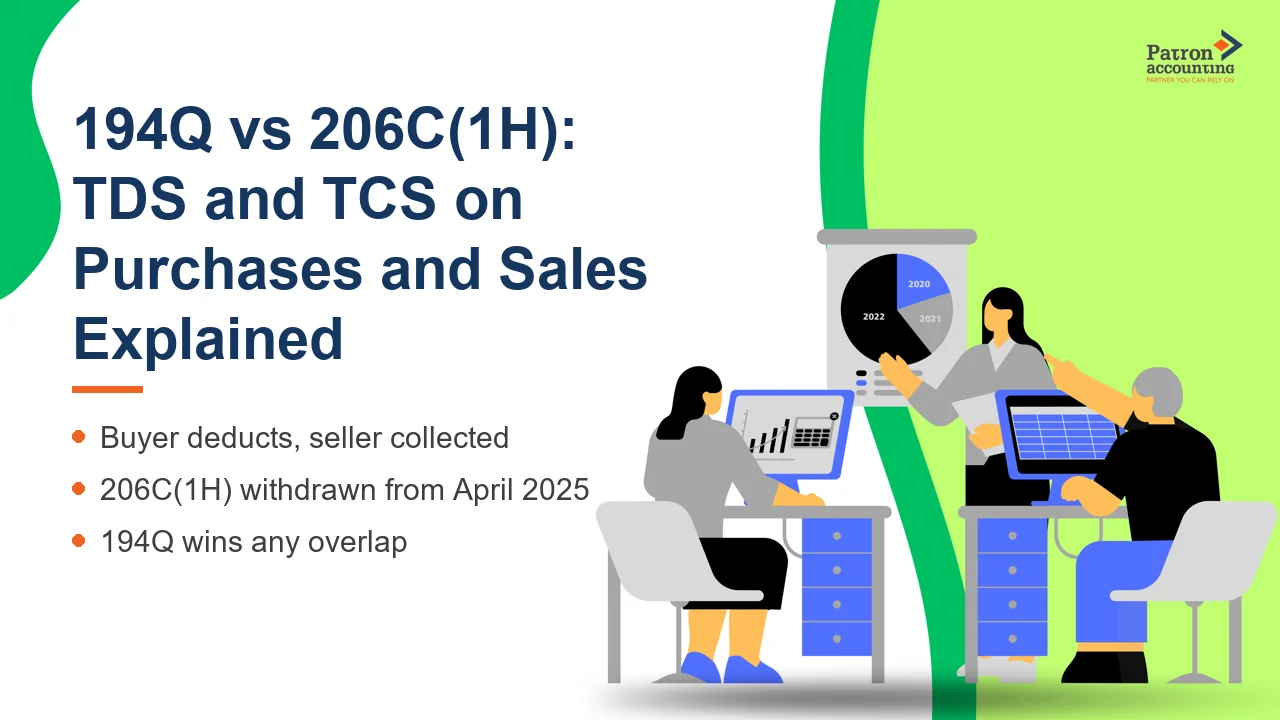
The short answer to 194Q vs 206C(1H) is that they sit on opposite sides of the same invoice: Section 194Q asks the buyer to deduct TDS on a purchase of goods, while Section 206C(1H) asked the seller to collect TCS on a sale of goods. Both used the same 0.1 per cent rate and the same Rs 50 lakh threshold, which is exactly why they overlapped and confused finance teams for four years. The important update for anyone reading this in FY 2025-26 is that 206C(1H) was withdrawn with effect from 1 April 2025, so today only the buyer's 194Q duty survives. This explainer sets out how each section works, why 194Q always overrode 206C(1H), and what the withdrawal changes in practice for a trading business.
What is Section 194Q: TDS on purchase of goods
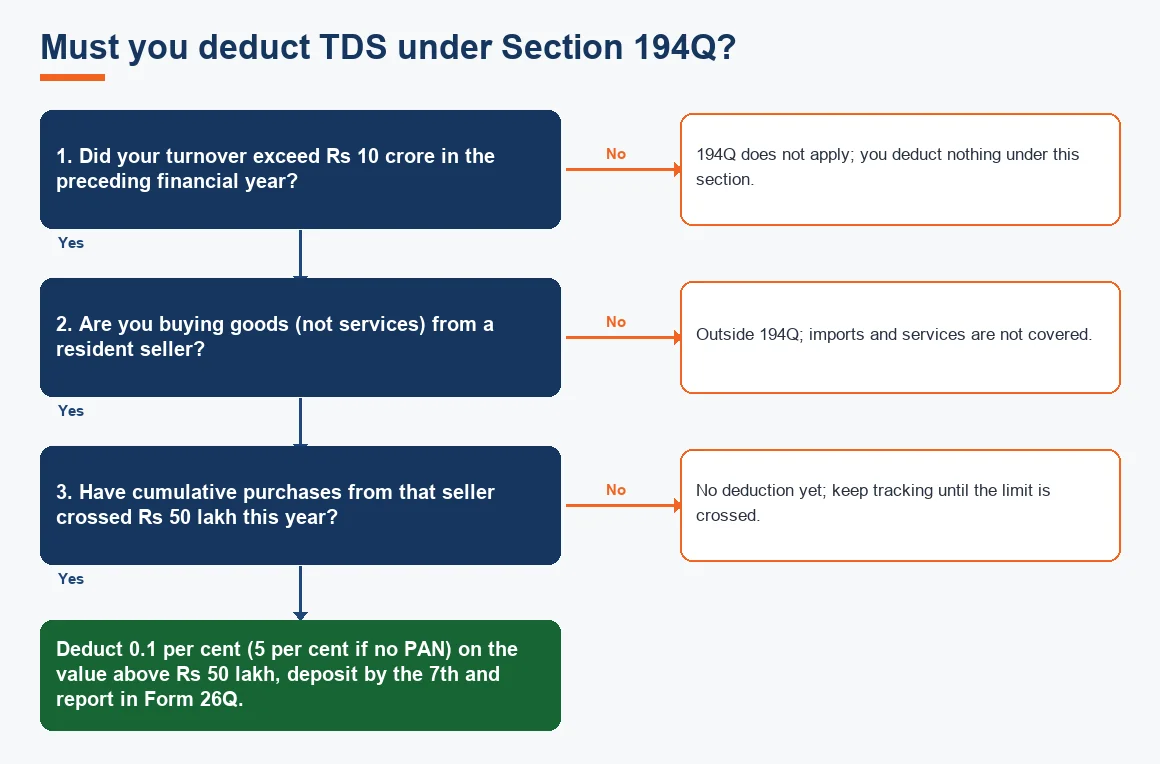
Section 194Q applies to a buyer whose total sales, gross receipts or turnover exceeded Rs 10 crore in the immediately preceding financial year. Such a buyer must deduct TDS at 0.1 per cent on the value of goods purchased from a resident seller, but only on the amount that crosses Rs 50 lakh paid or credited to that seller during the year. The deduction is triggered at the time of payment or credit to the seller's account, whichever is earlier, so accrual and cash both matter. If the seller has not furnished a PAN, the rate jumps to 5 per cent under Section 206AA, which is a costly slip to leave running through a full year. The section covers goods only, not services, and applies to resident sellers, so imports fall outside it. You can read the bare provision on the Income Tax Department portal before you set thresholds in your accounting system.
What was Section 206C(1H): TCS on sale of goods
Section 206C(1H) was the mirror image. A seller whose turnover exceeded Rs 10 crore in the preceding year had to collect TCS at 0.1 per cent from a buyer on sale consideration received above Rs 50 lakh in the year. Because TCS attaches to receipt of money, the timing was different from 194Q, which follows payment or credit. That timing gap is one reason the two provisions were awkward to run side by side. Section 206C(1H) was withdrawn by the Finance Act 2025 with effect from 1 April 2025, so for the current financial year sellers no longer collect this 0.1 per cent TCS on goods. Any TCS your sales ledger still shows for sales made on or after that date is an error to reverse, not a liability to deposit.
Difference between 194Q and 206C(1H) at a glance
The cleanest way to hold the two apart is side by side. The rate and threshold look identical, but who acts, when, and on which figure are all different.
| Feature | Section 194Q (TDS) | Section 206C(1H) (TCS) |
|---|---|---|
| Who is liable | Buyer | Seller |
| Nature | Tax deducted at source on purchase | Tax collected at source on sale |
| Turnover test (preceding FY) | Buyer above Rs 10 crore | Seller above Rs 10 crore |
| Rate | 0.1% (5% if no PAN) | 0.1% (1% if no PAN) |
| Threshold | Value above Rs 50 lakh per seller | Receipts above Rs 50 lakh per buyer |
| Point of tax | Payment or credit, whichever earlier | Receipt of consideration |
| Return form | Form 26Q | Form 27EQ |
| Current status | In force | Withdrawn from 1 April 2025 |
Does 194Q override 206C(1H)?
Yes, and this was the rule that resolved the overlap while both sections existed together (from 1 July 2021 to 31 March 2025). The second proviso to Section 206C(1H) stated that where the buyer was liable to deduct TDS under any other provision and had done so, the seller was not required to collect TCS on the same transaction. In plain terms, 194Q took priority: if the buyer deducted, the seller stepped back. To avoid double taxation on one sale, sellers routinely obtained a written confirmation from each large buyer at the start of the year stating that Section 194Q was being applied. That declaration became the seller's evidence for switching off TCS on that account. With 206C(1H) now withdrawn, this priority question no longer arises for goods, but the declarations you collected for FY 2021-22 to FY 2024-25 should stay in your assessment records.
What changed from 1 April 2025
Before the change, a large buyer dealing with a large seller had to establish, contract by contract, which section applied so the sale was taxed once, not twice. From FY 2025-26 the seller's side of that decision is simply gone. The buyer's Section 194Q obligation continues untouched, so if your turnover crossed Rs 10 crore last year you keep deducting 0.1 per cent on domestic goods purchases above Rs 50 lakh per supplier. The practical benefit is one fewer reconciliation: your customers no longer add TCS to your purchase cost, and you no longer chase 206C(1H) credits in your Form 26AS. Sellers, meanwhile, lose a working-capital drag, since they are no longer collecting and depositing tax on money they receive. If you also sell through online marketplaces, note that Section 52 TCS under GST is a separate levy that is unaffected by this income-tax change.
How to calculate the Rs 50 lakh limit and the turnover test
Two figures decide whether you deduct at all, and preparers mix them up often.
The Rs 10 crore turnover test
Look only at the immediately preceding financial year. If your total sales, gross receipts or turnover from business exceeded Rs 10 crore in that year, you are a buyer covered by 194Q for the current year. It is a business-turnover test, so professional receipts and one-off capital sales are viewed on their own footing.
The Rs 50 lakh per-seller limit
The threshold is cumulative and per seller across the financial year. Add up all purchases from one seller from 1 April. TDS applies only on the portion above Rs 50 lakh, not on the whole amount. On whether GST should sit inside the base, the accepted position (per CBDT Circular 13 of 2021) is that where tax is deducted at the time of credit and the GST is shown separately on the invoice, TDS is computed on the value excluding that GST. When you deduct on an advance payment, GST cannot be separated cleanly, so the deduction runs on the whole sum. This is the same disciplined vendor tracking that keeps your GSTR-2B input tax credit matching clean, and it is worth reading alongside our note on GSTR-2B reconciliation for traders.
Step by step: applying Section 194Q as a buyer
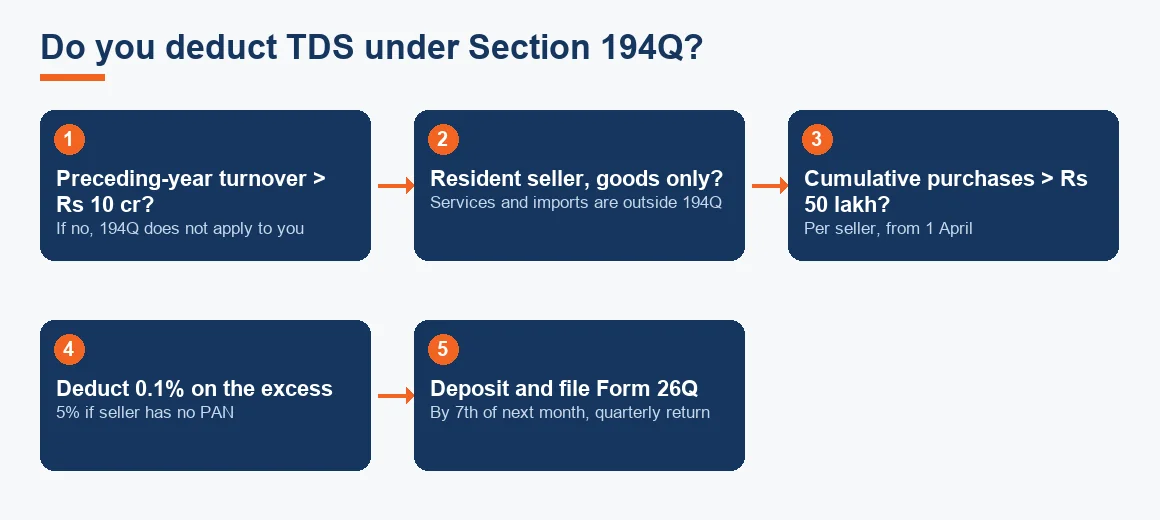
- Confirm your preceding-year turnover crossed Rs 10 crore, so the section applies to you at all.
- Maintain a running total of purchases per resident seller from 1 April, in your accounts payable ledger.
- Collect each seller's PAN; without it the rate is 5 per cent, not 0.1 per cent.
- When cumulative purchases from a seller cross Rs 50 lakh, deduct 0.1 per cent on the excess at payment or credit, whichever is earlier.
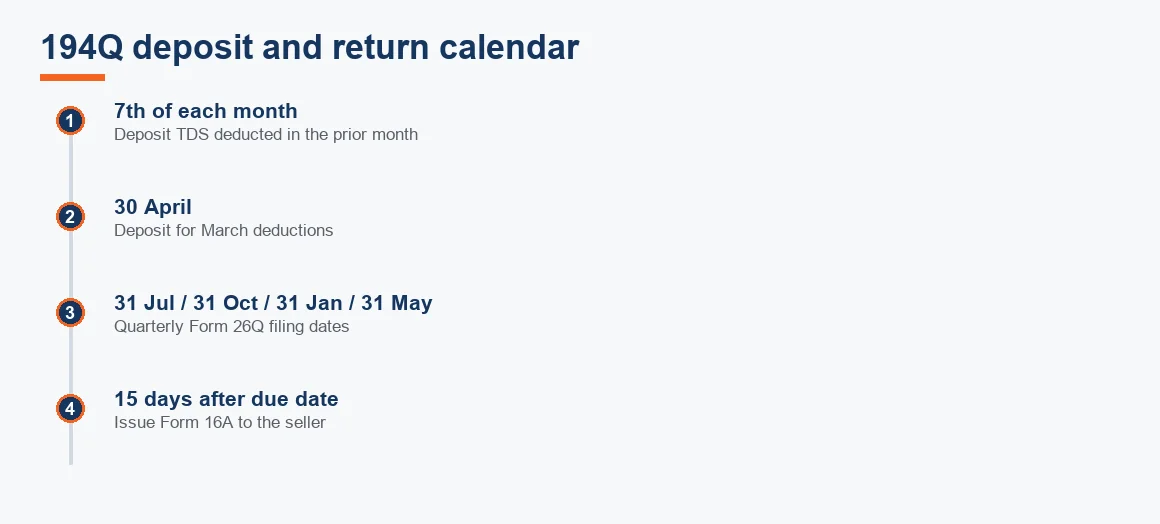
- Deposit the TDS by the 7th of the following month (30 April for March deductions).
- File Form 26Q every quarter and issue Form 16A to the seller.
Worked example: 194Q on a trader's purchase
Take a trading firm, Buyer A, with FY 2024-25 turnover of Rs 40 crore, buying steel from a resident supplier during FY 2025-26. The supplier has furnished a PAN. Cumulative purchases reach Rs 90 lakh by December. TDS applies only on the Rs 40 lakh above the Rs 50 lakh threshold. All figures are illustrative.
| Item | Amount (Rs) |
|---|---|
| Cumulative purchases from supplier, FY 2025-26 | 90,00,000 |
| Less: threshold not taxed | 50,00,000 |
| Value liable to TDS | 40,00,000 |
| TDS at 0.1% | 4,000 |
| Amount paid to supplier (net of TDS on liable portion) | 89,96,000 |
The Rs 4,000 is deposited by the 7th of the next month and reported in the December quarter Form 26Q. Had the supplier not given a PAN, the rate would be 5 per cent, making the TDS Rs 2,00,000 on the same Rs 40 lakh, which shows why chasing PAN details early matters. The related journal entry credits a TDS payable account and follows normal accrual accounting.
What happens if you miss the deduction
The penalties are heavier than the tax. Thirty per cent of the purchase value is disallowed as expenditure under Section 40(a)(ia) until the tax is deducted and paid, which can dwarf a 0.1 per cent slip. Interest runs at 1 per cent a month from the date deduction was due until it is deducted, then 1.5 per cent a month until it is deposited. Late filing of the quarterly statement costs Rs 200 a day under Section 234E, capped at the tax amount. Because trading businesses run thousands of vendor lines, a single mis-set threshold can quietly repeat all year, so the control belongs in your three-way matching routine, not in a spreadsheet someone updates by memory. The current utilities and due dates are published on the e-filing portal.
Key terms
- Section 194Q TDS on Goods: buyer's duty to deduct 0.1 per cent on domestic goods purchases above Rs 50 lakh per seller.
- Section 52 TCS under GST: separate GST-law collection by e-commerce operators, unrelated to income-tax 206C(1H).
- Accounts Payable: the ledger where per-seller cumulative purchases are tracked against the Rs 50 lakh limit.
- Cost of Goods Sold: TDS does not change the cost of goods; it is a withholding, not an expense.
Key takeaways
- 194Q is the buyer's TDS; 206C(1H) was the seller's TCS; same rate, opposite roles.
- 206C(1H) is withdrawn from 1 April 2025, so only 194Q applies to goods now.
- While both existed, 194Q always overrode 206C(1H) on the same sale.
- Threshold is 0.1 per cent on value above Rs 50 lakh per seller, per year, if buyer turnover crossed Rs 10 crore.
- Missing it disallows 30 per cent of the purchase, so build the control into vendor tracking.
For a trading business that would rather not run this control in-house, our Trading Business Accounting Services team sets up per-vendor 194Q tracking as part of monthly books. If you operate in software or services, the same discipline applies through our SaaS Accounting Services (IT & SaaS) and IT & Software Company Accounting Services, and early-stage founders can start with Startup Accounting Services India. Traders will also find our guides on e-way bill and e-invoicing rules, stock valuation methods and Section 44AD presumptive taxation useful alongside this note.
Decision guide