In this guide
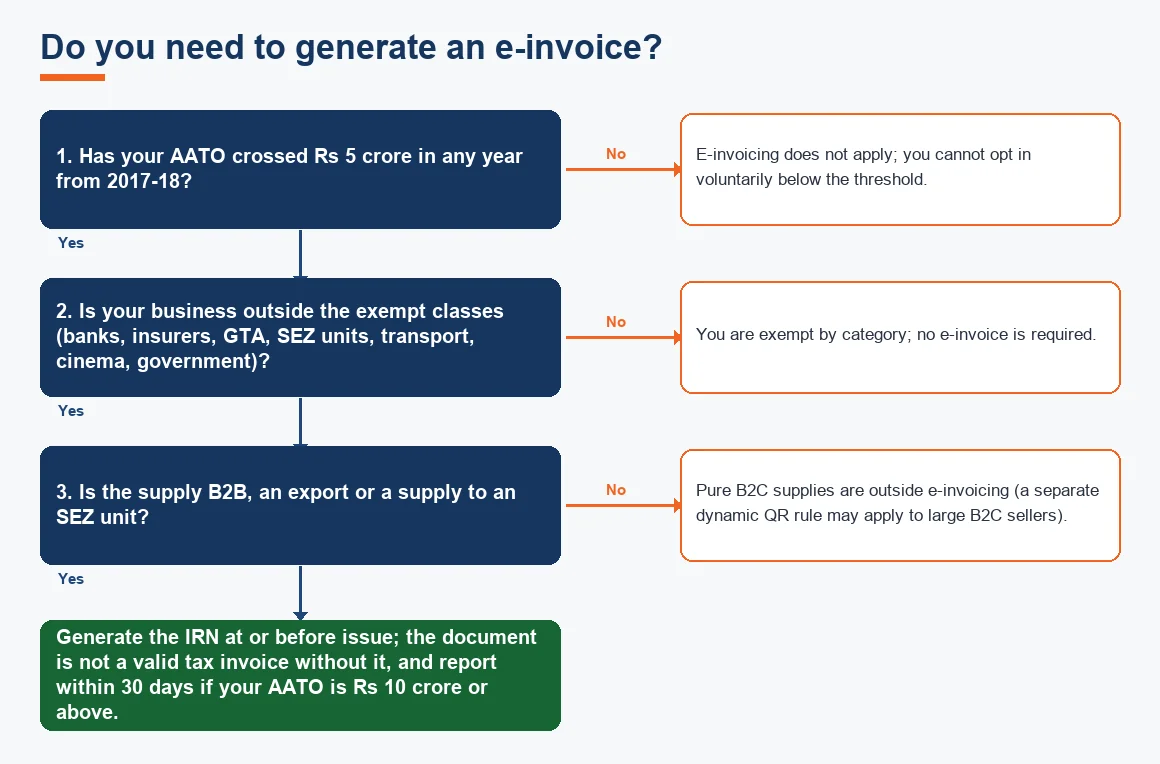
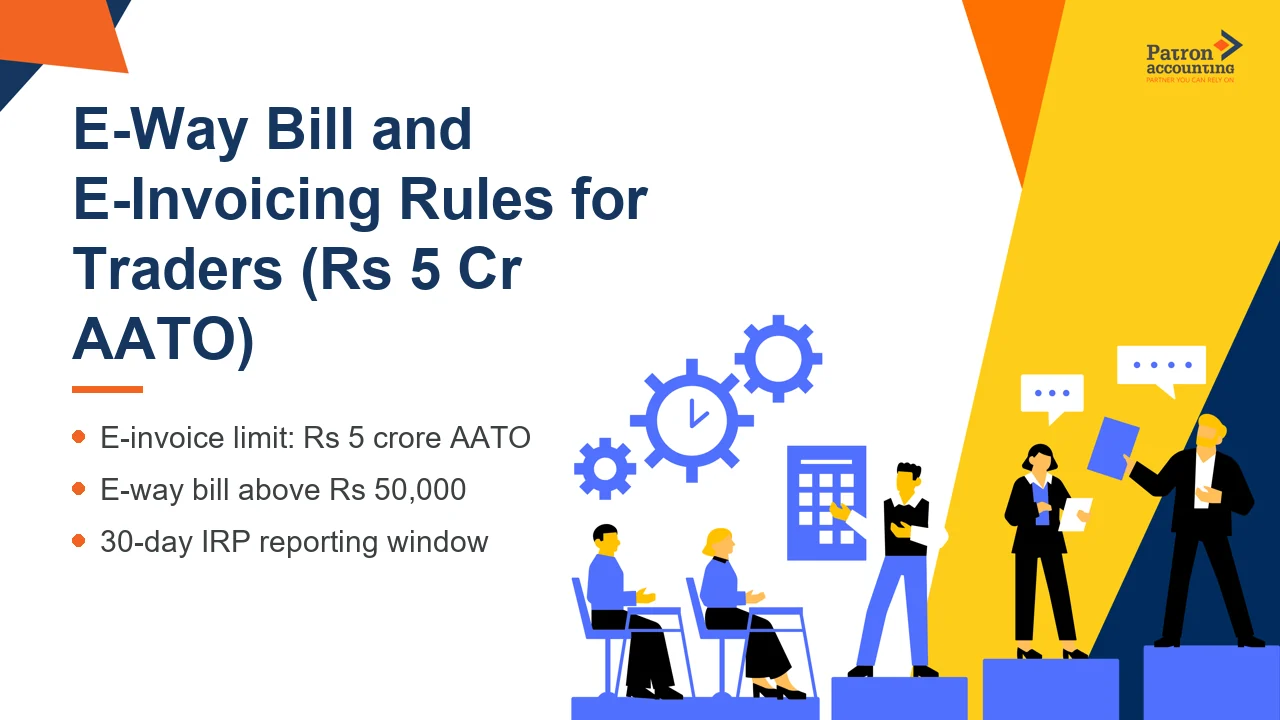
The e-invoicing turnover limit is Rs 5 crore of annual aggregate turnover (AATO). Any business, including a trader, whose AATO has crossed Rs 5 crore in any financial year from 2017-18 onwards must generate e-invoices for its B2B, export and SEZ supplies. E-invoicing and the e-way bill are two separate obligations that overlap constantly in a trading business, and this explainer sets out the thresholds that trigger each, the timing rules, and how to reconcile both back to your sales register with the working shown rather than just the rule quoted. For the commercial side of running the books, see our Trading Business Accounting Services.
What is the e-invoicing turnover limit for traders?
E-invoicing under GST is mandatory once a registered person's AATO exceeds Rs 5 crore. The test is done on a PAN-India basis: you add turnover across all GSTINs on the same PAN, and you look back to every financial year from 2017-18. If the figure has crossed Rs 5 crore even once, e-invoicing applies from the first day of the next financial year and does not switch off later even if turnover falls. So the answer to "Is e-invoicing mandatory for 5 crore turnover?" is yes, once you are above Rs 5 crore you are in. A trader sitting at exactly Rs 5 crore or below is not covered.
The Rs 5 crore figure is the current limit and remains the e-invoice turnover limit for 2026. There has been no fresh notification lowering it further, so anyone quoting a smaller threshold is describing a proposal, not the law. AATO here means the aggregate of taxable supplies, exempt supplies, exports and inter-state stock transfers, excluding GST itself. The exact scope is defined by the Central Board of Indirect Taxes and Customs (CBIC) at cbic-gst.gov.in.
Who is exempt from e-invoicing?
Exemption is by category of taxpayer, not by turnover, so a large trader is rarely exempt while a specialised business can be. The notified exempt classes are: banks and financial institutions including NBFCs, insurers, goods transport agencies (GTA), passenger transport operators, suppliers of admission to cinema and multiplex screenings, Special Economic Zone (SEZ) units (though SEZ developers are covered), government departments and local authorities. If your trading company falls outside these classes and sits above Rs 5 crore, you are eligible for e-invoicing and it is compulsory to issue an e-invoice for covered supplies.
Two points trip traders up. First, e-invoicing applies only to B2B, export and SEZ supplies; pure B2C invoices are outside it (a separate dynamic QR-code rule can apply to large B2C sellers). Second, "can small businesses use e-invoicing?" voluntarily is a common question: the system does not allow voluntary opt-in below the threshold, so a small trader cannot generate an IRN even if it wanted the audit trail. Sister sectors have their own quirks, which is why SaaS Accounting Services (IT & SaaS), IT & Software Company Accounting Services and Startup Accounting Services India treat export and SEZ invoicing differently from a goods trader.
What is the e-invoice generation time limit?
There is no delay allowed at the point of raising the tax invoice: the IRN must be generated at or before issue, because a document without a valid IRN is not a legal tax invoice at all. Separately, a reporting deadline now applies. From 1 April 2025, taxpayers with AATO of Rs 10 crore and above must report each invoice, credit note and debit note to the Invoice Registration Portal (IRP) within 30 days of the document date. The portal simply rejects anything older than 30 days.
So the answer to "what is the time limit for e-invoice for more than 100 crores?" is the same 30-day window, because the Rs 100 crore threshold that once applied was lowered to Rs 10 crore. Traders between Rs 5 crore and Rs 10 crore AATO are covered by e-invoicing but not yet by the 30-day IRP cut-off, though the sensible practice is to report same-day regardless. The GSTN advisory sits on the GST portal at gst.gov.in.
When is an e-way bill required?
The e-way bill is a movement document, not a turnover document, so it has nothing to do with the Rs 5 crore test. It is required whenever goods worth more than Rs 50,000 move, whether inter-state or intra-state, and that includes stock transfers between your own branches and goods sent out for job work. The bill must exist before the vehicle starts. Some states set a higher intra-state floor: Maharashtra, for instance, exempts intra-state movement below Rs 1 lakh, so the state notification always overrides the national default.
Validity and Part B
Validity runs one day for every 200 km of distance for regular cargo, and it can be extended only in a narrow window of eight hours before expiry to eight hours after. Part B, which carries the vehicle number, may be left blank where the movement is 50 km or less within the state between consignor and transporter or between transporter and consignee, but the bill itself is still generated. Cancellation is possible only within 24 hours of generation and not once the consignment has been verified in transit.
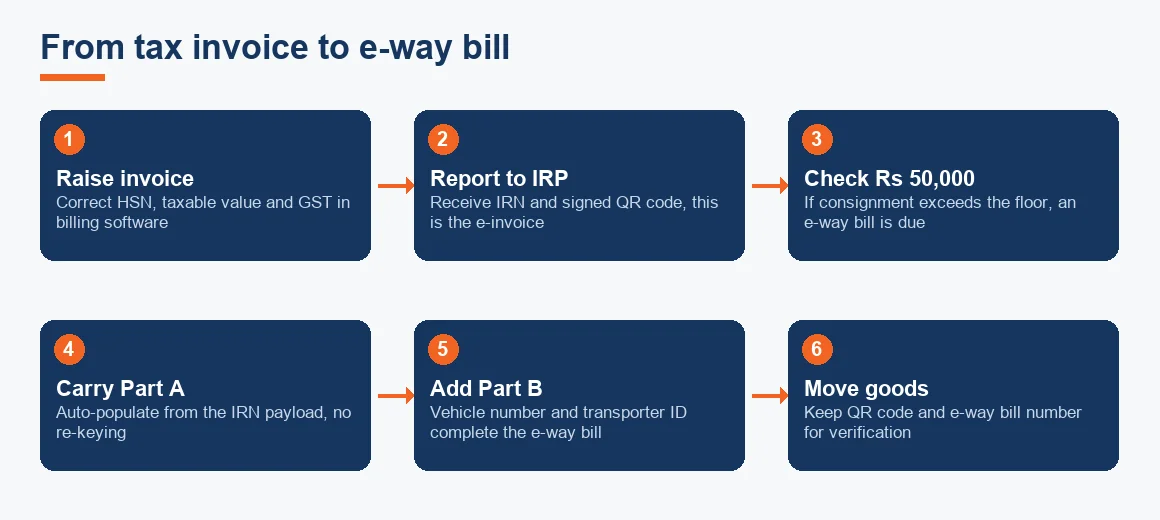
How an e-invoice becomes an e-way bill
For a covered trader the two systems are wired together, which reduces double keying if you use it. When you report an invoice to the IRP and it returns the IRN and signed QR code, Part A of the e-way bill can be auto-populated from the same payload. You then add Part B (transport details) to complete the e-way bill. The step-by-step flow for a single dispatch is straightforward.
- Raise the tax invoice in your billing software with correct HSN, taxable value and GST.
- Push it to the IRP; receive the IRN and signed QR code (this is the e-invoice).
- If the consignment value exceeds Rs 50,000, carry Part A across from the IRN data.
- Enter Part B (vehicle number, transporter ID) to generate the e-way bill.
- Move the goods, keeping the QR code and e-way bill number available for verification.
Because the invoice data feeds both, an error in the e-invoice repeats itself in the e-way bill, so the reconciliation below matters more than it looks.
Worked example: reconciling e-invoice and e-way bill to the sales register
Month-end reconciliation is where traders actually lose money, through blocked input tax credit at the buyer's end or notices on unreported movement. The test is simple: every covered B2B invoice in the sales register should have an IRN, and every consignment above Rs 50,000 should have an e-way bill. Take five dispatches from a wholesaler with AATO of Rs 12 crore (so both the 30-day rule and e-way bills apply). All values are taxable value in Rs and are indicative.
| Invoice | Taxable value (Rs) | IRN generated? | E-way bill needed? (> 50,000) | E-way bill present? | Action |
|---|---|---|---|---|---|
| INV-101 | 2,40,000 | Yes | Yes | Yes | Clean |
| INV-102 | 38,000 | Yes | No | No | Clean (below floor) |
| INV-103 | 1,10,000 | No | Yes | Yes | Generate IRN; invoice invalid without it |
| INV-104 | 85,000 | Yes | Yes | No | Generate e-way bill before dispatch |
| INV-105 | 4,20,000 | Yes | Yes | Yes | Clean |
Two of five rows fail. INV-103 moved on a document that is not a valid tax invoice, so the buyer cannot claim GSTR-2B input tax credit matching against it until an IRN exists. INV-104 moved without an e-way bill, which is an independent penalty exposure even though the e-invoice was fine. Running this three-column check (IRN, e-way bill, register) each month catches both before they become notices, and it dovetails with wider three-way matching of purchase order, goods receipt and invoice.
Where this sits in a trader's compliance stack
E-invoicing and e-way bills feed directly into the returns and tax numbers that follow. The reported invoices flow into GSTR-1 and, at the buyer's end, into GSTR-2B, so getting IRNs right protects your customers' credit and your own supplier relationships (covered in GSTR-2B Reconciliation for Traders: Stop Losing Input Tax Credit). The same sales values drive your turnover-based choices, such as whether Section 44AD presumptive taxation still fits, and the purchase side interacts with 194Q and 206C(1H) TDS and TCS once you cross Rs 50 lakh with a counterparty. Accurate invoice values also underpin stock valuation, because the taxable value you report is the same figure that lands in cost of goods sold and closing stock. Where purchases are subject to Section 194Q TDS on goods, the invoice value net of GST is your deduction base. If you are still deciding which reporting standards apply to your entity, our Ind AS Applicability Checker is a quick starting point.
Key terms
- GSTR-2B Input Tax Credit Matching: matching your purchase register to the auto-drafted GSTR-2B before claiming input tax credit.
- Section 194Q TDS on Goods: buyer's 0.1% TDS on purchases above Rs 50 lakh from a resident seller in a year.
- Section 52 TCS under GST: tax collected at source by e-commerce operators on supplies made through them.
- Three-Way Matching: reconciling purchase order, goods receipt note and supplier invoice before payment.
- Cost of Goods Sold: the direct cost of stock sold in a period, linked to your reported invoice values.
Key takeaways
- E-invoicing is mandatory once AATO crosses Rs 5 crore in any year from 2017-18; the limit still stands for 2026.
- Exemption is by category (banks, insurers, GTA, SEZ units, transport, cinema, government), not by turnover.
- From 1 April 2025, AATO of Rs 10 crore and above must report to the IRP within 30 days; below that, report same-day as good practice.
- E-way bills are triggered by movement of goods above Rs 50,000, independent of the e-invoice threshold; state floors can differ.
- Reconcile every covered invoice on three tests each month: IRN present, e-way bill present where needed, and both tied to the sales register.
Decision guide