In this guide
An educational institution in India can claim income tax exemption through one of two routes: section 10(23C) or the section 12A/12AB registration that unlocks exemption under sections 11 and 12. For a school, the 10(23C) exemption is often automatic where annual gross receipts stay within Rs 5 crore, while larger institutions now register under 12AB. This article sets out how each route works, where they differ and which one applies after the 1 October 2023 changes. It is a plain explainer, not advice on any single institution; if you want help putting the numbers together, our Accounting Services for Schools & Colleges page is the better starting point.
What is the exemption under section 10(23C)?
Section 10(23C) of the Income-tax Act, 1961 lists specific bodies whose income does not enter total income at all. Several of its sub-clauses cover educational institutions and hospitals that exist solely for education or medical relief and not for profit. Where a sub-clause applies, the surplus of the institution is simply left out of the tax computation, which is why it is often called a direct exemption. The route sits outside the sections 11 to 13 machinery that governs charitable trusts, though the Finance Acts of recent years have brought the two regimes much closer together.
You can read the statutory text and the current forms on the Income Tax Department portal. A short definition also sits in our glossary entry on the Section 10(23C) exemption rules.
The three sub-clauses that matter for schools
Not every part of section 10(23C) is relevant to a private school or college. Three sub-clauses do most of the work.
Sub-clause (iiiab): government-financed institutions
An educational institution that exists solely for education and not for profit and is wholly or substantially financed by the Government is exempt without any receipt limit and without any application. This covers most aided schools and government colleges.
Sub-clause (iiiad): the automatic Rs 5 crore route
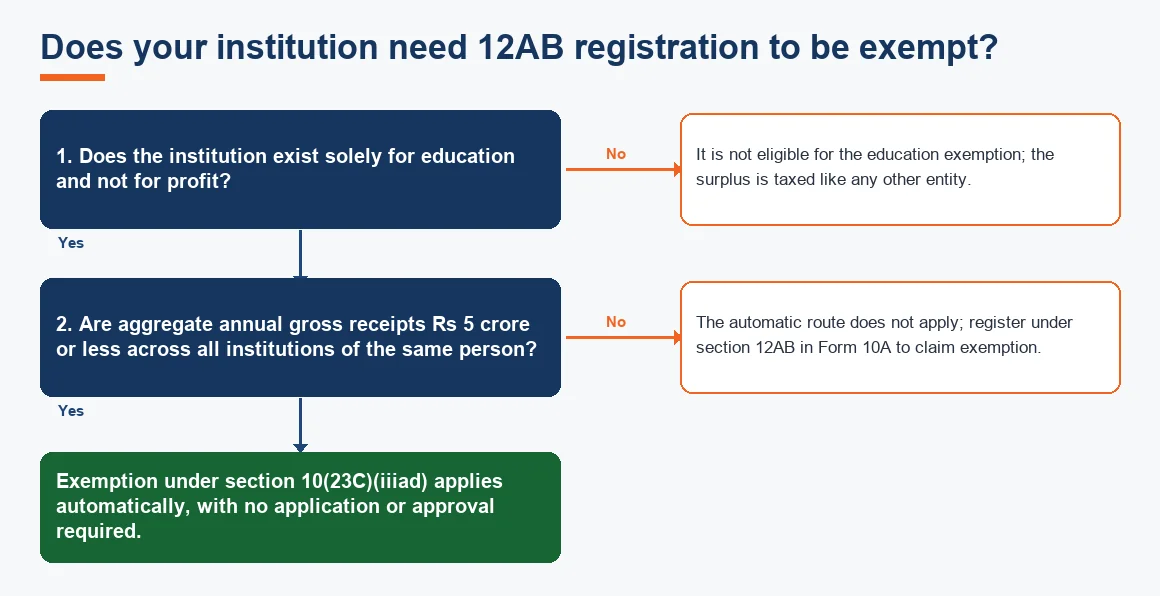
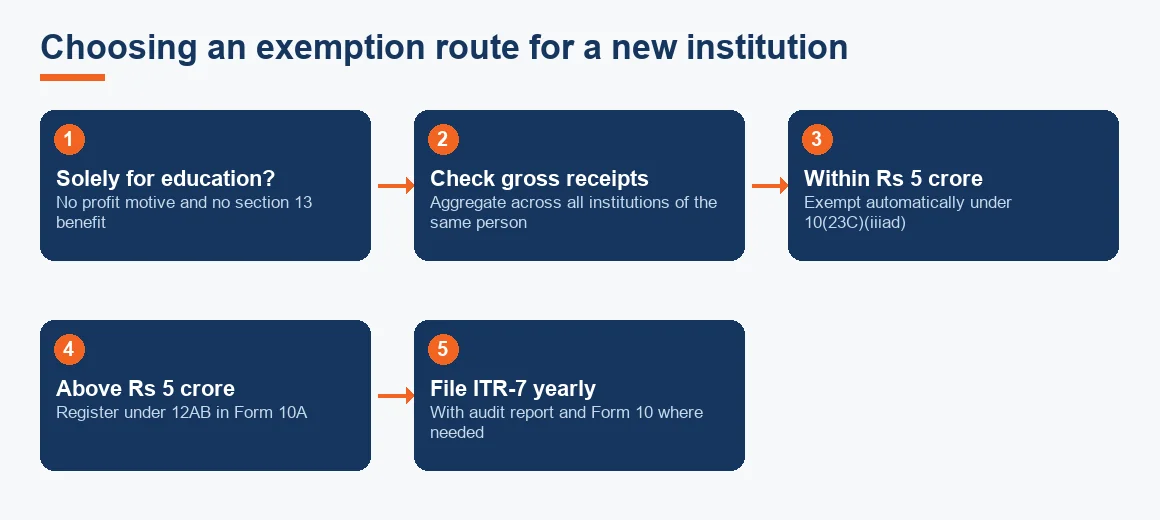
An institution existing solely for education and not for profit is exempt where its aggregate annual gross receipts do not exceed Rs 5 crore, again with no application or approval required. The limit rose from Rs 1 crore with effect from assessment year 2022-23, and it is tested across all institutions run by the same person taken together, not school by school. This is the workhorse for smaller standalone schools.
Sub-clause (vi): larger institutions needing approval
An institution with receipts above the Rs 5 crore threshold historically needed prior approval under sub-clause (vi). Fresh approvals here were discontinued from 1 October 2023, so a new large institution now goes to the 12AB route instead. Existing approvals continue until they expire.
What is section 12A and 12AB registration?
Section 12A is the gateway condition: a trust or institution must be registered before it can claim exemption under sections 11 and 12 for its property held for charitable purposes, and education is a charitable purpose. Since April 2021 the registration itself is granted under section 12AB, on an application in Form 10A for provisional or fresh registration and Form 10AB for renewal or migration. Registration now runs for a fixed period and is renewed, rather than being granted once for good.
The 12A/12AB route carries its own ongoing obligations: an annual filing discipline, the 85 per cent application test and, where donations are involved, a matching 80G registration. Our glossary note on section 12A / 80G annual upkeep summarises what that upkeep looks like across a year.
Difference between 12A and 10(23C)
The two routes reach the same destination, exempt surplus, but the conditions, the paperwork and the flexibility differ. The table below is a summary; it is not a substitute for reading the section against your own facts.
| Feature | Section 10(23C) | Section 12A / 12AB |
|---|---|---|
| Legal basis | Direct exemption under section 10(23C) | Exemption under sections 11 and 12, gated by 12A registration |
| Who it suits | Institutions solely for education or medical relief | Any charitable trust or institution, including multi-object bodies |
| Automatic threshold | Receipts up to Rs 5 crore exempt without approval, under (iiiad) | No automatic threshold; registration always required |
| Application form | Form 10A / 10AB where approval is needed | Form 10A (fresh or provisional), Form 10AB (renewal or migration) |
| Income application test | 85 per cent to objects, balance accumulable | 85 per cent to objects, balance accumulable under Form 10 |
| New approvals after 1 Oct 2023 | Discontinued for (iv), (v), (vi), (via) | The route new institutions now use |
| Return and audit | ITR-7, audit in Form 10BB | ITR-7, audit in Form 10B or 10BB |
Are educational institutions exempt from income tax?
Not automatically, and not simply because they are schools. Exemption depends on three tests being met together. First, the institution must exist solely for education and not for purposes of profit; a modest incidental surplus does not by itself defeat this, but a profit motive does. Second, at least 85 per cent of income must be applied to educational objects in the year. Third, no benefit may pass to trustees or specified persons, because section 13 pulls any such benefit out of exemption and taxes it at the maximum marginal rate. Where these tests fail, the surplus is taxed like that of any other body. We cover the wider question in our explainer on whether schools and colleges pay income tax in India.
The 85 per cent application rule and surplus
The core discipline of both routes is the 85 per cent rule: at least 85 per cent of income has to be applied towards the objects in the same year. The remaining 15 per cent can be retained without condition. Where the 85 per cent cannot be spent in the year, the shortfall can be accumulated for a specific purpose by filing Form 10, and it must then be applied within five years. This is where fund discipline and clean books matter, since application has to be traced to the objects. We go deeper into this in our note on the 85% income application rule for educational trusts, and the mechanics of tracking restricted money sit in fund-based accounting for schools and colleges. If your institution restricts donor money to a named purpose, the glossary entry on restricted corpus donations is worth a look.
Filing and compliance: returns, audit and due dates
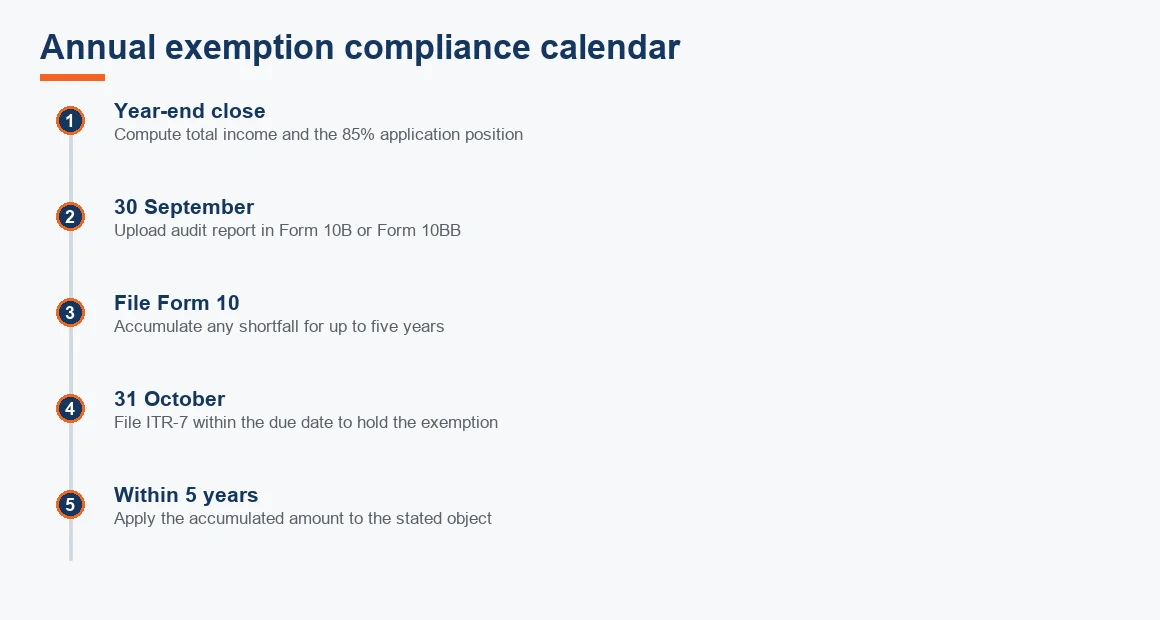
Getting the exemption is only half the task; keeping it depends on filing correctly and on time. The steps below run in the same order every year.
- Close the books and compute application. Work out total income and how much was applied to objects, so the 85 per cent position is clear.
- Get the audit report. Where the institution needs an audit, upload Form 10B or Form 10BB by 30 September.
- Decide on accumulation. If there is a shortfall, file Form 10 to accumulate it for up to five years, along with the return.
- File ITR-7. Submit the return by 31 October where accounts are audited. Filing within the due date is itself a condition of exemption under section 12A(1)(ba), so a late return can make the whole surplus taxable.
Miss the audit date or the return date and the exemption for that year can fall away entirely, which is a harsh outcome for what is often a filing slip rather than a substantive default. The Income Tax Department portal hosts the current versions of Form 10B, Form 10BB, Form 10 and ITR-7.
Which route should a new institution choose?
For an institution set up today the decision has become simpler. If receipts are within Rs 5 crore, the (iiiad) exemption applies automatically and no registration is needed. If receipts are larger, or the body has objects beyond pure education, the 12AB route is the one to use, because fresh 10(23C) approvals are closed. An existing 10(23C) holder that wants to migrate applies in Form 10AB to the Commissioner of Income Tax (Exemptions) at least six months before the current approval expires.
A trust with mixed charitable objects, or one that also runs a hospital, an orphanage or a place of worship alongside a school, will usually sit better under 12AB than under the narrower 10(23C) sub-clauses. Bodies that also receive foreign contributions, or that share features with the wider not-for-profit sector, may find our NGO and non-profit accounting services more relevant, and the full range of options sits on our accounting services hub. We build similar sector explainers for other industries too, including startup accounting, SaaS accounting and IT and software company accounting, each with its own compliance rhythm.
Worked example: computing a school's taxable shortfall
Take a school trust registered under 12AB with total income of Rs 6 crore for the year, above the Rs 5 crore automatic threshold. It applied Rs 4.80 crore to educational objects and did not file Form 10 to accumulate the gap. The computation below shows how the shortfall becomes taxable. Figures are illustrative and Exl GST where relevant.
| Line | Amount (Rs) |
|---|---|
| Total income for the year | 6,00,00,000 |
| Permitted retention (15 per cent) | 90,00,000 |
| Required application (85 per cent) | 5,10,00,000 |
| Actual application to objects | 4,80,00,000 |
| Shortfall in application | 30,00,000 |
| Accumulated under Form 10? | No |
| Taxable income for the year | 30,00,000 |
Had the trust filed Form 10 in time and earmarked the Rs 30,00,000 for a specific object to be met within five years, the taxable figure would have been nil for the year. That single form is the difference between an exempt surplus and a Rs 30 lakh tax base, which is why the accumulation step belongs in every year-end checklist. Institutions with sizeable capital spend on buildings and equipment should also confirm how that spend counts towards application; our depreciation calculator helps keep the asset side of the books consistent.
Key terms
- Section 10(23C) Exemption Rules: the direct income tax exemption available to institutions existing solely for education or medical relief.
- 85% Income Application Rule: the requirement to apply at least 85 per cent of income to charitable objects each year.
- Section 12A / 80G Annual Upkeep: the recurring filings and renewals that keep registration and donation benefits alive.
- Restricted Corpus Donations: donations tied to a named purpose that must be tracked separately from general funds.
- Fund-Based Accounting: the method of segregating income and spending by restricted and unrestricted funds.
Key takeaways
- Section 10(23C)(iiiad) gives schools within Rs 5 crore of receipts an automatic exemption with no application.
- Fresh 10(23C) approvals closed on 1 October 2023, so larger and new institutions register under section 12AB in Form 10A.
- Both routes require 85 per cent of income to be applied to objects, with the balance accumulated under Form 10 for up to five years.
- ITR-7 by 31 October and Form 10B or 10BB by 30 September are conditions of exemption, not just formalities.
- An institution cannot claim 10(23C) and 12AB for the same year, so choose one route before filing.
Decision guide