In this guide
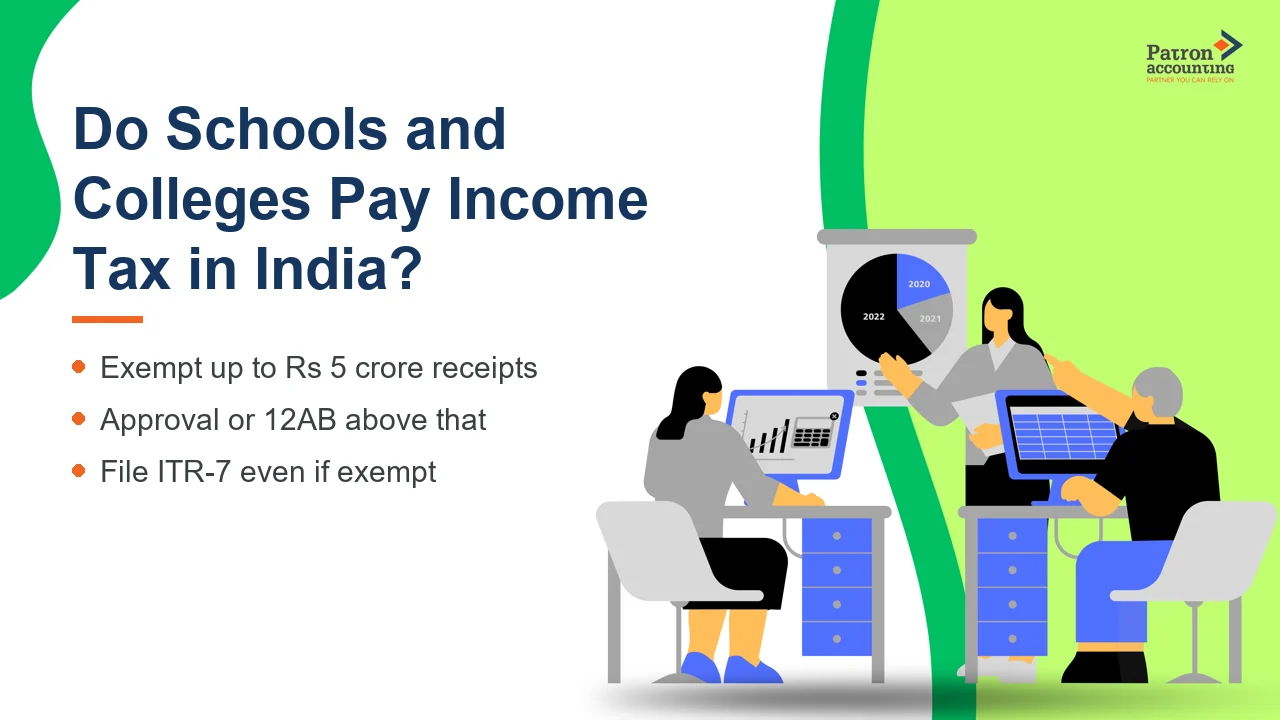
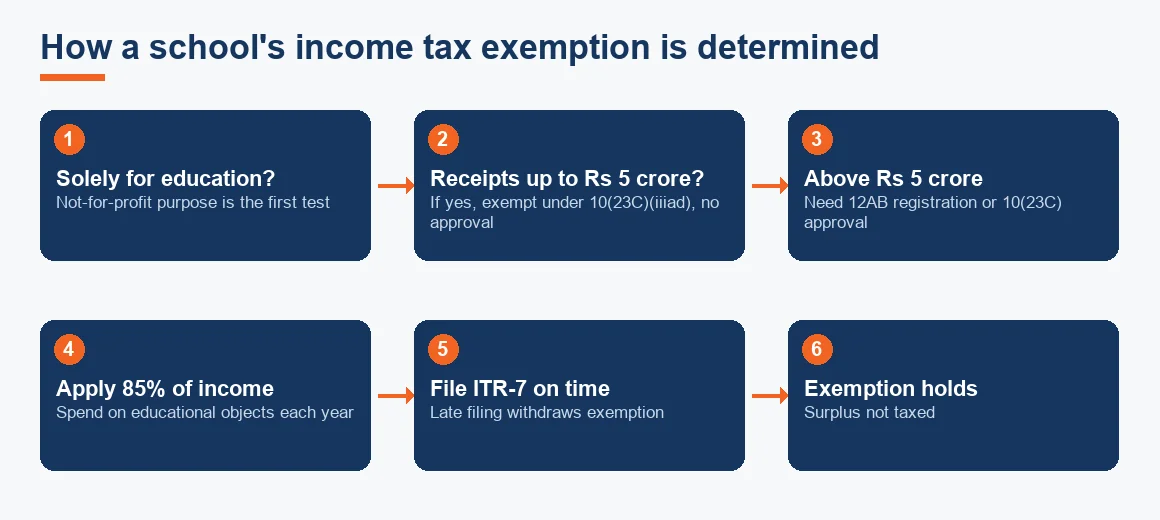
Most schools and colleges in India do not pay income tax, but the exemption is conditional rather than automatic. An institution existing solely for education and not for profit is exempt under Section 10(23C) of the Income-tax Act, and a smaller institution with annual gross receipts up to Rs 5 crore is exempt without any separate approval. The moment a school earns for private gain, breaches its conditions, or crosses the receipt limit without approval, part or all of its surplus becomes taxable. This article explains where the line sits and what keeps an institution on the right side of it.
Do schools pay income tax in India?
As a rule, a genuine educational institution does not pay income tax on its surplus. The law recognises education as a charitable purpose, so a trust, society or Section 8 company that runs a school or college and ploughs its income back into education is exempt. The exemption sits in two main places: Section 11, available to institutions registered under Section 12AB, and Section 10(23C), which is specific to educational and medical institutions. What matters is not the label "school" but the substance: the institution must exist wholly for education, not to generate profit for any person. For a fuller comparison of the two routes, see our explainer on Section 10(23C) versus 12A for educational institutions.
Are educational institutions exempt from income tax under Section 10(23C)?
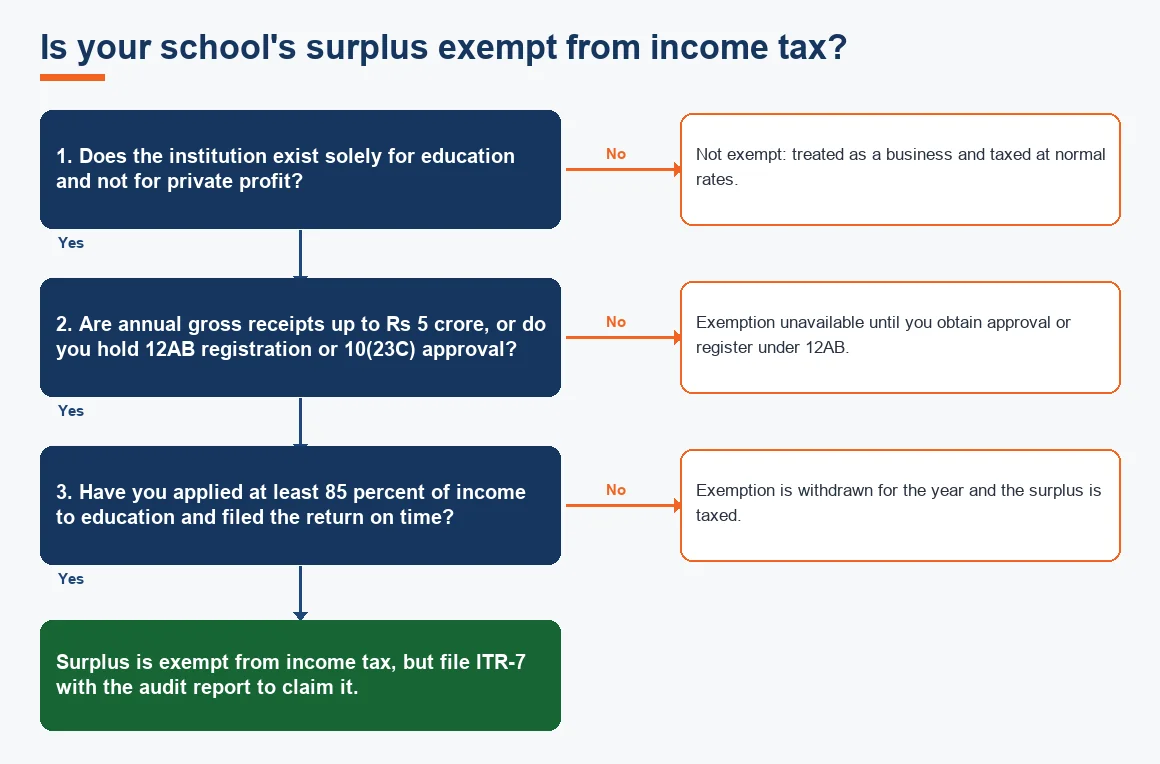
Section 10(23C) carries several sub-clauses. The one most schools rely on is clause (iiiad), which exempts a school or college existing solely for education where the aggregate annual gross receipts do not exceed Rs 5 crore. No application to the department is needed at this level. This Rs 5 crore ceiling is tested across all institutions run by the same person taken together, not campus by campus, so a society running three small schools adds their receipts before checking the limit.
Once receipts cross Rs 5 crore, the institution must obtain approval under Section 10(23C) (the clause (vi) route) or register under Section 12AB and claim under Section 11. Both routes require the institution to keep applying its income to education and to meet the annual conditions. You can read the statutory wording of these clauses on the Income Tax Department portal. The definitions themselves are summarised in our glossary entry on Section 10(23C) exemption rules.
What conditions keep the exemption alive?
Exemption is not a one-time badge. Three conditions run every year. First, the institution must apply at least 85 percent of its income towards its educational objects; the balance can be accumulated only under specific rules. Second, it must file its income tax return by the due date. Third, its income and property must not benefit any trustee, founder or their relatives. Miss any one and the shield weakens for that year. The application requirement is set out in detail in our note on the 85 percent income application rule and defined in the glossary under the 85% income application rule.
Filing on time is part of the exemption
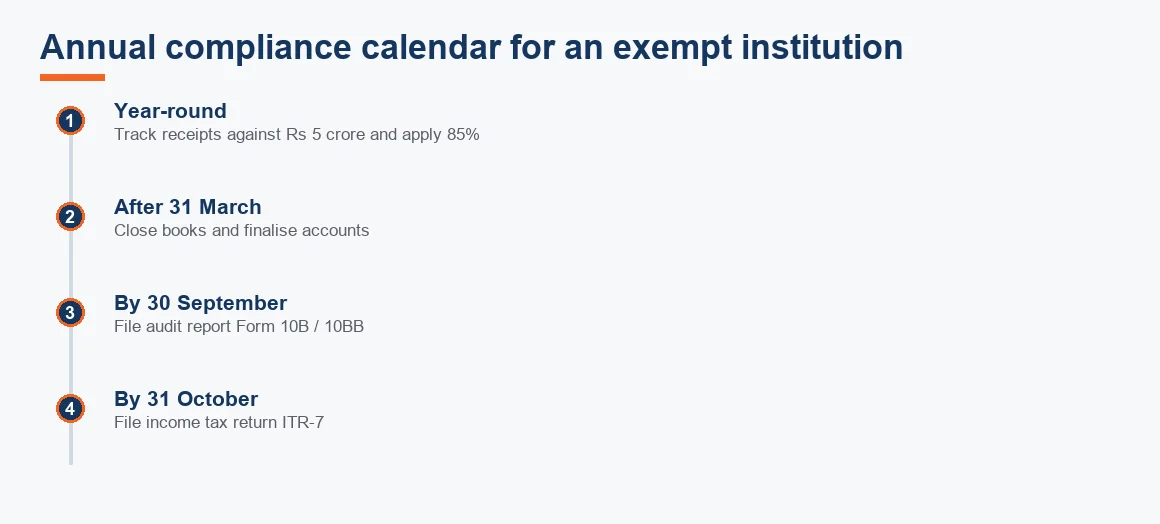
Section 12A(1)(ba) makes timely filing a condition of exemption, not a mere formality. If a registered trust does not file its return within the due date, it loses the exemption for that year and the whole surplus can be taxed. Where an audit report is required, the report (Form 10B or 10BB) must reach the department one month before the return, and the return itself is due by 31 October. Diarise both dates.
Are private schools allowed to be profitable in India?
A private school may earn a surplus, and running efficiently is not the same as running for profit. The distinction the law draws is what happens to that surplus. If it is retained and reinvested in the institution's buildings, salaries, scholarships and equipment, the school remains "solely for education" and stays exempt. If the surplus is siphoned to trustees or connected parties, Section 13(1)(c) denies exemption on that amount and taxes it at a flat 30 percent under Section 115BBI (plus surcharge and cess). So private schools can be well run and cash-generative; they cannot distribute profit like a company. This is why so many schools are structured as trusts or societies rather than ordinary businesses, a structure our team handles under NGO and non-profit accounting services.
Is a coaching institute taxed like a school?
No, and this is one of the most misunderstood points. A private coaching or tuition centre is treated as carrying on a business because it does not lead to a recognised qualification or degree. Its profit is taxed at normal rates: 30 percent for a firm, or 22 percent plus surcharge and cess for a company that opts into Section 115BAA. Coaching fees also attract 18 percent GST, whereas fees charged by a recognised school up to higher secondary are outside GST. The GST position on educational services is set out by the Central Board of Indirect Taxes and Customs. The table below summarises how the three common set-ups compare.
| Set-up | Income tax position | GST on fees | Usual return |
|---|---|---|---|
| Recognised school or college (non-profit, receipts up to Rs 5 crore) | Exempt under Section 10(23C)(iiiad) | Nil on tuition up to higher secondary | ITR-7 |
| Larger institution with 12AB or 10(23C) approval | Exempt if 85% applied and conditions met | Nil on core education | ITR-7 |
| Private coaching or tuition centre | Taxed as business at normal rates | 18% | ITR-3, ITR-5 or ITR-6 |
Which ITR form does a school use, and does it file if fully exempt?
Yes, an exempt institution still files a return every year. Filing is how the exemption is claimed and evidenced; skipping it forfeits the benefit. The correct form follows the legal owner of the institution, not the campus:
- Trust or society claiming under Section 11 or Section 10(23C): Form ITR-7. A single trust running several campuses files one consolidated ITR-7.
- Section 8 company or other company running the institution: Form ITR-6.
- Proprietor running a coaching business: the income sits in ITR-3 along with other personal income.
Good bookkeeping underpins all of this, particularly fund-based accounting for schools, which keeps restricted grants and general funds apart so the return and the audit report reconcile cleanly. The same discipline of tracking fee income across an academic year, closer to deferred revenue than simple cash receipts, matters for larger institutions.
Step by step: staying exempt through the year
Keeping the exemption is a routine, not a one-off filing. The core steps are:
- Confirm your route each year: below Rs 5 crore under clause (iiiad), or approval or 12AB above it.
- Track gross receipts monthly against the Rs 5 crore line, adding all campuses run by the same entity.
- Apply at least 85 percent of income to educational objects and document where it went.
- Ring-fence any trustee payments and keep them reasonable and minuted.
- Get the audit report (Form 10B or 10BB) filed one month before the return.
- File ITR-7 by 31 October and retain the acknowledgement.
Worked example: tax when the 85 percent rule is missed
Consider a registered educational trust (assessed like an association of persons) with income of Rs 5,00,00,000 for the year. It is required to apply 85 percent, that is Rs 4,25,00,000, to education. Suppose it applies only Rs 4,00,00,000. The shortfall of Rs 25,00,000 loses exemption and is taxed at the rates applicable to an AOP. The figures below are illustrative.
| Particulars | Amount (Rs) |
|---|---|
| Total income for the year | 5,00,00,000 |
| Required application at 85% | 4,25,00,000 |
| Actual application | 4,00,00,000 |
| Taxable shortfall | 25,00,000 |
| Tax on shortfall (slab rates for AOP) | 5,62,500 |
| Add: health and education cess at 4% | 22,500 |
| Total tax payable | 5,85,000 |
The slab tax is nil up to Rs 2,50,000, then 5 percent, 20 percent and 30 percent on the successive bands, giving Rs 5,62,500 on Rs 25,00,000. A shortfall of just Rs 25 lakh in application therefore costs nearly Rs 5.85 lakh in tax, which is why the 85 percent test is worth planning for well before year-end. A deferred tax calculator and a depreciation calculator help you project surplus and application accurately across the year.
Key terms
- Section 10(23C) Exemption Rules: the clauses exempting educational and medical institutions, including the Rs 5 crore no-approval threshold.
- 85% Income Application Rule: the requirement to apply at least 85 percent of income to charitable objects each year.
- Fund-Based Accounting: tracking restricted and unrestricted funds separately so grants are used and reported correctly.
- Section 12A / 80G Annual Upkeep: the yearly filings and renewals that keep registration and donor deduction status valid.
- Restricted Corpus Donations: donations given with a specific direction to form part of the corpus, treated differently from general income.
How the rules differ by sector
The education exemption is specific to institutions that lead to a recognised qualification, which is why coaching, edtech and campus-linked ventures often fall outside it and are taxed like ordinary businesses. Sector matters more than most owners expect: a SaaS learning platform is taxed quite differently from a school, closer to how we treat SaaS accounting and IT company accounting, and an early-stage edtech venture usually needs the same discipline as any startup accounting engagement. For general compliance across entity types, our accounting services team maps the right treatment to your structure.
Key takeaways
- A non-profit school or college is exempt from income tax, but only while it meets its conditions.
- Receipts up to Rs 5 crore need no approval; above that, get 12AB registration or 10(23C) approval.
- Apply at least 85 percent of income to education and file the return on time, or the surplus is taxed.
- Coaching centres are businesses: taxed at normal rates and charging 18 percent GST.
- Even a fully exempt institution files ITR-7 every year, with the audit report a month ahead.
If your institution is approaching the Rs 5 crore mark, restructuring, or unsure which route applies, our specialist accounting services for schools and colleges can set up the books and compliance calendar so the exemption holds year after year.
Decision guide