In this guide
The 85% application rule requires a registered charitable or educational trust to spend at least 85% of its annual income on its stated objects in the same financial year, and only then is that income exempt from tax under Section 11 of the Income Tax Act. A school or college trust that collects Rs 1 crore must, put simply, apply Rs 85 lakh towards education; the balance Rs 15 lakh may be retained without any conditions. This article explains how the threshold is computed, what counts as application, and the forms that rescue a trust when it cannot spend enough in time. It is an explainer, not a filing service: if you want hands-on help closing your books, our Accounting Services for Schools & Colleges team handles the compliance end to end.
What is the 85% rule for a trust?
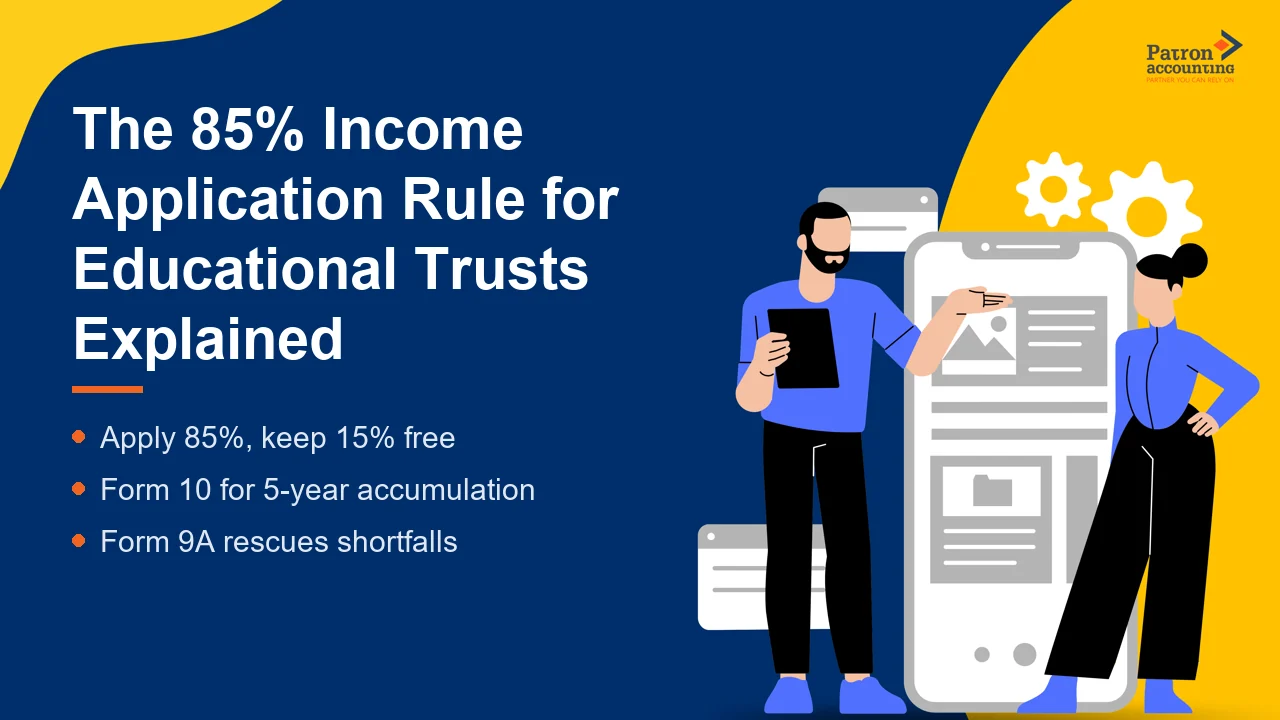
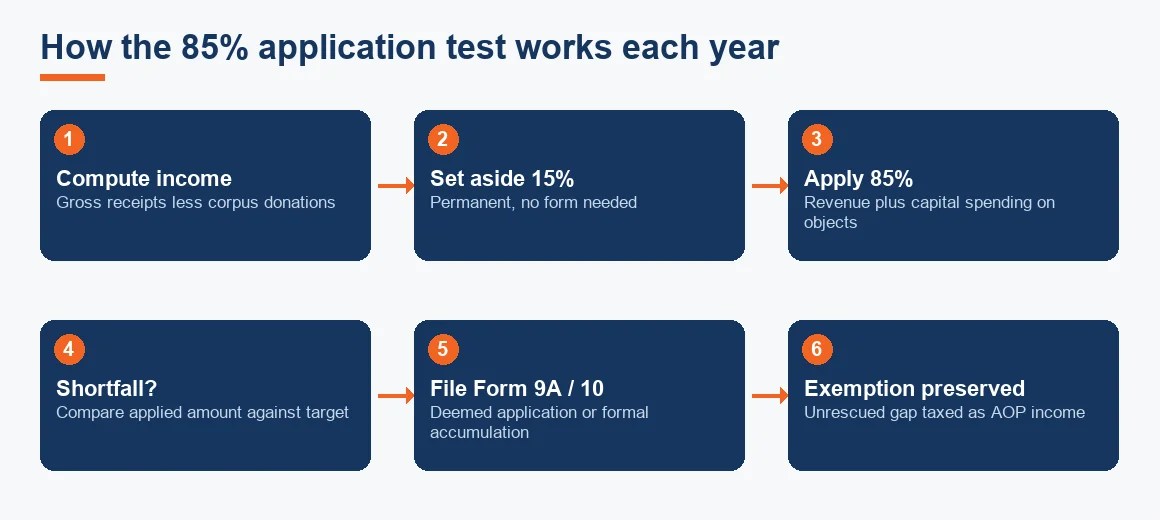
Under Section 11(1)(a), income derived from property held under a trust for charitable or religious purposes is exempt to the extent it is applied to those purposes in India during the year. The law expects application of 85% of that income and permits the trust to accumulate or set apart up to 15% permanently, with no time limit and no form to file. So the working rule is not "spend everything"; it is "spend at least 85%, and the other 15% is yours to keep within the trust". For a fuller definition you can browse the 85% Income Application Rule entry, but the practical mechanics are what most trustees get wrong.
The 85% is measured on gross receipts of the year, reduced by the 15% standard accumulation, not on surplus or profit. Voluntary contributions received with a specific direction that they form part of the corpus are excluded from this base, as explained further below. Everything else, including tuition fees, hostel income, interest, and general donations, feeds the computation.
Section 11 exemption for trusts: the basic framework
A trust does not enjoy Section 11 exemption automatically. It must first be registered under Section 12AB (the successor to the older 12A registration) and keep that registration current, alongside its 80G approval where it issues donation receipts. Once registered, the exemption flows year on year provided the 85% test is met and the trust does not breach the anti-abuse conditions in Section 13, such as diverting funds to interested persons. Educational institutions have a parallel route under Section 10(23C), and choosing between the two matters; our companion post on Section 10(23C) vs 12A tax exemption routes weighs that decision, and the Section 10(23C) Exemption Rules glossary gives the short version.
The distinction that trips people up is the difference between a trust being registered and a trust being tax-free. Registration keeps the door open; the 85% test decides whether income actually walks through it each year. A trust that forgets to apply enough does not lose its registration, but it does lose exemption on the shortfall for that year.
What counts as application of income
Application is broader than day-to-day running costs. It includes revenue spending on the objects (teacher salaries, books, utilities, scholarships) and, importantly, capital spending. Money laid out on a new classroom block, a laboratory, or a school bus counts fully as application in the year the payment is made. There is one firm limit: Section 11(6) blocks claiming depreciation on an asset whose cost has already been treated as application, so you cannot count the same rupee twice. If you are modelling asset write-offs for your non-charitable arms, our Depreciation Calculator handles the Schedule II side, but for the trust's own assets, remember the double-count bar.
Loan repayments of money earlier borrowed and applied to objects, and inter-charity donations to other registered trusts (other than towards their corpus), also qualify. What does not qualify is a mere provision or a book entry with no actual outflow, since application from Assessment Year 2022-23 onwards is largely on a payment basis.
Worked example: applying the 85% rule to a school trust
Consider Vidya Education Trust, registered under Section 12AB, with the following figures for the year. All amounts are illustrative. It shows how a trust can spend a large sum and still fall short of the 85% line.
| Particulars | Amount (Rs) |
|---|---|
| Gross income (fees, interest, general donations) | 1,00,00,000 |
| Less: 15% standard accumulation permitted | 15,00,000 |
| Required application (85%) | 85,00,000 |
| Applied: revenue spending on objects (salaries, utilities) | 60,00,000 |
| Applied: capital spending (new classroom block) | 20,00,000 |
| Total actually applied | 80,00,000 |
| Shortfall against the 85% requirement | 5,00,000 |
The trust applied Rs 80 lakh against a target of Rs 85 lakh, leaving a Rs 5 lakh shortfall. Unless it acts, that Rs 5 lakh is taxable. Its choices are to file Form 10 and formally accumulate the Rs 5 lakh for a stated purpose, or, if the gap arose because income was never received, to file Form 9A. If it does neither, the Rs 5 lakh is added to its taxable income for the year.
What if 85% of income is not applied?
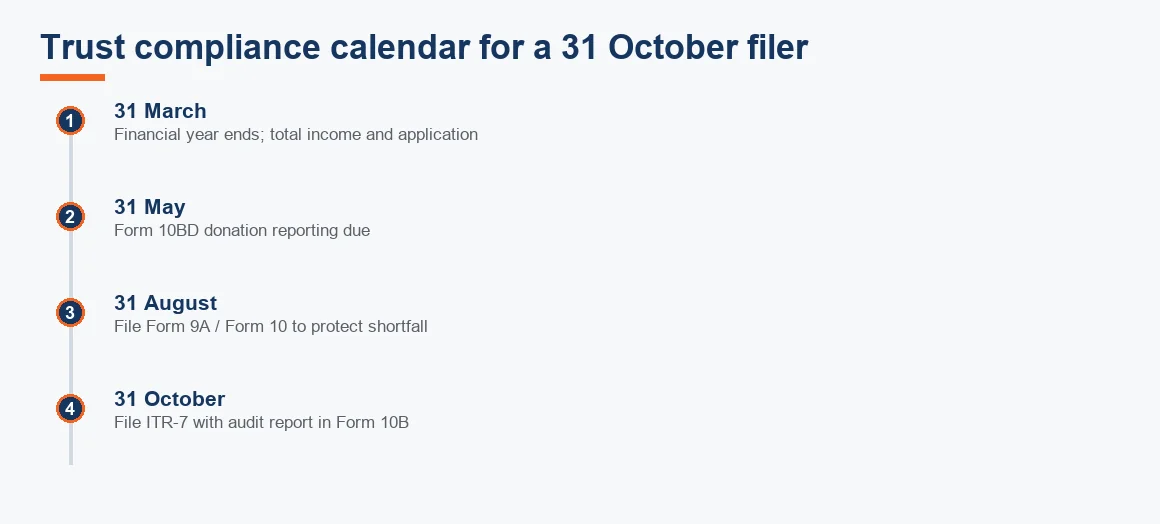
A shortfall is not automatically fatal. The Act gives two escape routes, each depending on why the trust fell short, and each with a hard deadline of at least two months before the ITR-7 due date (so 31 August where the return is due on 31 October).
- Income was not received, or received late: file Form 9A to treat the shortfall as deemed application. The trust must then actually spend that income in the immediately following financial year.
- Income was received but you want to hold it back for a project: file Form 10 to accumulate the amount for a specified charitable purpose for up to five years, with the money parked in Section 11(5) investment modes.
- Neither applies: the unapplied balance is taxed as the trust's income at the rates applicable to an association of persons.
You can confirm the current forms and e-filing timelines on the Income Tax Department portal, which hosts both Form 9A and Form 10 under the trust's e-filing login.
Trust income accumulation: Form 10 and the five-year rule
Form 10 is the formal accumulation route. It lets a trust set aside income beyond the free 15%, for a specific purpose it names in the form, for a period not exceeding five years. The accumulated funds must be invested only in the modes listed in Section 11(5), such as scheduled bank deposits and government securities. If the money is not spent on the stated purpose within five years, or is applied to a different purpose, it becomes taxable in the year the condition is broken. The table below summarises the three mechanisms trustees juggle.
| Mechanism | What it does | Form & timing |
|---|---|---|
| Standard 15% accumulation | Permanently retain up to 15% of income, no purpose needed | No form; claimed in ITR-7 |
| Formal accumulation | Hold income beyond 15% for a stated purpose, up to 5 years | Form 10, by 31 August (2 months before ITR) |
| Deemed application | Treat income not received as applied, spend it next year | Form 9A, by 31 August (2 months before ITR) |
Corpus donations and the 85% computation
A corpus donation is a voluntary contribution received with a written direction that it forms part of the trust's capital fund. Section 11(1)(d) keeps it out of income entirely, so it never enters the 85% base. Since the Finance Act 2021 amendments, however, corpus funds must be invested in Section 11(5) modes, and spending out of corpus is treated as application only in the later year when the trust puts the money back into corpus. Donor-tied money of this sort sits close to fund-based accounting practice; if your books do not yet segregate restricted funds, our primer on fund-based accounting for schools and the Restricted Corpus Donations entry are the places to start. Trusts receiving foreign contributions must additionally route them through an FCRA designated bank account, a separate compliance strand from Section 11.
How much tax does a trust pay, and which trusts are exempt?
A registered charitable or educational trust that meets the 85% test pays no tax on its applied income, which is the whole point of Section 11. There is no separate "basic exemption limit" in the individual sense; instead, exemption is a function of application. Tax arises only on what is neither applied nor validly accumulated. That taxable slice is charged at the rates applicable to an association of persons, and where a trust breaches Section 13 (for example, benefiting a settlor), the maximum marginal rate can apply to the tainted portion. Whether schools and colleges pay tax at all is a common question we answer in more depth in Do schools and colleges pay income tax in India?. Trusts that are not registered at all are taxed as ordinary associations of persons, with the usual slab-based basic exemption but no Section 11 shelter.
Keeping the exemption alive is an annual discipline, not a one-off registration. That means timely renewal, Form 10BD donation reporting, and audit in Form 10B where receipts cross the threshold. Patron supports this through its broader industry practices, from NGO and non-profit accounting services to general accounting services, and even the compliance patterns familiar to startup accounting, SaaS accounting and IT company accounting teams; the recurring theme across all of them is that the exemption or benefit survives only as long as the paperwork keeps pace.
Key terms
- 85% Income Application Rule: the requirement to apply 85% of a trust's income to its objects to retain Section 11 exemption.
- Section 10(23C) Exemption Rules: the alternative exemption route open to educational and medical institutions.
- Restricted Corpus Donations: donor-directed capital contributions excluded from income under Section 11(1)(d).
- Section 12A / 80G Annual Upkeep: the recurring registration and reporting tasks that keep exemption valid.
- Fund-Based Accounting: the method of tracking restricted and unrestricted funds separately in a non-profit's books.
Key takeaways
- Apply at least 85% of income to your objects each year; keep the remaining 15% freely, with no form and no time limit.
- Capital spending counts as application in full, but you cannot also claim depreciation on that asset.
- File Form 9A or Form 10 by 31 August, two months before the ITR-7 deadline, to protect any shortfall.
- Corpus donations stay outside the 85% base but must be invested in Section 11(5) modes.
- Tax bites only the unapplied, un-accumulated balance, charged at association-of-persons rates.
Decision guide