
In this guide
Fund accounting for schools is a method of bookkeeping in which money is grouped by its purpose rather than kept in one pooled account, so that fees, government grants, scholarship money and corpus donations each sit in their own fund with its own balance. The point is accountability: a parent's building-fund contribution or a restricted scholarship grant must be seen to have been spent only on what it was given for, and fund accounting makes that visible at a glance. This is an informational primer on how the method works in an Indian educational institution. If you want the underlying compliance service, our page on Accounting Services for Schools & Colleges covers the engagement side.
What is fund accounting, with an example?
In ordinary business accounting you track one entity's profit. In fund accounting you track several self-balancing funds inside one entity, each answering the question "what is this pot of money for, and how much of it is left?". A school might run a general fund for day-to-day operations, a building fund for construction, a scholarship fund and a corpus fund. Suppose a donor gives 5,00,000 rupees specifically for scholarships. Under fund accounting you credit a scholarship fund on the liabilities side and debit bank; when 1,20,000 rupees of scholarships are awarded, you charge them against that fund. The fund still shows 3,80,000 rupees earmarked, and nobody can argue the money leaked into salaries. The transaction never touches the income and expenditure account as revenue, because it was never the school's own income to spend freely.
What are the key principles of fund accounting?
Four principles hold the method together. First, segregation: each fund is a separate accounting entity that must itself balance. Second, restriction is honoured, meaning restricted money can only be applied to its stated purpose and any unspent balance is carried forward as a liability, not released to income. Third, the books remain on the accrual basis and on double-entry bookkeeping, so fees are recognised across the academic year they relate to rather than when the cheque clears. Fourth, transparency: the annual accounts and the income-tax annexures report each fund separately, so a reader can trace what came in, what was applied and what remains. Cash-basis single-entry survives only in very small societies; a school run by a section 8 company has no choice, because section 128 of the Companies Act mandates accrual double-entry books.
What are the different types of funds in a school?
There are three broad categories, and most school fund structures are a variation on them.
General (unrestricted) fund
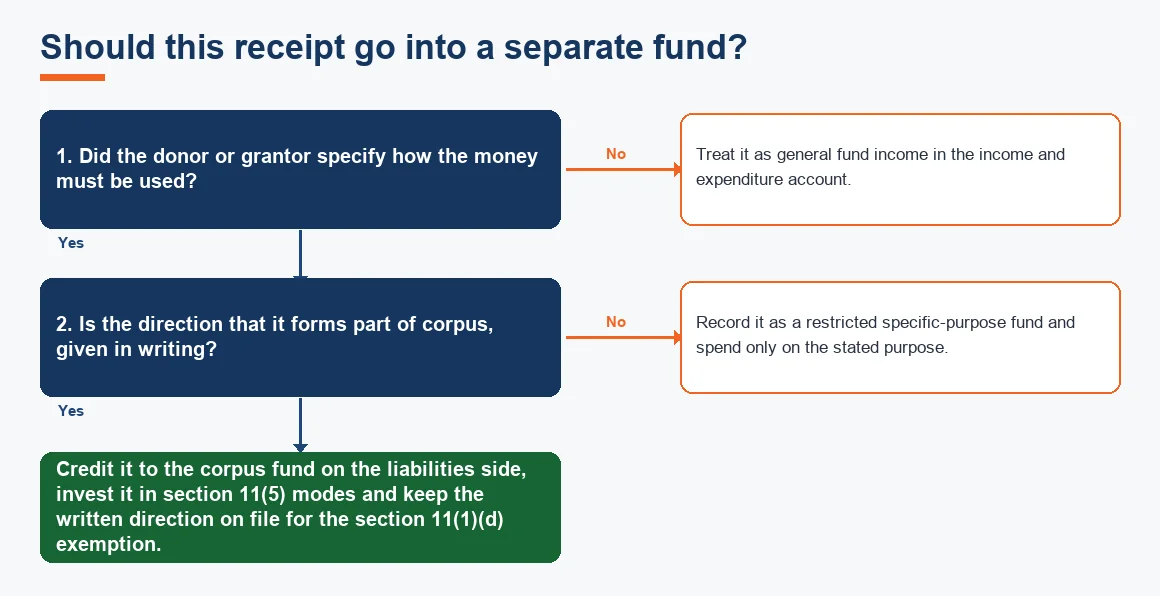
This is the operating fund. Tuition fees, examination fees and untied income flow here, and routine running costs are met from it. A surplus in the general fund is the school's free reserve.
Restricted (specific-purpose) fund
Money received for a named purpose: a building fund, a laboratory fund, a sports fund or a specific grant from a government scheme or CSR donor. The direction may come from the donor or from the terms of the grant. Unspent balances stay as fund liabilities and are reported separately, never absorbed into general income.
Corpus (endowment) fund
A permanent fund. A corpus donation is one the donor directs, in writing, to be held as capital. It is credited to the corpus fund and must be invested in the modes specified in section 11(5) of the Income-tax Act. The section 11(1)(d) exemption for that donation depends entirely on the written direction, so keep it on file. For the tax mechanics of restricted and corpus receipts, our note on the 85% income application rule for educational trusts and the comparison of section 10(23C) versus 12A routes go into more depth.
The fund accounting process: general ledger and journal entries
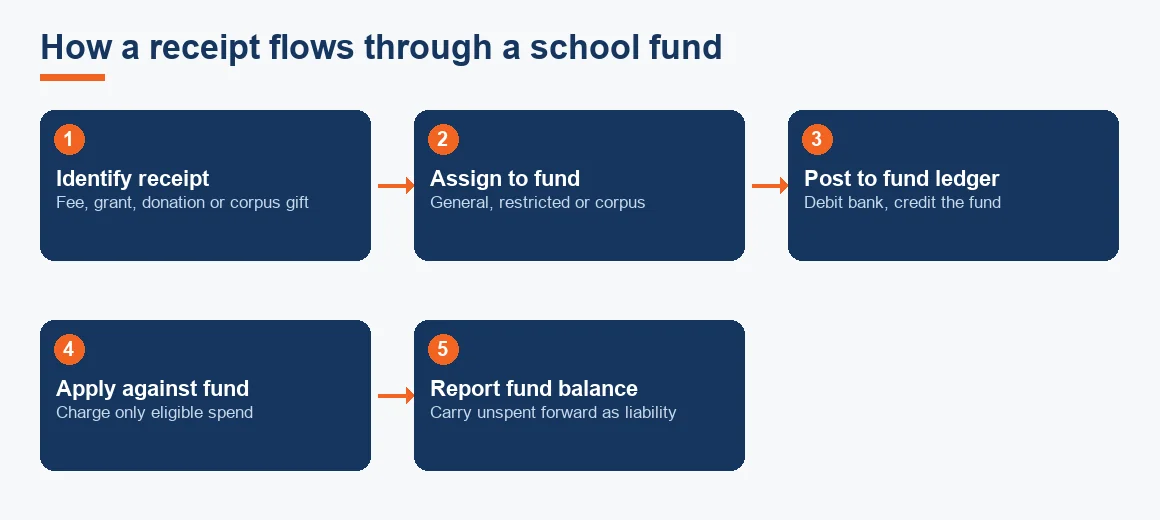
The mechanics are ordinary double entry with one extra discipline: every receipt is classified to a fund before it is posted. The process runs receipt to report in five steps. You identify the receipt, assign it to the correct fund, post it to that fund's ledger in the general ledger, charge expenditure against the fund as it is applied, and finally report the closing fund balance. A single journal entry for a restricted receipt debits bank and credits the fund; the fund never passes through revenue. Accrual entries are handled the same way as elsewhere: fee income is spread over the academic year, and fees collected in advance sit as deferred revenue until the term they relate to arrives. If you also want a refresher on how the whole set of statements fits together, financial statement preparation follows the same fund-wise logic on the balance sheet.
Worked example: journal entries for a building fund
A school receives a 10,00,000 rupee donation earmarked for a new classroom block, with a written direction that it be held as corpus. It parks the money in a fixed deposit (a section 11(5) mode), then spends 6,00,000 rupees on construction during the year. The entries below show how the fund is protected through to utilisation.
| Step | Particulars | Debit (Rs) | Credit (Rs) |
|---|---|---|---|
| 1 | Bank A/c Dr / To Building (Corpus) Fund A/c (earmarked donation received) | 10,00,000 | 10,00,000 |
| 2 | Fixed Deposit (Sec 11(5)) A/c Dr / To Bank A/c (corpus invested) | 10,00,000 | 10,00,000 |
| 3 | Building (Fixed Asset) A/c Dr / To Bank A/c (construction cost paid) | 6,00,000 | 6,00,000 |
| 4 | Building (Corpus) Fund A/c Dr / To Capital Fund A/c (fund utilised, transferred against the asset created) | 6,00,000 | 6,00,000 |
After these entries the building fund shows a 4,00,000 rupee balance still earmarked, the new asset of 6,00,000 rupees appears on the balance sheet, and the capital fund records the portion converted into a permanent asset. Nothing has touched the income and expenditure account. Any professional fee quoted for setting up such a structure is indicative and Exl GST.
Where is fund accounting used, and how does it reach the tax return?
Beyond schools, the same method is used by trusts, societies, hospitals run on charitable lines, religious institutions and government bodies, because they all handle restricted money. For an Indian school specifically, the fund figures do not stay internal; they are pulled straight into statutory filings. The annual accounts of a trust or society comprise a receipts and payments account, an income and expenditure account and a balance sheet. On top of that, the audit report in Form 10B or 10BB asks for fund-wise details of application, accumulation and investment. Form 10BD, due by 31 May, reports every donation against which an 80G deduction is claimed, tagged as corpus, specific grant or others. Restricted grants then appear in their own schedules in the ITR-7. Because each of these wants fund-level numbers, the fund balances have to be maintained live through the year, which is the whole argument for the method. The Income-tax Department's filing portal at incometax.gov.in hosts the current Form 10B, 10BB and 10BD utilities, and the Ministry of Corporate Affairs site mca.gov.in carries the section 8 company requirements.
Corpus spending: the rule that trips schools up
Since 1 April 2021, an amount spent out of corpus is not treated as application of income in the year it is spent. It is treated as application only in the later year when the corpus is restored from the institution's other income. Spend corpus and fail to put it back, and you get no application benefit at all for that outgo. This is exactly why the building-fund example above routes utilisation through a fund-to-capital transfer rather than through revenue, and why a clean fund ledger matters. Whether a school pays tax on any residual surplus is a separate question, taken up in our piece on whether schools and colleges pay income tax in India.
General fund versus restricted fund at a glance
The table below summarises how the two working fund types differ in treatment. Corpus is a restricted fund with the added permanence and investment conditions.
| Feature | General (unrestricted) fund | Restricted / corpus fund |
|---|---|---|
| Source | Tuition and untied income | Earmarked donations, specific grants, corpus gifts |
| Balance sheet side | Reserve (own funds) | Liability (earmarked / corpus fund) |
| What it may fund | Any lawful running cost | Only the stated purpose; corpus, only capital per its terms |
| Unspent balance | Surplus carried to reserves | Carried forward as fund liability |
| Investment condition | None specific | Corpus must sit in section 11(5) modes |
| Tax annexure | General application in Form 10B/10BB | Fund-wise in Form 10B/10BB and 10BD |
Key terms
- Fund-Based Accounting: grouping money by purpose into self-balancing funds rather than one pooled account.
- Restricted Corpus Donations: donations directed in writing to be held permanently as capital.
- Section 12A / 80G Annual Upkeep: the recurring filings that keep a charitable school's exemptions live.
- Accrual Accounting: recognising income and cost when earned or incurred, not when cash moves.
- General Ledger: the master record where every fund's postings are collected and balanced.
Schools are one of several sectors where accounting turns on this kind of purpose-tagging. We publish similar sector guides for startups, for IT and software companies and for SaaS businesses, each with its own recognition quirks. And if you are separately reviewing depreciation on the school's building and equipment, our depreciation calculator works to Schedule II.
Key takeaways
- Fund accounting sorts school money by purpose, so restricted receipts can never quietly fund salaries.
- Run three fund categories: general, restricted and corpus, and keep each self-balancing on the accrual basis.
- Corpus and building funds sit on the liabilities side and take only capital charges, never revenue.
- Since April 2021, corpus spent counts as application only when it is restored from other income.
- Form 10B, 10BB and 10BD all want fund-wise figures, so track balances live rather than rebuilding them at audit.
Decision guide