
In this guide
Ind AS 2 inventory valuation for Sanand manufacturing units means valuing raw material, work in progress and finished goods at the lower of cost and net realisable value, where cost includes direct material, direct labour and a fair share of production overhead absorbed on normal capacity. For a factory on a GIDC plot at Sanand or an older shed at Naroda, that single rule decides how much profit shows in a slow month, how idle machines are treated and what number the auditor will accept as closing stock. This explainer walks through the mechanics so an owner-run unit can read its own books with confidence. For the commercial engagement itself, see our Manufacturing Accounting Services and the local Manufacturing Accounting Services Ahmedabad page.
What Ind AS 2 (and AS 2) require for a Sanand unit
Most owner-managed factories in Ahmedabad still report under AS 2 (Valuation of Inventories); larger companies that cross the Ind AS thresholds apply Ind AS 2 instead. On the point that matters most to a manufacturer, the two standards agree: inventory is measured at the lower of cost and net realisable value, and the cost of a finished unit is built up from direct material, direct labour and production overhead. What they exclude is just as important. Selling and distribution costs, head office administration, abnormal wastage and storage of finished goods are not part of inventory cost and belong in the profit and loss account as they arise. The Institute of Chartered Accountants of India publishes both standards in full at icai.org, and the AS vs Ind AS Comparison Matrix tool lets you check where the two diverge for your reporting basis.
Building the cost of inventory: material, labour and overhead
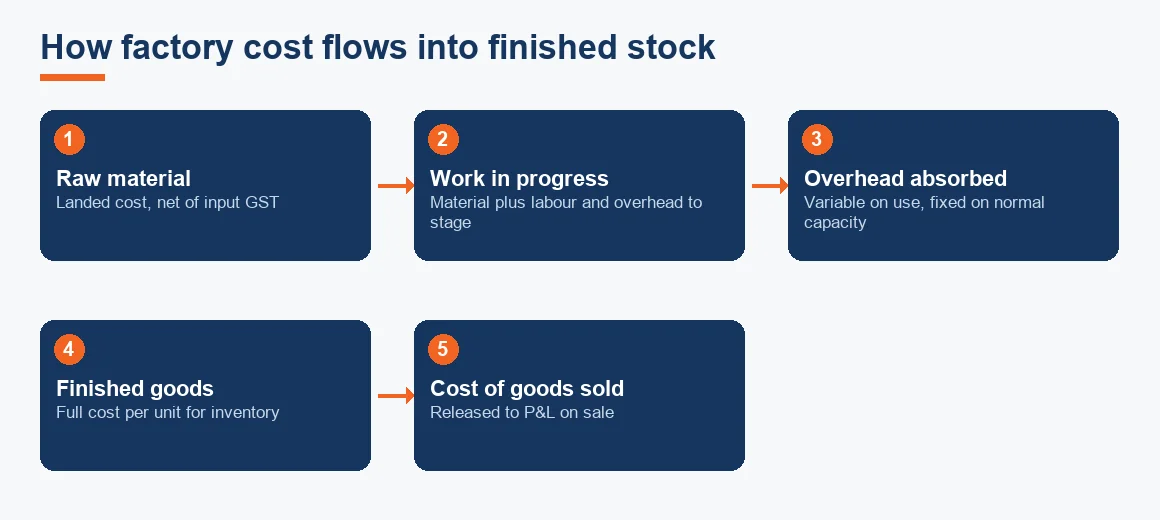
The cost of a manufactured unit is assembled in layers. Direct material is the metal, resin or component that physically becomes the product, taken at landed cost after freight and non-refundable duty but after deducting GST input credit. Direct labour is the wages of the workers who convert it. Production overhead is everything else the factory floor consumes to run: supervision, power, factory rent, consumables, repairs, insurance on plant and depreciation of machinery.
Direct versus indirect factory overheads
Overhead splits into variable overhead, which moves with output such as power and consumables, and fixed overhead, which stays broadly flat such as factory rent and the plant manager's salary. The split matters because the two are absorbed differently. Variable production overhead is absorbed on the actual usage of the production facility, while fixed production overhead is absorbed on normal capacity. This is the single distinction that trips up most factory books, and it is covered in more depth under direct versus indirect factory overheads.
Normal capacity and the idle-time trap
Normal capacity is the output a unit expects to achieve on average across a season, allowing for planned maintenance and ordinary downtime, not the theoretical maximum. Fixed overhead is spread over that normal figure. When actual output falls below normal, the overhead that fails to attach to product (the unabsorbed portion) is expensed immediately; it does not get parked in closing stock to be recovered later. When output runs above normal, the fixed overhead per unit is reduced so that stock is not carried above cost.
Absorbing factory overhead with a machine hour rate
A press shop, injection-moulding line or CNC unit runs on machine time, so a machine hour rate is the natural way to attach overhead to jobs. The method is a short, repeatable sequence:
- Group overhead by cost centre (press shop, paint line, assembly) so each area carries only its own costs.
- Estimate the budgeted overhead for that cost centre for the year.
- Estimate the budgeted machine hours at normal capacity for the same period.
- Divide budgeted overhead by budgeted machine hours to get the rate per machine hour.
- Charge each job or process with the machine hours it actually consumes at that rate.
- At year end, compare overhead absorbed against overhead actually incurred and write off the variance.
The gap between absorbed and actual overhead is the standard cost variance; a persistent under-absorption usually signals that the normal-capacity assumption is too optimistic for that shop. Owners who want to sanity-check the depreciation feeding into the overhead pool can use the Depreciation Calculator built on Schedule II lives.
Worked example: costing one unit at a Sanand press shop
Take a press shop that budgets Rs 60,00,000 of annual fixed production overhead against a normal capacity of 30,000 machine hours, giving a fixed overhead rate of Rs 200 per machine hour. Each unit takes 0.5 machine hours. The per-unit cost that may sit in inventory is built up as follows (all figures indicative and Exl GST).
| Cost element | Basis | Per unit (Rs) |
|---|---|---|
| Direct material | Landed cost, net of input GST | 420 |
| Direct labour | Converting-shift wages | 90 |
| Variable production overhead | Power and consumables on actual use | 60 |
| Fixed production overhead | 0.5 hr at Rs 200 (normal capacity) | 100 |
| Cost per unit for inventory | 670 |
Now test a slow month. Normal capacity is 2,500 machine hours a month (30,000 divided by 12), and monthly fixed overhead is Rs 5,00,000. The shop runs only 2,000 machine hours. Overhead absorbed into product is 2,000 hours at Rs 200, or Rs 4,00,000. The remaining Rs 1,00,000 is unabsorbed fixed overhead and is charged to the profit and loss account for the month. It is not added back to raise the per-unit cost above Rs 670 and it never enters closing stock. That is the idle-capacity rule working exactly as the standard intends.
E-way bills and delivery challans for job work in Gujarat
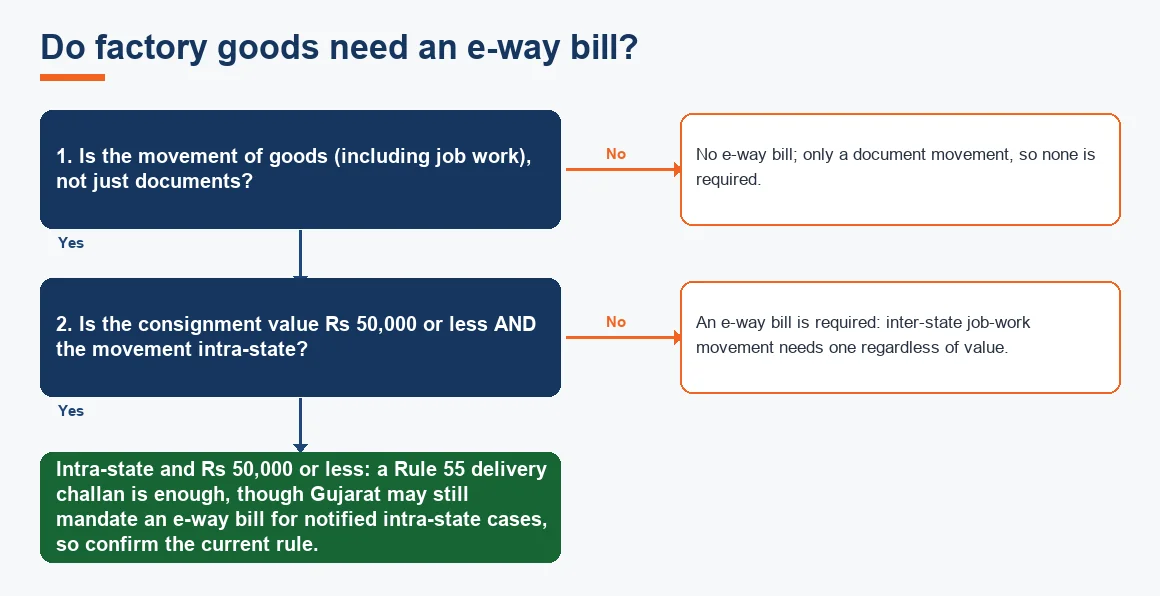
Gujarat manufacturing runs on job work: pressed parts go out for plating, castings go out for machining, and semi-finished goods move between the principal and the job worker. Such movement is not a supply, so it travels on a delivery challan under Rule 55, not a tax invoice. The challan carries a serial number, date, both GSTINs, HSN, quantity, taxable value and place of supply, and is prepared in triplicate. An e-way bill is added once the consignment value crosses Rs 50,000, and any inter-state movement needs one regardless of value. Goods sent for job work are also tracked and returned within the statutory window through Form ITC-04 job work tracking, and the semi-finished stock lying with the job worker stays in the principal's books as work-in-progress valuation. The current e-way bill and Rule 55 provisions are on the CBIC portal at cbic-gst.gov.in and the live system at gst.gov.in.
Professional tax and payroll at a Naroda or Sanand unit
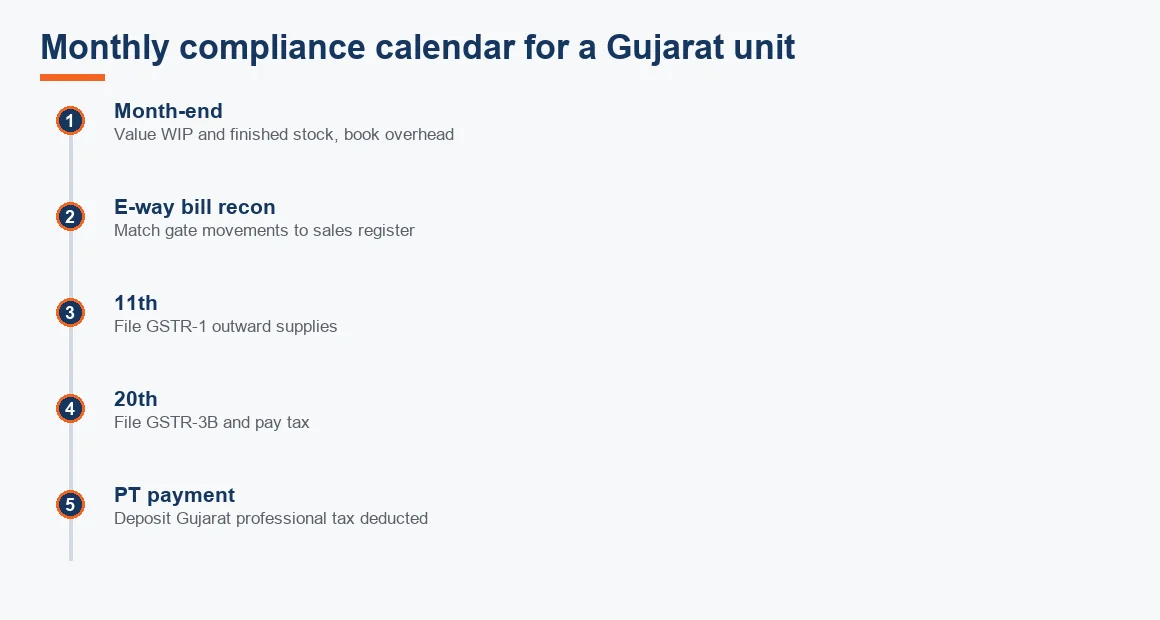
Unlike Delhi and Haryana, Gujarat levies professional tax, and a factory has two obligations. As an employer it deducts professional tax from wages, currently Rs 200 a month from employees earning above Rs 12,000 a month, with nil below that threshold, and pays it to the local authority. Separately it holds an enrolment certificate for its own liability as a business. Both registrations are needed at a Sanand or Naroda plant, and payroll software should be set to the Gujarat slab, not a national default. The wider state position, including Shops and Establishment registration, is covered in our note on Gujarat professional tax and Shops Act compliance for employers.
AS 2 versus Ind AS 2: what changes for manufacturers
For day-to-day factory costing the two standards behave almost identically. The differences that a manufacturer notices sit at the edges, summarised below.
| Point | AS 2 | Ind AS 2 |
|---|---|---|
| Measurement base | Lower of cost and net realisable value | Lower of cost and net realisable value |
| Fixed overhead absorption | Normal capacity | Normal capacity |
| Cost formulas allowed | FIFO or weighted average | FIFO or weighted average (LIFO barred) |
| Deferred settlement purchases | Financing element not separated | Difference over normal credit treated as interest |
| Who applies it | Most owner-managed units | Companies past the Ind AS thresholds |
If you are unsure which basis applies to your company, the Ind AS Applicability Checker walks through the net-worth and listing tests. Whether to use FIFO or weighted average is explained under FIFO vs weighted average cost, and the bill that drives your material cost sits in bill of materials (BOM) costing.
Key terms
- Work-in-Progress (WIP) Valuation: valuing part-finished goods at material plus the labour and overhead absorbed to their stage of completion.
- Direct vs Indirect Factory Overheads: separating costs that attach to a product from shared factory costs spread by a rate.
- FIFO vs Weighted Average Cost: the two permitted cost formulas for assigning cost to stock as it moves out.
- Form ITC-04 Job Work Tracking: the GST return that tracks goods sent to and received back from a job worker.
- GIDC Industrial Estate Compliance: the plot-level and estate obligations that apply to a unit in a Gujarat industrial area.
Getting the local detail right in Ahmedabad
Manufacturing books tie together three things that rarely sit in one person's head: costing under AS 2 or Ind AS 2, GST on job work and e-way bills, and Gujarat payroll. A unit that keeps these in step month to month avoids the year-end scramble and the stock adjustments that shave real profit. If you are pricing the work, our cost of accounting and bookkeeping in Ahmedabad 2026 benchmarks and the guide on how to choose an accountant in Ahmedabad are the place to start, and the general accounting and bookkeeping services in Ahmedabad and Tally Prime accounting services in Ahmedabad pages cover the day-to-day bookkeeping. Units with a software or export arm may also read across to our SaaS accounting services, IT and software company accounting services and startup accounting services pages.
Key takeaways
- Value inventory at the lower of cost and net realisable value; build cost from direct material, direct labour and production overhead only.
- Absorb fixed production overhead on normal capacity, and expense the unabsorbed portion of a slow month to the profit and loss account.
- Use a machine hour rate for a machine-driven shop and write off the absorption variance at year end.
- Move job-work goods on a Rule 55 delivery challan, add an e-way bill above Rs 50,000 or for any inter-state trip, and track them on Form ITC-04.
- Set payroll to the Gujarat professional tax slab (Rs 200 above Rs 12,000 a month) and hold both employer registrations.
Decision guide