In this guide
Deferred revenue and ESOP accounting for Cyber Hub startups comes down to timing: recognising subscription income only as the service is delivered, and spreading share option cost across the years an employee earns it. If you run a SaaS or IT product company out of Cyber Hub, Udyog Vihar or Golf Course Road, the numbers that decide your books are the twelve month release of an annual contract, the GST that falls due the day an advance lands, and the non-cash charge your ESOP pool creates every quarter. This guide explains what applies, what does not, and the local Gurugram wrinkles, without touching the commercial engagement itself, which belongs to our SaaS Accounting Services (IT & SaaS) Gurugram page.
Deferred revenue: why an annual SaaS contract is not income on day one
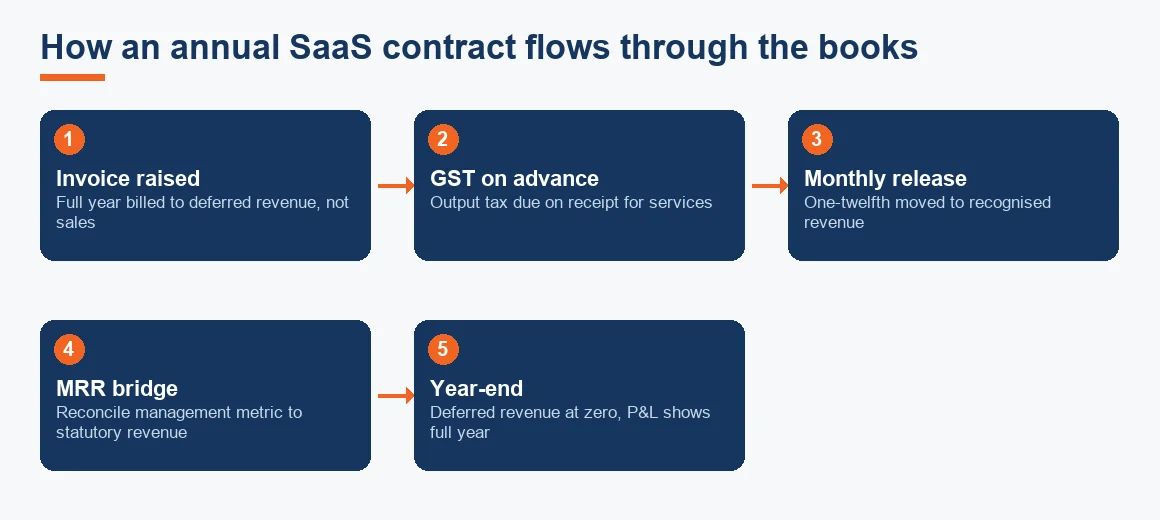
When a customer pays twelve months upfront, you have collected cash but not yet earned it. Under Ind AS 115, an annual subscription is a single performance obligation satisfied over time, so the billed amount is parked as a contract liability (deferred revenue) and released evenly across the subscription period. Only the portion of service actually delivered in a month reaches the profit and loss account. Onboarding or implementation fees that transfer no distinct service are not recognised upfront either; they are deferred over the expected customer life. This is the discipline that separates a fundable set of accounts from a cash-basis spreadsheet, and it is the core of proper SaaS Accounting Services (IT & SaaS).
Is GST payable on a subscription advance?
Yes, and this trips up almost every early-stage SaaS team. For services, GST falls due when the advance is received, even though the revenue stays deferred in your books. You must issue a receipt voucher under section 31(3)(d) of the CGST Act and report the advance in the advances table of GSTR-1. The relief that lets you pay GST only at invoice, rather than on advances, was granted for goods alone, never for services. So an annual plan billed in April creates a GST liability in April, while the income trickles in month by month until March. The Central Board of Indirect Taxes and Customs sets this out on its portal at cbic-gst.gov.in.
Exporting SaaS from Gurugram: zero-rated supply, LUT and SOFTEX
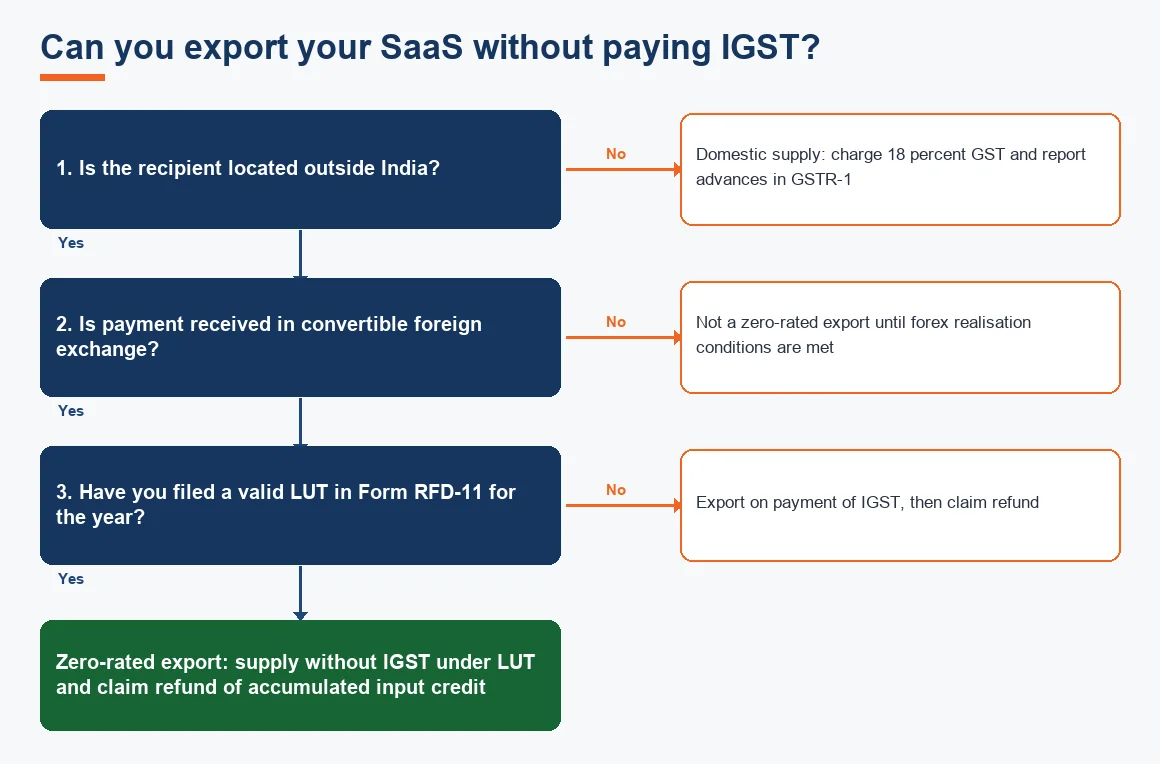
Most Cyber Hub product companies sell abroad, and export of services is a zero-rated supply under section 16 of the IGST Act where the recipient is outside India, payment is received in convertible foreign exchange, and supplier and recipient are not merely establishments of one person. File a letter of undertaking in Form RFD-11 at the start of each financial year to export without paying IGST, then claim refund of accumulated input credit. Foreign inflows are tracked as foreign currency receivables and revalued at period end.
On the export-documentation side, a software exporter registered with STPI files a monthly SOFTEX return so that invoice value is reconciled against foreign exchange realised. Note the transition: under FEMA 23(R)/2026-RB the SOFTEX regime stays operative only until 30 September 2026, after which a monthly Export Declaration Form (EDF) certified by your AD bank replaces it. If you claim a tax holiday from a notified SEZ unit, the Section 10AA SEZ export revenue rules add their own record-keeping. Whether your registered address sits in a DTA tower or an SEZ block changes the compliance path, which our note on Udyog Vihar SEZ vs DTA compliance unpacks. For the statutory framework on foreign exchange realisation, refer to the Reserve Bank of India at rbi.org.in.
MRR versus statutory revenue: the two numbers your board sees
Monthly recurring revenue annualises committed subscription value at a point in time. Statutory revenue under Ind AS 115 recognises only the service actually delivered in the period. They are not the same figure, and both are legitimate: one steers the business, the other is audited. MRR excludes one-off implementation fees, usage overages and taxes, all of which do appear in the profit and loss account. The discipline is to reconcile them every month so the investor deck and the signed accounts tell the same story.
| Item | MRR (management metric) | Statutory revenue (Ind AS 115) |
|---|---|---|
| Annual contract billed upfront | Counted at monthly committed value | Released one-twelfth per month |
| One-off implementation fee | Excluded | Deferred over customer life, then recognised |
| Usage overage / add-ons | Excluded | Recognised when the service is delivered |
| GST and taxes | Excluded | Not revenue; a separate liability |
| Purpose | Growth and runway tracking | Audited profit and loss account |
ESOP accounting: the charge that is real but never leaves the bank
Share options create a genuine expense. The share-based payment cost is charged to the profit and loss account over the vesting period, measured at grant date fair value under Ind AS 102, or under the ICAI Guidance Note on Accounting for Employee Share-based Payments for companies still on the older AS framework. The charge is non-cash: it is credited to a share options outstanding account within other equity, so it depresses reported profit without touching cash. Spreading the cost as employees earn it is a graded vesting amortisation question, and getting it wrong understates losses that every investor will re-compute. The ICAI guidance is published at icai.org. For the broader founder view, our Startup Accounting Services India and IT & Software Company Accounting Services pages cover the full stack.
Month-end close for a Cyber Hub SaaS company: step by step
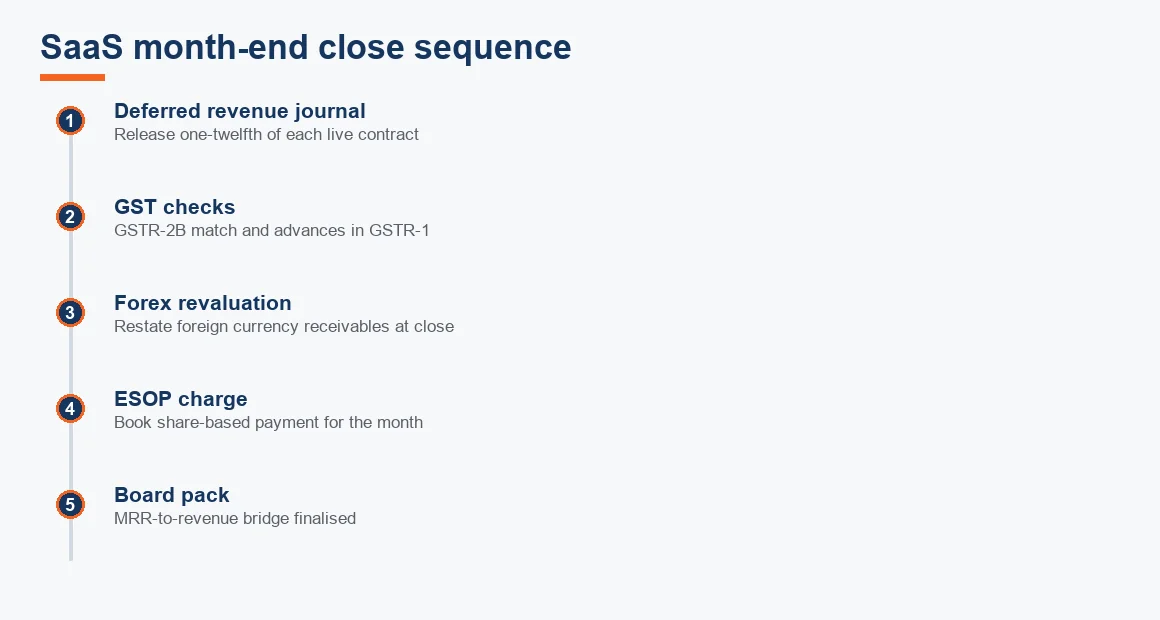
A repeatable close is what makes deferred revenue, GST and ESOP hang together each month. A practical sequence:
- Post the monthly deferred revenue release journal (one-twelfth of each live annual contract).
- Reconcile MRR from the billing system to recognised revenue and document the bridge.
- Match input credit against GSTR-2B and confirm advances reported in GSTR-1 carry receipt vouchers.
- Revalue foreign currency receivables at the closing rate and record the exchange difference.
- Book the ESOP charge for the month against the share options outstanding account.
- Review the deferred revenue schedule for churned or upgraded customers and adjust the release.
The same rhythm underpins a founder's finance function, which our Virtual CFO & Financial-Ops Checklist for Gurugram Startups lays out in operational detail.
Worked example: releasing an annual contract and its GST
Suppose a Cyber Hub SaaS company signs a domestic customer on 1 April for an annual plan of INR 12,00,000 (indicative, Exl GST), billed upfront. Revenue is released at INR 1,00,000 a month, while GST at 18 percent, INR 2,16,000, falls due in April on receipt of the advance. The schedule below shows the mismatch that every SaaS balance sheet must carry.
| Month | Revenue recognised (P&L) | Deferred revenue (closing) | GST position |
|---|---|---|---|
| April (billing) | 1,00,000 | 11,00,000 | 2,16,000 payable on advance |
| May | 1,00,000 | 10,00,000 | Already discharged |
| June | 1,00,000 | 9,00,000 | Already discharged |
| ... months 4 to 11 | 1,00,000 each | steps down by 1,00,000 | Already discharged |
| March (final) | 1,00,000 | 0 | Fully accounted |
| Full year | 12,00,000 | 0 | 2,16,000 paid in April |
The lesson: cash and GST are front-loaded to April, revenue is spread to March, and the deferred revenue line is what reconciles the two. An export contract would instead be zero-rated, with no output GST but a SOFTEX or LUT trail. You can pressure-test the standard that applies with the Ind AS Applicability Checker and model the timing difference in the Deferred Tax (DTA/DTL) Calculator.
The Gurugram angle: Haryana payroll and where your office sits
Two local facts shape a Gurugram SaaS company's books. First, Haryana levies no professional tax, so the payroll deduction stack is lighter than in Maharashtra or Karnataka; employer obligations run through the Shops Act, labour welfare fund and PF/ESI instead, as our note on Haryana compliance for employers sets out. Second, your registered address matters: a unit in an SEZ block such as parts of Udyog Vihar follows a different GST and export path from a plain DTA tower in Cyber Hub. Getting the entity structure and address on record correctly at incorporation saves painful refund delays later. If you are still comparing providers and budgets, our guide on the cost of outsourced accounting and Virtual CFO in Gurugram and on how to choose an accountant in Gurugram are the sensible next reads, alongside the broader Accounting & Bookkeeping Services in Gurugram and Startup Accounting Services in Gurugram pages. Product companies with a marketplace or reseller motion may also want our E-Commerce Accounting Services.
Key terms
- Deferred Revenue (Unearned Revenue): cash billed but not yet earned, held as a contract liability until the service is delivered.
- Ind AS 115 Revenue Recognition: the standard that recognises subscription income over the period the service is provided.
- Monthly Recurring Revenue (MRR): a management metric annualising committed subscription value, distinct from audited revenue.
- Ind AS 102 Share-based Payment: the standard that charges ESOP cost to the P&L over the vesting period at grant date fair value.
- STPI / SOFTEX Export Filing: the monthly reconciliation of software export invoices against foreign exchange realised.
Key takeaways
- Release annual subscriptions one-twelfth per month under Ind AS 115; never book a full year of cash as a full year of profit.
- GST on service advances is due on receipt, backed by a receipt voucher and the GSTR-1 advances table.
- Export SaaS is zero-rated: keep an LUT (RFD-11) live and a SOFTEX trail until the EDF regime takes over on 1 October 2026.
- Reconcile MRR to statutory revenue monthly so board and audited numbers agree.
- ESOP cost is a real non-cash charge spread over vesting; Gurugram's Haryana location means no professional tax.
This is an informational explainer. For a scoped engagement, the commercial keyword and pricing sit on our SaaS Accounting Services (IT & SaaS) Gurugram page.
Decision guide