In this guide
Fund accounting for an NGO is a method that divides the organisation's books into separate, self-balancing pools of money called funds, each governed by the condition the donor attached to it. Instead of one combined cash position, the trust tracks a general fund, one or more restricted project funds and often a corpus fund, so that when a grant-maker asks for a utilisation certificate the figures reconcile line by line. This explainer walks through the method, the fund types, the accounting basis and a worked example, and it stays informational: if you want a team to run the books, that sits with our NGO & Non-Profit Accounting service.
What is fund accounting in nonprofits?
In a company, all income belongs to the shareholders and can, in principle, be spent on anything the board approves. A charitable trust does not work that way. A donor who gives money for a girls' education programme in one district has effectively ring-fenced that money, and the trust holds it in a fiduciary capacity. Fund-based accounting captures that reality by treating each purpose as its own accounting entity within the same set of books, with its own income, its own expenditure and its own balance carried forward.
The unit of control is the fund, not the bank account. Two grants can share a single bank account and still be kept apart in the ledger through fund tagging; equally, a designated FCRA account holds foreign money that can never mix with domestic funds. The point is accountability by purpose, so that the answer to "where did the education grant go" is always available without unpicking the whole trial balance.
What are the basic principles of fund accounting?
Three principles hold the method together. First, every fund is self-balancing: its receipts, payments, assets and liabilities net to a fund balance that appears on the balance sheet. Second, money moves between funds only by an explicit inter-fund transfer, never quietly through the income and expenditure account, and a restricted fund can be tapped only with written donor consent. Third, the classification of a receipt is fixed by the donor's direction at the point of receipt, not by what the trust would prefer later.
Restricted vs unrestricted funds
The first cut every NGO makes is between money it can spend freely and money it cannot. An unrestricted, or general, fund carries no donor condition beyond the trust's charitable objects, so it pays for core costs, salaries and anything the trustees sanction. A restricted fund is earmarked by the donor for a stated project, geography or period, and spending outside that scope breaches the grant. Sitting apart from both is the corpus fund, a permanent capital pool where only the income earned may be applied while the capital itself is preserved.
| Feature | Unrestricted (general) fund | Restricted (project) fund | Corpus fund |
|---|---|---|---|
| Donor condition | None beyond charitable objects | Specific project, area or period | Written direction to form capital |
| Can the principal be spent | Yes | Yes, within the stated purpose | No, only income earned on it |
| Unspent balance at year end | Retained as general fund | Carried forward or refunded per agreement | Always preserved |
| Income tax note | Counts towards the 85% application test | Application when spent on objects | Exempt under Section 11(1)(d) if invested per Section 11(5) |
What are the three types of funds?
Most Indian NGOs map their world onto three fund families. The general fund absorbs untied donations, membership fees and interest that carries no string. Restricted or project funds hold each earmarked grant, often one per donor agreement so that reporting mirrors the contract. The corpus or endowment fund holds capital contributions the donor has directed be kept intact. A larger organisation may add designated funds, which are general funds the trustees themselves have set aside for a plan; these look restricted but the board can un-designate them, because the restriction is internal rather than donor-imposed.
The same instinct to tag every rupee to a purpose appears in other sectors we cover, from startup accounting to SaaS accounting and IT and software company accounting, but the donor-restriction and exemption rules described here are specific to the charitable sector.
Which accounting method and basis do nonprofits use?
Fund accounting is a layer on top of ordinary double-entry bookkeeping, not a replacement for it. Every transaction still has a debit and a credit; the fund dimension simply says which pool it belongs to. On the question of basis, the ICAI Technical Guide on accounting and auditing of not-for-profit organisations recommends the accrual basis, because it matches grant income to the period of expenditure and surfaces commitments a pure cash view would hide. Many small trusts still keep cash books, but grant funders and the audit forms increasingly expect accruals.
How is fund accounting done, step by step?
The mechanics are straightforward once the fund structure is in place.
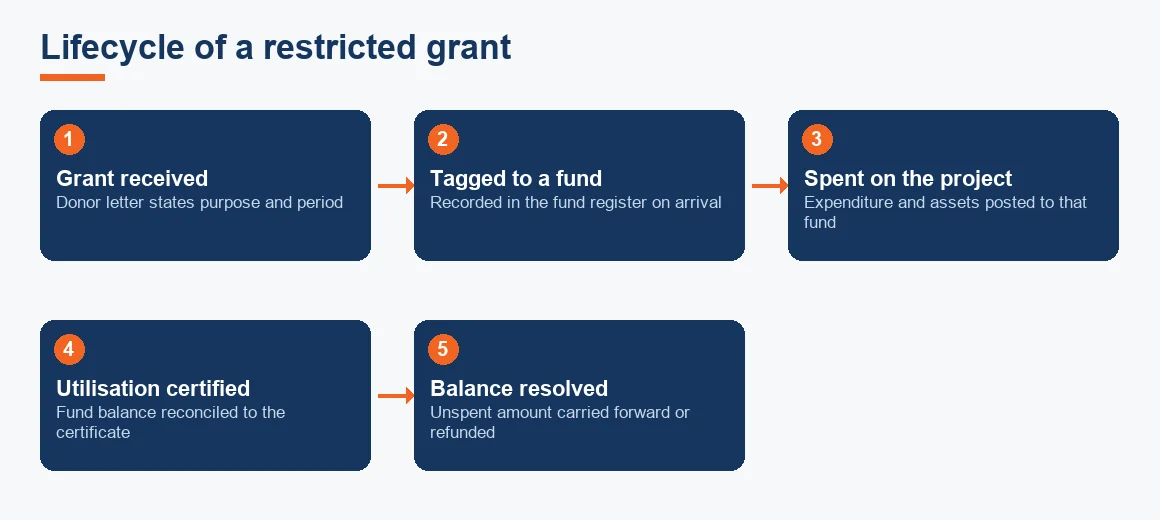
- Set up the fund register. List every fund with its donor, purpose, permitted period and opening balance.
- Tag receipts on arrival. Classify each donation or grant to a fund the moment it is banked, using the donor letter or agreement as the source.
- Post expenditure to the right fund. Every payment carries both an expense ledger and a fund code, so programme salaries hit the project fund, not the general fund.
- Capitalise assets within the fund. An asset bought from a restricted grant is recorded in the fixed asset register and mirrored inside that fund, so the fund balance holds the written-down value.
- Charge depreciation to the fund. Depreciation on that asset is charged against the same restricted fund each year, not the general fund.
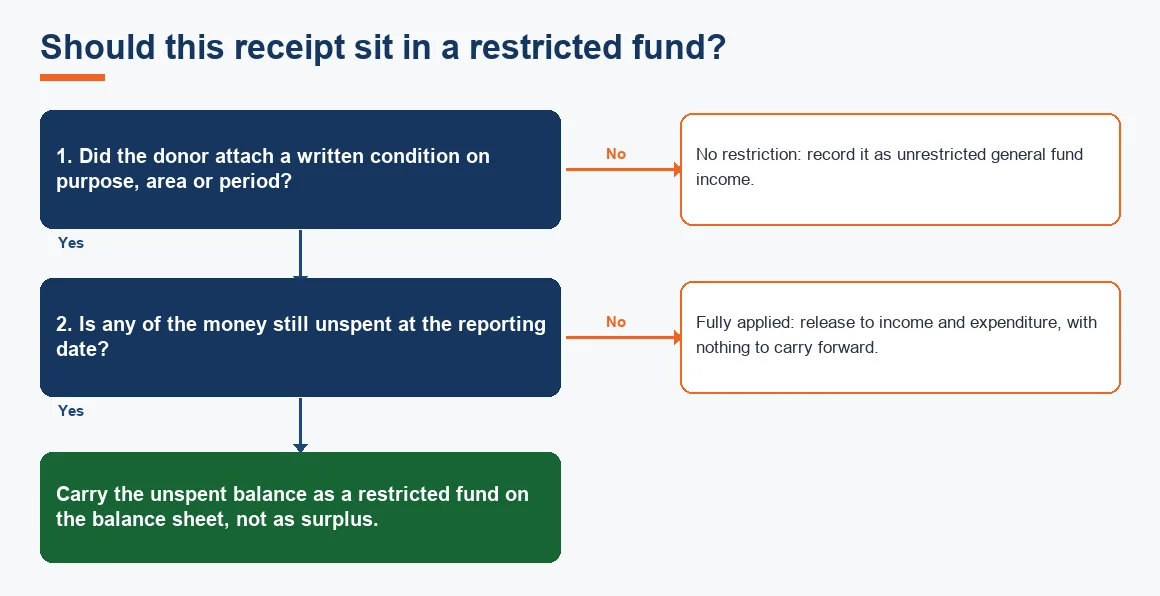
- Carry forward unspent balances. At year end, any unspent restricted money stays on the balance sheet as a fund, ready for a utilisation certificate.
What are the four basic financial statements for a nonprofit?
An Indian NGO typically presents a Receipts and Payments Account, which is a pure cash summary; an Income and Expenditure Account, which is the accrual equivalent of a profit and loss statement and shows the surplus or deficit by fund; and a Balance Sheet that lists each fund balance on the liabilities side against assets held. These three are supported by notes to accounts and, for larger bodies, a cash flow statement, giving the four-part picture that donors and auditors expect. The critical difference from a company is that the balance sheet does not carry share capital and reserves; it carries fund balances, one line per fund.
The income tax overlay: corpus, application and Form 10
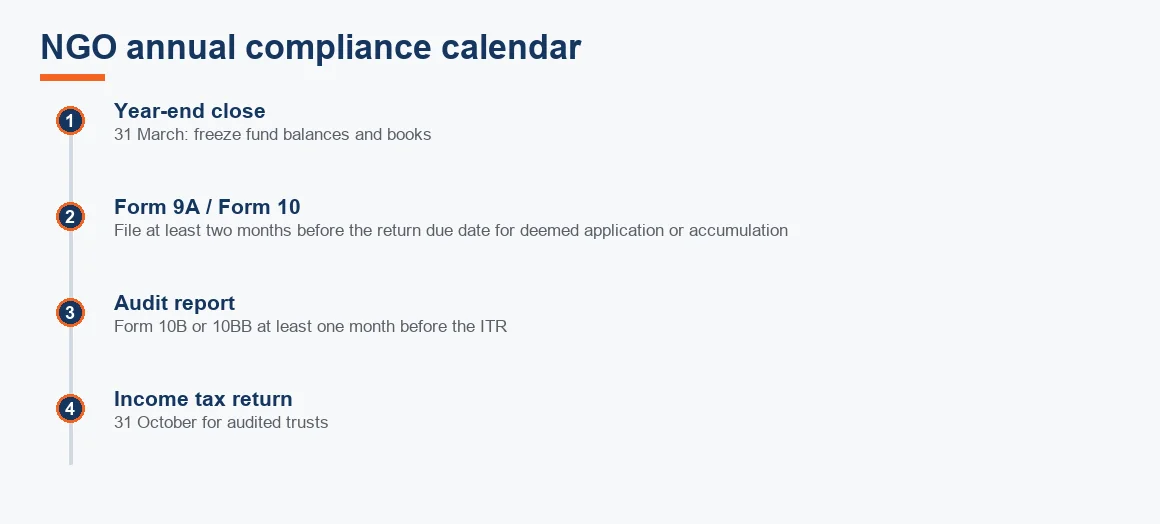
Fund classification is not just good housekeeping; it drives the exemption a registered trust claims under Sections 11 to 13 of the Income Tax Act. A corpus donation with a written direction is exempt under Section 11(1)(d), provided the money is invested in the modes listed in Section 11(5). For ordinary income, the trust must apply at least 85 per cent to its objects in the year, an obligation set out in the 85% income application rule. It may retain up to 15 per cent freely; to hold back more than that for a future project, it files Form 10 and earmarks the accumulation, at least two months before the return due date. A restricted grant spent on the trust's objects counts as application in the year it is spent.
Two traps deserve a flag. First, an asset bought from a grant is treated as application in the year of purchase, so depreciation on that same asset cannot be claimed again under Section 11(6). Second, the audit report on Form 10B or Form 10BB has to reach the department at least a month before the income tax return, which for audited trusts falls on 31 October; our sibling explainers on Form 10B versus 10BB and the annual 12A and 80G compliance checklist cover which form and which dates apply to you. Foreign money adds a further layer, handled in our note on FCRA compliance and the designated account. The primary sources are worth bookmarking: the Income Tax Department for Sections 11 to 13 and the audit forms, and the ICAI Technical Guide for the accounting treatment.
Worked example: allocating a restricted education grant
Suppose the trust receives a Rs 20,00,000 grant for a one-year education programme. During the year it spends Rs 14,00,000 on programme costs and buys a Rs 3,00,000 computer lab, leaving Rs 3,00,000 unspent. The fund movement, kept entirely within the restricted fund, looks like this.
| Movement in the education fund | Amount (Rs) |
|---|---|
| Opening restricted fund balance | 0 |
| Add: grant received | 20,00,000 |
| Less: programme expenditure applied to objects | (14,00,000) |
| Less: capital asset (computer lab) capitalised within the fund | (3,00,000) |
| Closing unspent restricted fund balance (carried forward) | 3,00,000 |
The Rs 3,00,000 unspent sits on the balance sheet as a restricted fund, not as surplus. The Rs 3,00,000 asset stays in the fixed asset register with a matching Rs 3,00,000 held inside the fund, and next year's depreciation is charged against this fund. For income tax, the full Rs 17,00,000 of spending (programme plus asset) is application of income in the year. You can size the yearly depreciation on the lab with our depreciation calculator.
Key terms
- Fund-Based Accounting: keeping separate self-balancing funds so each donor purpose is tracked on its own.
- Restricted Corpus Donations: capital gifts with a written direction to preserve the principal and spend only the income.
- 85% Income Application Rule: the Section 11 requirement to apply at least 85 per cent of income to charitable objects each year.
- Section 12A / 80G Annual Upkeep: the ongoing filings that keep a trust's registration and donor deduction alive.
- FCRA Designated Bank Account: the single SBI New Delhi account through which all foreign contributions must first arrive.
Key takeaways
- The fund, not the bank account, is the unit of control; tag every receipt to a purpose on arrival.
- Restricted and corpus funds carry conditions you cannot override without written donor consent.
- Unspent restricted grants are carried forward as a fund on the balance sheet, never as surplus.
- Use the accrual basis and the Receipts and Payments, Income and Expenditure and Balance Sheet trio, plus notes.
- Classification feeds the tax exemption: corpus under Section 11(1)(d), the 85 per cent test, and Form 10 for extra accumulation.
Decision guide