
In this guide
FCRA compliance for an NGO means accepting foreign contribution only after registration or prior permission from the Ministry of Home Affairs, routing every rupee through one designated bank account, keeping administrative spending within the 20% cap and filing the annual return in Form FC-4 by 31 December. It applies to any trust, society or Section 8 company that receives money or goods from a foreign source, and the rules are enforced strictly. This explainer walks through the Act, the registration routes, the designated account, the spending cap and the reporting calendar so your books are ready before a return falls due. For the commercial side of the work, our NGO & Non-Profit Accounting team handles the filings; here we focus on how the compliance actually works.
What is the FCRA Act for NGOs?
FCRA is the Foreign Contribution (Regulation) Act 2010, read with the Foreign Contribution (Regulation) Rules 2011. It regulates how a not-for-profit in India accepts and uses funds from foreign sources, so that foreign money does not influence activity against the national interest. A foreign source includes an overseas company, a foreign citizen, a foreign trust or a multilateral body. Even a donation in Indian rupees is foreign contribution if it originates from a foreign source, so the currency on the receipt does not settle the question.
FCRA sits alongside, and does not replace, your income tax registrations. An NGO still needs its 12A and 80G registrations with the Income Tax Department to stay exempt and to give donors a deduction, and a Section 8 company still answers to the Ministry of Corporate Affairs. FCRA is the extra layer that switches on the moment foreign money is involved. Our note on 12A and 80G compliance upkeep covers that parallel exemption track.
Is FCRA mandatory, and can an NGO receive foreign funds without it?
Yes, FCRA is mandatory for foreign contribution. An NGO cannot accept even a single foreign donation without either FCRA registration or prior permission. Accepting funds without one of the two exposes the trustees to penalty and to confiscation of the amount received. The only carve-outs are narrow: a personal gift up to a market value of Rs 1,00,000, and money received from a relative abroad, which sits under a separate intimation rule rather than under registration.
Rule 6 of the 2011 Rules covers that relative route. Where an individual receives more than Rs 10,00,000 in a financial year as foreign contribution from a relative living abroad, they must intimate the Central Government in Form FC-1 within three months. This is a personal reporting duty and does not let an organisation take foreign money without registration.
Who is prohibited from receiving foreign contribution?
Section 3 of the Act bars several categories outright, including election candidates, sitting judges, government servants, members of any legislature, and journalists or media organisations. A registered NGO that engages in these prohibited fields, or that is found to be of a political nature, can be refused or have its certificate cancelled.
FCRA registration versus prior permission
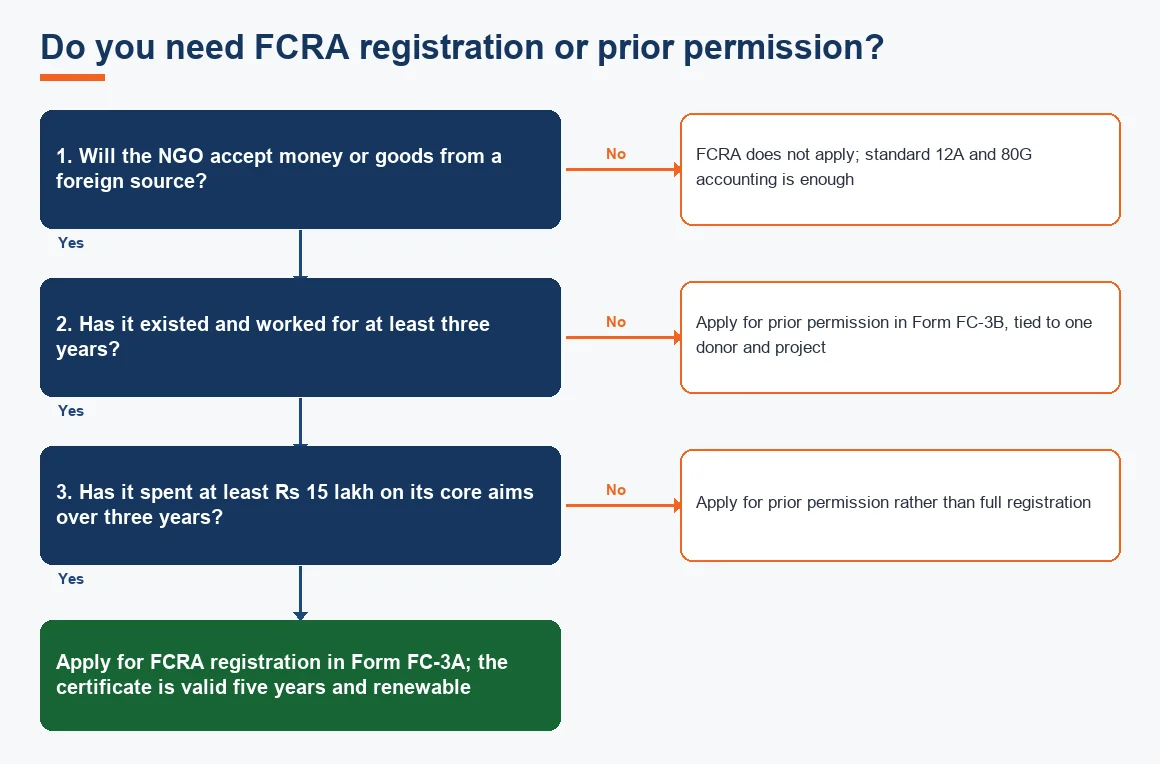
There are two doors into FCRA, and the right one depends on the age and track record of the organisation. Registration suits an established body; prior permission suits a newer one that has a committed foreign donor and a defined project.
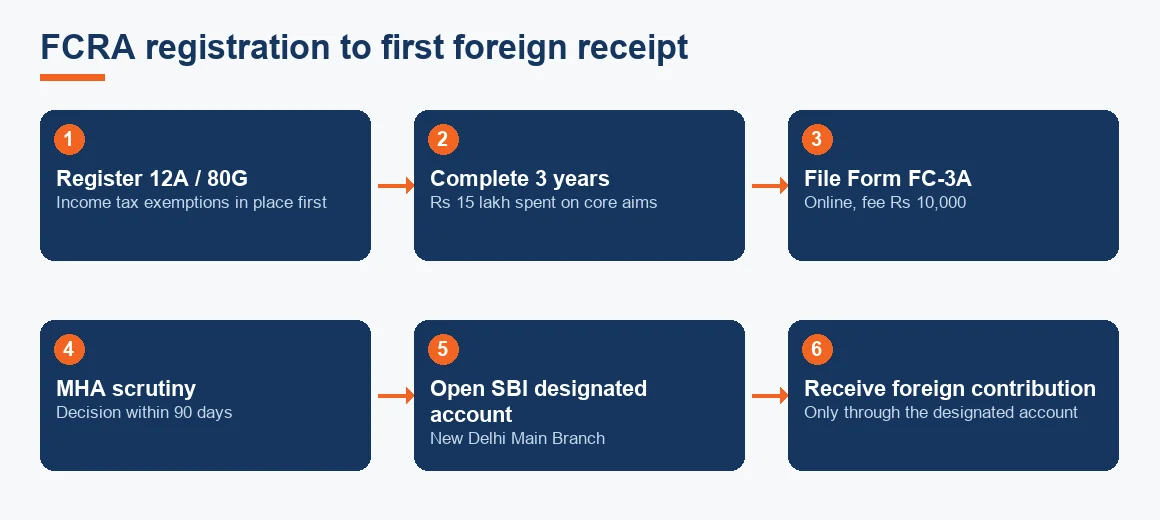
Full registration requires that the organisation has existed and worked for at least three years and has spent at least Rs 15,00,000 on its core aims over those three years, excluding administrative cost. The application is made online in Form FC-3A with a fee of Rs 10,000, and the Ministry is required to decide within 90 days of a complete application. A certificate, once granted, is valid for five years, and renewal must be filed within six months of expiry or the registration lapses.
Prior permission is the route for an organisation that cannot yet meet the three year and Rs 15 lakh conditions. It is applied for in Form FC-3B, is tied to one named foreign donor and one specific project, and permits only the amount committed for that project. The table below sets the two side by side.
| Feature | FCRA registration (FC-3A) | Prior permission (FC-3B) |
|---|---|---|
| Who it suits | Established NGO, 3+ years old | Newer NGO with a committed donor |
| Eligibility test | 3 years' work and Rs 15 lakh core spend | Named donor and defined project |
| Scope of funds | Foreign contribution generally | Only the committed project amount |
| Validity | Five years, renewable | Until the project is completed |
| Government fee | Rs 10,000 (indicative, Exl GST) | Rs 5,000 (indicative, Exl GST) |
The designated FCRA bank account and utilisation accounts
Since the 2020 amendment, all foreign contribution must first land in a single designated FCRA account opened at the State Bank of India, New Delhi Main Branch. This is a central requirement and there is no exception for location: an NGO in Chennai or Guwahati still opens and operates that Delhi account, usually remotely. The receiving bank reports the inward remittance so the flow is visible to the government, and separately the credit is captured in the country's foreign inward remittance reporting overseen by the Reserve Bank of India.
Once money is in the designated account, the NGO may move it into one or more utilisation accounts at any scheduled bank to actually spend it. What is forbidden is mixing: domestic donations must never enter the FCRA accounts, and foreign contribution must never be parked in a local account. Keeping the two streams in separate ledgers is the practical heart of fund-based accounting, and our guide on restricted versus unrestricted funds shows how to structure the chart of accounts for it.
The 20% administrative expenses cap under Rule 5
Administrative expenses met out of foreign contribution cannot exceed 20% of the foreign contribution received in a financial year. This was cut from 50% by the 2020 amendment, so older working papers that assume half are now wrong. Rule 5 lists what counts as administrative: salaries of management and office staff, travel of office bearers, rent, telephone and postage, legal and audit fees, and general office running cost.
Crucially, salaries of staff working directly on a programme are not administrative and sit outside the cap. That single distinction is why timesheets matter: a field coordinator's pay is programme cost, while the same person's time spent on office administration is capped cost. Good segregation of duties and clean cost allocation keep you comfortably under 20%. If you also run Ind AS financial statements, the Ind AS applicability checker helps confirm which reporting standard applies before you draw up the accounts.
FCRA compliance checklist and documents required
A working FCRA checklist has both one-time and recurring parts. The documents needed for the FC-3A application are the ones assessors ask for most often.
- Registered trust deed, society memorandum or Section 8 incorporation certificate.
- Three years of audited accounts and the activity report for the same period.
- Details of the designated SBI New Delhi Main Branch account.
- Aadhaar of every office bearer and the chief functionary.
- A darpan ID from the NITI Aayog portal.
The recurring duties, once registered, are the ones a finance team lives with month to month:
- Route every foreign receipt through the designated account only.
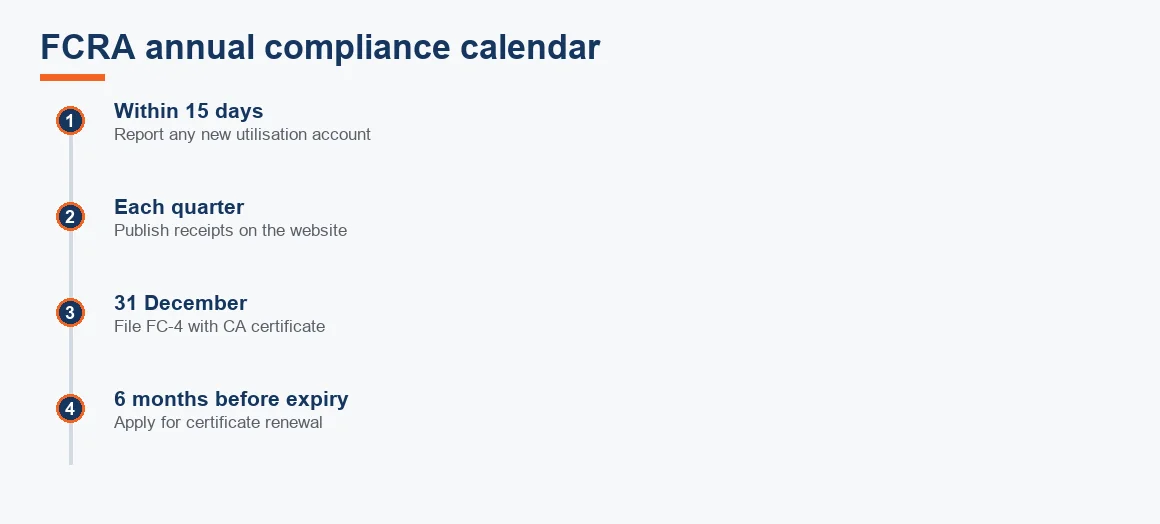
- Report any new utilisation account to the Ministry within fifteen days of opening it.
- Keep administrative spend under the 20% cap through the year.
- Publish quarterly receipts on the organisation's website.
- File the annual FC-4 return, with a chartered accountant's certificate, by 31 December.
Annual and quarterly FCRA reporting
The annual return, Form FC-4, is due by 31 December for the financial year ended the previous 31 March. It is filed online with a chartered accountant's certificate and the designated account statement attached. A nil return is compulsory even in a year with no foreign contribution, so silence is not an option. Late filing attracts a penalty of Rs 1,00,000 or 5% of the foreign contribution received, whichever is higher.
Alongside the annual return, an NGO must place its quarterly foreign contribution receipts on its own website within fifteen days of the quarter ending. The compliance calendar below sets out the rhythm across a year.
Worked example: testing the 20% administrative cap
Suppose an NGO receives Rs 50,00,000 of foreign contribution in a financial year and wants to check its administrative spend against the 20% ceiling. The cap is 20% of receipts, so Rs 10,00,000. The worksheet below sorts the year's foreign-funded costs into administrative and programme buckets, using Rule 5.
| Cost head | Amount (INR) | Classification |
|---|---|---|
| Foreign contribution received | 50,00,000 | Basis for cap |
| 20% administrative ceiling | 10,00,000 | Limit |
| Management and office salaries | 4,20,000 | Administrative |
| Office rent, telephone, postage | 2,10,000 | Administrative |
| Legal and audit fees | 1,50,000 | Administrative |
| Field programme staff salaries | 18,00,000 | Programme (excluded) |
| Total administrative spend | 7,80,000 | Within limit |
| Headroom to the 20% cap | 2,20,000 | Compliant |
Administrative spend of Rs 7,80,000 is 15.6% of receipts, comfortably under the Rs 10,00,000 ceiling, leaving Rs 2,20,000 of headroom. Had the field staff salaries been misclassified as administrative, the total would have breached the cap on paper, which is exactly why the programme-versus-admin split has to be documented as it happens.
Key terms
- FCRA Designated Bank Account: the single SBI New Delhi Main Branch account through which all foreign contribution must first be received.
- Fund-Based Accounting: tracking money by the fund it belongs to, keeping foreign and domestic streams separate.
- Restricted Corpus Donations: gifts a donor ties to a stated purpose, which cannot be spent elsewhere.
- Section 12A / 80G Annual Upkeep: the income tax registrations an NGO must keep current to stay exempt.
- 85% Income Application Rule: the income tax test requiring a trust to apply 85% of its income to its objects.
Where FCRA meets the wider trust accounts
FCRA compliance does not stand alone. The same foreign-funded activity flows into the trust's income tax position under the Section 10(23C) exemption rules, and the audit report you file depends on the size of the body, a choice our note on Form 10B versus 10BB unpacks. A grant-funded venture that behaves like an early-stage organisation still needs the same discipline. Sound financial internal controls tie these threads together, so that one clean set of records satisfies FCRA, the income tax exemption and the statutory audit at once.
Key takeaways
- FCRA is mandatory before any foreign contribution; there is no informal route.
- All foreign money must first enter the single SBI New Delhi Main Branch designated account.
- Administrative expenses are capped at 20% of foreign receipts, with programme staff pay excluded.
- File FC-4 by 31 December, a nil return included, or face a penalty of Rs 1,00,000 or 5%.
- Renew the five year certificate within six months of expiry to avoid a frozen account.
Decision guide