
In this guide
Keeping 12A and 80G compliance in order is less about the one-time registration and more about a handful of dated filings that repeat every financial year. A trust or society that has secured both approvals still has to file its income tax return on time, get its accounts audited, report every donation it receives and apply enough of its income to charity. Miss any of these and the exemption that makes the registration worth holding can lapse, sometimes for the whole year. This guide sets out the annual checklist, the deadlines that drive it and the practical points that trip up most non-profit finance teams.
What is the difference between 12A and 80G?
The two approvals do different jobs and are often confused. Registration under section 12A (granted today as 12AB) exempts the trust's own income from tax, provided it is applied to charitable purposes. Registration under section 80G is about the donor: it lets an individual or company that gives to the institution claim a deduction in their own return. A trust can hold 12A without 80G, but it cannot hold 80G without first being registered under 12A, because 80G approval assumes the entity is already a recognised charitable body. In practice most NGOs apply for both together. Patron's NGO and non-profit accounting desk sees the sharpest problems where a trust treats the two as one certificate and forgets that each carries its own renewal clock.
12A, 12AB and time-bound registration
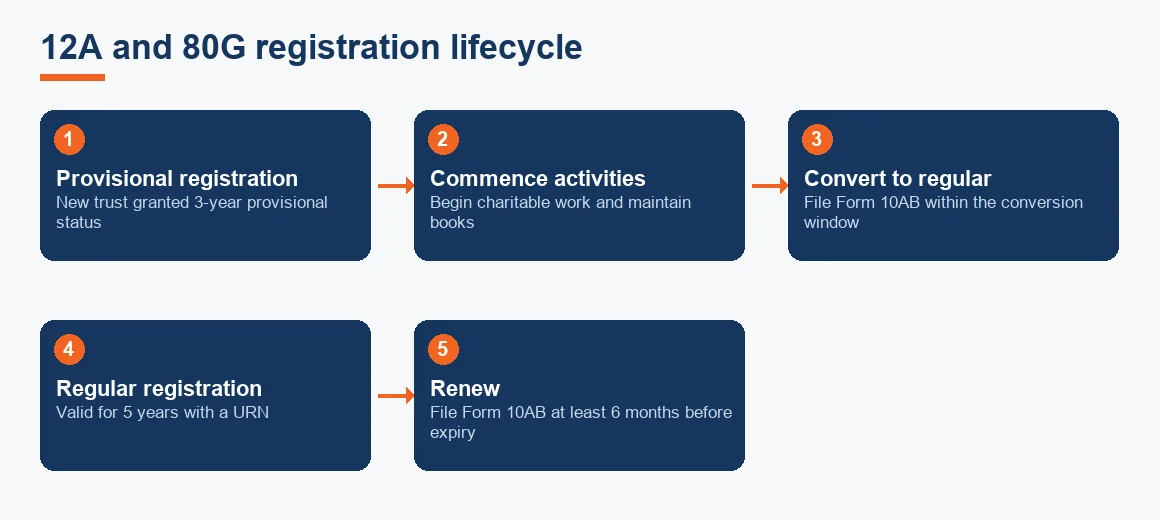
Older 12A certificates were granted in perpetuity. The Finance Act 2020 replaced that with section 12AB, under which every registration is now time-bound and has to be periodically renewed. Existing trusts were required to re-register, and the department issues the approval order in Form 10AC or Form 10AD carrying a Unique Registration Number (URN). That URN is the number donors, CSR funders and FCRA authorities ask for, so keep the downloaded order safe. The move to 12AB did not change what charitable work qualifies; it changed the fact that registration is no longer a permanent status you can file away and forget.
Validity periods and renewal windows
A regular 12AB or 80G registration runs for five years. A provisional registration, granted to a newly formed trust that has not yet begun activities, runs for three years. Renewal or conversion is done by filing Form 10AB, and the timing is strict.
| Registration type | Validity | Renewal form | Deadline to file |
|---|---|---|---|
| Provisional (new trust) | 3 years | Form 10AB | Within 6 months of commencing activities, or 6 months before expiry, whichever is earlier |
| Regular 12AB | 5 years | Form 10AB | At least 6 months before expiry |
| Regular 80G | 5 years | Form 10AB | At least 6 months before expiry |
Miss the window and there is no soft option: the trust reapplies as a fresh applicant and loses the continuity of its existing number. Diarise the expiry date the day the order is issued.
The annual 12A and 80G compliance checklist
Once both registrations are live, the yearly upkeep follows a predictable sequence. Work through it in this order each financial year.
- Maintain proper books. Keep receipts, payments and a donor register through the year so nothing has to be reconstructed at audit. A disciplined fund-based accounting approach on an accrual basis that separates restricted from unrestricted money is the backbone here.
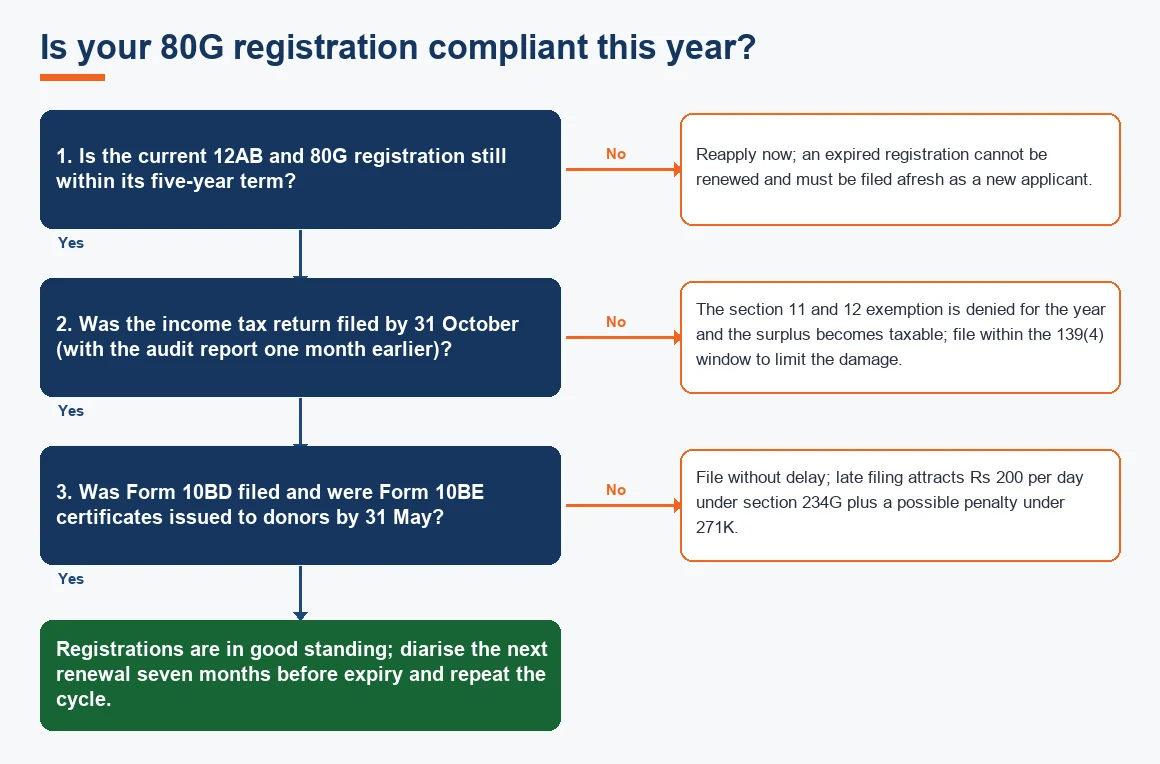
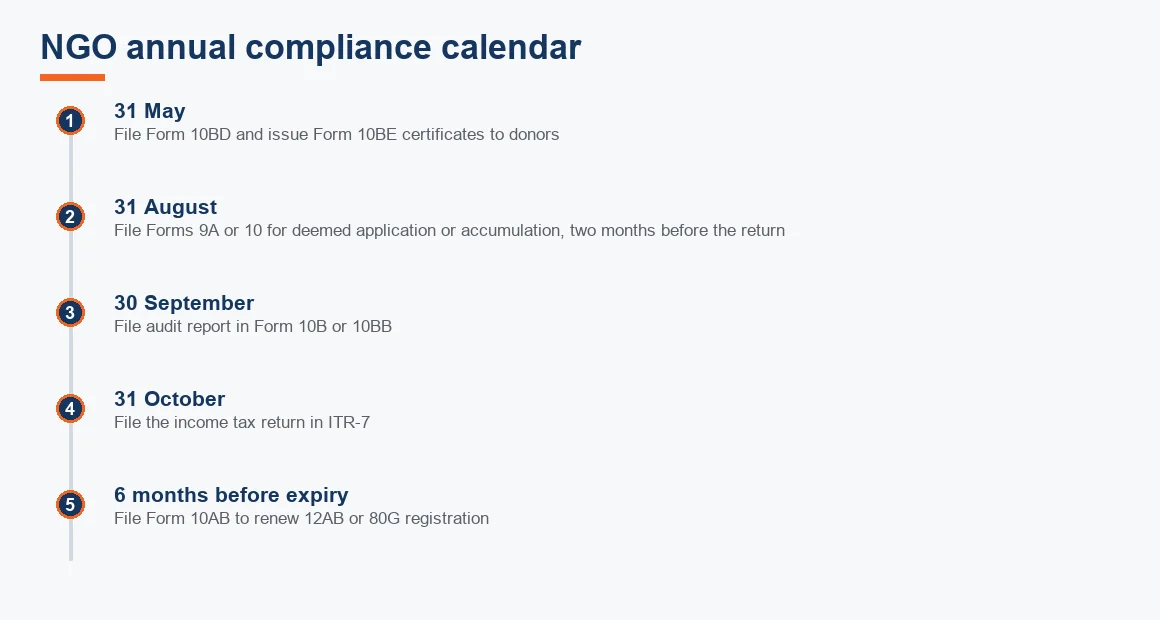
- Get the accounts audited. A registered trust with income above the basic exemption limit must have its accounts audited and file the report in Form 10B or Form 10BB. This is due one month before the return, that is by 30 September. Our sibling guide on Form 10B versus 10BB explains which report your trust files.
- File the income tax return. The return in ITR-7 is due by 31 October where the accounts are audited. Timely filing is a condition of exemption under section 12A(1)(ba), so this date is non-negotiable.
- File the donation statement. Every 80G institution files Form 10BD by 31 May reporting each donation, then issues Form 10BE certificates to donors.
- Deal with any income shortfall. If less than 85 per cent of income was applied, file Form 9A or Form 10 before the deadline (covered below).
The section 12A and 80G annual upkeep is really just these five items, repeated. What varies is the trust's own facts: foreign contributions, accumulation of income or a change in objects each add a filing on top.
Form 10BD and 10BE: reporting donations
Form 10BD is the annual statement of donations. It captures each donor's PAN or Aadhaar, address, the donation amount and the mode (cash, cheque, electronic or in kind). The statement is due by 31 May following the financial year, and once filed the institution downloads Form 10BE certificates and issues them to donors by the same date. The donor needs that 10BE to substantiate the 80G claim in their return, so a late or missing certificate is not just the NGO's problem. Late filing of Form 10BD attracts a fee of Rs 200 per day under section 234G of the Income Tax Act, and a separate penalty under section 271K can run from Rs 10,000 to Rs 1,00,000. The department's own guidance on the filing sits on the Income Tax Department portal.
The 85 per cent application rule and Forms 9A and 10
To keep the section 11 exemption, at least 85 per cent of the trust's income has to be applied to charitable purposes in the same financial year. Where it cannot be, the shortfall does not have to be taxed immediately: the trust can file Form 9A to treat income as deemed to have been applied (typically because it was not received in time), or Form 10 to accumulate income for a specified purpose for up to five years. Both forms are due two months before the income tax return due date. This is the mechanism the 85 per cent income application rule relies on, and it is easy to overlook because the deadline sits earlier than the return itself. Corpus and grant money that arrives with donor conditions is tracked as restricted corpus donations and follows its own rules on application.
80G deduction limit: is it 50 per cent or 100 per cent?
The 80G deduction limit confuses donors more than NGOs. For an ordinary institution registered under section 80G(5), the donor gets a deduction of 50 per cent of the amount given, and that donation is itself capped at a qualifying limit of 10 per cent of the donor's adjusted gross total income. A small set of government funds, such as the National Defence Fund or the Prime Minister's National Relief Fund, carry 100 per cent deduction and some without any qualifying limit, but a typical charitable trust does not fall in that category. Two practical points to pass on to donors: a cash donation above Rs 2,000 does not qualify at all, so give by bank transfer or cheque, and the deduction is available only under the old tax regime, not the new default regime. The statutory list of approved funds is published on the Income Tax Department site.
How to check and download your 12A and 80G status
To confirm a registration is live, log in to the income tax e-filing portal with the trust PAN, go to e-File, Income Tax Forms, then View Filed Forms. Open the Form 10A or Form 10AB entry and download the order in Form 10AC or 10AD; it shows the URN and the validity period. Donors and grant agencies verifying an NGO can also check the URN against the exempted institutions list on the e-filing portal. If your trust also receives foreign funds, remember that FCRA is a separate regime with its own designated bank account rules, explained in our guide to FCRA compliance for NGOs.
Worked example: 80G deduction on a Rs 1,00,000 donation
Suppose an individual donor with an adjusted gross total income of Rs 12,00,000 gives Rs 1,00,000 by bank transfer to a trust registered under section 80G(5) (the 50 per cent, with qualifying limit category). The deduction is worked out in steps, not on the full donation.
| Step | Working | Amount (Rs) |
|---|---|---|
| Adjusted gross total income | Given | 12,00,000 |
| Qualifying limit (10% of AGTI) | 10% of 12,00,000 | 1,20,000 |
| Donation made | By bank transfer | 1,00,000 |
| Eligible donation (lower of donation or limit) | Lower of 1,00,000 and 1,20,000 | 1,00,000 |
| Deduction under 80G (50%) | 50% of 1,00,000 | 50,000 |
So the donor deducts Rs 50,000 from taxable income, not the full Rs 1,00,000. Had the donation been Rs 1,50,000, the eligible amount would cap at the Rs 1,20,000 qualifying limit and the deduction at Rs 60,000. Figures are illustrative and assume the old tax regime.
Common mistakes in 12A and 80G compliance
Most lapses are avoidable and repeat across trusts. Watch for these:
- Treating registration as permanent. The 12AB regime made every registration time-bound; a certificate issued in perpetuity years ago is no longer valid without re-registration.
- Filing the return late. A belated return protects the exemption only if filed within the section 139(4) window; miss even that and the whole surplus is taxable.
- Ignoring the 85 per cent test. Forgetting Forms 9A and 10 turns a timing difference into a tax bill.
- Weak donor records. Form 10BD needs a valid PAN for each donor; gaps mean the statement cannot be filed cleanly.
- Mixing funds. Restricted grants spent on general running costs breach donor conditions and distort the application calculation.
Key terms
- Section 12A / 80G Annual Upkeep: the recurring set of filings and records that keep both registrations alive year to year.
- 85% Income Application Rule: the requirement to apply at least 85 per cent of income to charitable purposes each year.
- Restricted Corpus Donations: donations given with a donor condition that they be held as corpus or used for a stated purpose.
- FCRA Designated Bank Account: the single SBI New Delhi account through which all foreign contributions must first be received.
- Section 10(23C) Exemption Rules: an alternative exemption route for certain educational and medical institutions.
The upkeep behind 12A and 80G is not complicated, but it is unforgiving on dates. A trust that runs a clean set of books through the year, tracked with the same discipline that a fund-based accounting system brings, will find the annual filings almost routine. Where it helps to see the numbers first, our depreciation calculator handles fixed-asset schedules that feed the income and expenditure statement. Patron's NGO and non-profit accounting team manages this cycle end to end, and runs similar sector desks for startups, IT companies and SaaS businesses where compliance calendars are just as tight.
Key takeaways
- 12A (12AB) exempts the trust; 80G rewards the donor. Both now run for five-year terms and must be renewed with Form 10AB at least six months before expiry.
- The core annual cycle is: audit report by 30 September, ITR-7 by 31 October, Form 10BD and 10BE by 31 May, and Forms 9A or 10 two months before the return where income is under-applied.
- Filing the return late denies the section 11 and 12 exemption for the whole year, making the surplus taxable.
- The 80G deduction is usually 50 per cent, capped at 10 per cent of the donor's adjusted gross total income, and cash gifts above Rs 2,000 do not qualify.
Decision guide