In this guide
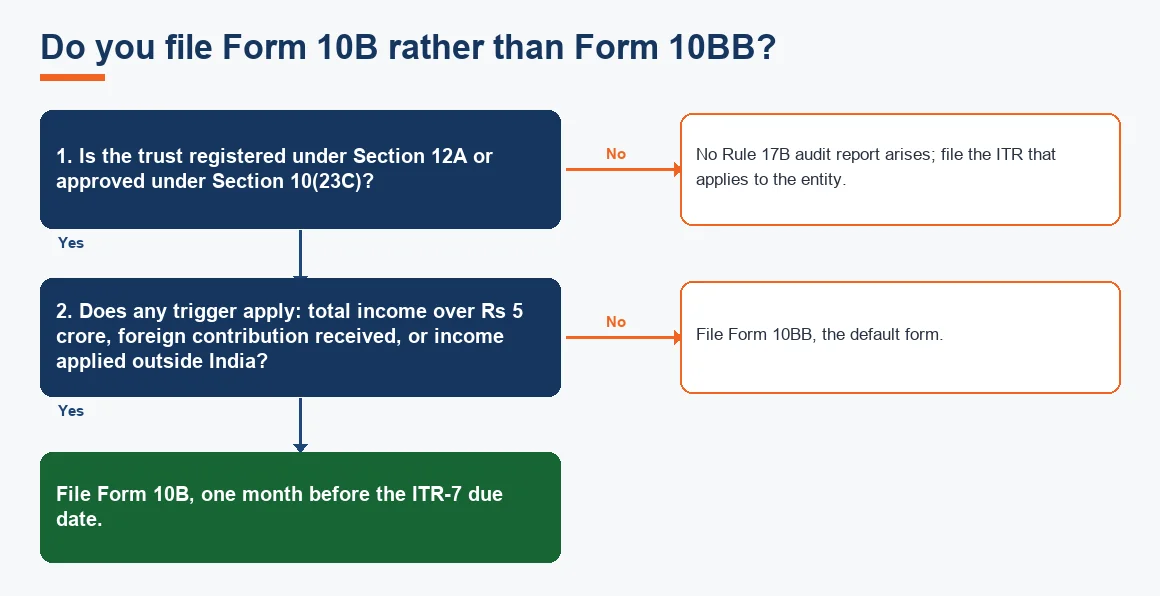
The difference between Form 10B and Form 10BB comes down to a single question: what are the trust's figures for the year? Since assessment year 2023-24, a charitable trust or institution registered under Section 12A or approved under Section 10(23C) files Form 10B if its total income exceeds Rs 5 crore, or it received any foreign contribution, or it applied any income outside India. Every other trust files Form 10BB. The section you are registered under no longer decides the form on its own, which is the reversal most trustees miss.
Form 10B vs 10BB: what actually changed from AY 2023-24
Before assessment year 2023-24 the split was simple: trusts registered under Section 12A filed Form 10B, and institutions approved under Section 10(23C) filed Form 10BB. The Income Tax (Third Amendment) Rules, 2023 rewrote Rule 17B and turned that on its head. Now both categories use the same test, and the test is about size and cross-border activity, not about which sub-section granted the registration. A large 12A trust that used to file Form 10B still files Form 10B, but a small institution approved under 10(23C) that once filed 10BB may now find itself on the same form, and the other way round. This is why a report format that was correct for years can suddenly be the wrong one.
Both forms are audit reports signed by a chartered accountant, and both carry the audited balance sheet and the income and expenditure account. The difference is the level of detail. Form 10B is the longer, more searching report, which is why it is reserved for the larger and cross-border cases. If your trust also runs on fund-based accounting with restricted and unrestricted funds, the schedules that feed either form come from the same books.
Form 10B applicability: the three triggers
Form 10B is required if any one of these three conditions is met during the previous year. They are alternatives, not a checklist you must satisfy together, so a single trigger is enough to move you onto Form 10B.
- Total income over Rs 5 crore: the total income of the trust or institution, computed without giving effect to the exemptions in Sections 11 and 12, exceeds Rs 5 crore.
- Foreign contribution: the trust received any foreign contribution during the year, in the sense of the Foreign Contribution (Regulation) Act. If money landed in your FCRA designated bank account, this trigger is live.
- Income applied outside India: the trust applied any part of its income outside India during the year.
The Rs 5 crore figure is read before the 15% accumulation and the 85% income application rule are applied, so it tends to catch trusts sooner than trustees expect. We cover the wider annual duties in our 12A and 80G compliance checklist for NGOs, and the FCRA side in the note on the FCRA designated SBI account and the 20% admin cap.
Form 10BB applicability: the default form
Form 10BB is the default. If none of the three triggers applies, that is, total income is Rs 5 crore or less, no foreign contribution was received and no income was applied outside India, the trust files Form 10BB. In practice this is where the large majority of small and mid-sized Indian trusts sit. It is still a full audit report by a chartered accountant with the accounts attached; it is simply the shorter of the two formats. Filing it is mandatory for a trust that wants to keep its Section 11 or Section 10(23C) exemption, so the choice is not between filing and not filing, but between the right form and the wrong one.
The rules on when a 10(23C) institution stays exempt are worth reading alongside this, and we gloss them at Section 10(23C) exemption rules.
Form 10B vs Form 10BB at a glance
The table below summarises the two forms on the points that decide which one you file.
| Point | Form 10B | Form 10BB |
|---|---|---|
| When it applies | Total income over Rs 5 crore, or foreign contribution received, or income applied outside India | None of the three triggers applies |
| Typical trust | Large, or cross-border, trust or institution | Small and mid-sized domestic trust |
| Registration covered | Section 12A and Section 10(23C) | Section 12A and Section 10(23C) |
| Signed by | Chartered accountant | Chartered accountant |
| Level of detail | Longer, more detailed report | Shorter report |
| Due date | One month before ITR-7 (30 September) | One month before ITR-7 (30 September) |
How to choose the right form: step by step
Work through the triggers in order. The moment one is met, you stop and file Form 10B; if you reach the end with none met, you file Form 10BB.
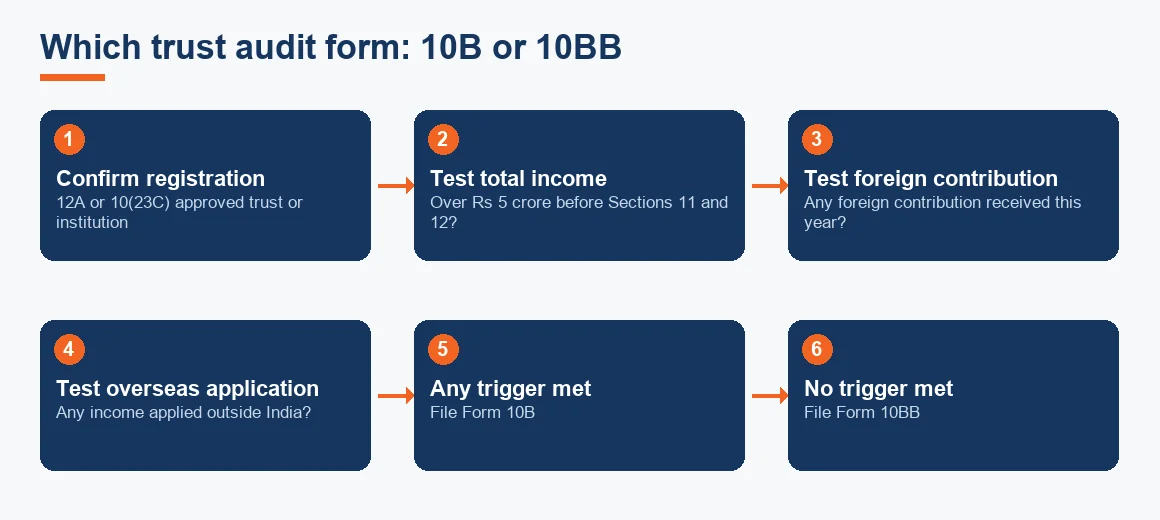
- Confirm the trust is registered under Section 12A or approved under Section 10(23C). If it is neither, no trust audit report under Rule 17B arises.
- Compute total income for the year before the Section 11 and 12 exemptions. Is it more than Rs 5 crore?
- Check whether any foreign contribution was received during the year.
- Check whether any income was applied outside India during the year.
- If any of steps 2 to 4 is a yes, file Form 10B. If all three are no, file Form 10BB.
Worked example: applying the three tests to a sample trust
Take a domestic education trust registered under Section 12A. It received no foreign contribution and spent nothing outside India, so those two triggers are clear. The only open question is the Rs 5 crore total income test, worked below.
| Line | Amount (Rs) |
|---|---|
| Voluntary contributions (domestic donations) | 4,10,00,000 |
| Government and CSR grants | 90,00,000 |
| Interest and other income | 20,00,000 |
| Total income before Sections 11 and 12 | 5,20,00,000 |
| Foreign contribution received | Nil |
| Income applied outside India | Nil |
The three amounts add to Rs 5,20,00,000, which is Rs 20 lakh over the Rs 5 crore line. One trigger is met, so this trust files Form 10B for the year even though its funds are entirely domestic. Had the interest income been, say, Rs 10 lakh lower, the total would have been Rs 5,10,00,000 and still over the line; only a figure of Rs 5 crore or less would have pointed to Form 10BB. This is why the test is worth running on final audited numbers, not on a mid-year estimate.
Due dates and the compliance calendar
The audit report, whether 10B or 10BB, must be filed at least one month before the due date for furnishing the return of income. For a trust filing ITR-7, the return is generally due on 31 October, so the report is due on 30 September. The chartered accountant uploads and digitally signs the form from the CA login, and the trust then accepts it on the e-filing portal; both steps must be done before the deadline for the report to count as filed.
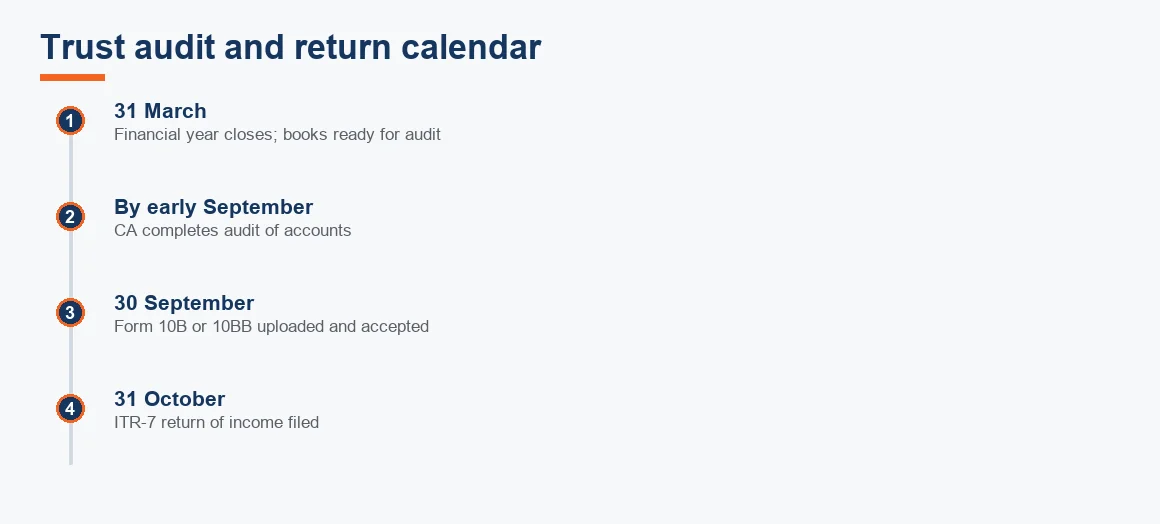
The financial year closes on 31 March, the audit report is due by 30 September, and ITR-7 by 31 October. Missing the 30 September date, or filing the wrong form, is the single most common way trusts lose the exemption, so the calendar deserves a diary entry well before September.
What happens if you file the wrong form or file late
Filing Form 10BB where Form 10B was required, or the reverse, can be treated as a defective audit report. The serious consequence is not a fixed penalty but the loss of the Section 11 exemption for the entire year, which makes the surplus taxable at the trust's applicable rate. Late filing carries the same risk. CBDT recognised how easily trusts tripped on the new rule and, through Circular 2 of 2024, allowed trusts that had filed the wrong form for assessment year 2023-24 to file the correct form by 31 March 2024. That was a one-time relief. Outside a specific circular, the only route is to file the correct report before the assessment is completed and to explain the position, which is far less comfortable than getting the form right the first time.
How to file Form 10B or 10BB on the income tax portal
The mechanics are the same for both forms. On incometax.gov.in the trust first adds the chartered accountant, then assigns the form, and the auditor uploads it.
- Log in as the trust and go to Authorised Partners, then My Chartered Accountant, and add the CA by membership number.
- Assign Form 10B or Form 10BB for the relevant assessment year to that CA.
- The CA logs in, prepares the form with the audited balance sheet and income and expenditure account attached, and uploads it with a digital signature.
- The trust logs back in and accepts the uploaded form. Only after acceptance is the filing complete.
Keep the audited financial statements, the registration certificate and the FCRA return, if any, ready before you start, because the form asks for figures that must tie back to them. Where a trust is also a registered public trust under a state law such as the Maharashtra Public Trusts Act, a separate state audit can apply on top of this income tax audit; the difference between the two is set out at statutory vs internal audit.
Key terms
- Section 10(23C) Exemption Rules: the conditions on which an approved fund, institution or educational body stays exempt.
- 85% Income Application Rule: the requirement to apply at least 85% of income to charitable purposes each year.
- Fund-Based Accounting: tracking money by restricted and unrestricted funds so donor conditions are visible in the books.
- FCRA Designated Bank Account: the single account through which all foreign contribution must first be received.
- Restricted Corpus Donations: donations given with a specific direction to form part of the corpus.
Key takeaways
- From AY 2023-24 the form is decided by figures, not by your section of registration.
- Form 10B if income tops Rs 5 crore, or there is foreign contribution, or income is applied abroad; otherwise Form 10BB.
- Run the three triggers on final audited numbers, and remember one trigger is enough.
- File the report by 30 September, a month before ITR-7, and have the trust accept it on the portal.
- The wrong form or a late one can cost the Section 11 exemption for the whole year.
Getting the audit form right is one line item in the wider annual burden a trust carries, from the restricted versus unrestricted fund treatment to donor reporting. If you would rather hand the books, the reconciliations and the audit coordination to a team that does this for charities every year, that is what our NGO and non-profit accounting service exists for. The same practice runs sector books for startups, SaaS companies and the wider IT sector, so cross-entity groups can sit with one adviser. For the accounting-standard questions that sit behind the numbers, the AS vs Ind AS comparison matrix is a quick reference. The statutory position here follows Rule 17B and the forms notified by the Income Tax Department; the amendment to the rule came through the Income Tax (Third Amendment) Rules, 2023, and the AY 2023-24 relief through CBDT Circular 2 of 2024, both available on the department's site.
Decision guide