In this guide
A Mumbai school, college or coaching institute that runs as a charitable trust or society keeps its books on a fund-based system and, once its income crosses the basic exemption limit, must complete a statutory trust audit under the Income Tax Act as well as a separate audit under the Maharashtra Public Trusts Act 1950. This explainer sets out the two audits, the income thresholds that trigger them, how the report is uploaded, and how fees, donations and development receipts are correctly accounted for. It is written for trustees and in-house accountants; if you want the work done for you, that sits with our Accounting Services for Schools & Colleges team rather than in this article.
What accounting in a school actually means
A school run by a trust does not chase profit, so its books are not built like a trading company's. Instead of a single profit and loss account, an educational trust uses fund-based accounting: general funds for day-to-day running, and restricted or corpus funds that can be spent only on the purpose for which the money was given. The year-end statements are an income and expenditure account (not a profit and loss account) plus a balance sheet showing each fund separately. Getting this structure right at the ledger stage is what makes the later audit painless, and it is where most disputes with the Charity Commissioner and the assessing officer begin.
The core mechanics are the same double-entry you would see anywhere. If terms like the general ledger or the trial balance are new to you, our related blogs and the guide to choosing an accountant in Mumbai cover the basics; here we stay on the trust-specific angle.
The two audits a Mumbai school trust faces
This is the point most trustees miss. A Mumbai educational trust does not have one audit, it has two, and they run in parallel.
1. The income-tax audit (Section 12A)
Section 12A(1)(b) of the Income Tax Act, read with Rule 17B, requires a registered trust to get its accounts audited and to file an audit report in Form 10B or Form 10BB. This is the audit that protects your exemption under Sections 11 and 12. The relevant forms and rules are published by the Income Tax Department.
2. The Charity Commissioner audit (Maharashtra Public Trusts Act)
A trust registered in Maharashtra is separately audited under Sections 33 and 34 of the Maharashtra Public Trusts Act 1950. The auditor certifies the accounts in the Schedule VIII and Schedule IX formats and the trust files them with the office of the Charity Commissioner. This is a state-law obligation and is unique to the local angle: a school registered as a society in another state would not file these schedules.
Is the trust audit compulsory or voluntary?
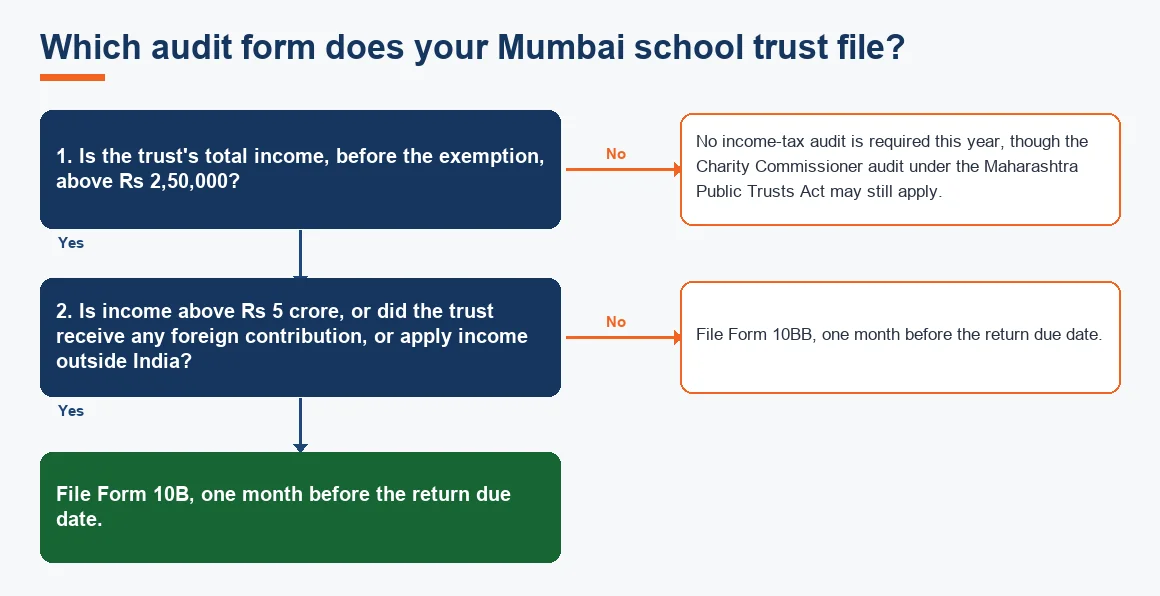
It is compulsory, not a matter of choice, once total income computed before giving effect to the exemption exceeds the basic exemption limit of Rs 2,50,000. Below that figure the audit is not required; above it the trust must file its audit report one month before the due date for the return of income. Filing the report late, or filing the return without the report already accepted, is treated as if the report was never furnished, and that can cost the exemption for the whole year.
Form 10B or Form 10BB: which one applies
The two forms are not interchangeable. Filing the wrong one is a defect, so run the test below before the auditor uploads anything.
| Test | Form 10B | Form 10BB |
|---|---|---|
| When it applies | Total income exceeds Rs 5 crore, OR any foreign contribution is received, OR any income is applied outside India | Every other case (income up to Rs 5 crore, no foreign contribution, no application outside India) |
| Governing provision | Section 12A(1)(b) with Rule 17B | Section 12A(1)(b) with Rule 16CC |
| Deadline | One month before the return due date | One month before the return due date |
| Reporting depth | Detailed, with fuller disclosures | Lighter schedule |
A trust that receives foreign donations under FCRA into its designated bank account is pushed into Form 10B regardless of income size, so most Mumbai institutions with overseas alumni giving will file 10B.
How to upload the trust audit report online
The upload is a three-party handshake on the income-tax e-filing portal, and the order matters. Do it in the sequence below.
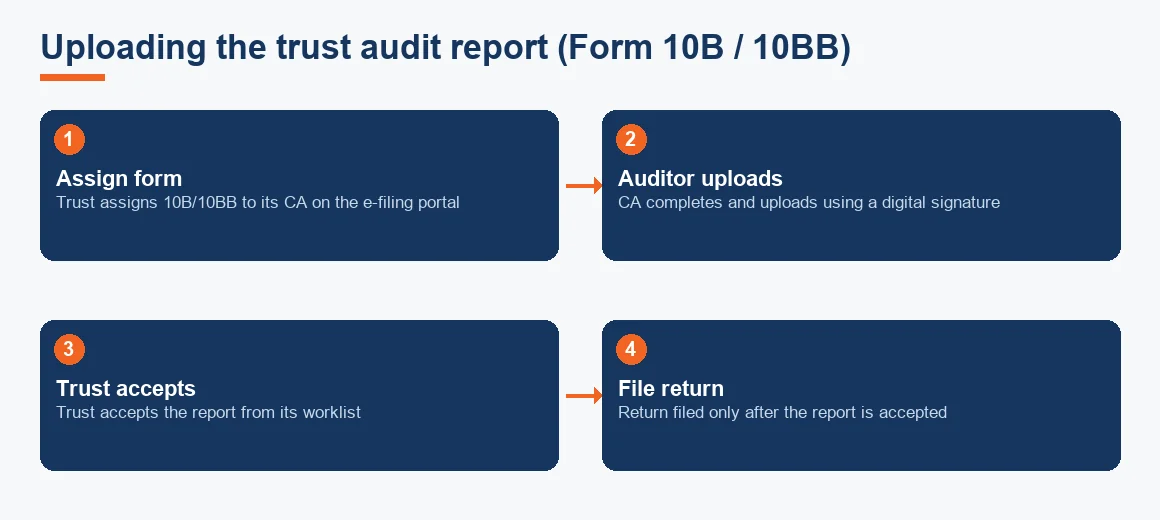
- Assign the form: the trust logs in and, under e-File, Income Tax Forms, File Income Tax Forms, assigns Form 10B or 10BB to its chartered accountant.
- Auditor uploads: the CA accepts the assignment, completes the form and uploads it using a valid digital signature.
- Trust accepts: the trust returns to its worklist and accepts the uploaded report.
- File the return: only after acceptance does the trust file its return of income. Acceptance must precede the return, or the report counts as not furnished.
GST on school fees and coaching in Mumbai
Fees charged by a school up to higher secondary level for tuition, admission or examination carry no GST, under entry 66 of Notification 12/2017 Central Tax (Rate), published by the CBIC. The exemption extends to transport, catering, security and housekeeping services bought by the school for its own students up to that level. Coaching classes, test series and private tutorials fall outside the exemption and are taxable at 18 per cent, so a Mumbai institution that runs both a recognised school and a commercial coaching wing must keep the two revenue streams on separate ledgers and register for GST for the taxable side.
Development fees, capitation and the Section 269ST trap
Development fee is collected for capital purposes, so it is credited to a development fund on the liabilities side and applied only against capital expenditure such as building or equipment. It should never be routed through the income and expenditure account as revenue. Capitation fee, a lump sum charged as a condition of admission, is prohibited by state law in Maharashtra and cannot appear in the books at all. Separately, any receipt of Rs 2,00,000 or more taken in cash, whether labelled donation, development or fee, breaches Section 269ST and attracts a penalty equal to the amount received. Route every material receipt through the bank.
These restricted receipts feed straight into corpus and restricted fund tracking, and the fixed assets they buy then depreciate over their useful life. Our depreciation calculator handles the Schedule II working for a school's buildings, lab equipment and buses.
Worked example: the 85 per cent application rule
The heart of trust accounting is the requirement to apply at least 85 per cent of income towards the trust's objects each year. The short worksheet below shows how a mid-sized Mumbai school trust computes its position. All figures are illustrative.
| Particulars | Amount (Rs) |
|---|---|
| Gross receipts (fees and general donations) | 1,20,00,000 |
| Less: corpus donations credited to corpus fund | 20,00,000 |
| Income eligible for application | 1,00,00,000 |
| 85 per cent required to be applied | 85,00,000 |
| Actually applied (salaries, running costs, capital spend) | 78,00,000 |
| Shortfall | 7,00,000 |
The trust applied Rs 78,00,000 against a requirement of Rs 85,00,000, leaving a shortfall of Rs 7,00,000. That shortfall is taxable at the applicable rate unless the trust files Form 10 to accumulate it for a specified purpose over the next five years, or Form 9A to treat it as deemed application. Corpus donations are excluded from the base and parked in the corpus fund, which is why keeping the application computation clean from day one matters so much.
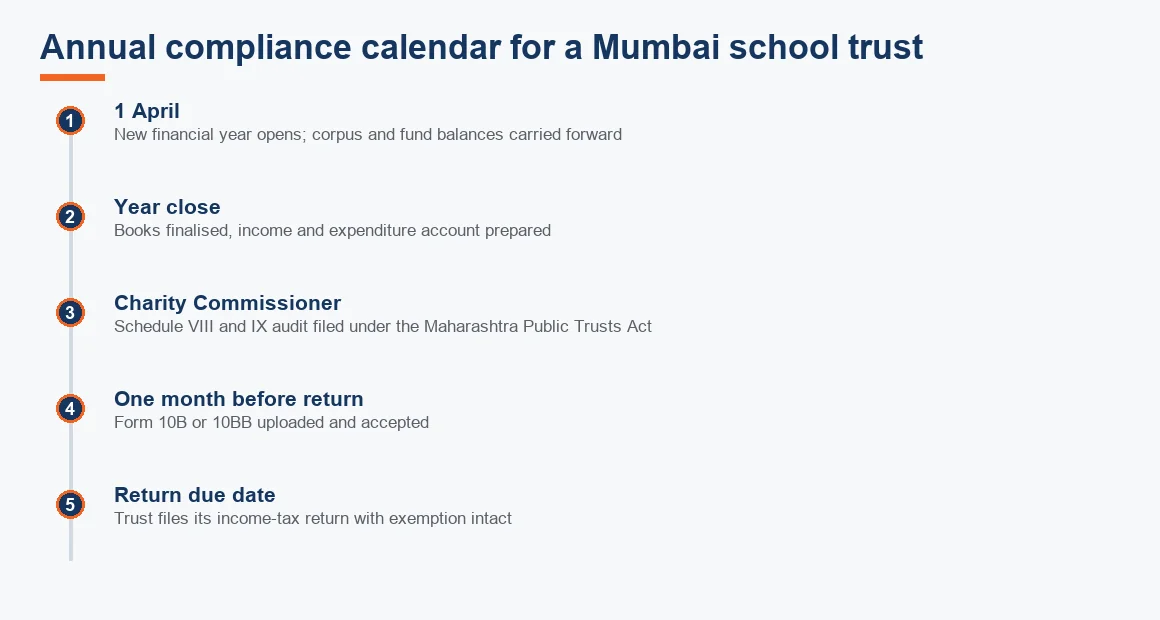
The annual compliance calendar for a Mumbai school trust
Both audits and the return sit inside one financial year. Mapping them onto a calendar stops the last-minute scramble that costs exemptions.
The book-cleanup that precedes all of this is worth starting early; our audit-readiness checklist for Mumbai businesses works just as well for a trust, and employers should not forget the parallel Maharashtra professional tax and Shops Act filings for teaching and non-teaching staff.
Key terms
- Fund-Based Accounting: recording income and spending against separate general, restricted and corpus funds rather than a single profit figure.
- 85% Income Application Rule: the requirement that a trust apply at least 85 per cent of its income towards its objects each year.
- Section 10(23C) Exemption Rules: the alternative exemption route for educational institutions run not for profit.
- Restricted Corpus Donations: donations given with a specific direction that they form part of the corpus, excluded from the application base.
- Section 12A / 80G Annual Upkeep: the periodic renewals and filings that keep a trust's registration and donor deduction alive.
Key takeaways
- A Mumbai educational trust runs two audits in parallel: income-tax under Section 12A and Charity Commissioner under the Maharashtra Public Trusts Act 1950.
- The income-tax audit is compulsory once income before exemption crosses Rs 2,50,000, filed one month before the return due date.
- Form 10B applies above Rs 5 crore or where foreign contribution or overseas application exists; Form 10BB covers the rest.
- School fees up to higher secondary are GST-exempt; coaching and test series are taxable at 18 per cent.
- Development fee is a fund credit, capitation is banned in Maharashtra, and cash receipts of Rs 2,00,000 or more breach Section 269ST.
For the commercial engagement, whether you run a single Mumbai school or a group of institutions, see our Accounting Services for Schools & Colleges Mumbai page and the wider accounting services in Mumbai. Institutions with a technology or software arm can also look at our SaaS accounting services, IT and software company accounting and startup accounting services. If you are budgeting the engagement, the 2026 price benchmarks for outsourced accounting in Mumbai give a realistic range.
Decision guide